Did Sherlock Holmes Ever Wear a Deerstalker? 0 in 60 Stories
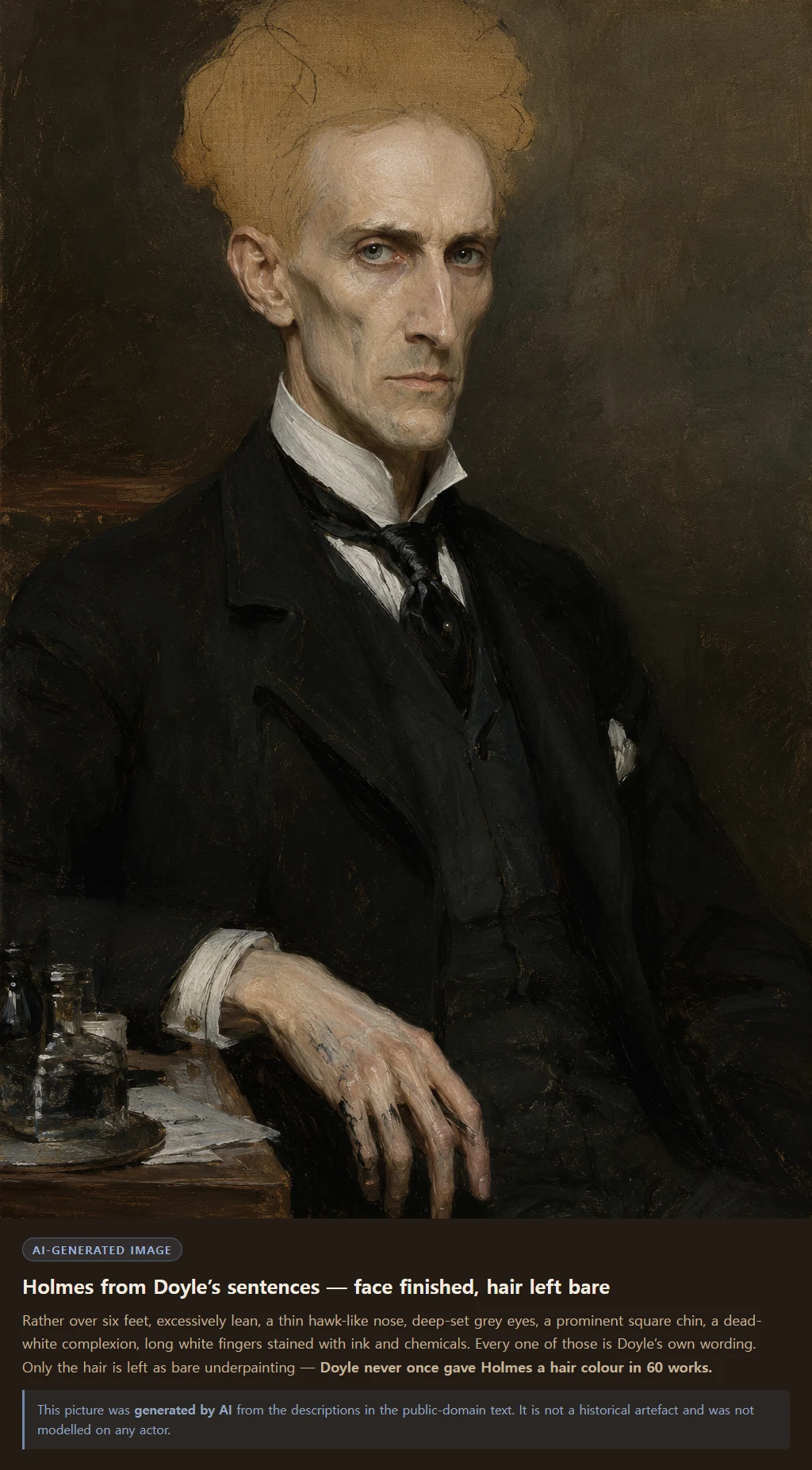
Three things come to mind when someone says "Sherlock Holmes."
The deerstalker cap.
The big curved pipe.
And "Elementary, my dear Watson."
Last updated: 15 September 2026 · Quotations and occurrence counts were checked against the source text on this date.
I searched all 60 works of the Canon — 658,554 words — and all three come back zero.
Not "rare." Not "paraphrased." The words are not in the text.
This is Part 3 of a series that counts who filled in what the source text left blank. In Part 1 (Pride and Prejudice), the text was silent. In Part 2 (The Odyssey), the text was specific and later artists ignored it.
Part 3 breaks the pattern in a third way.
Conan Doyle described Holmes with unusual precision. Height, nose, eye colour, chin, fingers, even the colours of his dressing gowns. And then later hands bolted three objects onto him that are nowhere in the text.
Nobody filled a gap here. They painted over a finished picture.
The useful part is that the painters left their names and their dates. October 1891. October 1899. 1903. February 1908. We can walk through them one at a time.
Method. The Canon is 4 novels + 56 short stories = 60 works. All nine volumes were downloaded from Project Gutenberg (eBooks #244, #2097, #1661, #834, #2852, #108, #3289, #2350, #69700), stripped of Gutenberg front and back matter, and searched with case-insensitive regular expressions, with every hit traced back to the individual story. Body text totals 658,554 words. Every quotation below is from the public-domain original.
Did Sherlock Holmes ever wear a deerstalker? Here is the full-text count
Zero times — including the hyphenated deer-stalker. Across all 60 works, the word does not appear.
Here are the raw numbers first.
| Search term | Occurrences in the 60-work Canon |
|---|---|
deerstalker / deer-stalker |
0 |
Inverness |
0 |
calabash |
0 |
meerschaum |
0 |
Elementary, my dear Watson (as a phrase) |
0 |
my dear Watson (first half alone) |
92 |
Elementary (second half alone) |
8 |
221 (the address) |
6 — while Baker Street appears 110 times |
Moriarty |
54, in 7 of 60 works |
lens |
33 (+ magnifying 7) |
violin |
24 |
cocaine |
9 |
game is afoot |
1 |
Source: counted directly from the nine Project Gutenberg volumes listed above.
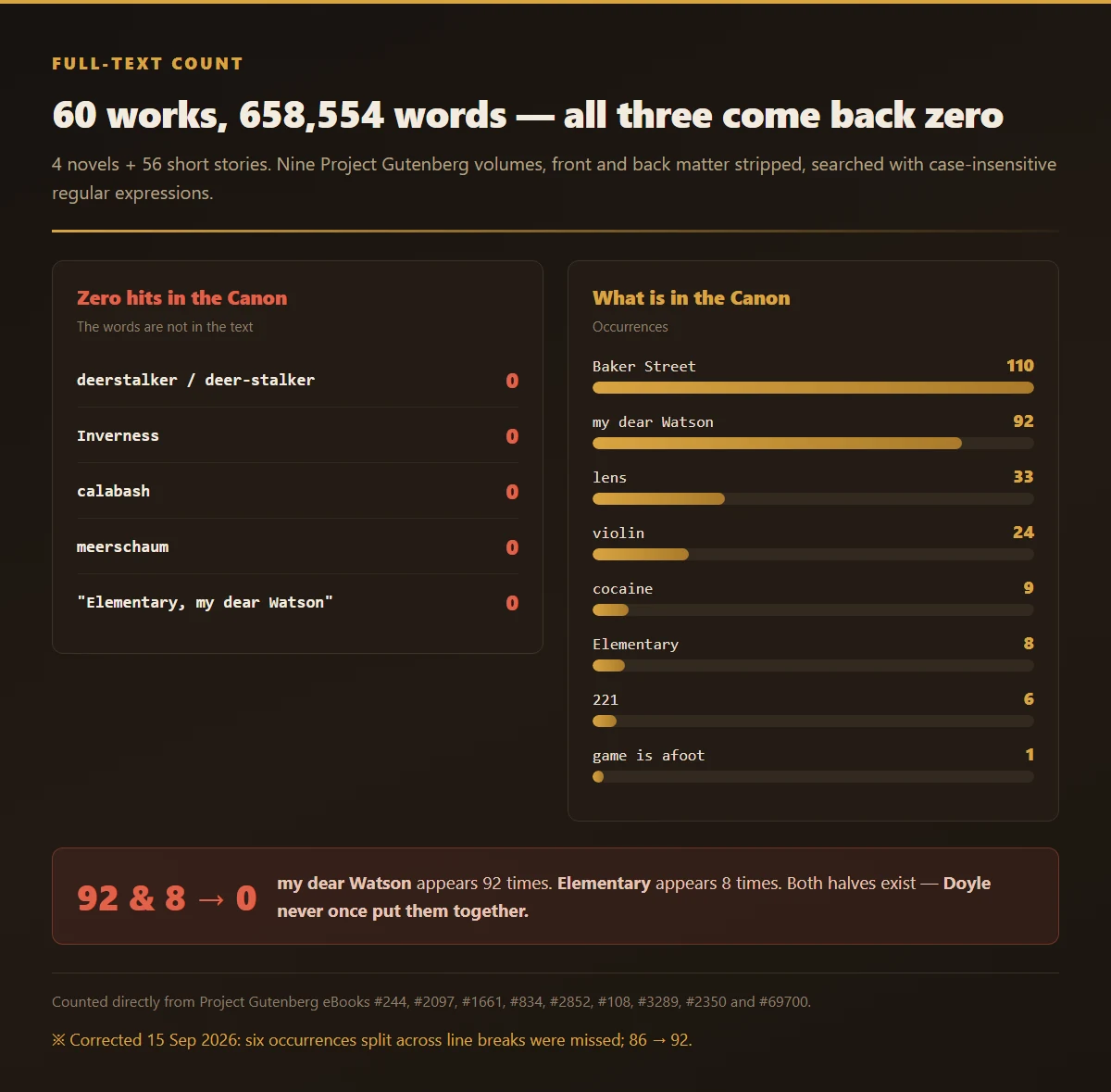
A row of zeros is easy to misread, so look at the two rows underneath.
my dear Watson occurs 92 times. Elementary occurs 8 times. Both halves of the famous line are sitting right there in the text.
They just never touch.
The closest they ever get is in "The Crooked Man," and even there they are four sentences apart. That passage is quoted in full further down.
What does Sherlock Holmes actually look like in the books?
Doyle did not leave the face vague. He wrote one sustained paragraph that fixes almost everything about it.
It comes in A Study in Scarlet, Part I, Chapter II, a few weeks after Watson moves in and starts studying his new flatmate. It is the longest physical description of Holmes anywhere in the Canon.
"In height he was rather over six feet, and so excessively lean that he seemed to be considerably taller. His eyes were sharp and piercing... and his thin, hawk-like nose gave his whole expression an air of alertness and decision. His chin, too, had the prominence and squareness which mark the man of determination. His hands were invariably blotted with ink and stained with chemicals, yet he was possessed of extraordinary delicacy of touch."
— A Study in Scarlet, Pt. I, ch. 2 (Project Gutenberg eBook #244)
"Rather over six feet" puts him around 6 foot 1.
The load-bearing phrase is excessively lean. Doyle's design is tall plus emaciated — and that is the single most-violated line in the history of Holmes casting.
The rest is scattered across the other 59 works, so I collected it.
- Eye colour — "his grey eyes dancing with amusement" (The Hound of the Baskervilles, ch. 12) and "his austere grey eyes" ("The Three Garridebs"). Grey, stated twice.
- Fingers — "long, white, nervous fingers" (The Sign of the Four, ch. 1); "long, thin fingers" ("The Red-Headed League").
- Face — "clear-cut, hawklike features" (The Sign of the Four); "strong-set aquiline features" ("The Man with the Twisted Lip").
- Eyes, again — "beady eyes gleaming and deep-set like those of a bird" (The Sign of the Four).
- After Reichenbach — "even thinner and keener than of old," with "a dead-white tinge in his aquiline face" ("The Empty House"). Doyle even tracked the change.
Source: all quotations verified directly against the Project Gutenberg texts.
Put together: around 6 foot 1, gaunt to the point of emaciation, long thin hawk-like nose, deep-set grey eyes, prominent square chin, bloodless complexion, long white fingers, hands blotted with ink and chemicals.
That is more than enough to draw from.
Except for one thing — he never gave Holmes a hair colour
From A Study in Scarlet (1887) to The Case-Book (1927), there is no statement of Holmes's hair colour anywhere in the Canon. The only hair hit that pattern-matches a Holmes-style description belongs to Jefferson Hope in Part II of A Study in Scarlet.
That is exactly the same hole that made Part 1 of this series work — Darcy's hair colour, zero mentions. The difference here is that Doyle filled in nearly everything else and stopped at that one square.
Who invented the Sherlock Holmes deerstalker hat?
An illustrator named Sidney Paget, and the date is pinnable: The Strand Magazine, October 1891.
Sidney Edward Paget (4 October 1860 – 28 January 1908) produced roughly 356 Holmes drawings for The Strand. The hat first appears in his illustrations for "The Boscombe Valley Mystery," which ran with 10 Paget plates. The relevant drawing shows Holmes and Watson alone in a railway compartment, and its original caption reads:
"WE HAD THE CARRIAGE TO OURSELVES."
Sources: Wikipedia, "Sidney Paget" and "The Boscombe Valley Mystery"; Wikimedia Commons file records for
File:Strand1891-V2 0398.png(the full magazine page, PD-scan) andFile:Sidney Paget - The Boscombe Valley Mystery 02.jpg, checked 23 August 2026; attribution corroborated by Smithsonian Magazine, Sarah C. Rich, 26 July 2012.
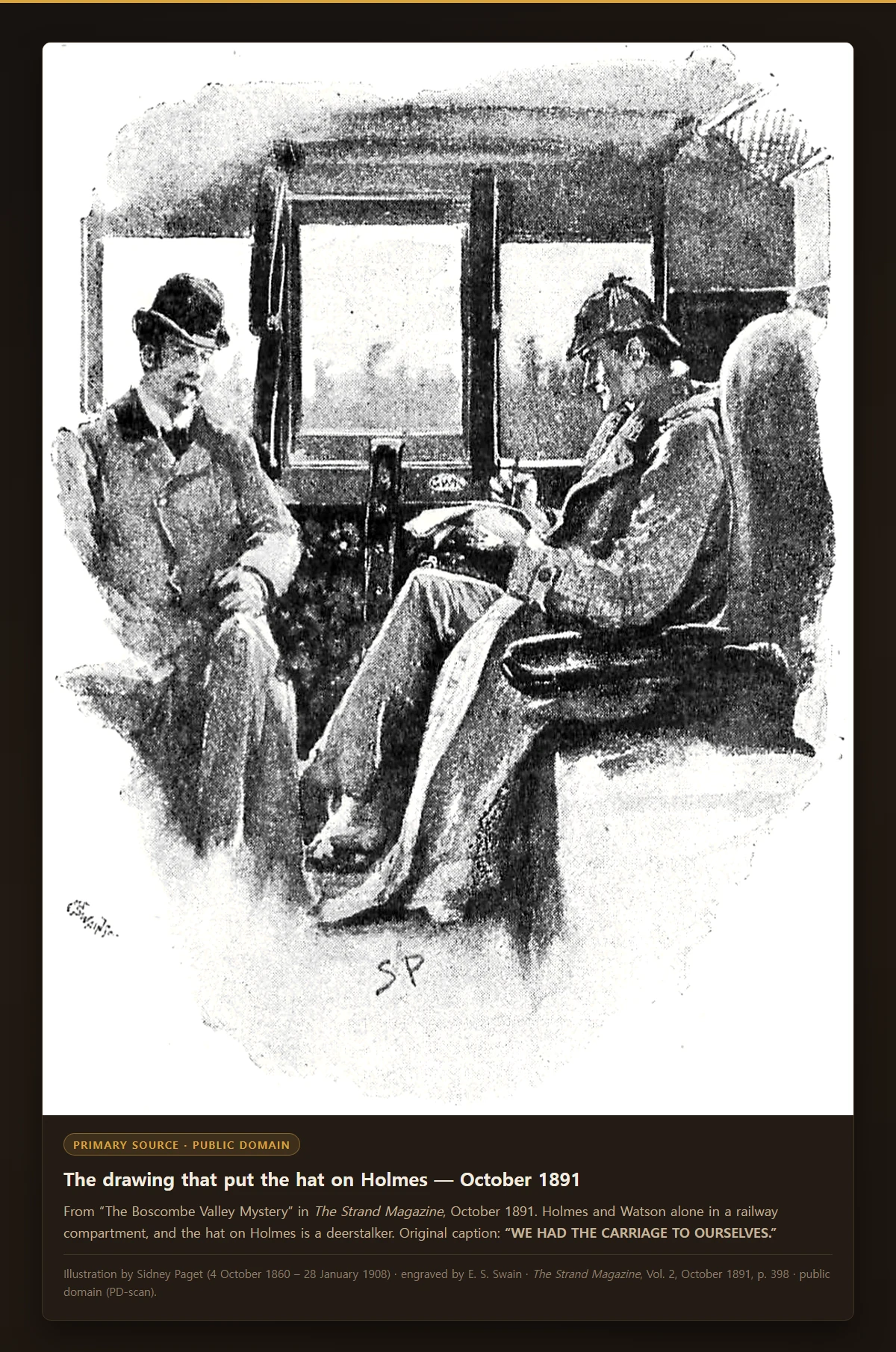
Now the part that most write-ups leave out.
"The deerstalker isn't in the books" is all over the internet. What Doyle wrote instead, at that exact moment in that exact story, is not. So I went and found it.
In the very story whose illustrations introduced the hat:
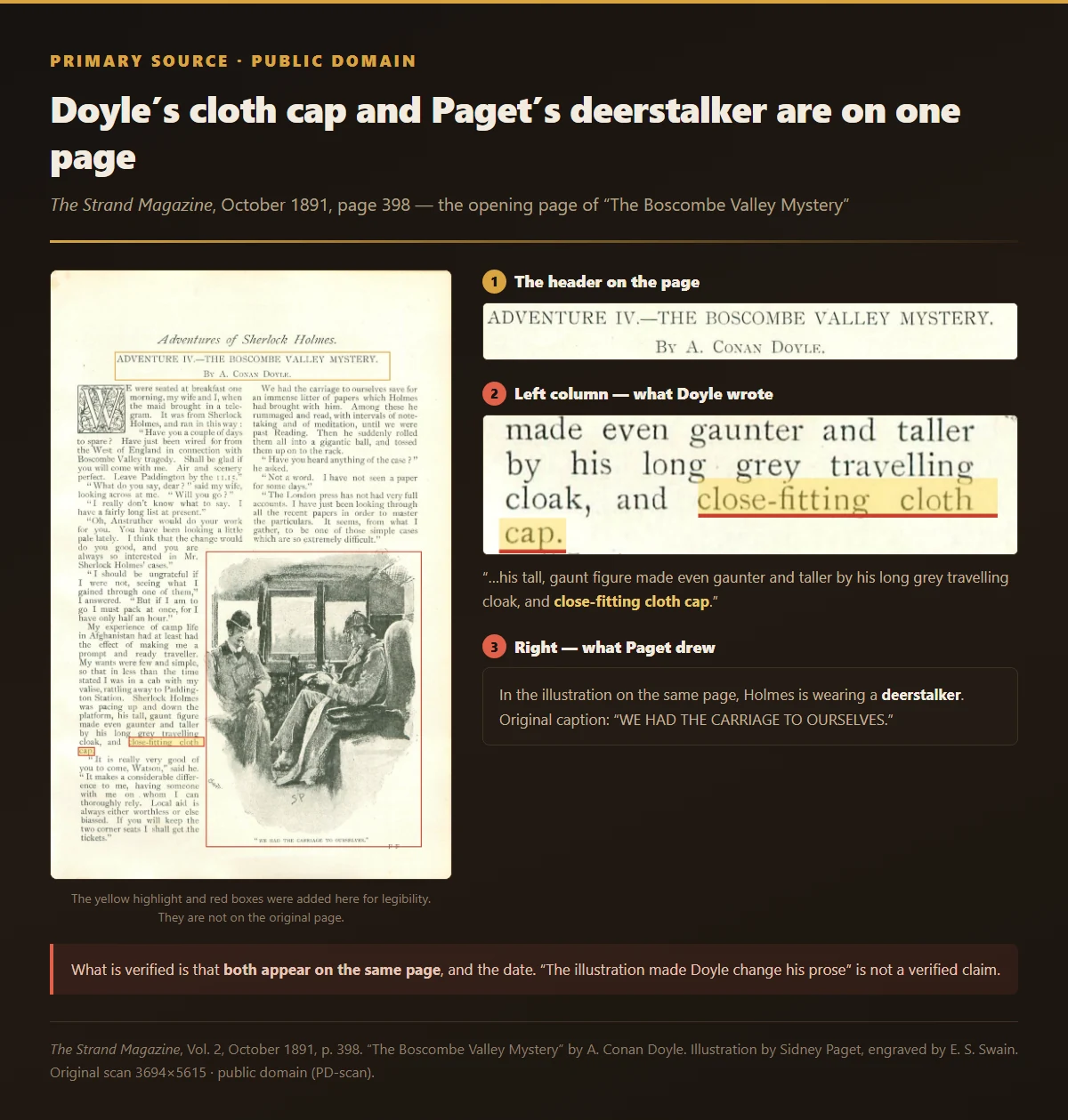
"Sherlock Holmes was pacing up and down the platform, his tall, gaunt figure made even gaunter and taller by his long grey travelling-cloak and close-fitting cloth cap."
— "The Boscombe Valley Mystery" (The Adventures of Sherlock Holmes)
A "close-fitting cloth cap" is not a deerstalker. A deerstalker has a brim front and back and ear flaps tied over the crown. "Close-fitting" is close to the opposite instruction.
And "long grey travelling-cloak" is the sentence that became what everybody now calls the Inverness cape. Inverness itself: 0 occurrences.
Doyle wrote a cloth cap. Paget drew a deerstalker. And both of them are on the same page.
Page 398 of the October 1891 Strand carries the story's title, Doyle's sentence in the left column, and Paget's drawing beside it. You do not have to take my word for any of this — the contradiction is one page, printed in 1891, and it is in the public domain.
The reversal — fourteen months later, Doyle wrote "ear-flapped"
Paget drew the hat in October 1891. In December 1892, ear flaps show up in Doyle's own prose for the first time.
The story is "Silver Blaze" (The Strand, December 1892; the US Strand carried it in January 1893).
"Sherlock Holmes, with his sharp, eager face framed in his ear-flapped travelling-cap, dipped rapidly into the bundle of fresh papers"
— "Silver Blaze" (The Memoirs of Sherlock Holmes)
ear-flapped travelling-cap occurs exactly once in all 60 works, and it is the closest thing to a deerstalker Doyle ever put on the page.
Laid out in order, with nothing added:
| Date | What Doyle wrote | What Paget drew |
|---|---|---|
| October 1891 | close-fitting cloth cap |
a deerstalker ("The Boscombe Valley Mystery," 10 plates) |
| December 1892 | ear-flapped travelling-cap |
the same hat again ("Silver Blaze," 9 plates) |
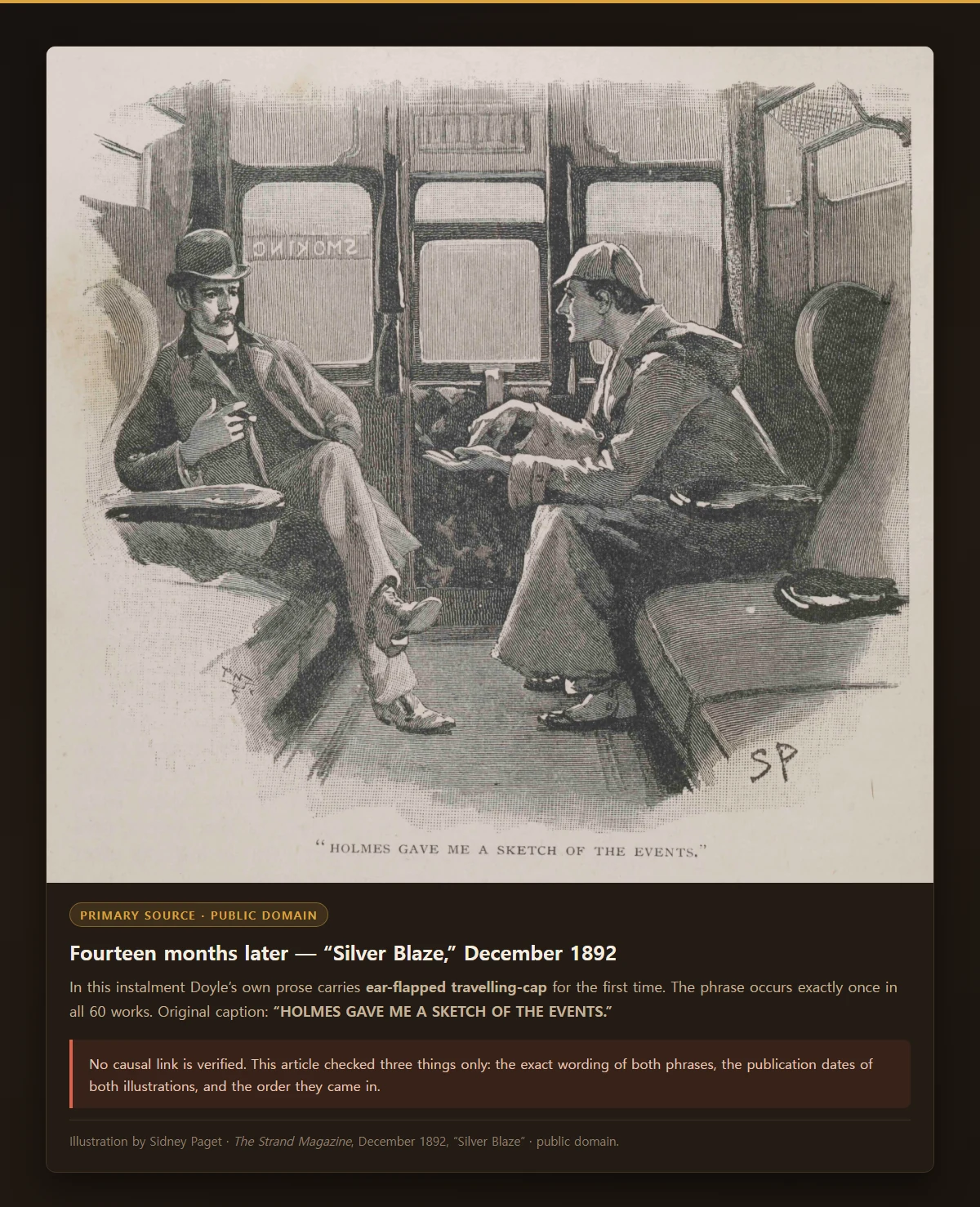
Now the honest line, and I want to be blunt about it: "Paget's drawing changed Doyle's prose" is not a verified claim. There is no evidence that Doyle was writing with the illustration in front of him.
What this article verified is three things — the exact wording of both phrases, the exact publication dates of both illustrations, and the order they came in. The inference is yours to make or refuse.
The same discipline applies to the popular explanations for why Paget picked that hat. "He was a sportsman drawing his own cap" and "it was a visual pun on hunting for clues" both circulate widely; neither has a reliable source behind it. The best-sourced version of that story is an annotation the hosting site itself flags as "Not Vetted."
Source on the contested explanations: COVE Collective annotation, Fahimah Hamidavi, 15 October 2020 (page self-labelled "Not Vetted"); the DNB rebuttal of the related "Walter Paget was the model" claim is noted in Wikipedia, "Sidney Paget."
What kind of pipe does Sherlock Holmes smoke in the books?
Three kinds, and none of them is a gourd.
calabash: 0. meerschaum: 0. Here is what Doyle actually put in Holmes's mouth.
| Pipe | Text | Story |
|---|---|---|
| Black clay | "his black clay pipe thrusting out like the bill of some strange bird" | "A Case of Identity" |
| Black clay | "with his black clay pipe between his lips" | The Hound of the Baskervilles |
| Old, oily clay | "the old and oily clay pipe, which was to him as a counsellor" | "The Copper Beeches" |
| Brier-root | "filling up his old brier-root pipe" | The Sign of the Four |
| Old briar | "an old briar pipe between his lips" | "The Man with the Twisted Lip" |
| Long cherry-wood | "the long cherry-wood pipe which was wont to replace his clay when he was in a disputatious rather than a meditative mood" | The Adventures |
Source: all six passages verified directly in the Project Gutenberg texts.
Read that last row again.
Doyle bothered to specify that Holmes switches pipe according to mood — clay when he is thinking, cherry-wood when he wants an argument. A writer that fussy about pipes never once reached for a curved gourd.
One bonus: "It is quite a three pipe problem, and I beg that you won't speak to me for fifty minutes" ("The Red-Headed League") is genuine. The three-pipe problem is real; the calabash is not.
The curved pipe came from an American stage actor in 1899
William Gillette introduced it, and the reason was purely practical: he had lines to deliver.
William Hooker Gillette (24 July 1853 – 29 April 1937) co-credited the play Sherlock Holmes with Conan Doyle. It premiered 23 October 1899 at the Star Theatre in Buffalo, New York, and moved to Broadway's Garrick Theatre on 6 November 1899.
He then played Holmes roughly 1,300 times, ending with his final performance on 19 March 1932 — nearly 33 years in the part. For most American theatregoers of that era, Gillette simply was Holmes.
Why bend the pipe? Multiple accounts give the same three stagecraft reasons.
- A straight pipe kept slipping out of his teeth while he spoke.
- A larger bowl was readable from the back of the house.
- Hanging low, it neither covered his face nor sent smoke into his eyes.
Sources: Wikipedia, "Sherlock Holmes (play)" and "William Gillette"; HistoryNet, "Sherlock Holmes: The History of the Mystery"; Black Gate, 6 October 2014.
So the most recognisable prop in detective fiction is not a character trait. It is a solution to a blocking problem.
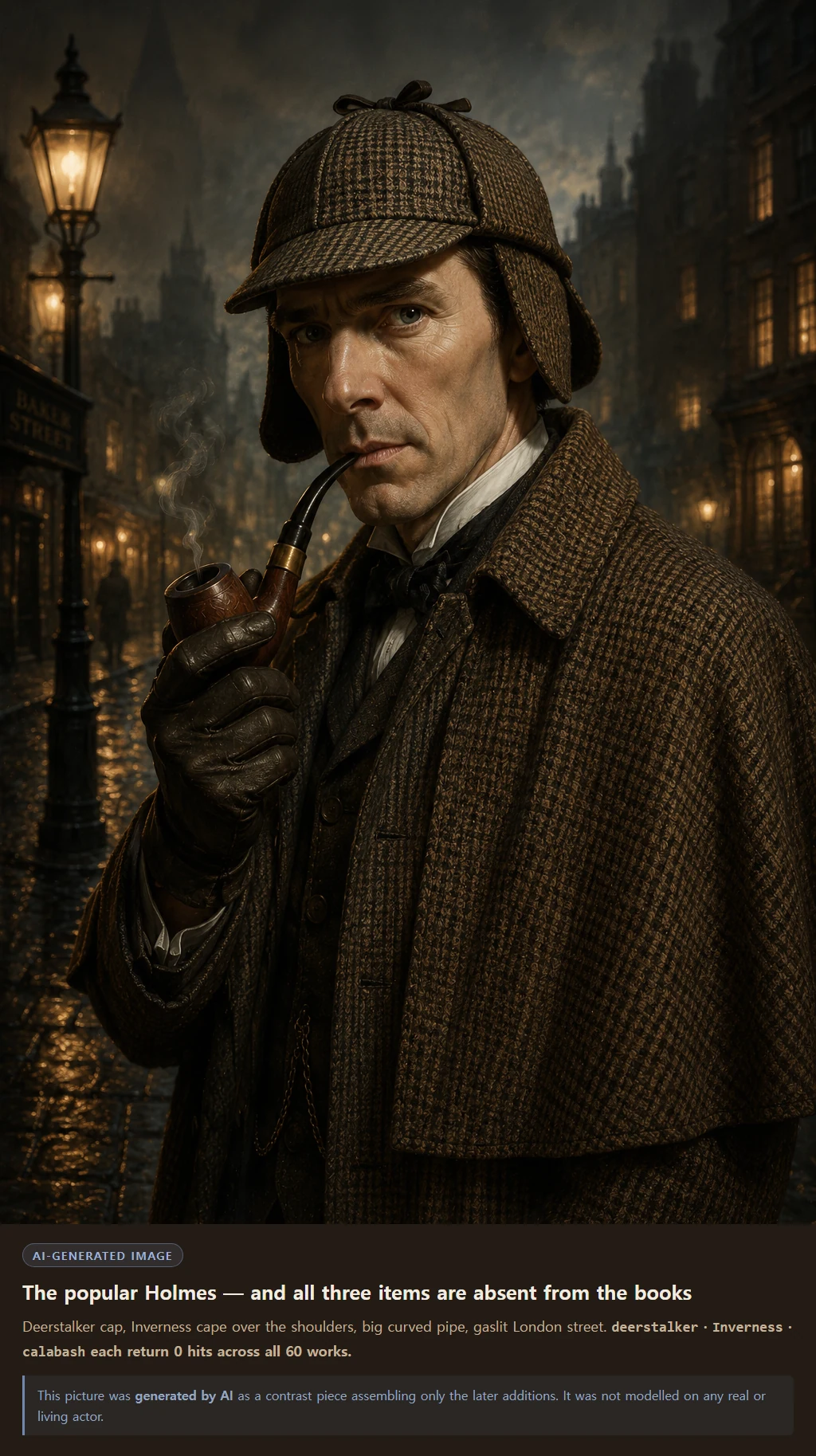
But nobody can show you Gillette smoking a calabash
This is the part worth slowing down for, because it cuts against the tidy version of the story.
Pipe historian Thomas Gwinner, in Sherlock Holmes As A Pipe Smoker, reports that he could find no photograph or illustration of either Gillette or Basil Rathbone actually smoking a gourd calabash. The documented calabash appearances he identifies are Rathbone in Sherlock Holmes in Washington (1943) and The Spider Woman (1944), and Roger Moore in Sherlock Holmes in New York (1976).
Source: MX Publishing blog, extract from Thomas Gwinner, Sherlock Holmes As A Pipe Smoker, 4 October 2020.
So this article splits the claim in two:
- The curved pipe → Gillette, 1899. Well attested across sources.
- The specific calabash shape → later, hardened by mid-century film. The photographic evidence is disputed.
How it reached American readers: Frederic Dorr Steele
For readers in the US, this is the link in the chain that matters most, and it is the one usually skipped.
Frederic Dorr Steele (6 August 1873 – 6 July 1944) was commissioned by Collier's in 1903 and illustrated 26 of the last 33 Holmes stories for their first American magazine appearances. Whatever Paget had done for British readers, Steele did for American ones — except he wasn't drawing from Doyle's sentences.
He was drawing from Gillette. In his own words:
"Everybody agreed that Mr. Gillette was the ideal Sherlock Holmes, and it was inevitable that I should copy him. So I made my models look like him, and even in two or three instances used photographs of him in my drawings."
Source: Wikipedia, "Frederic Dorr Steele."
Wikipedia's summary of his effect is blunt: his illustrations "were largely responsible for popularizing the association of Holmes with a curved pipe and deerstalker hat."
Which completes the chain, every link dated:
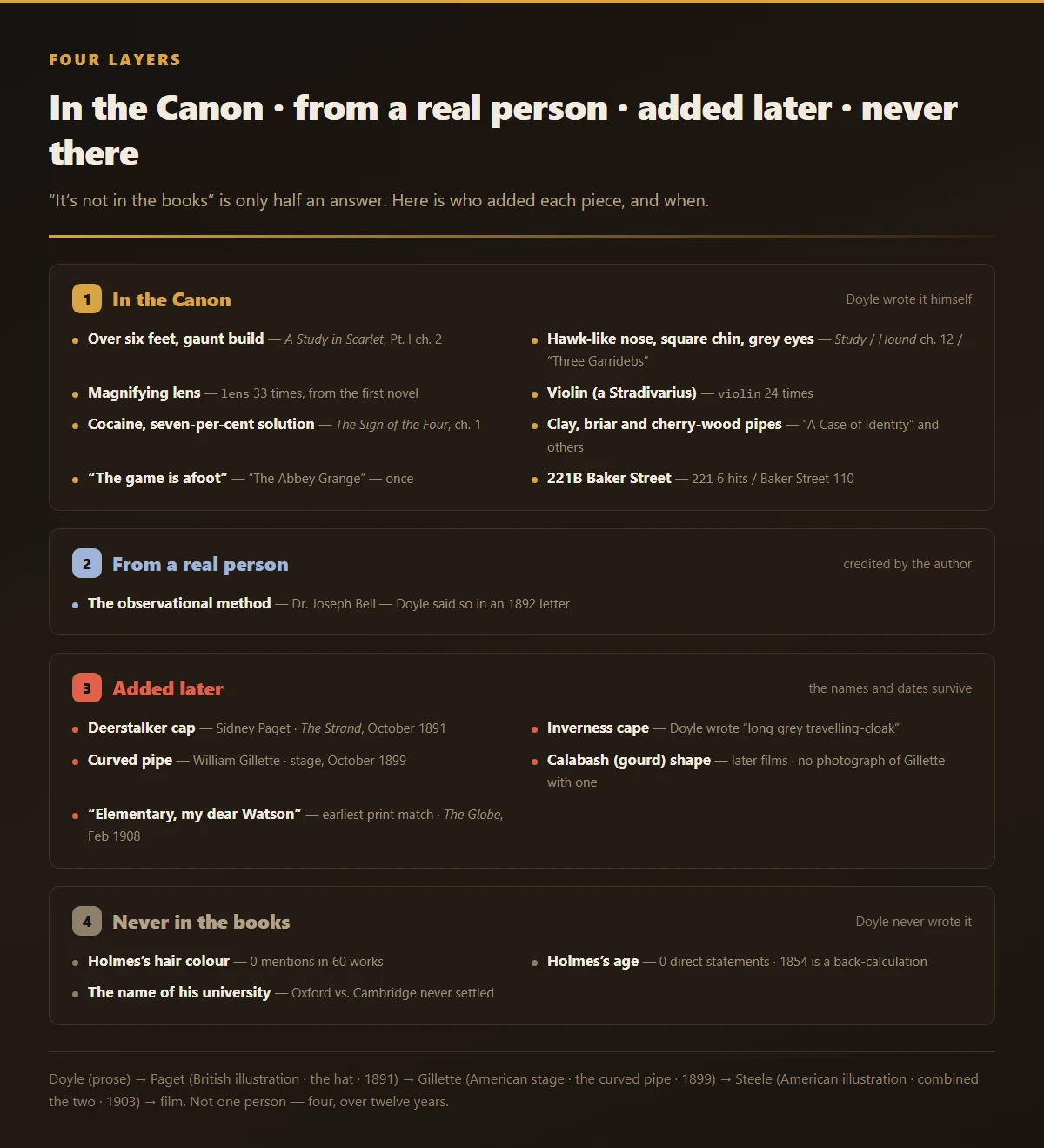
Doyle (prose) → Paget (British illustration, the hat, 1891) → Gillette (American stage, the pipe, 1899) → Steele (American illustration, fusing both, 1903) → Rathbone (film, 1939–46, fixed worldwide).
No single person invented the Holmes in your head. Four of them layered it, over roughly twelve years, and then film set it.
Where did "Elementary, my dear Watson" actually come from?
Not from Doyle, and — despite the popular story — not from Gillette's play either. The earliest exact printed match found is The Globe of London, February 1908.
The two halves exist separately in the Canon, as the count table showed: 92 and 8. The nearest miss is in "The Crooked Man" (The Memoirs).
"'I have the advantage of knowing your habits, my dear Watson,' said he. 'When your round is a short one you walk, and when it is a long one you use a hansom. As I perceive that your boots, although used, are by no means dirty, I cannot doubt that you are at present busy enough to justify the hansom.'
'Excellent!' I cried.
'Elementary,' said he."
Same conversation. Four sentences apart. Doyle never closed the gap.
So who did? A quotation-etymology researcher working newspaper databases assembled this chronology:
| Year | Publication | Form |
|---|---|---|
| Sept 1893 | English Mechanic and World of Science | "quite elementary, my dear 'Fellow of the Chemical Society'" (wordplay) |
| Nov 1901 | The Northampton Mercury | "Elementary, my dear Potson" (a "Shylock Combs" parody) |
| July 1902 | Journal of the British Homoeopathic Society | "It is the merest elementary knowledge, my dear Watson" |
| Feb 1908 | The Globe (London) | "Elementary, my dear Watson" — earliest exact match located |
| Aug 1909 | Times Dispatch | already used as a cliché |
| 1915 | P. G. Wodehouse, Psmith, Journalist | "Elementary, my dear Watson, elementary" |
| 1929 | Film, The Return of Sherlock Holmes (first Holmes talkie) | the film's closing lines |
Source: Quote Investigator, 14 July 2016.
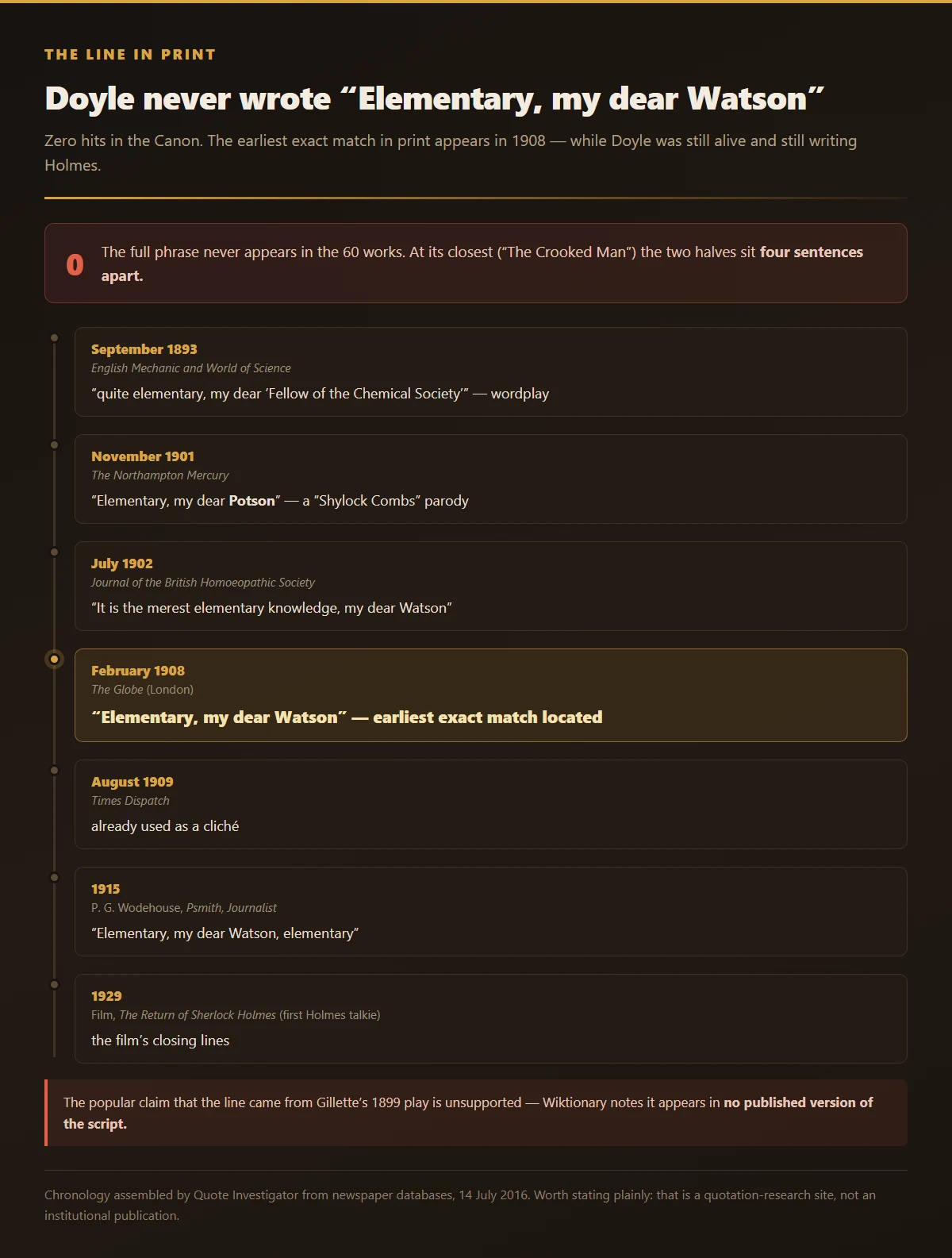
A note on what that source is. This chronology comes from a quotation-research site working newspaper archives, not an institutional publication. Every entry is specified by title and month, and nothing in it conflicts with Wiktionary or Snopes — but it is not the same class of evidence as a library catalogue, and I would rather say so.
One more correction while we are here. The frequently repeated claim that the line came out of Gillette's 1899 play is unsupported: Wiktionary notes that it appears in no published version of the script. Gillette changed the pipe. He did not write the line.
The catchphrase that is real shows up exactly once
"Come, Watson, come! The game is afoot. Not a word! Into your clothes and come!"
— "The Abbey Grange" (The Return of Sherlock Holmes)
game is afoot: 1 occurrence in 60 works.
Fake catchphrase, zero. Real catchphrase, one. The line he never wrote is the one everybody can quote.
So what in the popular image is real? More than you'd think
This is not a debunking exercise, and leaving out the genuine items would make it one.
The magnifying glass is real, and it is there in the first novel.
"he whipped a tape measure and a large round magnifying glass from his pocket."
— A Study in Scarlet, Pt. I, ch. 3
lens appears 33 times. He hands it over in "The Blue Carbuncle": "Here is my lens. You know my methods."
The violin is real, and it comes with a bargain-hunting anecdote. Holmes brags about buying his own Stradivarius, worth at least five hundred guineas, from a broker on Tottenham Court Road for fifty-five shillings ("The Cardboard Box").
The cocaine is real, down to the concentration.
"'It is cocaine,' he said, — 'a seven-per-cent. solution. Would you care to try it?'"
— The Sign of the Four, ch. 1
The Sign of the Four opens with the injection, and Watson notes a forearm "all dotted and scarred with innumerable puncture-marks."
The fighting is real. Watson's list of Holmes's attainments includes "expert singlestick player, boxer, and swordsman" (A Study in Scarlet). In "The Speckled Band" he straightens a poker that Dr. Roylott has just bent double. At Reichenbach he escapes using "baritsu, or the Japanese system of wrestling."
221B Baker Street is real in the text but surprisingly rare — the string "221" appears just 6 times in 60 works, against 110 for "Baker Street."
And here is the odd afterlife of that address. When Doyle wrote it, Baker Street numbers did not reach 221. The number became real only after the street was extended and renumbered in the 1930s, with Abbey House (built 1932) receiving 215–229. On 27 March 1990, Westminster City Council assigned 221B to the Sherlock Holmes Museum — a building that physically stands between 237 and 241. Abbey National, which had employed a secretary to answer roughly 30 letters a month addressed to Holmes, moved out in 2005, ending a 15-year dispute over who got the mail.
Source: Wikipedia, "221B Baker Street."
The novel didn't invent the address. The city eventually caught up to the novel.
Watson, meanwhile, gets one description — and it's a joke
Doyle spent paragraphs on Holmes and almost nothing on his narrator. Watson's only real physical description arrives in "Charles Augustus Milverton," when Lestrade reads out a description of a burglar:
"He was a middle-sized, strongly built man — square jaw, thick neck, moustache, a mask over his eyes."
"That's rather vague," said Sherlock Holmes. "My, it might be a description of Watson!"
The burglar was Watson. That sentence — middle height, strongly built, square jaw, thick neck, moustache — is effectively everything Doyle ever gave us.
Who was the real Sherlock Holmes? Doyle answered that himself in 1892
His medical school teacher in Edinburgh, Dr. Joseph Bell. This isn't a fan theory — Doyle wrote it down.
Joseph Bell (2 December 1837 – 4 October 1911) was a Scottish surgeon and lecturer at the University of Edinburgh Medical School, senior surgeon at the Royal Infirmary, and President of the Royal College of Surgeons of Edinburgh from 1887 to 1889.
Doyle worked as Bell's outpatient clerk at the Royal Infirmary in 1877 — logging and marshalling the waiting patients, sometimes seventy or eighty of them, and showing them in to Bell in front of the assembled students. (One source gives 1879 instead; two others give 1877.)
Sources: Wikipedia, "Joseph Bell"; Hektoen International, JMS Pearce MD FRCP, Summer 2019; Linda Hall Library, Dr. William B. Ashworth Jr., 2 December 2019.
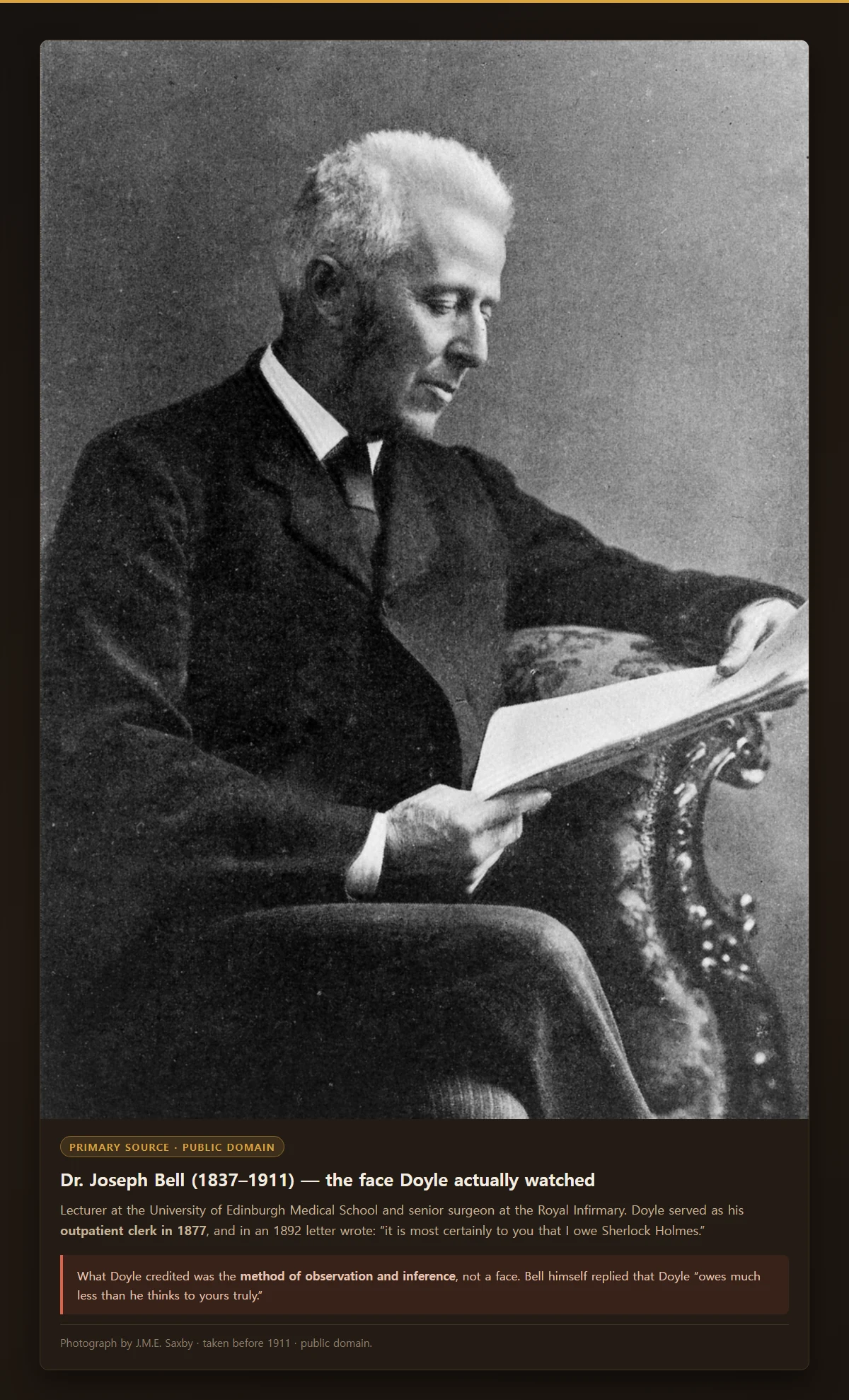
In 1892 Doyle wrote to him:
"it is most certainly to you that I owe Sherlock Holmes and although in the stories I have the advantage of being able to place him in all sorts of dramatic positions, I do not think that his analytical work is in the least an exaggeration of some of the effects which I have seen you produce in the out-patient ward."
And Bell turned it down. In The Strand Magazine that same year:
"Dr. Doyle's genius and vivid imagination has on this slender basis made his detective stories a distinctively new departure but he owes much less than he thinks to yours truly Joseph Bell."
By 1901 he was calling the whole phenomenon "the cataract of drivel for which Conan Doyle is responsible."
Source: Hektoen International, Summer 2019. (The exact date of Doyle's letter differs between sources — 4 May versus 7 May 1892 — so this article does not date it. The wording is consistent everywhere.)
So the accurate sentence is not "Bell was Holmes." It is: Doyle said he owed Holmes to Bell, and Bell said Doyle owed him far less than he thought. That disagreement is more interesting than the legend, and it is documented on both sides.
The method lines up almost exactly
Bell explained himself to The Strand in two sentences worth keeping:
"physiognomy helps you to nationality, accent to district"
"Nearly every handicraft writes its sign-manual on the hands"
One recorded demonstration: he identified that a woman worked in a linoleum factory from the dermatitis on her hand.
Now the text. Holmes's first words to Watson are "You have been in Afghanistan, I perceive." Later he reconstructs it:
"He has just come from the tropics, for his face is dark, and that is not the natural tint of his skin, for his wrists are fair."
— A Study in Scarlet, Pt. I, ch. 2
Dermatitis on the hand → linoleum factory. Dark face, fair wrists → recently back from the tropics. Structurally the same move, and the boot-mud deduction quoted earlier is a third instance of it.
Bell also did real forensic work: he assisted in the Elizabeth Chantrelle murder investigation, and with the forensic scientist Henry Littlejohn took part in handwriting analysis connected with the Jack the Ripper case.
There is one artefact I badly wanted for this article and cannot show you. The Linda Hall Library's account of Bell lists, among its illustrations, an undated photograph of Bell wearing a deerstalker cap and cloak, held by the Library & Archive at Surgeons' Hall, Royal College of Surgeons of Edinburgh. The real man behind the method, photographed in the hat an illustrator invented. But the date is unknown, it is not on Wikimedia Commons, and reuse terms were not established — so I can report that it exists and where it is held, and stop there.
Doyle contradicted Doyle: five holes only a full-text search finds
A piece that only says "later adaptations distorted the original" is leaning on the scale. Doyle didn't keep his own record straight either.
These are the kind of thing you only catch by searching everything.
1. Watson's war wound: shoulder, leg, or "one of my limbs"
Jezail appears 3 times, and the three disagree.
| Work | Text | Wound |
|---|---|---|
| A Study in Scarlet (1887) | "struck on the shoulder by a Jezail bullet, which shattered the bone and grazed the subclavian artery" | shoulder — specific enough to name the artery |
| The Sign of the Four (1890) | "I sat nursing my wounded leg. I had a Jezail bullet through it some time before" | leg |
| "The Noble Bachelor" (1892) | "the jezail bullet which I had brought back in one of my limbs" | unspecified limb |
The third phrasing reads like someone hedging. There is no evidence it was deliberate, so I'll leave the three sentences side by side and stop.
2. Watson's first name: John or James
The preface to His Last Bow is signed "John H. Watson, M.D." In "The Man with the Twisted Lip," Mrs. Watson says to her husband: "Or should you rather that I sent James off to bed?"
His wife calls him by a different name. (The familiar fan repair — that the H. stands for the Scots "Hamish" — is not in the text.)
3. The landlady: Mrs. Hudson or Mrs. Turner
Mrs. Hudson appears 26 times. Mrs. Turner appears once, in "A Scandal in Bohemia" — the very first short story. "When Mrs. Turner has brought in the tray I will make it clear to you," and one sentence later Watson calls her "our landlady."
4. How long was Holmes at university?
- "The 'Gloria Scott'": "during the two years I was at college" — two years.
- "The Musgrave Ritual," in the same volume: "during my last years at the University" — plural, indefinite.
The institution is never named anywhere in the Canon. Doyle never settled Oxford versus Cambridge.
5. Doyle misdates his own novel — in his own preface
From the preface to The Case-Book of Sherlock Holmes (1927):
"As a matter of cold fact Holmes made his début in A Study in Scarlet and in The Sign of Four, two small booklets which appeared between 1887 and 1889."
The Sign of the Four appeared in Lippincott's Monthly Magazine, February 1890.
Source: all five items verified directly in the public-domain texts.
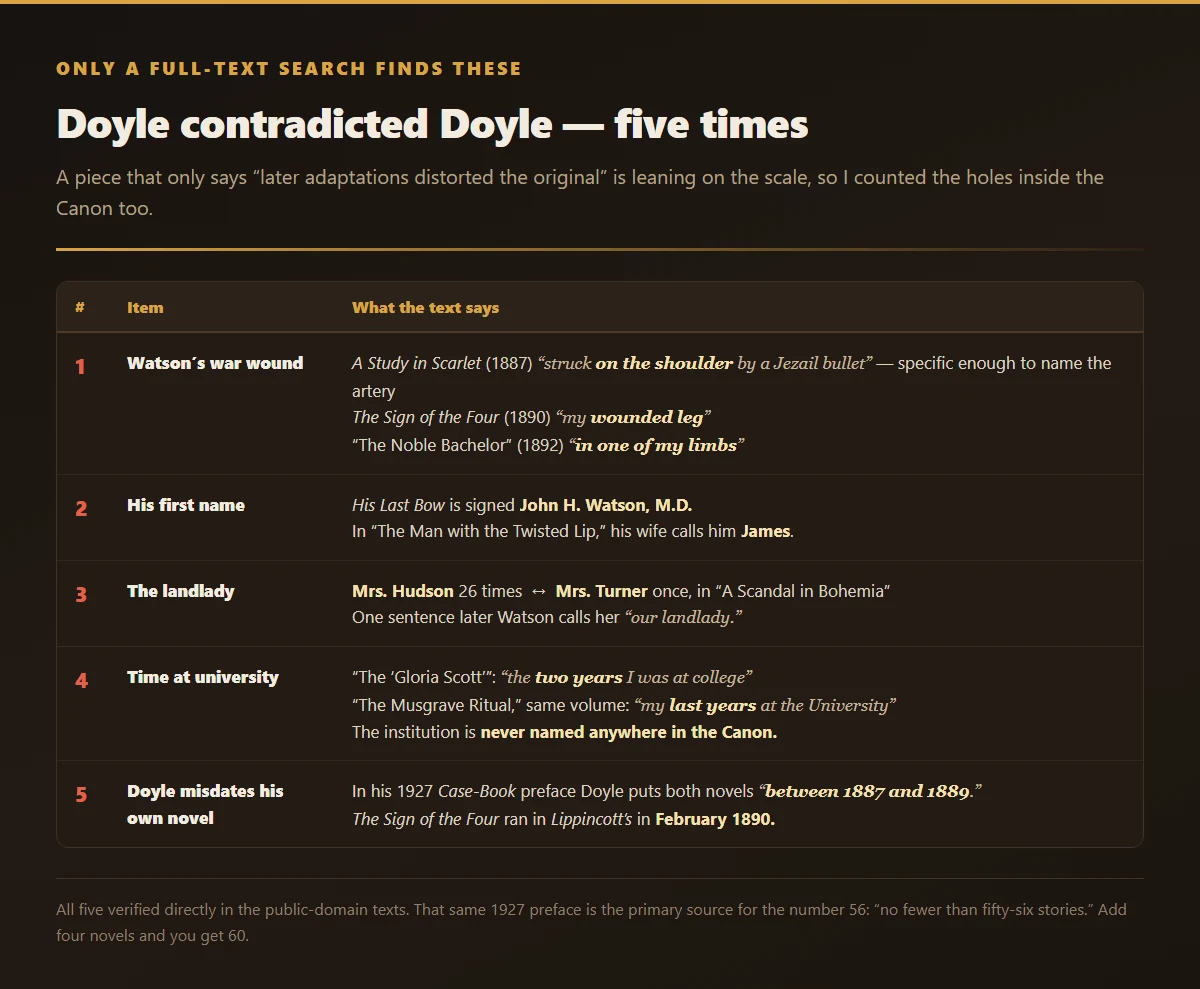
That same paragraph, incidentally, is the primary source for the number 56: "no fewer than fifty-six stories... and there remain these twelve." Add the four novels and you get 60.
In one paragraph, Doyle counted his own stories correctly and got his own publication date wrong.
How old is Sherlock Holmes in the books? Doyle never says
There is no direct statement of Holmes's age anywhere in the 60 works.
Height, nose, eyes, chin, fingers, complexion — all specified. Age, never. This is the one square Doyle actually left blank.
Two indirect signals exist, and one of them is a trap.
Signal A — the cabman in The Hound of the Baskervilles. Do not use it.
"'I'd put him at forty years of age, and he was of a middle height, two or three inches shorter than you, sir. He was dressed like a toff, and he had a black beard, cut square at the end.'"
This is usually where "Holmes is 40 in the books" comes from online. But the man being described is impersonating Holmes — it's Stapleton. And "middle height, two or three inches shorter" than Watson directly contradicts "rather over six feet." The mismatch is Doyle's planted clue, not a data point.
Signal B — "His Last Bow," set in August 1914.
"He was a tall, gaunt man of sixty, with clear-cut features and a small goatee beard..."
That is Holmes in disguise as the Irish-American "Altamont," described by the narrator. It gives an apparent age, of a costume.
So the commonly cited birth year of 1854 is a Sherlockian back-calculation, not canon. The honest sentence is that Doyle never gave Holmes an age. Watson's is likewise never stated — all we get is that he was an army surgeon invalided home after Maiwand in July 1880.
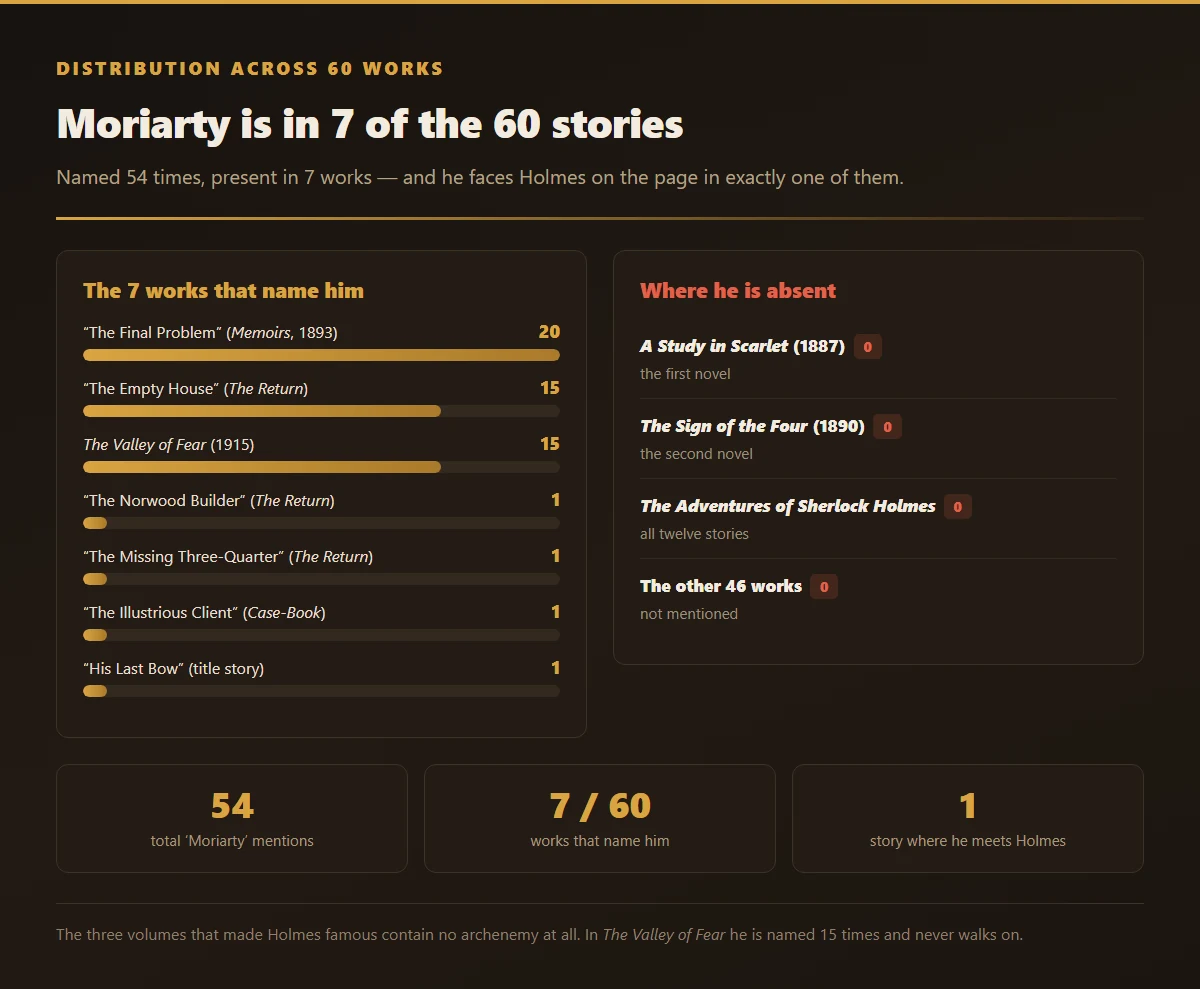
How much of the Canon is Moriarty actually in? 7 stories out of 60
He is named 54 times, but only in 7 of the 60 works — and he faces Holmes on the page in exactly one.
| Work | "Moriarty" mentions |
|---|---|
| "The Final Problem" (The Memoirs, 1893) | 20 |
| "The Empty House" (The Return) | 15 |
| The Valley of Fear (1915) | 15 |
| "The Norwood Builder" (The Return) | 1 |
| "The Missing Three-Quarter" (The Return) | 1 |
| "The Illustrious Client" (The Case-Book) | 1 |
| "His Last Bow" (title story) | 1 |
| Total | 54, across 7 of 60 works |
Two things stand out.
He is completely absent from the first three volumes. A Study in Scarlet, The Sign of the Four, and all twelve Adventures contain zero Moriarty. The stories that made Holmes famous have no archenemy in them at all.
And he appears in person in a single story — "The Final Problem," the Baker Street visit and Reichenbach. In The Valley of Fear he is named 15 times and never walks on.
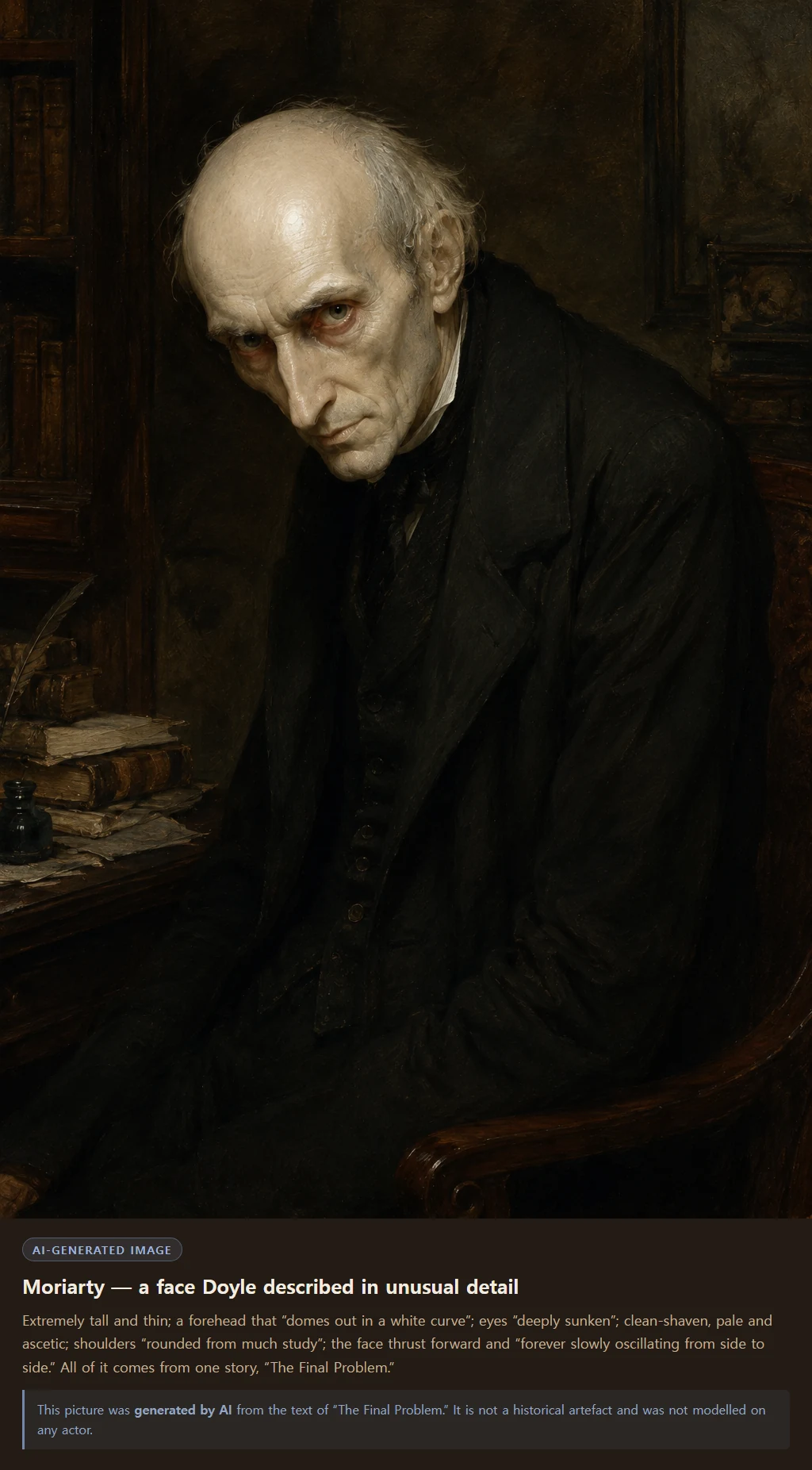
What Doyle did give him is a description as detailed as Holmes's own:
"He is extremely tall and thin, his forehead domes out in a white curve, and his two eyes are deeply sunken in his head. He is clean-shaven, pale, and ascetic-looking... His shoulders are rounded from much study, and his face protrudes forward, and is forever slowly oscillating from side to side in a curiously reptilian fashion."
— "The Final Problem"
Note who is speaking: this is Holmes describing him to Watson. Watson never gets his own look at Moriarty on the page.
In Enola Holmes 3 (2026), Moriarty is a principal antagonist, played by Sharon Duncan-Brewster.
A character who steps on stage once has become the permanent nemesis.
Is Sherlock Holmes in the public domain? Yes — and that's why you can see the 1891 drawing above
The entire 60-work Canon entered the US public domain on 1 January 2023, and Paget's illustrations have been free for far longer.
The Case-Book of Sherlock Holmes, the last Holmes book, was published in 1927. When the 1927 copyright term expired on Public Domain Day 2023, the last protected pieces of the Canon went with it.
There's a neat piece of primary confirmation: Project Gutenberg's edition of The Case-Book (eBook #69700) carries a release date of 3 January 2023 — two days after the term ran out.
Before that, the estate defended the property hard.
- In Klinger v. Conan Doyle Estate, Ltd. (7th Cir., 2014), the court rejected the estate's theory that a character stays out of the public domain as long as any single work featuring it remains protected.
- In 2020 the estate sued Netflix over Enola Holmes, and the case settled.
Sources: Copyright Lately, "Public Domain Day 2023" and "'Enola Holmes' and the Case of the Overreaching Copyright Owner"; Stanford Copyright & Fair Use, Klinger v. Conan Doyle Estate Ltd.; Project Gutenberg eBook #69700 file header, verified directly.
Sidney Paget matters here too. He died on 28 January 1908, which puts his drawings comfortably out of copyright everywhere; Wikimedia Commons carries them under expired-term tags keyed to that date.
Which is the reason this article can put the actual drawing that created the hat next to the actual sentence Doyle wrote instead. Not a description of the evidence. The evidence.
Sherlock on screen in 2026 — and where Cavill sits in the chain
The 2026 adaptations are not a departure from the "real" Holmes. They are the most recent coat of paint on a figure that was already several coats deep.
Netflix's Enola Holmes 3 was released 1 July 2026, directed by Philip Barantini — the first in the series not directed by Harry Bradbeer. Millie Bobby Brown returns as Enola, with Henry Cavill as Sherlock, Helena Bonham Carter, Louis Partridge, Himesh Patel as Watson and Sharon Duncan-Brewster as Moriarty.
Reception, as of this research date (22 August 2026): Rotten Tomatoes 65% from 78 critics, Metacritic 58 from 17 critics — the lowest of the trilogy. (A separate outlet reported 68% critics; RT percentages move as reviews accumulate.) Variety reported 20.7 million views in five days, the top Netflix title for the week of 29 June–5 July, but a slower start than Enola Holmes 2's 29.3 million in three days.
Sources: Wikipedia, "Enola Holmes 3"; MovieWeb; Variety, July 2026 (⚠️ the Variety article body was behind a paywall on direct retrieval, so the viewership figure is attributed to Variety and should be treated as reported rather than independently verified).
Cavill and "excessively lean"
Doyle's line was rather over six feet, and so excessively lean that he seemed to be considerably taller.
Cavill matches the height and not the build. He carries the same broad, muscular frame that made him Superman and Geralt, and commentary has noted the mismatch since the first film in 2020. Director Harry Bradbeer has said the physique was not a reason for the casting.
Sources: ScreenRant, "Enola Holmes: Everything Netflix Changes About Sherlock Holmes"; MEL Magazine; IMDb News.
I want to be careful with this, because "the book says otherwise, so the film is wrong" is the lazy version of this article. Paget put a hat on him that wasn't in the book. Gillette put a pipe in his mouth that wasn't in the book. Cavill is standing at the end of a very long line, not outside it.
The rest of the 2026 slate
- Young Sherlock (Prime Video, 4 March 2026) — Guy Ritchie's first Holmes project in fifteen years, eight episodes released at once, with Hero Fiennes Tiffin as a 19-year-old Holmes at Oxford. It topped Prime Video's charts and stayed near the top for at least three weeks. Slate argued that what devotees value in Holmes — "cerebral methods and serene rationality" — sits badly with Ritchie's taste for "bare-knuckle brawling and frantic plots."
- Watson — worth a correction, because it is widely misfiled. It is a CBS series created by Craig Sweeny, starring Morris Chestnut, streaming on Paramount+ — not a Netflix show. CBS cancelled it on 27 March 2026, with the finale airing 3 May 2026. Season 2 averaged a 0.17 rating among adults 18–49 and 2.86 million viewers, down 57% and 44% from season 1.
Sources: Amazon MGM Studios press release; Wikipedia, "Young Sherlock"; Collider, March 2026; Slate, March 2026; TV Series Finale, 27 March 2026.
One table: in the Canon, added later, or never there at all
| Item | Verdict | Basis |
|---|---|---|
| Over six feet, gaunt build | In the Canon | A Study in Scarlet, Pt. I, ch. 2 |
| Hawk-like nose, square chin, grey eyes | In the Canon | Study in Scarlet / Hound ch. 12 / "Three Garridebs" |
| Magnifying lens | In the Canon | lens 33 times, from the first novel |
| Violin (a Stradivarius) | In the Canon | violin 24 times |
| Cocaine, seven-per-cent solution | In the Canon | The Sign of the Four, ch. 1 |
| Clay, briar and cherry-wood pipes | In the Canon | "A Case of Identity" and others |
| "The game is afoot" | In the Canon (once) | "The Abbey Grange" |
| 221B Baker Street | In the Canon (6 hits) | vs. Baker Street 110 |
| The observational method | From a real person | Dr. Joseph Bell — Doyle said so in 1892 |
| Deerstalker cap | Added later | Sidney Paget, The Strand, October 1891 |
| Inverness cape | Added later | Doyle wrote "long grey travelling-cloak" |
| Curved pipe | Added later | William Gillette, stage, October 1899 |
| Calabash (gourd) shape | Later still, and disputed | no photograph of Gillette with one (Gwinner) |
| "Elementary, my dear Watson" | Added later | earliest exact print match: The Globe, Feb 1908 |
| Holmes's hair colour | Never in the Canon | 0 mentions in 60 works |
| Holmes's age | Never in the Canon | 0 direct statements; 1854 is a back-calculation |
| The name of his university | Never in the Canon | Oxford vs. Cambridge never settled |
Correction — the count was low by six (15 September 2026)
When I re-downloaded all nine Gutenberg volumes to re-check these numbers, one didn't reproduce.
my dear Watson was published here as 86. It is 92.
The six that went missing were the ones that fell across a line break — my dear at the end of one line, Watson at the start of the next. A search that doesn't collapse whitespace first walks straight past them.
without normalising line breaks    86
with line breaks normalised        92
                                    6   lost to the gap between two lines
Elementary at 8 and Elementary, my dear Watson at 0 both held on the recount. The finding doesn't change: both halves are in the Canon, and Doyle never put them together. Only the size of one half was wrong.
It is worth saying which way this cuts. A full-text search is only as good as the text you hand it, and this piece leans on full-text searches throughout. Every "zero" here carries the same risk.
Where this article's evidence gets thin
Six places, and they're worth stating plainly.
- "Zero" is a word-search result. The absence of the word
deerstalkeris not the same as proof that Doyle never pictured such a hat. What is directly comparable is the phrase he did use at that moment — "close-fitting cloth cap" — and how far it is from a deerstalker. - The Paget → Doyle causation is unproven. Verified: both phrasings, both publication dates, the order. Nothing beyond that is claimed here.
- "Gillette smoked a calabash" is contested. The curved pipe is well attested; the gourd shape has a documented shortage of photographic evidence.
- The catchphrase chronology is not from an institution. It comes from a quotation-research site working newspaper databases. It is internally specific and consistent with Wiktionary and Snopes, but it is a different class of source.
- Story counts shift by edition. "The Cardboard Box" migrates between The Memoirs and His Last Bow. In this Gutenberg set it sits in The Memoirs, so the 56 short stories are each counted exactly once.
- Some dates conflict between sources. The year Doyle clerked for Bell (1877 vs. 1879) and the exact date of his letter (4 May vs. 7 May 1892) are the two examples in this piece, and I have not asserted either.
Frequently asked questions
Q. Did Sherlock Holmes ever say "Elementary, my dear Watson"?
A. No. The full phrase appears 0 times in the 60-work Canon. my dear Watson appears 92 times and Elementary 8 times, but Doyle never joined them — the closest they come is four sentences apart in "The Crooked Man." The earliest exact match found in print is The Globe of London, February 1908. The popular claim that it came from Gillette's 1899 play is unsupported; the line is in no published version of that script.
Q. Who invented the Sherlock Holmes deerstalker hat?
A. Illustrator Sidney Paget, in The Strand Magazine, October 1891, for "The Boscombe Valley Mystery." Doyle's own words for that scene were "long grey travelling-cloak and close-fitting cloth cap."
Q. What kind of pipe does Sherlock Holmes smoke in the books?
A. Three kinds: clay, briar and cherry-wood. calabash and meerschaum each appear 0 times. Doyle specified that Holmes uses clay when he is thinking and cherry-wood when he is in a disputatious mood.
Q. How many Sherlock Holmes stories are there?
A. 4 novels + 56 short stories = 60 works. That figure is not a fan tally — Doyle gives it himself in the preface to The Case-Book of Sherlock Holmes (1927).
Q. How tall is Sherlock Holmes in the books?
A. "Rather over six feet" — roughly 6 foot 1 — and "excessively lean," with a thin hawk-like nose, grey eyes, a prominent square chin and long white fingers. His hair colour is never given.
Q. How old is Sherlock Holmes in the books?
A. Doyle never says. The commonly cited 1854 birth year is a later back-calculation. The "forty years of age" line in The Hound of the Baskervilles describes a man impersonating Holmes, not Holmes.
Q. Who was the real-life inspiration for Sherlock Holmes?
A. Dr. Joseph Bell, Doyle's teacher at Edinburgh. Doyle wrote to him in 1892 that "it is most certainly to you that I owe Sherlock Holmes." Bell replied in print that Doyle "owes much less than he thinks to yours truly Joseph Bell."
Q. Where was Dr. Watson wounded?
A. It depends on the book. A Study in Scarlet says the shoulder (naming the subclavian artery), The Sign of the Four says the leg, and "The Noble Bachelor" says "one of my limbs." Jezail appears three times and the three passages disagree.
Q. How many stories is Moriarty actually in?
A. 7 of 60, with 54 mentions total. He appears in person in only one — "The Final Problem" — and there are zero mentions across A Study in Scarlet, The Sign of the Four and all twelve Adventures.
Q. Is Sherlock Holmes in the public domain?
A. Yes, fully, in the United States since 1 January 2023, when the last book, The Case-Book of Sherlock Holmes (1927), lost copyright protection. Sidney Paget's illustrations are public domain as well.
Next time Holmes turns up on your screen, check one thing
No grand summary. One sentence covers it.
Doyle wrote the man down clearly. Later hands didn't fill a blank — they painted over a finished canvas.
That's what makes this installment different from the first two. In Pride and Prejudice the text said nothing. In The Odyssey the text said plenty and the artists ignored it. Here the text was detailed, and people bolted objects onto it anyway.
And they signed and dated their work:
- October 1891 — Sidney Paget drew the deerstalker.
- October 1899 — William Gillette bent the pipe so he could speak around it.
- 1903 — Frederic Dorr Steele carried Gillette's face into American magazines.
- February 1908 — a London newspaper printed the line for the first time.
So next time a Sherlock Holmes shows up — Cavill, or whoever comes after him — try one small thing. Look at the hat, the pipe and the catchphrase, and ask whether each one came from Doyle, or from one of those four.
Most of the time, it's the four.
Method note. All occurrence counts and the 658,554-word total were produced by downloading the nine public-domain Project Gutenberg volumes (eBooks #244, #2097, #1661, #834, #2852, #108, #3289, #2350, #69700), stripping Gutenberg front and back matter, and running case-insensitive regular-expression searches across the combined body text. All quotations from the stories are from those public-domain files. Illustrations and photographs are public-domain items from Wikimedia Commons. Enola Holmes 3 review scores are as of 22 August 2026 and will shift as reviews accumulate.


Comments
Post a Comment