Is Mr. Hyde Smaller Than Dr. Jekyll in the Original Book?
Every witness who ever lays eyes on Edward Hyde says the same two things.
Something is deeply wrong with his face. And they cannot tell you what it is.
Last updated: 10 September 2026 · Quotations and occurrence counts were checked against the source text on this date.
That isn't Robert Louis Stevenson failing to describe his villain. A full-text search of the 1886 novella shows it's a device — repeated by four separate witnesses, in four separate chapters, using almost the same words each time.
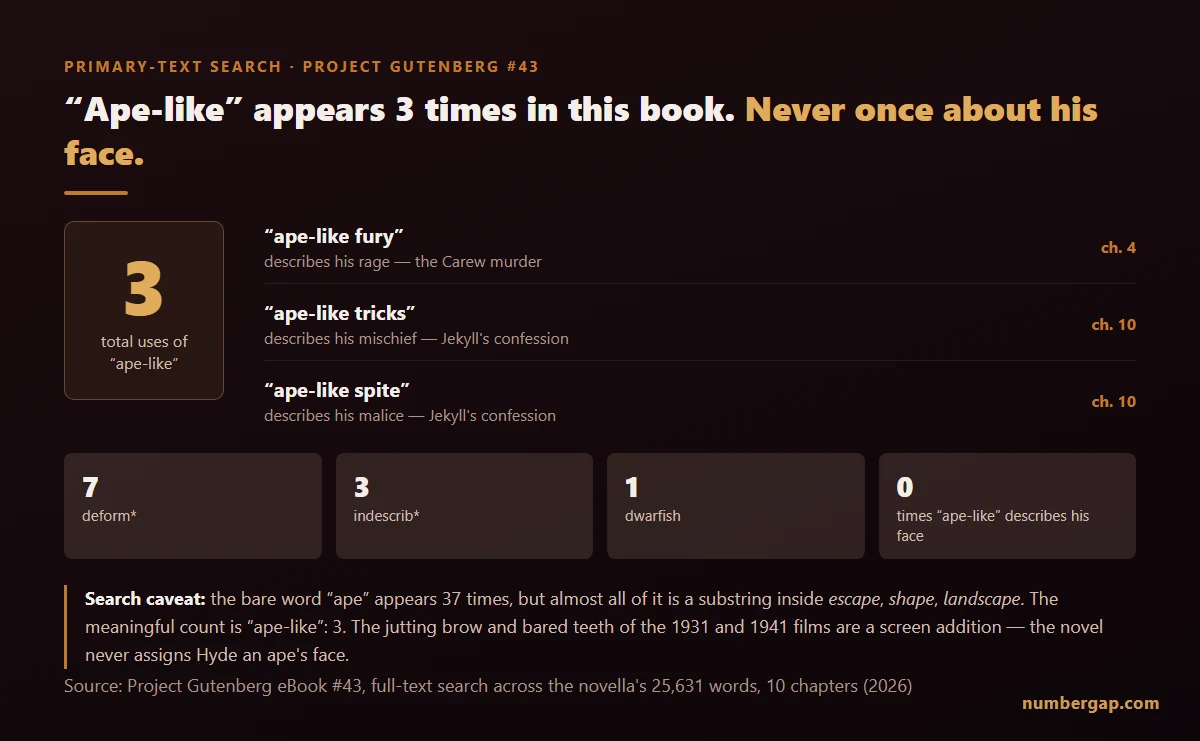
There's a second finding in the same search, and it runs against every film poster made since 1920: Edward Hyde is smaller, slighter, and younger than Henry Jekyll. Not bigger. Not a hulking brute. And a third finding is the one most "what the movie got wrong" pieces miss entirely — the word critics reach for to explain Hyde's monstrousness, "ape-like," never once describes his face in the book. All three times it appears, it's describing what he does, not how he looks.
None of that makes the book tame. Hyde tramples a child under his own feet and beats a man to death hard enough that the bones are audible across the street. Small and quiet, in this novel, is not the same thing as harmless.
I searched the full text, start to finish.
Here's what turned up.
⚠️ The plot and character sections below spoil the ending. Skip ahead to the FAQ if you'd rather read the book first.
First, who's who — the cast in one table
Seven names carry you through the rest of this piece.
| Name | Who they are | Why they matter here |
|---|---|---|
| Gabriel John Utterson | A reserved London lawyer | The novel's real point-of-view character for 9 of its 10 chapters |
| Henry Jekyll | Respected physician, "a large, well-made, smooth-faced man of fifty" | Gets the only full physical description of either man |
| Edward Hyde | Jekyll's isolated "evil" self | Never gets a full description — only fragments no witness can pin down |
| Richard Enfield | Utterson's distant kinsman, "the well-known man about town" | Witnesses the opening incident. The text gives him no physical description at all |
| Dr. Hastie Lanyon | Jekyll's oldest friend, a fellow physician | The one character whose face the text tracks before and after — he watches the transformation and it kills him |
| Poole | Jekyll's butler of twenty years | Raises the alarm at the end. Physical description: almost nothing |
| Sir Danvers Carew, MP | An elderly, well-liked gentleman | Gets one warm, detailed passage — then is murdered within a page of being introduced |
The plot in six lines (ending included)
Utterson hears from his cousin Enfield about a sinister stranger, Edward Hyde, who trampled a child and paid the family off with a check signed by Utterson's old friend, Dr. Henry Jekyll.
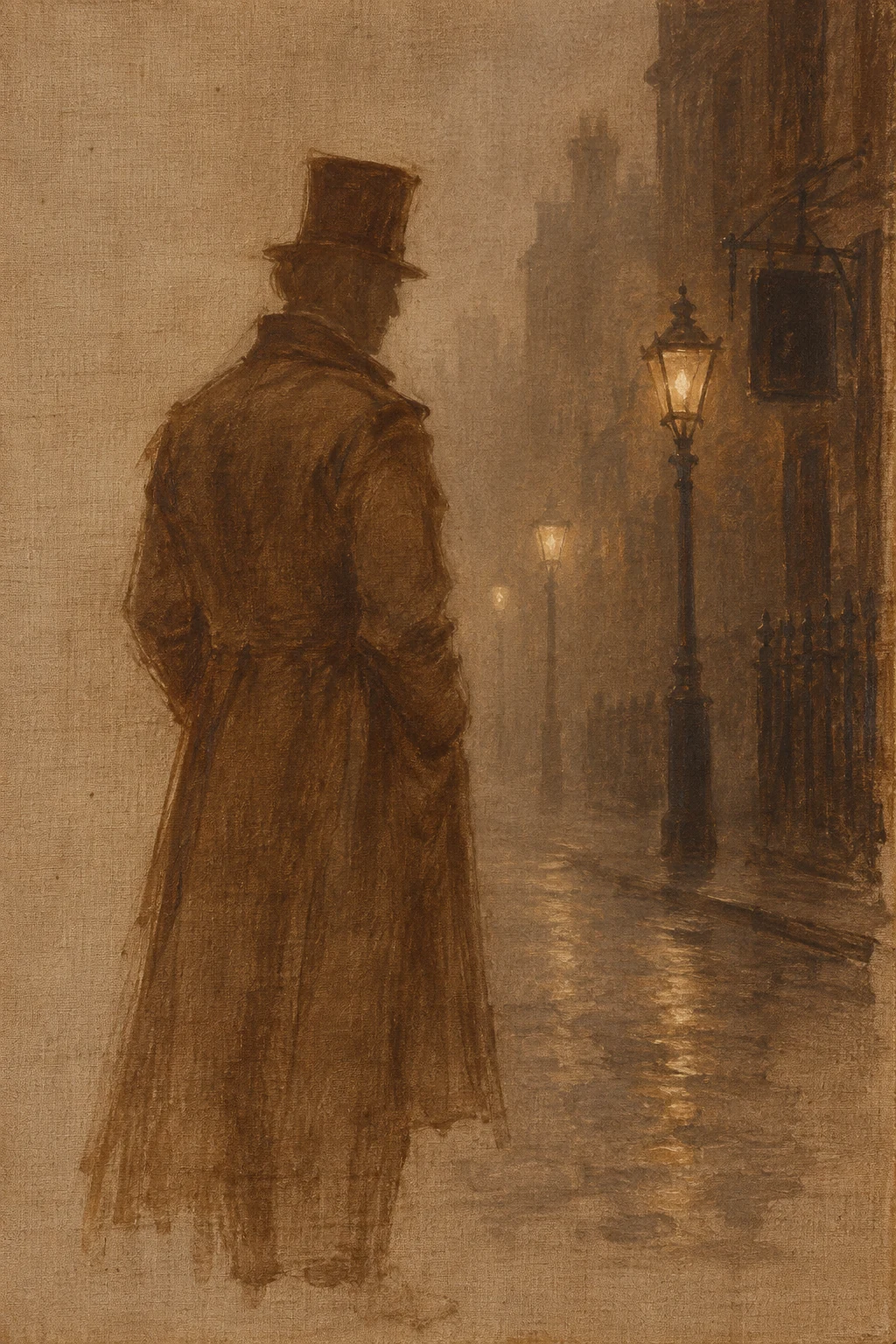
Utterson learns Jekyll has left his entire will to Hyde in the event of death or disappearance, and eventually meets Hyde face to face — small, pale, and instantly, inexplicably repulsive.
A year later, Hyde beats an elderly gentleman, Sir Danvers Carew, to death in the street "with ape-like fury," for no apparent motive, and vanishes.
Jekyll appears to reform, then relapses. His friend Dr. Lanyon falls into terror after a private meeting with Jekyll and dies of shock two months later, leaving Utterson a sealed letter.
Jekyll's butler Poole begs Utterson to come to the house — someone has been locked in Jekyll's cabinet for over a week. They break down the door and find Hyde's body, dead by suicide, wearing Jekyll's oversized clothes. Jekyll is nowhere in the house.
Utterson reads two documents left behind: Lanyon's narrative (he watched Hyde transform into Jekyll) and Jekyll's own confession — he had discovered a drug that split the good and evil sides of his nature, Hyde was the evil side made flesh, and near the end the transformations began happening involuntarily, until Jekyll ran out of the one batch of salt that worked and killed himself as Hyde rather than hang.
📌 Getting the ending right: Jekyll and Hyde being the same physical body is not ambiguous or symbolic within the story — it's explicit, first-person, forensic testimony from Jekyll himself in the final chapter. The reveal only lands in the last two chapters, even though it structures the entire book. That delayed reveal is a big part of why the novella reads so differently from adaptations that show the transformation up front.
One more structural fact worth knowing before you read on: Jekyll's own confession — the tenth and final chapter — is 6,932 words, 27% of the entire 25,631-word novella, longer than the first seven chapters combined. The book spends nine-tenths of its length withholding Jekyll's interior life, then hands you all of it at once, in writing, after both men are already dead.
What does Mr. Hyde actually look like? Every fragment, collected for the first time
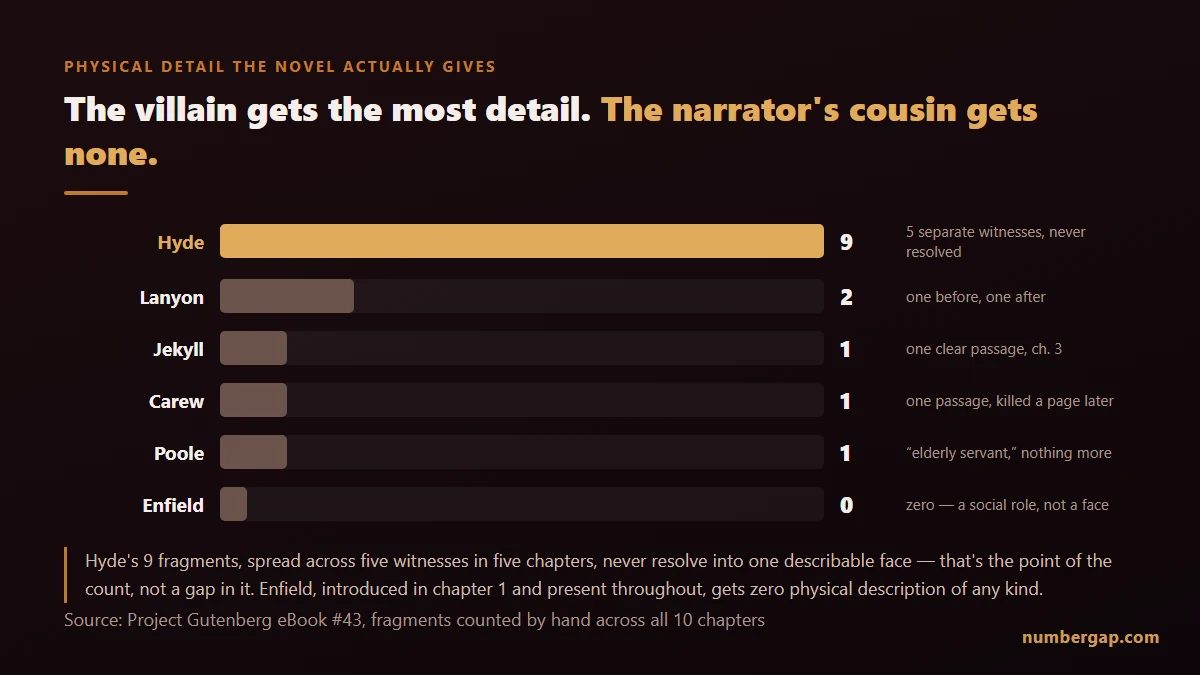
No single passage in the book gives Hyde a head-to-toe description. Instead, five separate witnesses drop partial, contradictory-feeling fragments across ten chapters — and no character in the story ever lines them up side by side. Here they are, together, for the first time:
| # | What's said | Who says it | Chapter |
|---|---|---|---|
| 1 | "he gives a strong feeling of deformity, although I couldn't specify the point" | Enfield | 1 |
| 2 | "Mr. Hyde was pale and dwarfish, he gave an impression of deformity without any nameable malformation, he had a displeasing smile" | Utterson | 2 |
| 3 | "he spoke with a husky, whispering and somewhat broken voice" | narrator (Utterson's impression) | 2 |
| 4 | "Mr. Hyde shrank back with a hissing intake of the breath" | narrator | 2 |
| 5 | "particularly small and particularly wicked-looking" | the maid who witnessed the Carew murder, via a police officer | 4 |
| 6 | "the haunting sense of unexpressed deformity with which the fugitive impressed his beholders" | narrator, summarizing multiple witnesses | 4 |
| 7 | "that masked thing like a monkey jumped from among the chemicals" | Poole, describing what he glimpsed through the cabinet door | 8 |
| 8 | "there was something abnormal and misbegotten in the very essence of the creature" | Dr. Lanyon | 9 |
| 9 | his clothes "enormously too large for him in every measurement" | Dr. Lanyon | 9 |
Conspicuously never given: hair color, eye color, a nose, a mouth shape, an age in years, or skin color/tone beyond "pale" — which several other characters, including Utterson himself, also are at various points. The one body part the novella renders in real detail belongs not to an outside witness at all, but to Jekyll's own confession (more on that below).
Here's how that table got built. I downloaded Project Gutenberg's eBook #43 — the standard reading text of Strange Case of Dr Jekyll and Mr Hyde, 25,631 words. Stripped the header and footer. Split it into the novella's ten titled chapters — the original has no chapter numbers, only titles. Searched it end to end. Every hit, I went back and read in context to confirm who was actually speaking. Every count in this piece comes from that same search, unless a separate source is named for a specific claim.
The face never arrives.
Why can't anyone in the book describe Hyde's face?
Because Stevenson built it that way — not once, but four separate times, in four separate chapters, in the mouths of four separate witnesses.
| Speaker | Chapter | What they say |
|---|---|---|
| Enfield | 1 (Story of the Door) | "He must be deformed somewhere; he gives a strong feeling of deformity, although I couldn't specify the point." |
| Utterson (narrator reports his private verdict) | 2 (Search for Mr. Hyde) | Hyde "gave an impression of deformity without any nameable malformation" |
| Multiple witnesses to the Carew murder, summarized by the narrator | 4 (The Carew Murder Case) | "Only on one point were they agreed; and that was the haunting sense of unexpressed deformity" |
| Dr. Lanyon | 9 (Dr. Lanyon's Narrative) | "there was something abnormal and misbegotten in the very essence of the creature — something seizing, surprising, and revolting" |
The search counts confirm this isn't a one-off line: deform* returns 7 hits, indescrib* 3, describ* (as in "not easy to describe") 10 total, nameable 1, abnormal 1, misbegotten 1, and the phrase "something wrong" 2. Notably, the word "ugly" is never used as a sufficient explanation on its own — it appears 4 times, and every time it's paired with a disclaimer that ugliness alone doesn't account for the reaction Hyde provokes.
The book gets closest to explaining itself in Utterson's own private theorizing, after his first face-to-face encounter with Hyde:
"There is something more, if I could find a name for it. God bless me, the man seems hardly human! Something troglodytic, shall we say? or can it be the old story of Dr. Fell? or is it the mere radiance of a foul soul that thus transpires through, and transfigures, its clay continent?"
— ch. 2, Search for Mr. Hyde
"The old story of Dr. Fell" is a nod to a 17th-century English nursery rhyme about disliking someone for a reason you can't name. Stevenson has his own narrator name the device: the horror isn't a describable feature. It's an unlocatable wrongness — and the novella offers this folk allusion as its nearest thing to a theory, then drops it. Dr. Lanyon's line makes the same move in different words: the wrongness is in the creature's essence, not its features.
The word "ape-like" appears three times in this book — and never once about his face
This is the single most useful fact for correcting the popular image of Hyde, and it's easy to verify: search ape-like in the primary text and you get exactly three hits. Here are all three:
| # | Quote | Chapter | What it describes |
|---|---|---|---|
| 1 | "with ape-like fury, he was trampling his victim under foot and hailing down a storm of blows" | 4 | Hyde's rage, during the Carew murder |
| 2 | "Hence the ape-like tricks that he would play me, scrawling in my own hand blasphemies on the pages" | 10 | Hyde's mischief, in Jekyll's confession |
| 3 | "save it once again from the action of his ape-like spite" | 10 | Hyde's malice, also in the confession |
All three describe behavior or temperament. None describes a face, a jaw, a brow, or a skull. That's worth pausing on, because a jutting brow, protruding teeth, and simian posture are exactly what film history did to Hyde starting in 1920 — the adaptations took a simile for fury and rebuilt it as a face.
⚠️ A search caveat: the bare word ape appears 37 times in the novella, but almost all of those are substrings inside words like escape, shape, and landscape — not references to apes at all. The meaningful count is ape-like, at 3. Any version of this claim that cites "37 ape references" is counting the wrong thing.
Is Mr. Hyde smaller than Dr. Jekyll? The text says yes
This is the claim the whole piece is built on, and it isn't a metaphor. It's stated as narrated fact by the single most authoritative voice in the book on the subject — Jekyll, describing his own body, in his own confession:
"And hence, as I think, it came about that Edward Hyde was so much smaller, slighter and younger than Henry Jekyll. Even as good shone upon the countenance of the one, evil was written broadly and plainly on the face of the other."
— ch. 10, Henry Jekyll's Full Statement of the Case
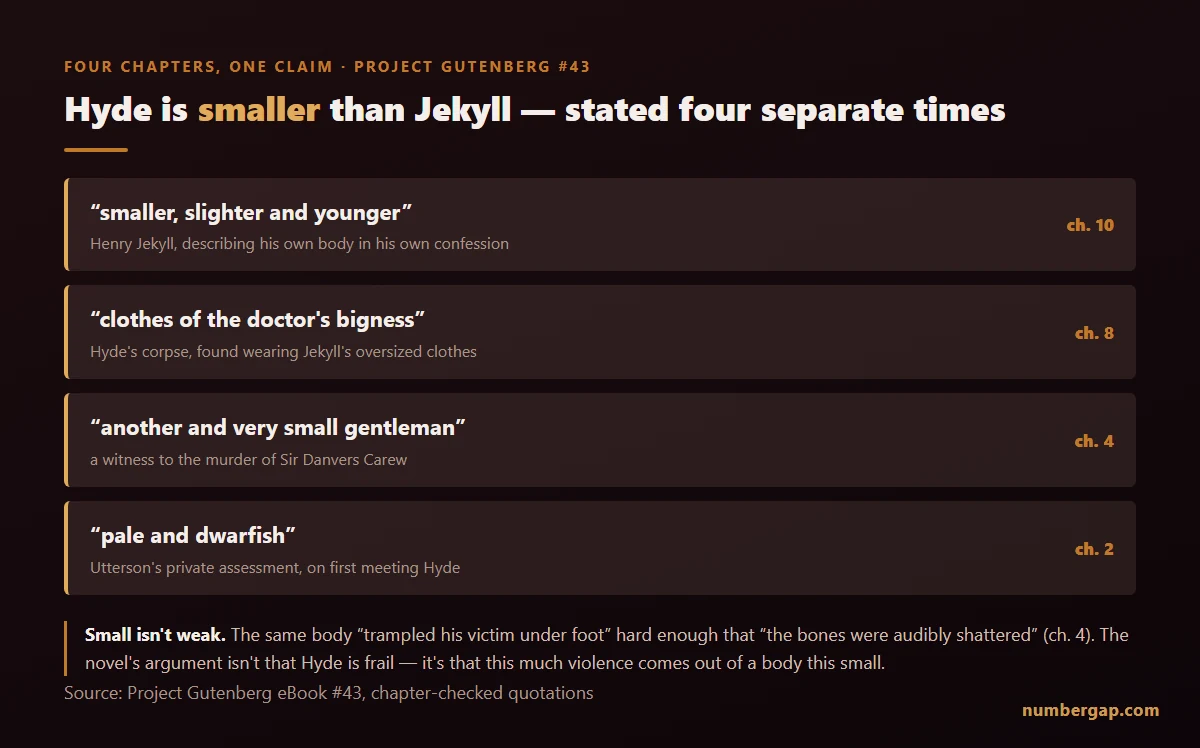
Every piece of supporting evidence points the same way:
| Term | Count | Key hits |
|---|---|---|
dwarfish |
1 | Utterson's private assessment: "Mr. Hyde was pale and dwarfish" (ch. 2) |
small (referring to Hyde) |
at least 5 of 14 total | "he was small" (ch. 4, maid's account); "a small man crouching against the pillars" (ch. 9, Lanyon's first sight of him) |
stature |
5 | Utterson's own question to a police officer, right after recognizing the murder weapon: "Is this Mr. Hyde a person of small stature?" (ch. 4) |
smaller |
1 | the direct line quoted above (ch. 10) |
| "dwarf" (third-party) | 1 | Poole, describing what he glimpsed in the cabinet: "My master... is a tall, fine build of a man, and this was more of a dwarf." (ch. 8) |
| clothes-too-large motif | multiple | the corpse at the end wears "clothes far too large for him, clothes of the doctor's bigness" (ch. 8); Lanyon describes Hyde's clothes as "enormously too large for him in every measurement — the trousers hanging on his legs and rolled up to keep them from the ground" (ch. 9) |
younger |
3 (2 refer to the transformation) | "so much smaller, slighter and younger" (ch. 10); "I felt younger, lighter, happier in body" — Jekyll's own sensation on first transforming (ch. 10) |
Jekyll even offers his own theory for why Hyde comes out smaller — presented as his best guess, not settled science:
"The evil side of my nature, to which I had now transferred the stamping efficacy, was less robust and less developed than the good which I had just deposed. Again, in the course of my life, which had been, after all, nine tenths a life of effort, virtue and control, it had been much less exercised and much less exhausted."
— ch. 10
In the novella's own logic, Hyde is smaller because evil is the newer, less-used part of Jekyll — not because he's more monstrous or more physically powerful. That directly inverts the visual logic of every film adaptation, where Hyde is made bigger specifically to read as "more monstrous."
Small doesn't mean harmless
Everything above could be read as "Hyde is basically a frail little man" — and that reading is wrong. Here's what the same smaller body actually does, in the same book:
"he was trampling his victim under foot and hailing down a storm of blows, under which the bones were audibly shattered and the body jumped upon the roadway"
— ch. 4, describing the murder of Sir Danvers Carew
"the man trampled calmly over the child's body and left her screaming on the ground. It sounds nothing to hear, but it was hellish to see. It wasn't like a man; it was like some damned Juggernaut."
— ch. 1, Enfield's account of the opening incident
Search counts: trampled 1, storm of blows 1, shattered 1, Juggernaut 2, fury 3. This is the part of the novel a "small and quiet" summary erases. The book's actual argument isn't that Hyde is small and therefore weak — it's that something this violent can come out of a body that small, which is a stranger and more disturbing idea than a body-count monster ever was. It's also, as the next section gets into, the exact problem every adaptation from 1887 onward had to solve some other way, because a small, quiet body doesn't read as a threat from a theater's back row.
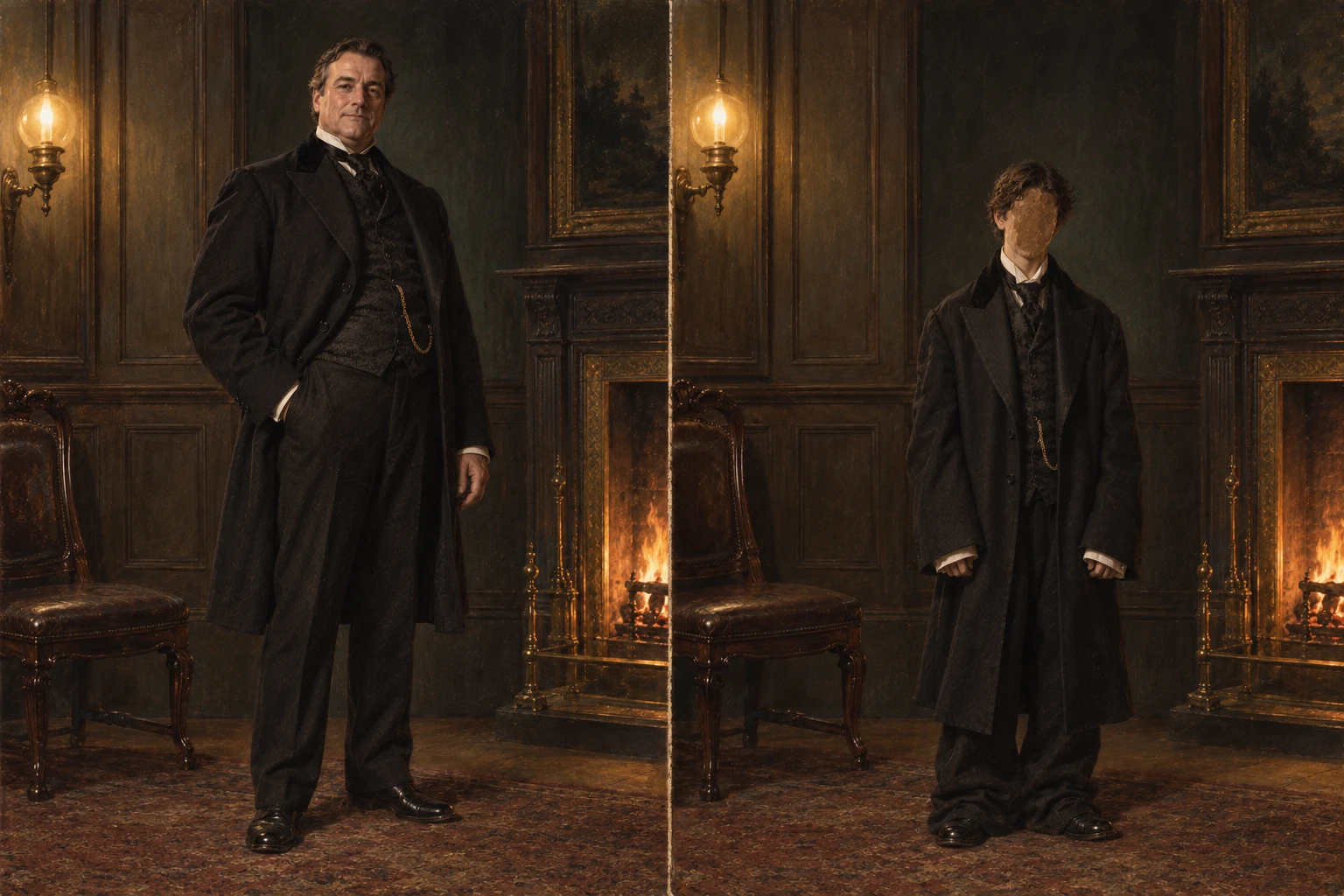
The baseline: what does Dr. Jekyll himself look like?
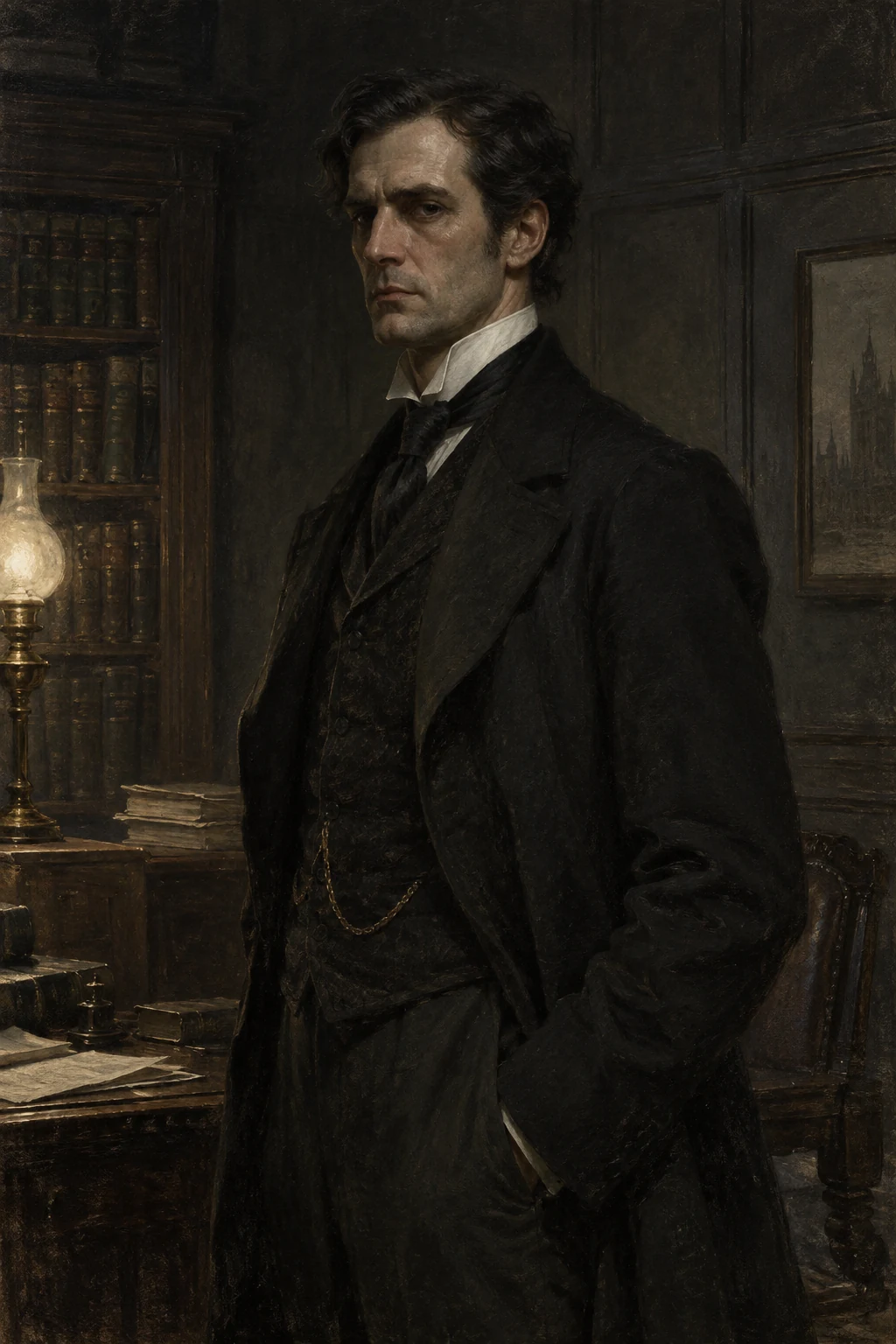
The size contrast only lands if you know what Jekyll looks like, and the book gives exactly one clear passage, as Utterson watches him by the fire:
"Dr. Jekyll was no exception; and as he now sat on the opposite side of the fire — a large, well-made, smooth-faced man of fifty, with something of a slyish cast perhaps, but every mark of capacity and kindness."
— ch. 3, Dr. Jekyll Was Quite at Ease
And later, frightened: "The large handsome face of Dr. Jekyll grew pale to the very lips, and there came a blackness about his eyes" (ch. 3).
That's the entirety of his physical description: large, well-made, smooth-faced, fifty, handsome. No hair color, no eye color, no height in feet or inches. "Fifty" is the only concrete age figure given for either man in the main narrative — Hyde's age in years is never stated at all, only described relatively, as "younger."
The one body part the book describes in forensic detail — and it isn't Hyde's face
It's Jekyll's hand. And the person who describes it isn't an outside witness — it's Jekyll himself, alone in his room, realizing he's changed in his sleep.
"The hand of Henry Jekyll (as you have often remarked) was professional in shape and size; it was large, firm, white and comely. But the hand which I now saw, clearly enough, in the yellow light of a mid-London morning, lying half shut on the bedclothes, was lean, corded, knuckly, of a dusky pallor and thickly shaded with a swart growth of hair. It was the hand of Edward Hyde."
— ch. 10
Two chapters later, as he loses control of the transformation for good:
"my clothes hung formlessly on my shrunken limbs; the hand that lay on my knee was corded and hairy. I was once more Edward Hyde."
— ch. 10
This is the closest the book comes to a literal "hairy hand" reveal — worth flagging because that detail (a gnarled, hair-shaded hand as the tell) likely influenced later werewolf-transformation imagery in horror film, even though the novella never frames Hyde as bestial or lupine. The hand is simply older, corded, and hair-shaded, set against Jekyll's smooth "professional" one.
The one thing every witness can actually identify: his voice
If the face is a dead end, the voice isn't. Twice in the book, sound does what sight can't.
"he spoke with a husky, whispering and somewhat broken voice"
— ch. 2, the narrator's account of Hyde's speech
And later, when Utterson and Poole are outside the locked cabinet door, listening to whoever — or whatever — is inside:
"Ah, that's not Jekyll's voice—it's Hyde's!"
— ch. 8, The Last Night
Utterson identifies Hyde correctly through a closed door, from voice alone, with zero visual information. In this novel, the one reliable identifier isn't a face — it's a voice. That distinction turns out to matter for stage history, too. Richard Mansfield, the actor who first brought both roles to life on stage starting in 1887, played both parts himself, live, every night, with no cuts and no body double — and according to an 1888 newspaper report on his method (more on that below), voice was one of the few tools he actually had. The Pall Mall Gazette described his Jekyll voice as "plaintive and deeply-musical" against a Hyde voice that was "gurgling and raucous." A century-plus later, stage and screen adaptations that lean on a lower, rougher voice to distinguish Hyde from Jekyll are, unlike the size question, standing on real textual ground.
No green liquid, no lightning — what the transformation scene actually says
Jekyll's account of his very first transformation is quiet and physical, not theatrical:
"I was suddenly aware that I had lost in stature."
— ch. 10, before he even reaches a mirror.
"There was no mirror, at that date, in my room... I stole through the corridors, a stranger in my own house; and coming to my room, I saw for the first time the appearance of Edward Hyde."
— ch. 10
The only apparatus named on the page is "the salt," "the powders," and "the drug" — and the exact recipe is deliberately withheld. Jekyll refuses to write it down even in his own confession, saying the original ingredient was impure and that a later batch, bought from a different supplier, never worked the same way again. There's no bubbling green liquid, no electrical apparatus, no shouted "eureka" moment. The entire discovery is narrated retrospectively, in a study, by a dying man writing a confession.
How much does the book tell us about Utterson, Enfield, and Lanyon?
Not the same amount for anyone. That unevenness is itself part of what the text is doing.
| Character | What's given | What's withheld |
|---|---|---|
| Utterson | "a man of a rugged countenance that was never lighted by a smile; cold, scanty and embarrassed in discourse; backward in sentiment; lean, long, dusty, dreary and yet somehow lovable" (ch. 1) | No hair or eye color, no exact age. Built entirely from temperament, not face |
| Enfield | Introduced only as "his distant kinsman, the well-known man about town" (ch. 1) | No physical description at all — he's a social role, not a face |
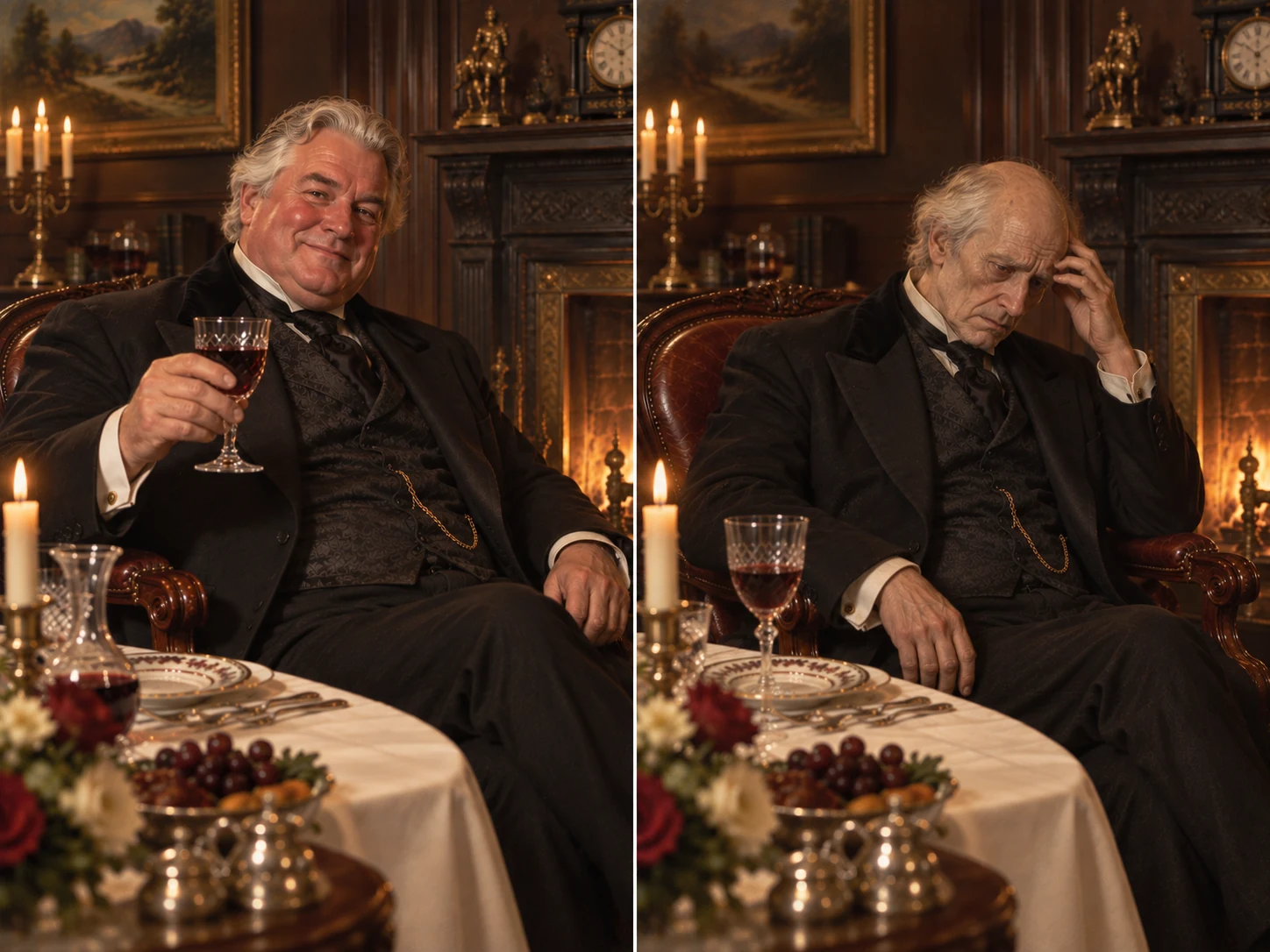
| Dr. Lanyon | Before: "a hearty, healthy, dapper, red-faced gentleman, with a shock of hair prematurely white" (ch. 2). After watching the transformation: "The rosy man had grown pale; his flesh had fallen away; he was visibly balder and older... He had his death-warrant written legibly upon his face" (ch. 6) | No eye color, no height — but the only character the text tracks in documented physical decline |
| Poole | "A well-dressed, elderly servant" (ch. 2), twenty years' service (ch. 8) | Essentially nothing further — he is voice and loyalty, not face |
| Sir Danvers Carew | "an aged beautiful gentleman with white hair"; "innocent and old-world kindness of disposition" (ch. 4) | Killed almost immediately — the fullest physical praise in the book goes to a man who dies within a page of being introduced |
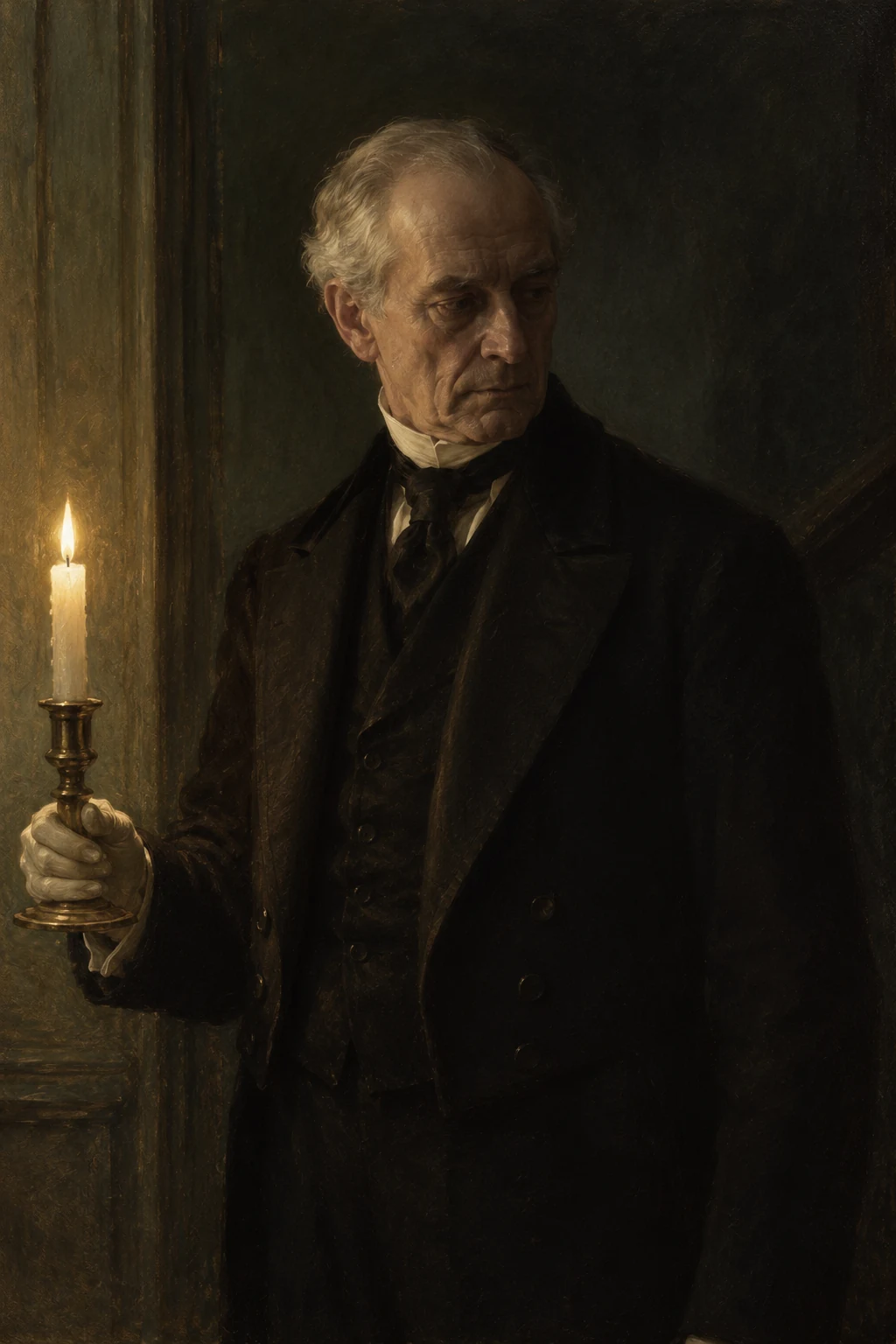
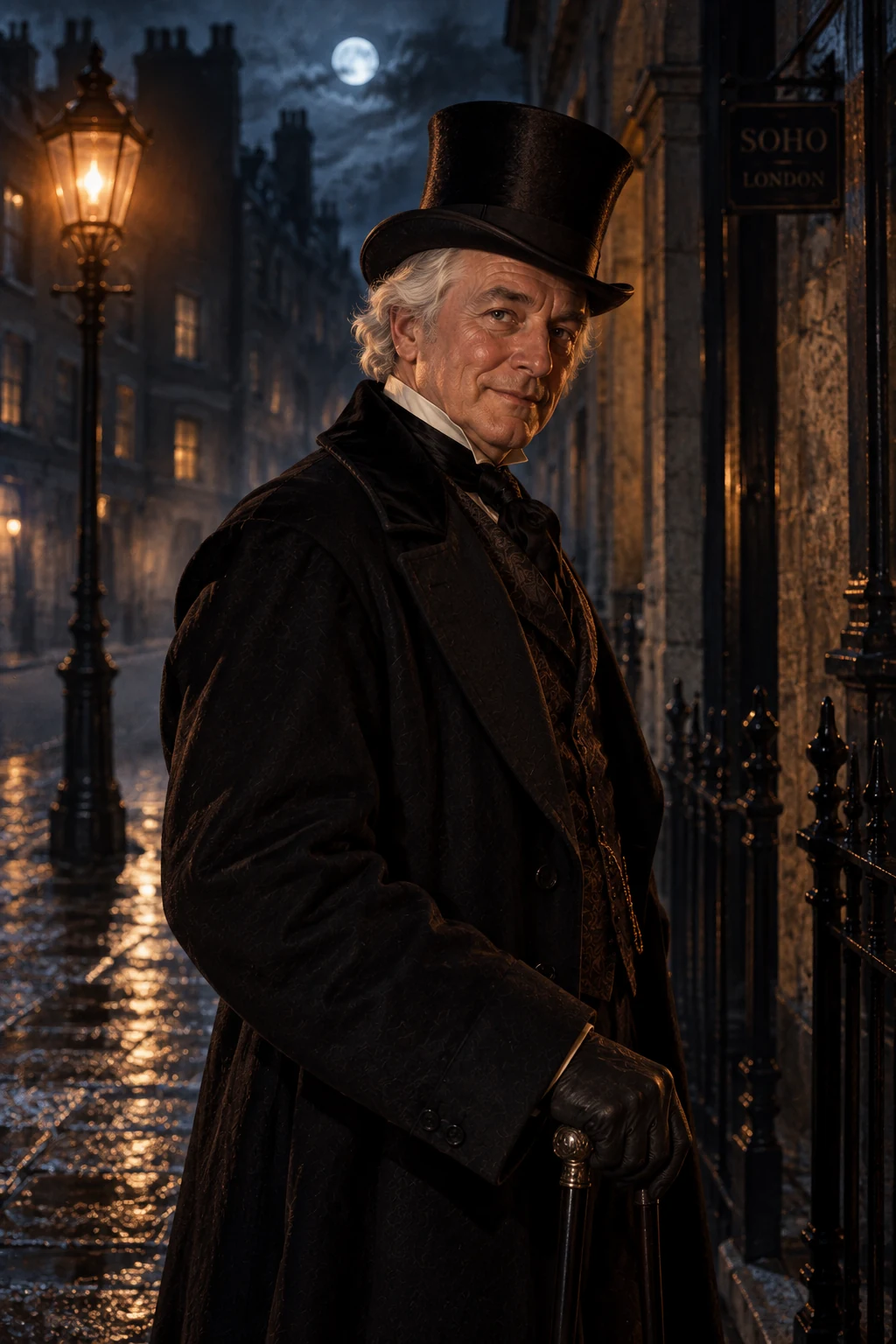
How Hollywood turned a small, quiet man into a giant monster
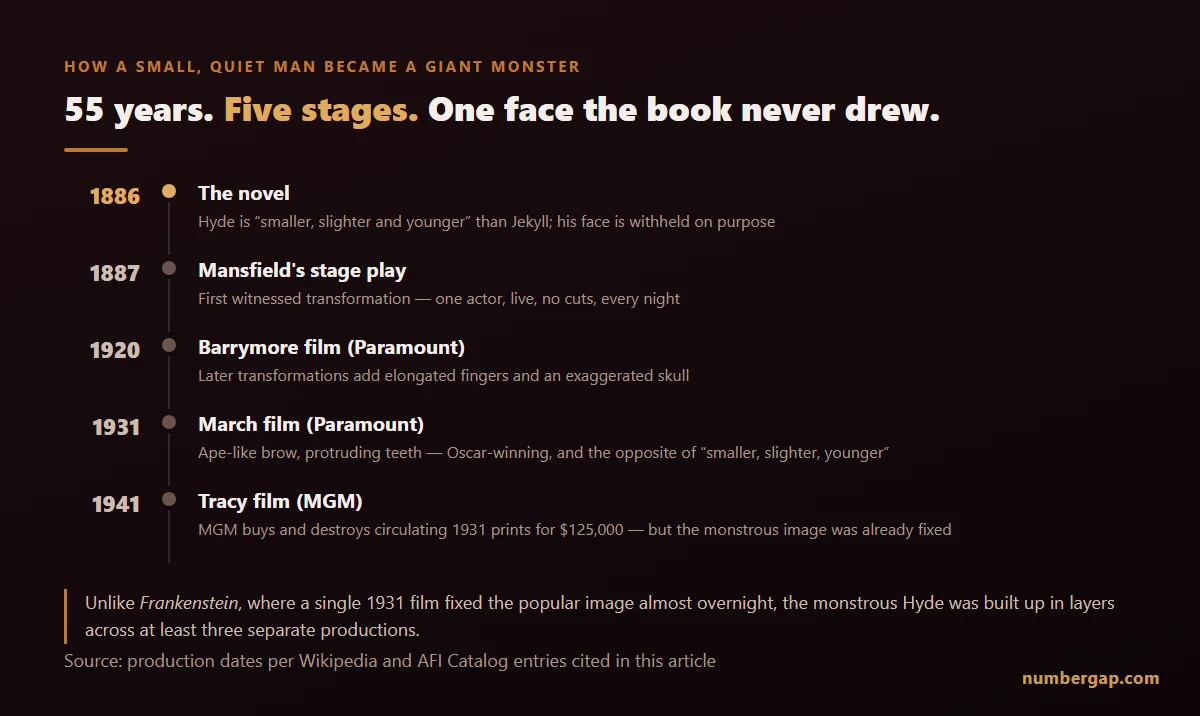
The novella's blank, withheld face didn't stay blank. Over 54 years, stage and screen built up an increasingly large, increasingly bestial one.
| When | What happened | What it added |
|---|---|---|
| 1886-01 | First publication (Scribner's in the US, Longmans, Green in the UK); the withheld-description device and Hyde's smaller/younger stature are already in the text | — |
| 1886, six months | Reportedly sold around 40,000 copies in Britain, widely read across class lines | Not independently re-verified against a primary sales ledger — treat as widely reported, not audited |
| 1887-05-09 | Richard Mansfield's stage adaptation opens (Boston, then Broadway and London), script by Thomas Russell Sullivan | First major dramatization — turns the transformation into a witnessed stage spectacle, something the novel itself never shows to any other character |
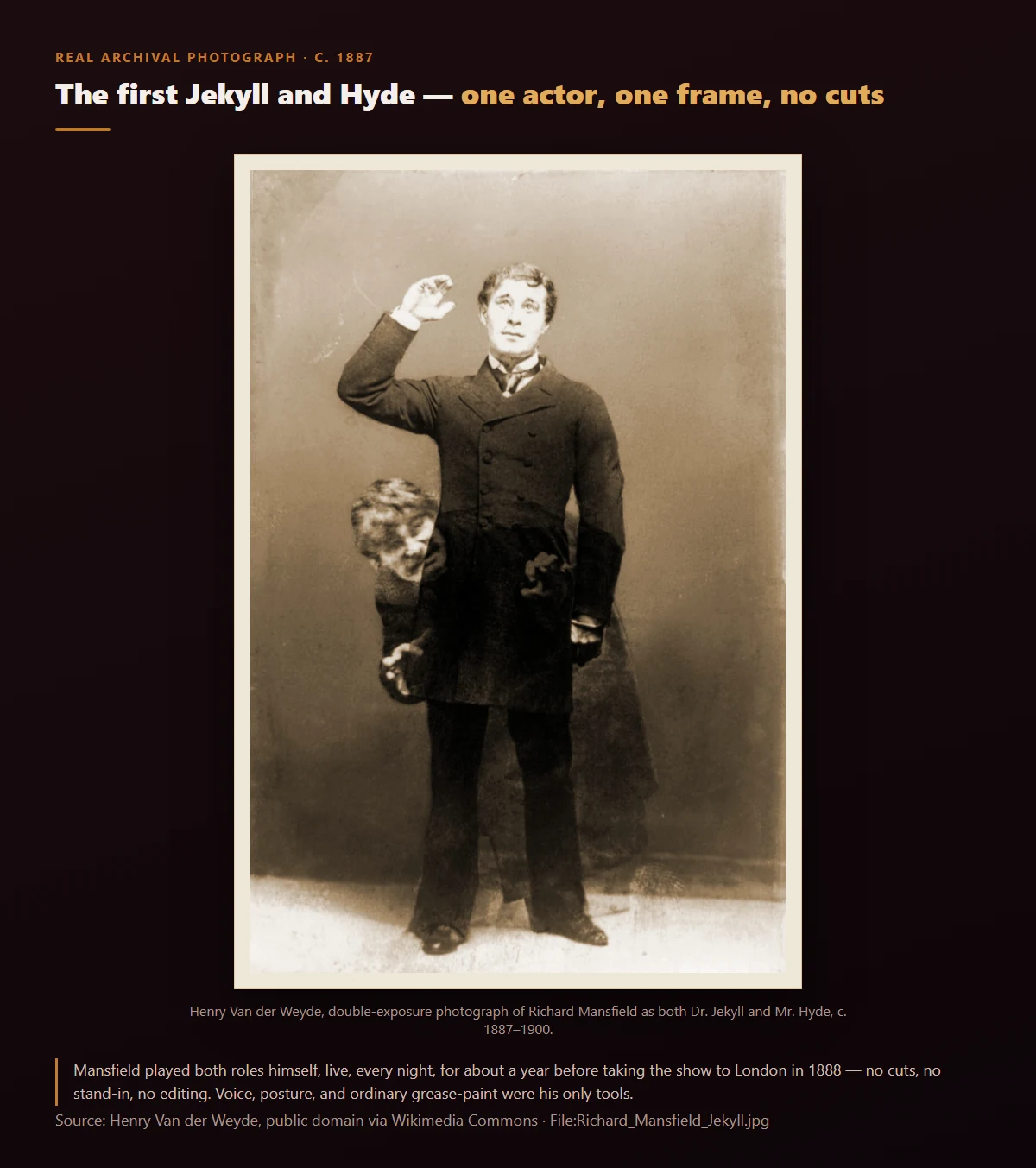
| 1887 | Henry Van der Weyde's double-exposure photograph of Mansfield as both roles becomes the era's iconic image | A single photograph — not a costume design — becomes the visual shorthand for "the actor who plays both" |
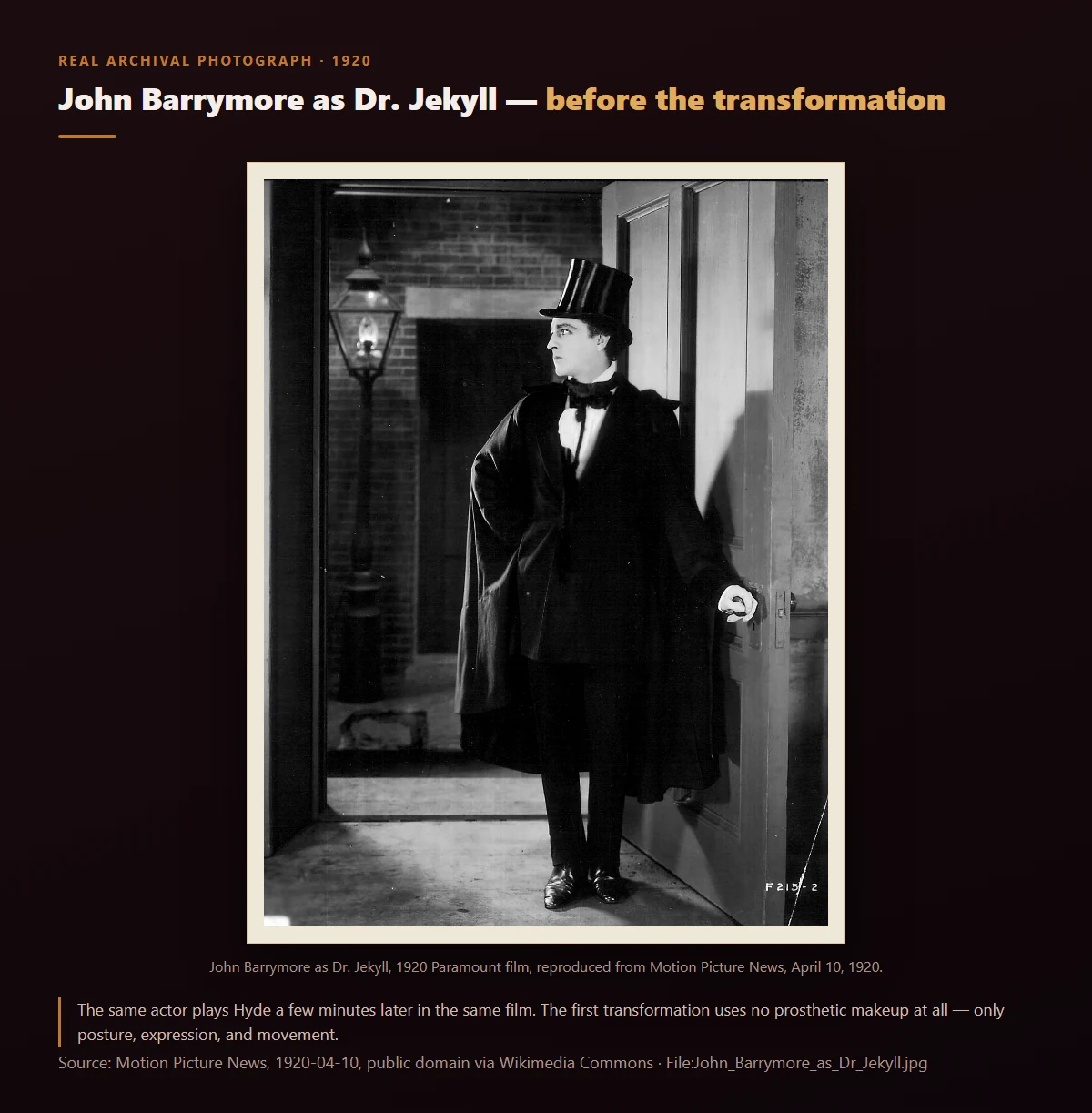
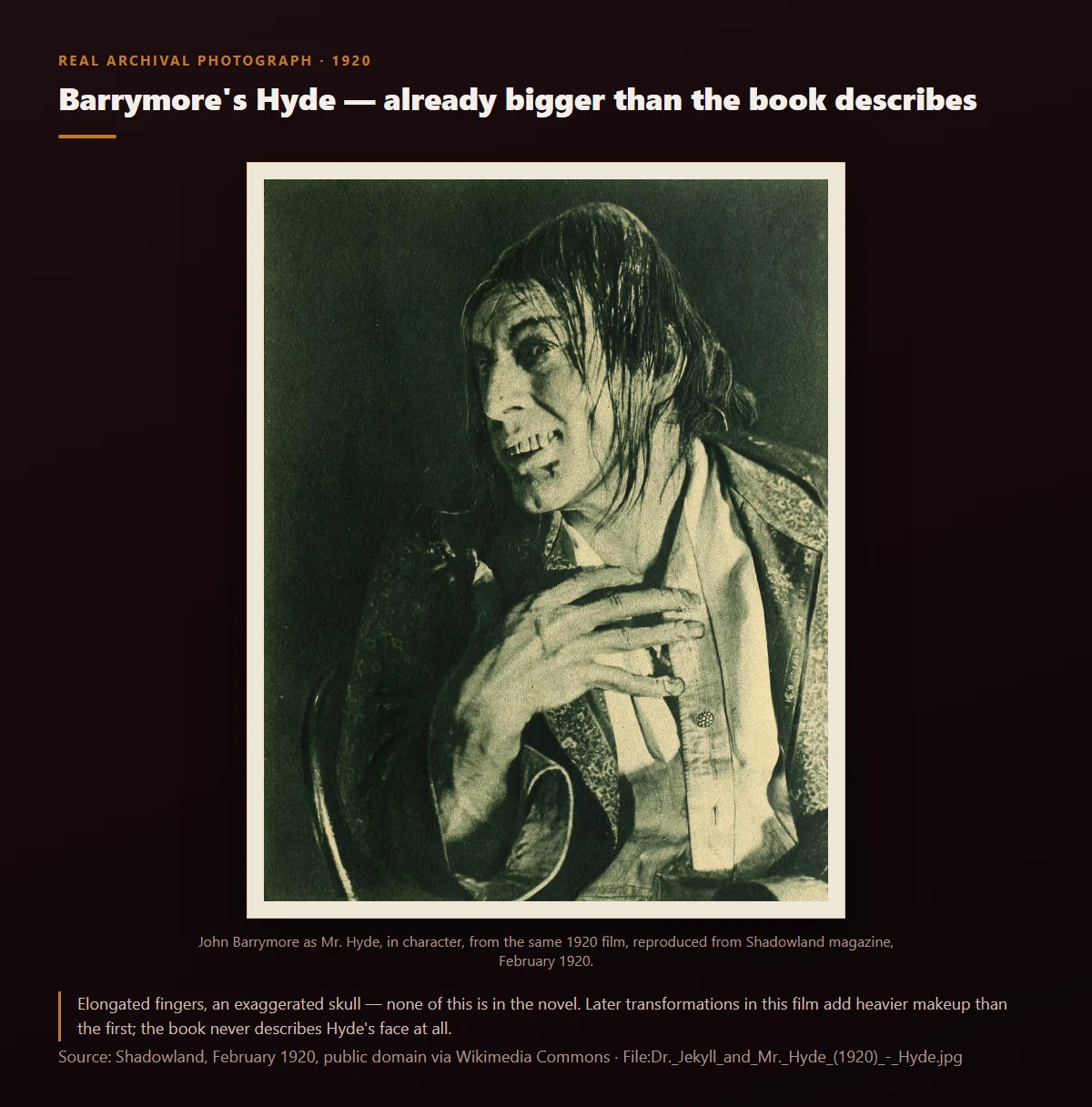
| 1920-03 | Dr. Jekyll and Mr. Hyde (Paramount), dir. John S. Robertson, starring John Barrymore as both roles | First influential screen Hyde. The first transformation uses minimal makeup; later ones add elongated fingers and a more pronounced skull shape — already past "smaller, slighter" |
| 1931-12-24 | Dr. Jekyll and Mr. Hyde (Paramount), dir. Rouben Mamoulian, starring Fredric March | March won the Academy Award for Best Actor — the only Oscar-winning performance in this lineage. Ape-like brow, protruding teeth, matted hair: the high-water mark of "monstrous Hyde," and the exact opposite of "smaller, slighter, younger" |
| 1941-08-12 | Dr. Jekyll and Mr. Hyde (MGM), dir. Victor Fleming, starring Spencer Tracy | MGM bought the negative and rights to both the 1931 and 1920 films for $125,000 and recalled and destroyed prints of the 1931 version, keeping it out of circulation for decades. Tracy's Hyde makeup was comparatively restrained by comparison to March's |
Unlike Frankenstein, where a single 1931 film fixed the popular image almost overnight, the monstrous Hyde was built up in layers across at least three major dramatizations over 54 years. The next section gets into why — and it turns out each medium had a real, practical reason it couldn't just leave Hyde small.
Why did they make him bigger? Three forces the novel never had to deal with
A book only has to convince one reader at a time, silently, at whatever pace they read. A stage or a movie has to convince an entire room, instantly, in real time. That gap — not artistic failure — explains most of what follows.
The stage had one actor, no cuts — and a 138-year-old rumor about rubber masks
Richard Mansfield played both Jekyll and Hyde himself, live, every night, for about a year in the US before taking the show to London in 1888. He kept his method secret, and the secrecy became its own marketing — audiences and reporters spent months guessing how he did it. One theory, floated by a reporter in St. Louis, was that he used a rubber mask, spring mechanisms, and a special wig.
On September 1, 1888, London's Pall Mall Gazette ran a piece headlined "How Mr. Mansfield Does It," calling the rubber-mask story "entirely untrue" and laying out what its reporting found instead — six ordinary techniques, not a single mechanical trick: he straightened his stooped Hyde posture back into Jekyll's; he relaxed his contorted facial expression; he switched his voice from "gurgling and raucous" to "plaintive and deeply-musical"; he wiped away an outer layer of pre-applied makeup with a handkerchief to reveal a different layer underneath; he opened and closed his coat and collar to change his silhouette; and he brought up a gas lamp that had been rising slowly through the scene. The materials, the paper specified, were "grease-paint, rouge, lining-pencil, and powder" — nothing more exotic than a standard Victorian actor's kit.
In other words: 138 years before this article, a newspaper was already fact-checking a viral rumor about how Mr. Hyde's face actually works. The tools were ordinary. What wasn't ordinary was the constraint — one performer, no editing, no stand-in, an audience that had to register the switch in seconds. That constraint, not artistic choice, is the root of everything that follows it in this section.
Correcting the record: Jack the Ripper did not shut the play down
This one gets repeated constantly. It's worth actually checking, one date at a time.
Mansfield's London run, at the Lyceum Theatre, opened August 4, 1888. The Whitechapel murders attributed to "Jack the Ripper" happened between August and November 1888 — so yes, the two did overlap in London, at the same time, in the same city.
On October 5, 1888, an anonymous letter to the City of London Police named Mansfield as a suspect, reasoning (per the letter as later reported) that the play had started before the murders, that a murder happened on a night Mansfield had no performance, and that Mansfield was American. Mansfield offered a benefit performance to quiet the rumors — of a comedy, not Jekyll and Hyde — but it lost money and was cancelled.
Then check the closing date.
Mansfield's Lyceum tenancy ended December 1, 1888. That was the originally contracted end date — not a panic shutdown. The run was, by multiple accounts, "financially unsuccessful," but for ordinary box-office reasons, not because of the murders. (One small, unrelated find from the same week: a September 17, 1888 issue of the London evening paper The Star reported that "Both Dr. Jekyll and Mr. Hyde were seized with a sharp attack of rheumatism on Saturday morning, and in consequence there was no performance at the Lyceum" — a joke about the character's name, and ordinary illness, nothing more.)
No emergency closure. No early exit forced by the murders.
What is fair to say: a 2026 academic piece on the play's afterlife argues that the Ripper murders "heightened emphasis on violence" around the production in the public imagination, with contemporary papers describing Mansfield's transformation in increasingly monstrous terms. That's a claim about public perception, not about the play's schedule — and it's worth keeping those two things separate.
Silent film had no dialogue at all
By 1920, John Barrymore had lost the one tool Mansfield still had: sound. For the first transformation, he used no prosthetic makeup at all — just posture, contorted facial muscles, clawed hands, and mussed hair. Later in the same film, he added heavier makeup: elongated fingers, a more pronounced skull. Film historians reviewing the picture say that, with no line of dialogue available to signal Hyde's corruption, Barrymore leaned harder on exaggerated physical performance — grimacing, crawling, screaming, leaping — to do a job the book had handed to four different witnesses' words.
Horror was suddenly profitable, and Paramount already owned the rights
This part has nothing to do with storytelling and everything to do with what was making money in 1931. On February 12, 1931, Universal's Dracula opened at New York's Roxy Theatre and sold roughly 50,000 tickets in 48 hours; it went on to earn about a $700,000 profit on a $341,191 budget — Universal's biggest hit of the year. Frankenstein followed that November and reportedly outgrossed even Charlie Chaplin's City Lights to become the year's top earner.
Paramount already held the Jekyll and Hyde rights. According to a film-history summary of the production, once director Rouben Mamoulian pitched a new version, the studio "positively jumped at the chance" to greenlight it — a direct response to Universal's horror windfall, not a renewed interest in Stevenson specifically. Mamoulian's finished film, released at Christmas 1931, used 216 scenes, 35 built sets, and a cast of 81 plus 500 extras, according to the studio's own pressbook. March won his Best Actor Oscar for the role — still the only time an outright horror-makeup performance has won that award — out of a production built explicitly to be a horror spectacle, riding the wave of money Dracula had just made for Universal.
MGM paid $125,000 to make the 1931 version disappear
When MGM prepared its own 1941 remake with Spencer Tracy, it did something that has nothing to do with acting choices: it bought the negatives and rights to both the 1931 Paramount film and the 1920 Barrymore film for $125,000 — roughly $2.8 million in today's dollars — and then recalled and destroyed circulating prints of the 1931 version. That film was effectively unavailable for research or re-release for over 25 years, until 1967. Multiple film-history sources describe the studio's motive as protecting the new Tracy version from being unfavorably compared to March's Oscar-winning original. It didn't entirely work: reviews of the Tracy version were still mixed against memories of March's, and — in a detail repeated by several sources — March is said to have joked to Tracy in a telegram, thanking him for doing "the greatest favor" of March's career.
That's not an artistic decision about how big or small Hyde should look. It's a studio protecting a $1.1 million asset by physically removing its own earlier, better-reviewed competitor from the market.
Did 1930s "criminal face" science shape the ape look? Probably resonance, not proof
Several literary analyses argue that Stevenson's era — and definitely the era of the 1920 and 1931 films — was steeped in Cesare Lombroso's "born criminal" theory: the idea that criminality was hereditary and visible in the face, through supposedly primitive ("atavistic") features like a jutting jaw or sloped forehead. Some scholars point to the novel's own language — Hyde called "ape-like," evil "written broadly and plainly on the face" — as evidence the book is in dialogue with this idea.
Here's the honest caveat: Lombroso's landmark work was first published in Italian in 1876 and translated into English mainly in the 1880s–90s, right around when Stevenson was writing. No letter, diary entry, or other primary document confirming Stevenson had actually read Lombroso turned up in this research. What scholars can support is that the novel's language echoes a discourse that was genuinely in the air — not that Stevenson cited it, and not that Wally Westmore or the 1931 makeup team said "we're doing Lombroso" out loud. Treat the connection as a real resonance worth noting, not a documented cause.
The two times adaptors stayed small — it didn't obviously pay off either
If going bigger was mostly commercial pressure, you'd expect the rare "stay faithful" attempts to have done noticeably better with critics or audiences. They didn't, clearly.
Spencer Tracy's 1941 Hyde stays closest to the book's own restraint — slightly longer hair, darker brows, crooked teeth, and that's essentially it, no prosthetic transformation into something inhuman. Contemporary reception was rough anyway: The New York Times reportedly called it "a hodgepodge of nonsense," and Tracy is said to have told friends his acting career was finished. MGM's own internal accounting shows a modest profit — about $350,000 on a $1.1 million budget and roughly $2.35 million in box-office earnings — so it wasn't a flop by the books, but "closer to Stevenson's Hyde" clearly didn't translate into being remembered as the better film. (Correlation, not proof of causation — but it's the one clean natural experiment this history offers, and it points the same direction every time: audiences, given the choice, preferred the monster.)
Broadway offers a second version of the same lesson, in a completely different medium. Frank Wildhorn's Jekyll & Hyde musical ran on Broadway from April 1997 to January 2001 — nearly four years, 1,543 performances, with sold-out summers and repeated extensions in its first season. It still lost money; combined with two other Wildhorn shows running on Broadway around the same time, reported losses across all three totaled roughly $20 million. Popularity and profitability, even for a genuinely well-loved production, turned out to be two different things. (The same musical, notably, became one of the most-performed licensed productions in South Korea, where it had drawn more than 2 million cumulative admissions by 2025 across two decades of nearly continuous revivals — a reminder that one production's commercial fate doesn't travel with it to every market.)
Why there's no picture of the 1931 or 1941 Hyde in this article
The face most American readers actually picture — Fredric March's ape-like brow and teeth, or Spencer Tracy's more restrained version — isn't shown here, and it can't be.
Dr. Jekyll and Mr. Hyde (1931) is a 1931 published work. Under the U.S. 95-year term, it enters the American public domain on January 1, 2027. As of this writing (2026-09-07), it's still under copyright. A single publicity still of March in character is hosted on Wikimedia Commons under a "no copyright notice" rationale — but that's a different legal theory than the one covering the film itself, and this piece treats a usable still and a usable film as two separate questions, not one.
The 1941 film is under copyright until 2037 by the same rule, unless a single, low-resolution (488×379px) Commons file's claim that its copyright "was not renewed" turns out to be both true and applicable to the whole film — a claim this research could not independently confirm against a copyright-renewal registry or Library of Congress record.
The pun Stevenson planted in his own book — and how to say "Jekyll"
Buried in Utterson's private thoughts is Stevenson's own wordplay on the character's name:
"'If he be Mr. Hyde,' he had thought, 'I shall be Mr. Seek.'"
— ch. 2, Search for Mr. Hyde
Searched directly: capital-S "Seek" appears exactly once in the whole book, in this line. That's Stevenson himself, not a later critic, building the Hyde/hide pun into the text.
There's a second, quieter argument about the name that isn't settled at all: how "Jekyll" is supposed to sound. The traditional British pronunciation — "JEE-kul," rhyming with "treacle" — is what an official Robert Louis Stevenson research site (run by Edinburgh Napier University) says the author himself specified. Interesting Literature's own coverage of the same claim pushes back, noting that "there's no good evidence that this is what Stevenson himself said," and the BBC's pronunciation guide reportedly hedges the same way. What's traceable is the split in film history: the 1931 March version says "JEE-kul," while the 1941 Tracy version says "JEK-ul" — the pronunciation most people use today — which suggests the more familiar sound may owe more to Spencer Tracy's diction than to the author's intent.
Separately, Stevenson borrowed the surname "Jekyll" itself from a real acquaintance, Walter Jekyll, brother of the garden designer Gertrude Jekyll — this borrowing of the name is well documented by Wikipedia's own entry on Walter Jekyll, though nothing beyond the name itself (no personality trait or biographical detail) is claimed to have carried over into the character.
The strange, disputed story of how this book got written
The face isn't the only thing about this book that people disagree on. How it got written is contested territory too — which, for a series about unverified claims, is a fitting place to end up.
Stevenson said it came from a dream. In an essay called "A Chapter on Dreams," written about a year after the novella's publication and printed in Scribner's Magazine in January 1888, Stevenson described searching for years for a story that could give shape to "the strong sense of man's double being." He credited the plot's central beat — a hunted man taking a powder in front of his pursuers and transforming — to a dream. His wife Fanny left her own account of that same night, recorded in Graham Balfour's 1901 authorized biography: she woke Stevenson, thinking he was having a nightmare, and he was furious with her for interrupting what he called a "fine bogey tale."
How long it took him to write is disputed. Several sources describe a three-day first draft, followed by Stevenson discarding it and writing a second draft in another three days — a six-day total. The British Library's own account instead says the whole process, start to finish, took six weeks in the autumn of 1885. The likeliest explanation is that these are measuring different things — a fast first draft versus the full process including a rewrite and editing — but no single source spells out that distinction directly, so treat both figures as reported, not reconciled.
Who burned the first draft is a genuine, unresolved mystery. The long-standing story is that Fanny read Stevenson's first draft, criticized it as a shallow thriller that missed the allegory he was going for, and Stevenson — furious — threw it in the fire himself. In 2018, a letter Fanny had written to the critic W.E. Henley surfaced, in which she calls that first draft "utter nonsense" and writes, "I shall burn it after I show it to you" — her own words, about her own hands doing the burning. One auction specialist who reviewed the letter concluded Fanny herself likely burned it. But other surviving letters are said to back up Stevenson's stepson Lloyd's account, in which Stevenson burned it himself in anger — and reporting on the discovery in 2018 concluded the question is still unresolved. This book is about who can't be identified with certainty. The identity of the person who destroyed its own first draft turns out to be exactly that kind of case.
He was seriously ill while he wrote it. Stevenson was in Bournemouth at the time, suffering ongoing lung hemorrhages (widely attributed to tuberculosis) severe enough that he sometimes communicated by writing on a slate rather than speaking. This same period, 1884–1887, also produced Treasure Island and Kidnapped — commonly described as the years that made his fortune, written while he was, by several accounts, coughing blood.
The cocaine-and-ergot story is a near-perfect example of a claim that doesn't hold up. It's widely repeated that Stevenson wrote the book under the influence of cocaine, prescribed to manage his hemorrhaging. One investigation into the claim found that neither Stevenson himself nor his treating physician, Dr. Thomas Scott Bradley, ever mentioned cocaine in their own writing about the illness — Bradley wrote about trying morphine, not cocaine. A competing version of the same rumor claims ergot (a fungal compound and a precursor to LSD) instead. Multiple sources describing this dispute explicitly call the whole theory "speculative" rather than established. It's a genuinely interesting case for this series: the "he wrote it high" story is far more vivid and shareable than "his doctor's own notes don't mention it," and that's exactly why the vivid version survived.
The real burglar behind Mr. Hyde
Stevenson's split-personality idea had a real, historical dry run a decade before Jekyll and Hyde — and it's a genuinely strange one.
William Brodie (1741–1788) was a respected Edinburgh cabinetmaker, a city councilman, and the elected "deacon" (guild leader) of the city's wrights and masons. By night, he ran a gang of burglars. Both halves of that double life are historical fact, not legend — he was convicted and hanged, alongside an accomplice, at Edinburgh's Tolbooth on October 1, 1788.
The most dramatic version of his story — that Brodie, in his council role, had helped design an improved gallows, and was then hanged on it himself — is widely repeated by tourist and history sites, but historians have specifically questioned it; Brodie's council-era work on that gallows appears to be real, but the "hanged on his own invention" detail looks like an embellishment added later. A second popular claim, that Brodie bribed a hangman with a steel neck collar to survive the hanging, wasn't traceable to any court or execution record in this research. A third detail — that Stevenson's own father owned furniture built by Brodie, including a cabinet that sat in young Robert's childhood bedroom — is described by at least one source explicitly as "family lore," not documented fact.
What is documented: Stevenson had already written about Brodie once before, a full six years before Jekyll and Hyde. Co-written with critic W.E. Henley, the play Deacon Brodie; or The Double Life was privately printed in 1880 and staged in 1882 — its subtitle alone previews the exact theme Stevenson would return to in 1886.
How a "shilling shocker" got banned from train stations
Strange Case of Dr Jekyll and Mr Hyde was published in January 1886 by Longmans, Green & Co. as a cheap paperback — a "shilling shocker," priced for mass sale rather than prestige. It was originally meant to come out in December 1885, but by the time it was finished, booksellers' shelves were already full of Christmas stock, so the release slipped into the new year.
Then it nearly didn't get sold at all. W.H. Smith effectively controlled Britain's railway station bookstalls at the time and personally screened titles for "quality" — and, according to accounts from the National Railway Museum and History Today, balked at putting something this sensational on the shelves. The company's censorious reputation was well-enough known that the satirical magazine Punch had already nicknamed it "Old Morality."
The book found its audience anyway. A retrospective 1897 newspaper account (in the Dundee Evening Telegraph, looking back eleven years later) credits a Times review with sparking public interest after the railway-stall rejection, which in turn is said to have led clergy to cite the book from the pulpit as a parable about moral restraint — boosting sales further. The British Library's own summary confirms the general shape of that story (clergy reading it as a moral allegory) without naming a specific church or preacher, and this research couldn't independently confirm those specifics either — treat the phenomenon as reported, not the details.
In its first six months, the book reportedly sold around 40,000 copies in Britain. In the United States, where no international copyright treaty then protected British authors, unauthorized pirated editions flooded the market — reportedly more than 250,000 copies by 1901, over six times the UK's authorized first-half-year figure.
Frequently asked questions
Q. What does Mr. Hyde look like in the book?
A. The novel never gives a full description. Witnesses across five chapters call him pale, small, and deformed "without any nameable malformation" — but no one can say which feature is wrong. His clothes are always too large for him, and his hand is lean, corded, and hair-shaded.
Q. Is Mr. Hyde bigger or smaller than Dr. Jekyll in the book?
A. Smaller. Jekyll's own confession states directly that "Edward Hyde was so much smaller, slighter and younger than Henry Jekyll" (ch. 10). Multiple independent witnesses — the maid, Dr. Lanyon, and Poole — separately describe him as small.
Q. Why does "ape-like" never describe Hyde's face in the original book?
A. Because Stevenson only ever used the phrase to describe behavior. It appears exactly three times — "ape-like fury" (ch. 4, during the Carew murder), "ape-like tricks" (ch. 10), and "ape-like spite" (ch. 10) — describing rage, mischief, and malice, never a jaw, brow, or skull. The simian face is a film-era addition.
Q. Why can't anyone in the novel describe Hyde's face?
A. Stevenson built it that way on purpose. Four separate witnesses, across four separate chapters, use nearly identical language: a strong feeling of deformity with no feature they can name. The word deform* appears 7 times in that context.
Q. What does Dr. Jekyll look like in the original book?
A. "A large, well-made, smooth-faced man of fifty" with "every mark of capacity and kindness" (ch. 3). That single passage is the entirety of his physical description — no hair or eye color is given.
Q. Is there a lab scene with green liquid in Jekyll and Hyde?
A. No. The transformation happens off-page, alone, described only afterward in Jekyll's confession. The only apparatus named is "the salt," "the powders," and "the drug" — no bubbling liquid, no electrical equipment, no witnessed spectacle.
Q. Are Jekyll and Hyde the same person in the book?
A. Yes, explicitly. This isn't left ambiguous — Jekyll's own first-person confession in the final chapter states plainly that he and Hyde share one body, separated by a drug of his own invention.
Q. Did the Jack the Ripper murders shut down the 1888 Jekyll and Hyde stage play in London?
A. No. Richard Mansfield's London run at the Lyceum Theatre overlapped with the Whitechapel murders and an anonymous letter did name him a suspect in October 1888, but the run ended on its originally contracted date, December 1, 1888 — not an emergency early closure.
Q. Who burned the first draft of Dr. Jekyll and Mr. Hyde?
A. It's genuinely unresolved. The long-standing story is that Stevenson burned it himself in anger after his wife Fanny's criticism. A 2018-discovered letter, in which Fanny writes "I shall burn it after I show it to you," suggests she may have done it herself. Reporting on the letter's discovery concluded the question remains unsettled.
Q. Did the 1931 Jekyll and Hyde film win an Oscar?
A. Yes. Fredric March won the Academy Award for Best Actor for the role (shared with Wallace Beery for The Champ) — the only Oscar-winning performance across the adaptations discussed here.
Q. When does the 1931 Jekyll and Hyde movie enter the public domain?
A. January 1, 2027, under the U.S. 95-year copyright term. As of this writing it is still under copyright, which is why no frame or still from that film appears in this article.
What this piece could not verify
1. The "40,000 copies in six months" sales figure, the Queen Victoria reading anecdote, and the "250,000 pirated US copies by 1901" figure are widely repeated in secondary publication-history write-ups, but weren't traced to a primary bibliographic source (a Longmans, Green sales ledger, a contemporary 1886 press report, or a period publishing-industry tally) in this research. Treat as "widely reported," not audited.
2. Whether Robert Louis Stevenson had actually read Cesare Lombroso's criminal-anthropology theory before writing the novel could not be confirmed against a letter, diary, or reading list. What's supportable is that the novel's language resonates with that era's discourse — not that Stevenson cited it directly.
3. Who burned the first draft of the manuscript — Stevenson or his wife Fanny — remains a genuinely open question even in the sources that discovered the relevant 2018 letter. Both accounts are reported here; neither is presented as settled.
4. Whether Stevenson's own family owned furniture built by Deacon William Brodie, including the claim that a Brodie-made cabinet sat in Stevenson's childhood bedroom, is described by at least one source as "family lore" rather than documented fact, and wasn't independently confirmed here.
5. The specific church, preacher, or date behind the "sermons boosted sales" anecdote could not be identified. The general phenomenon (clergy discussing the book from the pulpit) is corroborated by the British Library's own account, but no primary source naming a specific sermon was located.
6. Whether the 1941 film's copyright lapsed rests on one low-resolution Commons file's unverified claim. Default to treating the film as still under copyright until 2037.
One thing to check the next time you picture Hyde
Pull up the text — it's public domain, free to read in five minutes — and find chapter 10, the paragraph that starts "And hence, as I think, it came about..."
If the Hyde in your head is bigger than Jekyll, has an ape's face, and looks obviously dangerous on sight — that's not a mistake anyone made. It's Richard Mansfield solving a one-actor, no-cuts staging problem in 1887; a silent film solving a no-dialogue problem in 1920; a studio riding Dracula's box office in 1931; and another studio spending $125,000 to bury its own competitor in 1941 — each one needing a monster the quiet, ambiguous novel never had to produce, because a book only has to convince a reader who's already alone with it, at whatever pace they choose.
The witnesses in the book never got to see what you're picturing either. That was the point — the text withheld it on purpose. What got added afterward wasn't a correction. It was 55 years of people in a very different business than Stevenson's, solving a very different problem than his.
This series keeps counting who filled in what the original text left blank, and — increasingly — why they had no choice.
Sources
Primary text
- Project Gutenberg eBook #43 — The Strange Case of Dr. Jekyll and Mr. Hyde, Robert Louis Stevenson. Released 2008-06-27, most recently updated 2026-05-12 · https://www.gutenberg.org/ebooks/43
- Counts run with Python regex over the chapter-split body text (25,631 words), with every hit's context checked by hand to confirm speaker and referent.
- "A Chapter on Dreams," Robert Louis Stevenson, Scribner's Magazine, January 1888 (written October 1887) · via Lit2Go
Public-domain images
- Henry Van der Weyde, double-exposure photograph of Richard Mansfield as Jekyll and Hyde, c. 1887–1900 · https://commons.wikimedia.org/wiki/File:Richard_Mansfield_Jekyll.jpg
- John Barrymore as Dr. Jekyll, Motion Picture News, 1920-04-10 · https://commons.wikimedia.org/wiki/File:John_Barrymore_as_Dr_Jekyll.jpg
- John Barrymore as Mr. Hyde, Shadowland, February 1920 · https://commons.wikimedia.org/wiki/File:Dr._Jekyll_and_Mr._Hyde_(1920)_-_Hyde.jpg
Reference and reporting
- Wikipedia: Dr. Jekyll and Mr. Hyde (1920 Paramount film), (1931 film), (1941 film), (1887 play), (character); Dracula (1931 English-language film); Jekyll & Hyde (musical); Walter Jekyll; William Brodie
- The Pall Mall Gazette, "How Mr. Mansfield Does It," 1888-09-01, reprinted via jack-the-ripper-tour.com
- The Star, London, 1888-09-17, reprinted via casebook.org
- jack-the-ripper-tour.com, "Richard Mansfield - Jack the Ripper Suspect"
- Journal of Victorian Culture Online, Monica F. Cohen, "From Savage to Superhero: Strange Afterlives of Robert Louis Stevenson's 'Dr. Jekyll and Mr. Hyde'," 2026-09-01
- Turner Classic Movies, "Dr. Jekyll and Mr. Hyde (1941)"
- Inverse, "85 Years Later, A Polarizing Sci-Fi Horror Remake Never Topped Its Beloved Predecessor"
- Big Shiny Robot, "1931: The Year That Changed Horror Forever"
- AFI Catalog, Dr. Jekyll and Mr. Hyde (1931) production notes
- Movies Silently, Fritzi Kramer, "Dr. Jekyll and Mr. Hyde (1920) A Silent Film Review," 2013-05-18
- Book Riot, Danika Ellis, "What Adaptations Get Wrong About Dr Jekyll and Mr Hyde," 2023-01-30
- in2013dollars.com, historical CPI inflation-adjustment figures
- The Daily Beast, Allison McNearney, "The Mysterious Burning of 'Dr. Jekyll and Mr. Hyde'," 2018-03-10
- Mental Floss, "11 Strange Facts About 'Dr. Jekyll and Mr Hyde'"
- Today I Found Out, "The Story Behind the Strange Case of Dr. Jekyll and Mr. Hyde," 2015-08-31
- British Library, official work page for Strange Case of Dr Jekyll and Mr Hyde
- National Railway Museum blog, "'Old Morality' and the rise of recreational reading"
- Renata Kobetts Miller, "Victorian Reviews of Jekyll and Hyde: Observations and Reflections," 2018-04-24 (citing Birmingham Daily Post 1886-01-19, Dundee Evening Telegraph 1897-06-26, Leamington Spa Courier 1888-11-24)
- Historic UK, "Deacon William Brodie"
- The little white attic, Vladimir Nabokov's lecture on Strange Case of Dr Jekyll and Mr Hyde
- Etymonline, "Jekyll and Hyde"; Interesting Literature, "The Surprising Truth behind Jekyll and Hyde" (Mr. Seek pun, Jekyll pronunciation dispute, Walter Jekyll namesake claim)
- Merriam-Webster, "Jekyll and Hyde"


_-_Hyde.jpg)
Comments
Post a Comment