How Many Shots Are in a Fifth? (It's Not a Fifth Anymore)
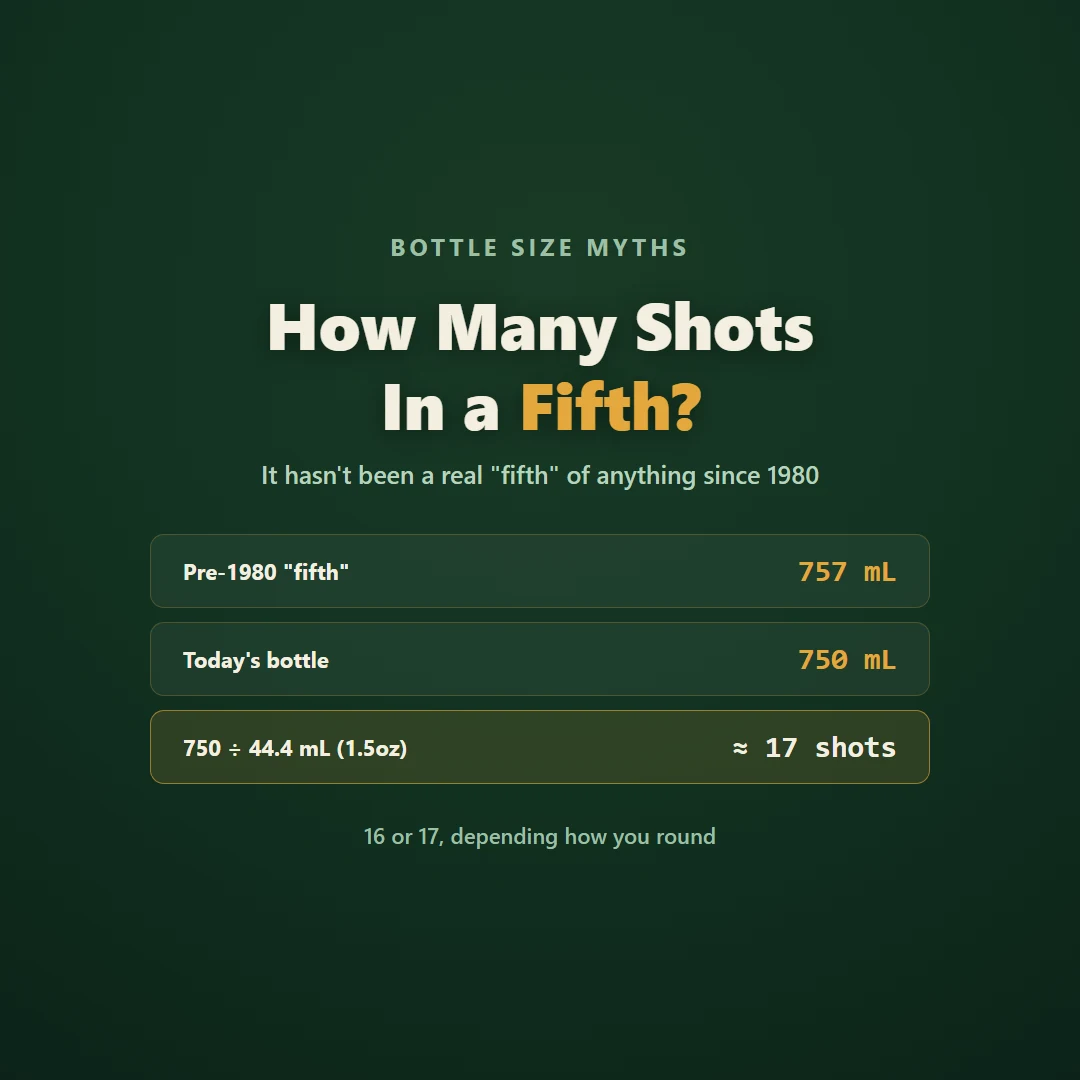
A fifth is 750 mL.
At the standard bar pour of 1.5 fl oz (44.4 mL), that works out to about 17 shots. Sixteen, if you round down instead of up — 750 divided by 44.4 doesn't land on a clean number, and neither does the law behind it.
Last updated: 17 September 2026 · Figures and rules in this post are current as of this date.
Here's the part that doesn't show up in the quick answer: there is no federal law defining how big a shot actually is. And the bottle itself hasn't been a real "fifth" of anything since January 1, 1980. The name is a fossil. What's underneath it is a string of regulatory fights, one of which the government tried to lose on purpose and couldn't.
How Many Shots Are in a Fifth of Liquor?
The direct math: 750 mL ÷ 44.4 mL (a 1.5 oz shot) ≈ 17 shots.
That 1.5 oz figure is the most common bar standard in the US today, not a legal requirement. Depending on the bar, the glass, and the bartender's hand, real-world pours run anywhere from about 1 to 2 fl oz.
Source: Wikipedia, "Shot glass"; promotionalproductinc.com, shot-size industry chart
So the honest answer to "how many shots in a fifth" is closer to "somewhere between 12 and 20" than to a fixed number — and the reason for that isn't sloppiness. It's that the US government spent most of a century regulating the bottle and never once regulated the glass.
So Why Is a 750 mL Bottle Called a "Fifth"?
Because it used to actually be one.
In the late 1800s, American liquor bottles that looked roughly quart-sized were often sold holding one-fifth of a US gallon instead — 25⅗ fl oz, or 757 mL. That fraction wasn't just a bottling convenience. At the time, one-fifth of a gallon was close to the legal line that separated a saloon selling liquor "by the drink" from a shop selling it "by the bottle."
Source: Wikipedia, "Fifth (unit)"
The fifth stayed the standard American liquor bottle for close to a century. Then, in 1975, the old Bureau of Alcohol, Tobacco and Firearms worked with the industry's own trade group, the Distilled Spirits Council of the United States, to propose switching the country's liquor bottles to metric sizes.
We tried to find out who specifically pushed that proposal through — a name, an office, a memo. We couldn't. Not in the Federal Register, not in any trade retrospective we could locate. If a record exists, it hasn't surfaced in English-language sources.
Wine went metric first: non-metric wine bottles stopped being legal on December 31, 1978. Spirits followed a year later. Non-metric fifths, quarts, and pints of liquor stopped being legal for new bottling on January 1, 1980.
The Washington Post marked the moment with a headline: "Era of the Fifth of Liquor to End With New Year." The article ran January 1, 1980. The full text is now locked behind the Post's paywalled archive — only the headline and dateline could be confirmed for this piece, so no quotes from the article's body appear here.
Source: Washington Post, "Era of the Fifth of Liquor to End With New Year," Jan. 1, 1980 (headline and dateline confirmed; full text not accessible)
750 mL was picked because it's the cleanest round metric number close to 757 mL — a gap of about 7 mL, less than the volume most people would notice missing from a full bottle.
Nobody renamed the bottle.
As far as we could find, there's no 1980 news coverage of drinkers complaining, hoarding, or noticing the switch at all — just the one headline announcing it was happening. That's either a sign the changeover really was seamless, or a sign nobody thought 7 missing milliliters was worth writing about. We couldn't confirm which.
Who Decides How Big a Shot Actually Is?
Nobody, federally. Every US state and every bar sets its own convention.
Before Prohibition, the standard bar tool for measuring liquor was the jigger, and a jigger typically meant a half-gill — 2 fl oz (59 mL). The now-familiar 1.5 fl oz "shot" only became the common standard in the second half of the 20th century.
Source: Wikipedia, "Shot glass"
In other words, the shot has quietly gotten smaller over the same century the fifth quietly got smaller. Nobody announced either change. Both just happened.
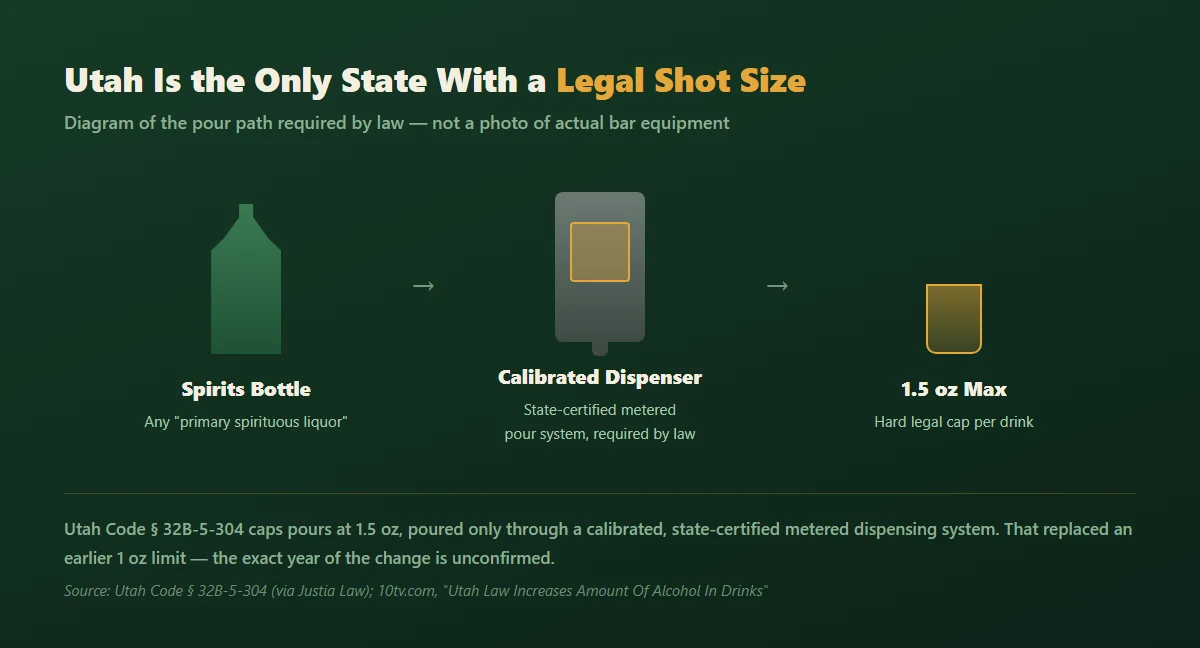
There is exactly one exception. Utah is the only US state where the size of a shot is written into law. Under Utah Code § 32B-5-304, a bar or restaurant can only serve "primary spirituous liquor" in amounts up to 1.5 oz per drink, and it has to come through a calibrated, state-certified metered dispensing system. That 1.5 oz cap replaced an earlier 1 oz limit; we couldn't pin down the exact year that change happened.
Source: Utah Code § 32B-5-304 (Justia); 10tv.com, "Utah Law Increases Amount Of Alcohol In Drinks"
Outside the US, the range gets wider still — shots run as small as about 20 mL in some Nordic countries and as large as 100 mL in Russia and Bulgaria.
Source: Wikipedia, "Shot glass"
So "how many shots in a bottle" was never really a bottle question. It was always a glass question, and the glass has been unregulated almost everywhere for most of American history.
The Government Tried to Scrap Bottle-Size Rules. It Backfired.
In July 2019, the federal Tax and Trade Bureau (TTB) proposed doing the opposite of what it did in 1980 — eliminating almost all standard bottle-size rules for wine and spirits, leaving producers free to bottle liquor in whatever size they wanted.
Source: Federal Register, Notice 2019-13767, "Elimination of Certain Standards of Fill for Distilled Spirits"
The public disagreed. TTB received 1,326 comments on the spirits proposal. 1,141 of them opposed dropping the standard sizes. One commenter pointed specifically to pre-1990s Europe as a cautionary tale — a market without standardized sizes, they argued, just meant "a confusing array of bottle sizes being sold side-by-side."
Source: Distillery Trail, "TTB Issues Final Ruling: Keeps Distilled Spirits Bottle Sizes and Authorizes 4 New Sizes"
It backfired.
TTB's final rule, issued in December 2020, kept every existing bottle size — and added four more: 700 mL, 720 mL, 900 mL, and 1.8 L. Three of those weren't a domestic ask. They came from three Japanese trade associations and the Japanese National Tax Agency, which wanted their standard export bottle sizes recognized in the US so producers wouldn't have to run a separate bottling line just for American shelves. The 700 mL size got broader support for the same reason — it's already common in other countries' markets.
Source: Federal Register, Doc. 2020-28747; Cocktailwonk.com, "US TTB to Allow 700 ml bottles"
A government agency tried to delete a rulebook and ended up publishing a longer one.
The rulebook kept growing. In January 2025, TTB authorized 15 more spirits sizes and 13 more wine sizes in a single rule — and, notably, added 360 mL to the wine list for the first time. Not the spirits list. The wine list.
Source: Federal Register, Doc. 2025-00271; TTB.gov, official announcement
That distinction — wine versus spirits — turns out to matter a lot for the next question.
How Many Shots Are in a Bottle of Soju?
Type "how many shots in a bottle" into a search bar, and the single most common way people finish that phrase is "of soju."
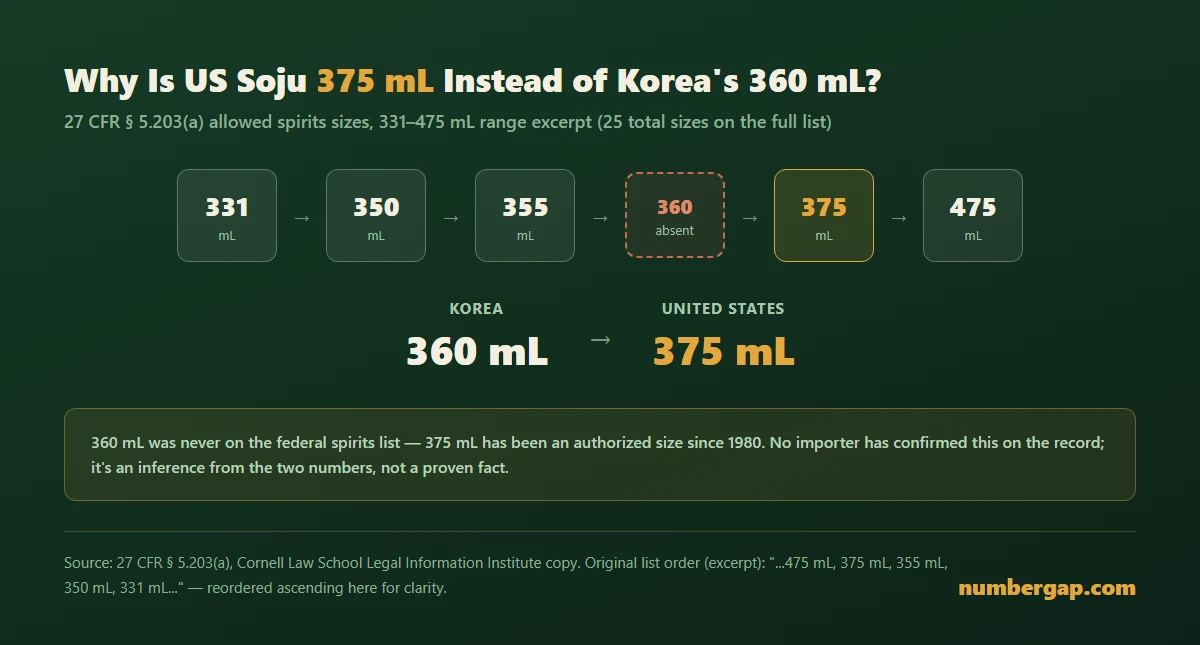
Here's the twist: the bottle isn't the same size in both countries. Korean soju is sold in 360 mL bottles. American soju — Jinro Chamisul, Good Day, and other familiar labels — is sold in 375 mL bottles.
Source: Binny's and The Liquor Barn, US retailer listings for Jinro Chamisul Soju, 375 mL
It grows 15 mL crossing the Pacific.
Here's why that's not a coincidence, as far as we can tell. Under federal law, distilled spirits in the US can only be bottled in a fixed list of sizes — 27 CFR § 5.203(a). That list runs 350 mL, then 355 mL, then jumps straight to 375 mL. 360 mL was never on it.
"3.75 Liters, 3 Liters, 2 Liters, 1.8 Liters, 1.75 Liters, 1.5 Liters, 1.00 Liter, 945 mL, 900 mL, 750 mL, 720 mL, 710 mL, 700 mL, 570 mL, 500 mL, 475 mL, 375 mL, 355 mL, 350 mL, 331 mL, 250 mL, 200 mL, 187 mL, 100 mL, 50 mL."
— 27 CFR § 5.203(a), current text (Cornell Law/LII)
No importer has said on the record, as far as we found, that this is why American soju is bottled at 375 mL instead of 360. But 360 isn't an option under the spirits list, and 375 has been an authorized US spirits size since 1980. It's an inference, not a confirmed fact — but it's hard to look at those two numbers side by side and see a different explanation.
So where did Korea's own 360 mL — and the traditional-sounding "hop" unit behind it — actually come from? Not from Japan, and not from unbroken Korean tradition either. In March 1905, the Korean Empire passed its own Weights and Measures Act — its own Law No. 1 — fixing one seung at 1.8039 liters, which set one hop at roughly 180.39 mL. A soju bottle at "two hop" lands almost exactly on 360 mL. That law was passed eight months before the 1905 Eulsa Treaty made Korea a Japanese protectorate. Four years after that, in November 1909, a revised measurement law brought in more of the Japanese system directly. The 180 mL figure behind Korea's soju bottle, in other words, is neither purely Korean tradition nor simply an imported Japanese unit — it's a number Korea's own government set for itself, right before it lost the ability to set much else.
Source: 한국민족문화대백과, "도량형"; 오마이뉴스, "대한제국 제1호 법률이 도량형법?"
For about a decade, every major brand's soju bottle in Korea looked the same on purpose. In 2009, Korea's Ministry of Environment and seven liquor makers signed a voluntary pact to standardize the soju bottle — later joined by three more companies — modeled on the bottle shape used by Jinro, the top-selling brand at the time. The ministry estimated it saved the industry somewhere between 30.7 and 50.2 billion won a year in reuse costs.
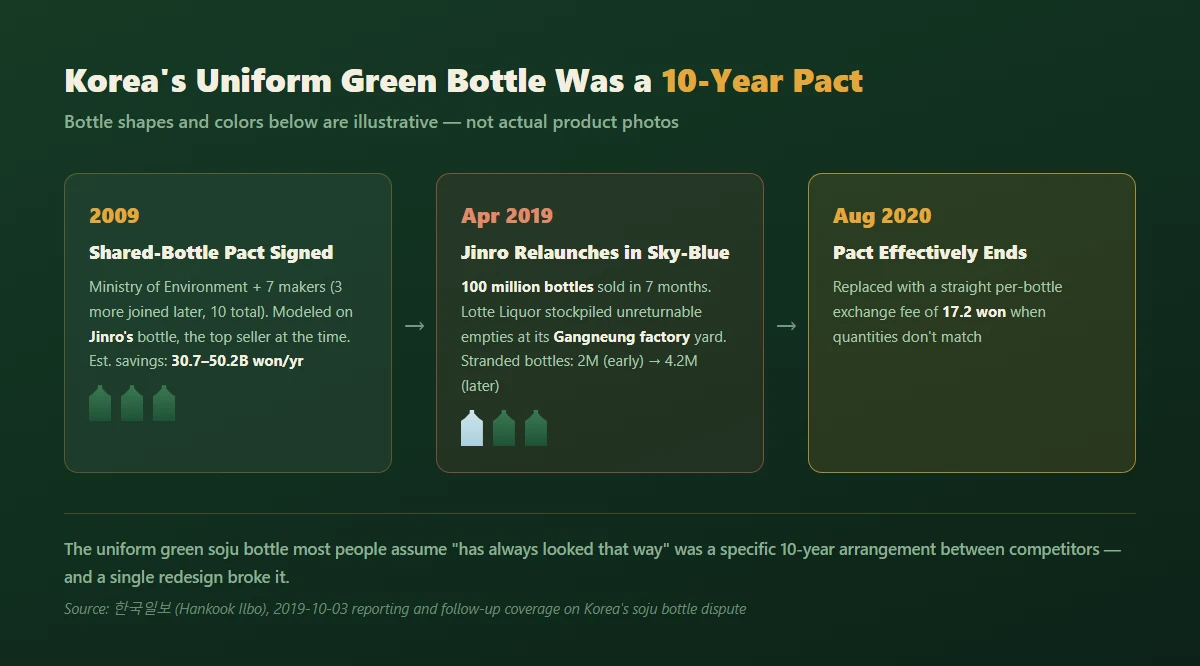
Then, in April 2019, HiteJinro relaunched its flagship soju in a new, pale sky-blue bottle. It sold 100 million bottles in seven months. Lotte Liquor, which relied on the shared-bottle pool, accused HiteJinro of "undermining a bottle recycling system other advanced countries envy" — and reportedly stockpiled returned empty bottles it couldn't use in the yard of its Gangneung factory rather than send them back. Early reporting put the number of stranded bottles at 2 million; later coverage put it at 4.2 million. By August 2020, the shared-bottle agreement was effectively dead, replaced by a straight per-bottle exchange fee of 17.2 won.
Source: 한국일보, 2019-10-03 reporting and follow-up coverage
The uniform green soju bottle — the one most people assume has always looked that way — is a specific, ten-year arrangement between competitors that a single redesign broke.
One more wrinkle on the size question: some soju sold in US grocery stores and wine aisles, at up to 24% ABV, is legally classified as wine rather than spirits, because it's fermented from a wine base instead of distilled from grain. California and New York both have specific statutes — California Business and Professions Code § 23398.5, and a parallel New York law — that let wine-licensed retailers sell this kind of soju. Since January 2025, TTB's wine list finally includes 360 mL. That means a wine-classified soju could, in theory, now be sold in the US at Korea's native size for the first time. We couldn't find a single brand that's actually done this yet. And under federal law, ordinary distilled soju is still a spirit, not a wine — so this is a door that opened, not a change that's happened.
South Korea's own health authorities define "high-risk drinking" for men as seven or more standard drinks in one sitting, at least twice a week — a threshold that lands, by coincidence, on the same number as the country's popular "one soju bottle equals seven shots" folk math. Whether the folk math's shot and the health guideline's standard drink are actually the same size is genuinely unsettled across Korea's own government documents. And the health threshold requires drinking that way twice a week — finishing one bottle once doesn't meet it.
Source: Korea Disease Control and Prevention Agency, National Health Information Portal, "위험음주! 알려드리겠습니다!"
Does "One Drink" Mean the Same Thing Everywhere?
Not even close — and not even within a single country's own paperwork.
In the US, the National Institute on Alcohol Abuse and Alcoholism defines a "standard drink" as any beverage containing 0.6 fl oz, or 14 grams, of pure alcohol. By that definition, one standard drink equals 12 oz of regular beer, 5 oz of table wine, or 1.5 oz of 80-proof spirits — a single shot.
Source: NIAAA, "What Is a Standard Drink," rethinkingdrinking.niaaa.nih.gov
This is a health-guidance figure, not a legal pour size. It exists so people can compare alcohol content across drink types, not to tell a bartender how much to pour.
It also isn't a universal number. South Korea's own government materials don't even agree with each other: some cite 7 grams per standard drink, while the Korea Disease Control and Prevention Agency's own consumer-facing page puts it at "roughly 8 to 12 grams." The World Health Organization uses 10 grams. None of these line up neatly with the US figure of 14, and none of them line up neatly with each other.
The size of "one drink" isn't a fact of nature. It's a number every health agency has had to guess at, separately, and none of them guessed the same.
Where Does the Word "Shot" Actually Come From?
Nobody knows for certain — and one of the most popular answers turns out to be false.
The strongest-supported theory traces "shot" back to Old English "scot" or "sceot," meaning a charge or payment. By the 15th century in England, a "shot" meant a tab to be settled at a bar — the origin, most likely, of the modern phrase "paying your shot."
Source: Oxford English Dictionary, via Snopes.com
The earliest known written use of "shot" as a liquor measure isn't American at all. It's in the autobiography of the Reverend Oliver Heywood, an English nonconformist minister who lived from 1630 to 1702. Heywood complained about "their vain way of drinking shots" — a line that predates the American Old West by roughly 150 years.
Source: Snopes.com, citing Heywood's autobiography
That timing matters, because the most popular origin story for "shot" is an American one, and Snopes checked it directly. The claim: that Old West cowboys traded a single bullet for a drink at the saloon bar, and that's where "a shot of whiskey" comes from.
The math doesn't survive contact with an actual 1891 hardware catalog. A .45 cartridge cost about 2.5 cents. A drink in an Old West saloon cost roughly 25 cents — about ten times as much. Trading one bullet for one drink would have meant the bartender losing money on every pour. And the term "shot" for a drink was already in use a century and a half before the Old West period began.
Source: Snopes.com, "Did the Phrase 'a Shot of Whiskey' Originate in the Old West?"
It's a good story. It's just not what happened.
Two other, less-documented theories float around: an 18th-century dictionary entry suggesting "shot" once referred to a metal flagon handed to a guest who'd had too much, and a folk claim linking "shot glass" to small lead-weighted glasses once used to hold ink for quills. Neither traces back to a primary source solid enough to call settled. Treat them as folklore, not fact.
What This Piece Could Not Verify
- Who at the Bureau of Alcohol, Tobacco and Firearms or the Distilled Spirits Council of the United States personally authored or championed the 1975 metric-conversion proposal. No named individual appears in any source we could locate.
- Whether the American public reacted to the January 1, 1980 changeover with complaints, hoarding, or indifference. Only the Washington Post's headline was confirmed; no follow-up coverage of public reaction turned up.
- The exact year Utah's shot-size cap rose from 1 oz to its current 1.5 oz.
- Whether US soju is bottled at 375 mL specifically because 360 mL isn't an authorized federal spirits size. The numbers line up; no importer's own statement confirms the reasoning.
- The precise number of stranded soju bottles at the peak of Korea's 2019–2020 bottle dispute. Early reports said 2 million; later reports said 4.2 million.
- A single settled origin for the word "shot" as a drink term. Multiple competing theories exist; none is definitively proven, though the Old West bullet-trading story specifically has been checked and does not hold up.
Frequently Asked Questions
Q. How many shots are in a fifth of vodka?
A. About 17, at the standard 1.5 oz bar pour. Bars aren't required to use that pour size, so the real number depends on where you're drinking.
Q. How many shots are in a fifth of whiskey?
A. The same math applies: roughly 17 shots at 1.5 oz. Whiskey, vodka, and tequila are all sold in the same federally standardized 750 mL bottle.
Q. How many shots are in a fifth of tequila?
A. Also about 17 at 1.5 oz. Tequila follows the same 750 mL federal standard as any other distilled spirit sold in the US.
Q. Why is it called a "fifth" if the bottle isn't actually a fifth of anything?
A. Because the name outlived the math. Bottles genuinely held one-fifth of a US gallon (757 mL) until January 1, 1980, when federal law switched everyone to the metric 750 mL size. Nobody renamed the bottle when the pour changed.
Q. Is there a legal shot size in the US?
A. Not federally. Utah is the only state that fixes one by law — 1.5 oz, poured through a state-certified metered dispensing system.
Q. How many shots are in a bottle of Jack Daniel's or Tito's?
A. Both are typically sold in standard 750 mL fifths in the US, so the same roughly-17-shot math applies. Some Tito's is also sold in the larger 1.75 L "handle" size.
Q. How many shots are in a bottle of soju?
A. It depends on the glass — Korea doesn't have a legally fixed soju-glass size any more than the US has a legally fixed shot glass. What's confirmed is that American soju bottles (375 mL) are actually larger than the ones sold in South Korea (360 mL).
Q. What's a "standard drink," and is it the same as a shot?
A. Not quite. The NIAAA's "standard drink" is a health-measurement concept — 14 grams of pure alcohol, which happens to equal 1.5 oz of 80-proof liquor. A "shot" is a bar-pour term with no single legally fixed size.
Q. Did the word "shot" really come from Old West cowboys trading bullets for drinks?
A. No. Snopes checked this specifically: an 1891 hardware catalog priced a .45 cartridge at about 2.5 cents against a 25-cent drink, and the term "shot" for a drink is documented roughly 150 years before the Old West period began.
Q. Why did the government add more bottle sizes in 2020 instead of fewer?
A. In 2019 it tried to eliminate almost all standard bottle sizes. The public pushed back — 1,141 of 1,326 comments opposed the change. The 2020 final rule kept every existing size and added four more instead.
So What's the Real Answer?
Not a fixed number. A range that depends entirely on who's holding the bottle.
How many drinks come out of a fifth was never really decided by the bottle. It's decided by the glass — and for almost all of American history, the glass has answered to nobody. The bottle, meanwhile, has answered to federal regulators since 1935, survived a metric conversion in 1980, survived an attempt to deregulate it out of existence in 2019, and come out the other side of all three rounds slightly bigger than before.
If you actually want to know your own number, there's a one-time fix: measure your usual pour with a real measuring cup once. After that, you'll know exactly how many "shots" are in your fifth — and you won't need federal law to tell you.
If TTB changes the standards-of-fill list again, or if a US brand ever bottles soju at Korea's native 360 mL, we'll update this.
Sources
- 27 CFR § 5.203 — Standards of Fill, current text via Cornell Law/LII, last amended by T.D. TTB-200 (Jan. 10, 2025)
- "Fifth (unit)" — Wikipedia
- Washington Post, "Era of the Fifth of Liquor to End With New Year," Jan. 1, 1980
- US Metric Association, "Packaging regulations for alcoholic beverages"
- "Shot glass" — Wikipedia
- Utah Code § 32B-5-304, via Justia Law
- 10tv.com, "Utah Law Increases Amount Of Alcohol In Drinks"
- NIAAA / Rethinking Drinking, "What Is a Standard Drink"
- Oxford English Dictionary, "shot, n."
- Snopes.com, "Did the Phrase 'a Shot of Whiskey' Originate in the Old West?"
- VinePair, "Where Did the Term 'Shot of Whiskey' Come From?" and "Why Do We Call Drinks 'Shots'?"
- Federal Register, Notice 2019-13767 (proposed elimination of standards of fill)
- Distillery Trail, "TTB Issues Final Ruling: Keeps Distilled Spirits Bottle Sizes and Authorizes 4 New Sizes"
- Federal Register, Doc. 2020-28747 (final rule, Dec. 29, 2020)
- Cocktailwonk.com, "US TTB to Allow 700 ml bottles"
- Federal Register, Doc. 2025-00271 (T.D. TTB-200, Jan. 10, 2025)
- TTB.gov, "TTB Adds New Standards of Fill for Wine and Distilled Spirits"
- Binny's and The Liquor Barn, US retailer listings, Jinro Chamisul Soju 375 mL
- California Business and Professions Code § 23398.5
- NY State Senate newsroom, legislation on shochu/soju sold under beer-and-wine licenses
- 한국민족문화대백과, "도량형"
- 오마이뉴스, "대한제국 제1호 법률이 도량형법?"
- 한국일보, 2019-10-03 reporting on Korea's soju bottle dispute, and follow-up coverage
- Korea Disease Control and Prevention Agency, National Health Information Portal, "위험음주! 알려드리겠습니다!"
This piece is about bottle-size regulation, unit history, and measurement myths. It is not medical guidance on alcohol consumption.


Comments
Post a Comment