HSA vs FSA: Does Your FSA Roll Over? It Depends on Your Plan
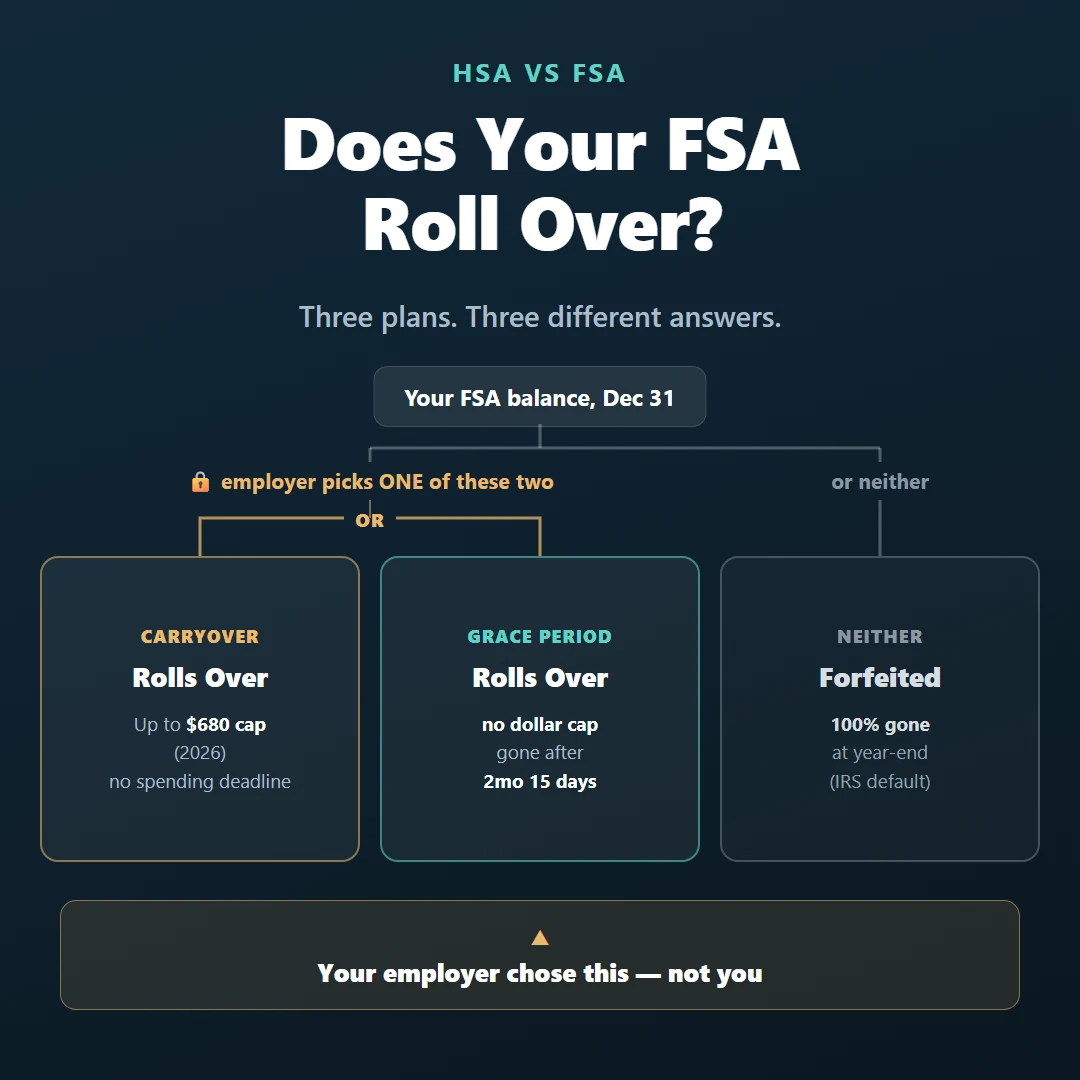
Three plans.
Three different answers.
And you didn't pick which one is yours.
Every fall, benefits season brings the same question: does my HSA or FSA money roll over into next year? The honest answer is that HSA money always does — it's yours, permanently. FSA money is a different story, and the IRS actually allows three different outcomes for it. Your employer picked one when they set up the plan. Most people never find out which.
Last updated: 7 September 2026 · Figures and rules in this post are current as of this date.
This isn't a "pick HSA or FSA" advice post. It's a look at what the rules actually say, based on IRS guidance and the two federal notices that created the exceptions — so you can go check your own plan documents and know what you're looking for.
Basis date for the numbers below: this article uses IRS figures current as of 2026 (Rev. Proc. 2025-19 for HSA/HDHP limits, Rev. Proc. 2025-32 for FSA limits).
HSA vs FSA: What's the Actual Difference?
The core difference isn't the tax break — both are tax-advantaged. It's who owns the account.
An HSA (Health Savings Account) belongs to you, the individual, the moment money lands in it. There's no vesting schedule allowed under HSA rules — even money your employer contributes becomes yours instantly. If you change jobs, the account and everything in it goes with you, and it never expires.
Source: National Health Savings Authority, "HSA Portability: Changing Jobs and Keeping Your Account" — https://nationalhealthsavingsauthority.com/hsa-portability-changing-jobs
An FSA (Flexible Spending Account) is different. It's a benefit your employer sponsors under their Section 125 cafeteria plan, and legally, the employer owns the account. If you leave the company before spending what you elected, you generally lose the unspent balance.
Source: dpath.com, "Who Owns an Employee's Benefit Account?" — https://dpath.com/who-owns-a-benefits-account/
There's also a gatekeeper difference: to open an HSA, you must be enrolled in a High-Deductible Health Plan (HDHP) and have no other disqualifying coverage. An FSA has no such requirement — it's available with most standard health plans. That gatekeeper is exactly why the two accounts get compared so often but work so differently.
Does Your FSA Roll Over? Here Are the Three Real Answers
The IRS's baseline rule for a health FSA is "use it or lose it" — unused money is forfeited at the end of the plan year, full stop.
Source: IRS Publication 969 (2025 edition) — https://www.irs.gov/publications/p969
But the IRS also created two optional exceptions an employer can adopt. A plan can pick one of them, or neither — never both. That's the three-answer structure:
1. Carryover. Up to a set dollar amount can carry into next year, with no deadline on when during that year it has to be spent.
Source: WEX Inc., "FSA carryover: What it is and what it means for you" — https://www.wexinc.com/resources/blog/fsa-carryover-what-it-is/
2. Grace period. No dollar cap — you can use 100% of what's left — but only during a fixed window after the plan year ends. That window can't exceed "the fifteenth day of the third calendar month after the end of the plan year," which is where the common shorthand "2.5-month grace period" comes from.
Source: IRS Notice 2005-42 (May 18, 2005) — https://www.irs.gov/pub/irs-drop/n-05-42.pdf
3. Neither. The employer adopts no exception at all, and 100% of unused funds are forfeited at year-end — the original use-it-or-lose-it default going back to the 1984-era rule.
Source: FSA Store, "What Happens to Unused FSA Funds?" — https://fsastore.com/articles/learn-what-happens-to-unused-fsa-funds.html
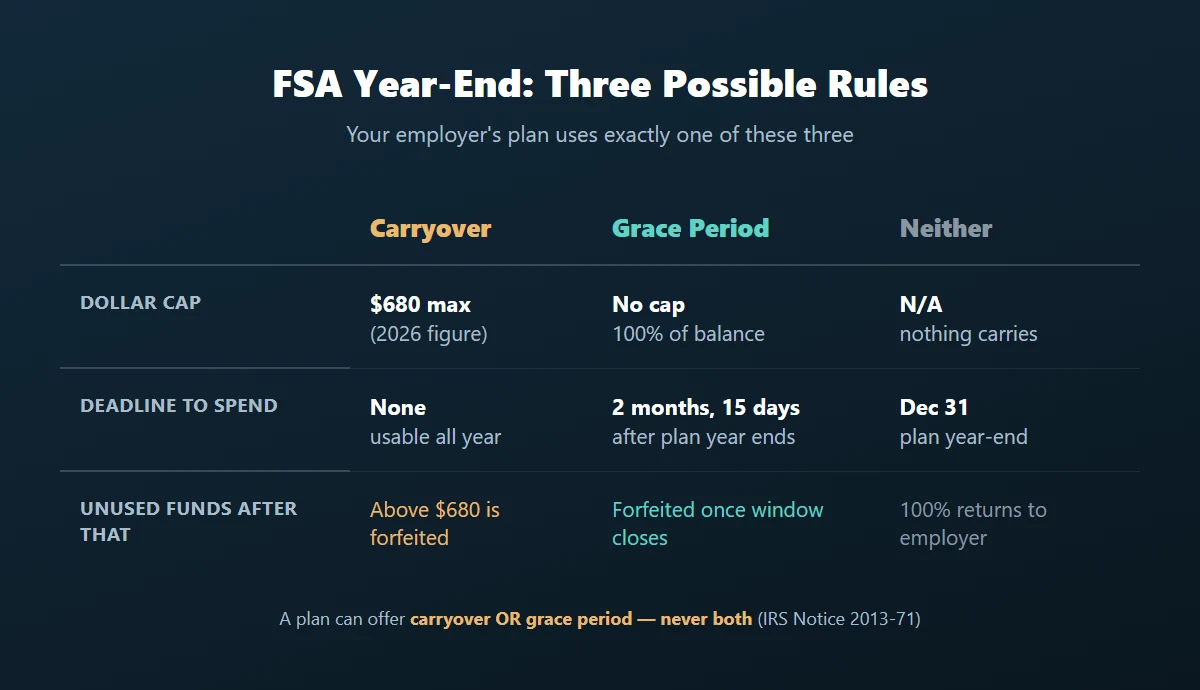
Here's what most explainer articles skip: you don't choose which of these three applies to you. Whoever administers your employer's cafeteria plan picked it, once, for everyone on the plan. The only choice you personally make is how much to elect during open enrollment.
Why Can't a Plan Offer Both Carryover and a Grace Period?
Because the IRS explicitly said no. When the agency created the carryover option in 2013, it stated plainly that employers "must choose between offering either a carryover or a grace period, not both."
Source: IRS Notice 2013-71 (October 31, 2013), as summarized by Vorys — https://www.vorys.com/publication-I-Labor-and-Employment-Alert-I-Health-FSA-500-Carryover
So if you're trying to figure out which rule applies to your FSA, you're really answering one yes/no question at a time: does my plan have carryover? If not, does it have a grace period? If neither — the balance is gone at year-end.
For context on how common each choice is: data from FSA administrator WEX's own platform shows 59% of the plans it administers have adopted carryover. Separately, Mercer's National Survey of Employer-Sponsored Health Plans found that among employers offering some form of protection, roughly 65% pick carryover over a grace period. Those two figures use different denominators — one is "all plans on one vendor's platform," the other is "employers that already offer some protection" — so they shouldn't be merged into one number. No source in this research gives a reliable nationwide figure for what share of employers offer neither option.
Sources: WEX Inc. — https://www.wexinc.com/resources/blog/fsa-carryover-what-it-is/ · Mercer survey cited via WorldatWork — https://worldatwork.org/publications/workspan-daily/the-current-state-of-fsas-and-how-to-maximize-this-employee-benefit
What Is the FSA Carryover Limit for 2026?
$680. But that number is only correct for 2026 — and that's exactly the trap.
The carryover cap changes almost every year, because it's defined as 20% of that year's maximum FSA contribution limit, rounded to the nearest $10. The IRS said so directly back in 2013: the original $500 figure "represented 20 percent of the maximum allowed salary reduction amount" at the time.
Source: IRS Notice 2013-71, as summarized by PLANSPONSOR — https://www.plansponsor.com/second-opinions-carryovers-of-unused-health-fsa-balances/
You can check the math yourself for the two most recent years:
- 2025 FSA contribution limit: $3,300 → 20% = $660 → matches the actual 2025 carryover cap
- 2026 FSA contribution limit: $3,400 → 20% = $680 → matches the actual 2026 carryover cap
| Carryover into plan year | Max carryover amount |
|---|---|
| 2014–2019 | $500 |
| 2020–2021 | $550 |
| 2022 | $570 |
| 2023 | $610 |
| 2024 | $640 |
| 2025 | $660 |
| 2026 | $680 |
Source: origin figure — IRS Notice 2013-71, 2013; year-by-year progression corroborated across Employee Benefit News, 20SomethingFinance, and Hylant's 2026 FSA limits summary — https://hylant.com/insights/blog/irs-releases-health-fsa-limits-for-2026
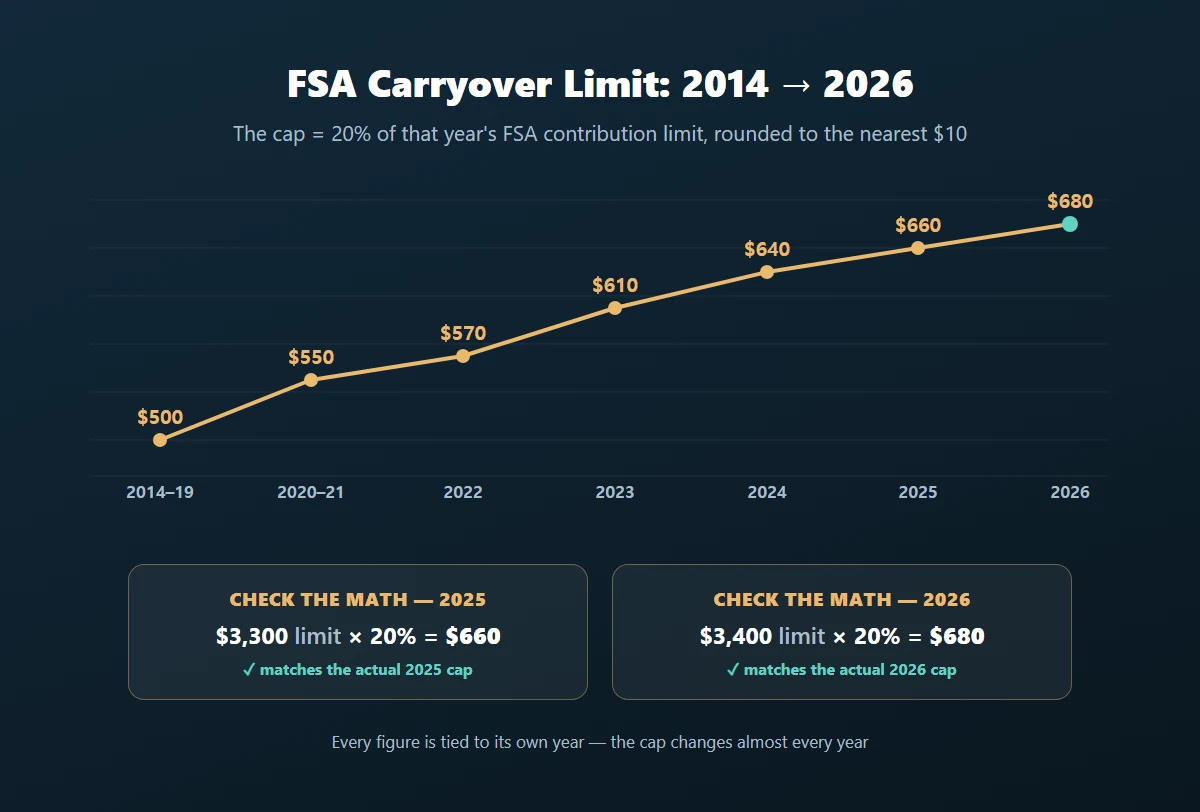
This is why an old blog post, an outdated HR handout, or even a forum answer from a few years ago can quietly be wrong. "$500," "$550," "$610," and "$640" are all still floating around online, and every one of them was accurate — for a different year.
Is It True FSAs Waste Billions of Dollars a Year?
This is the number that shows up in almost every "FSA use-it-or-lose-it" headline — and it's worth tracing to where it actually comes from, because the real data doesn't say what the headlines imply.
The solid, primary-source part is this: the Employee Benefit Research Institute (EBRI) maintains a database of over 3.2 million real FSA accounts. Its own published research reports that over half of accountholders forfeit at least some balance each year, averaging roughly $420 to $441 per account depending on the year.
Source: EBRI, "New Analysis of 3.2 Million Flexible Spending Accounts..." — https://www.ebri.org/content/new-analysis-of-3.2-million-flexible-spending-accounts-finds-average-contributions-increasing-while-half-forfeiting-funds-to-their-employers
But EBRI itself never publishes a national dollar total. The multi-billion-dollar figures you see quoted — $3 billion, $4.5 billion, $5.1 billion, $7.2 billion, depending on which article and which year — are extrapolations built by financial journalists, most notably Money.com, who took EBRI's per-account average and multiplied it by an estimated total number of FSA accounts nationwide. Money's own 2025 article discloses this methodology directly, and even notes its updated estimate came out "six times higher than previous estimates."
Source: Money, "Workers Lose Over $4 Billion in Unspent FSA Money a Year" (published 2025-03-11) — https://money.com/unspent-fsa-money-forfeit/
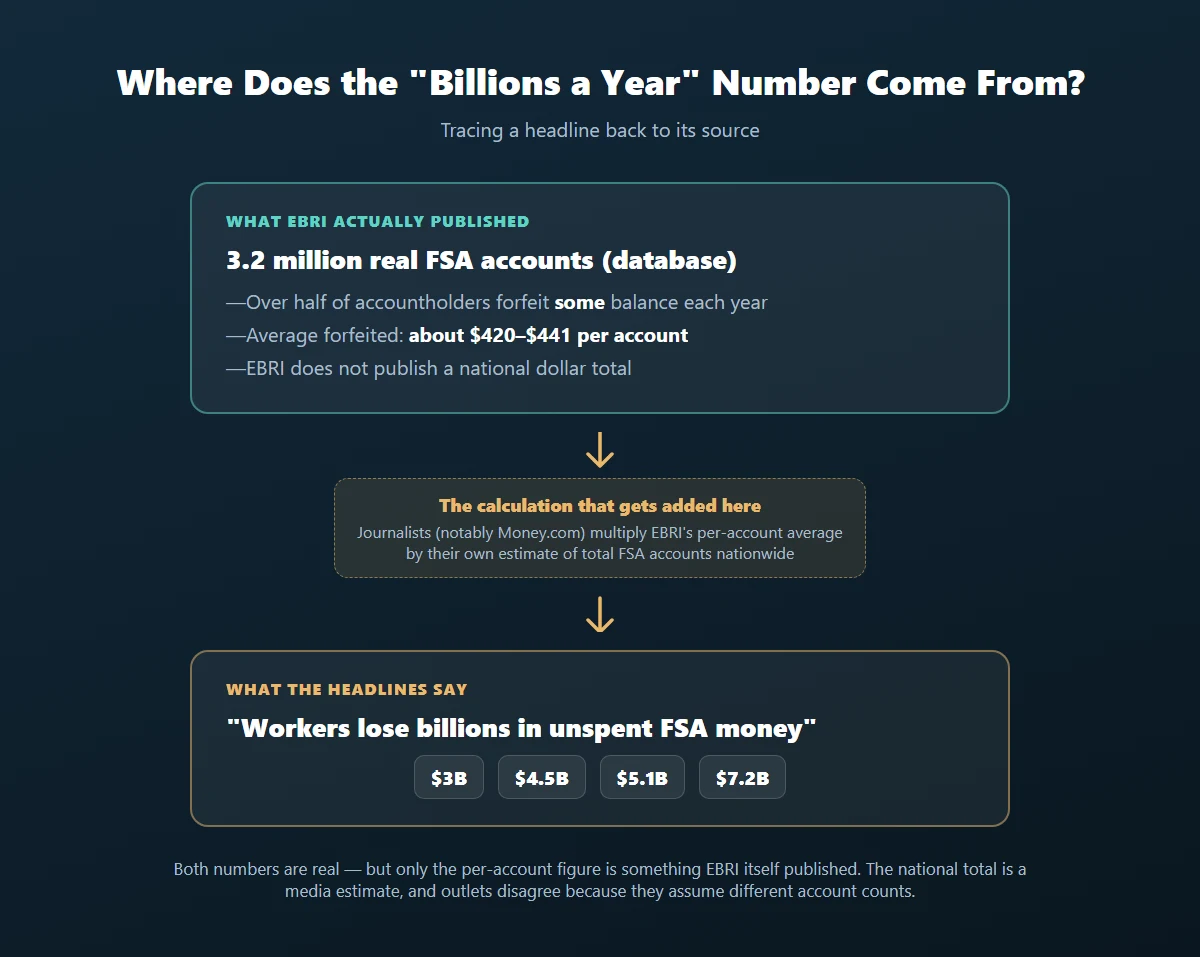
So both things are true at once: the underlying per-account data is real and comes from an actual dataset of 3.2 million accounts. The eye-catching billion-dollar total is a media calculation layered on top of it, and different outlets' calculations don't agree with each other because they use different assumptions about how many FSA accounts exist nationally. Neither figure is "made up" — but only one of them is something EBRI actually published.
How Much Can You Contribute to an HSA in 2026?
$4,400 for self-only coverage, $8,750 for family coverage — up from $4,300 and $8,550 in 2025. If you're 55 or older, you can add a $1,000 catch-up contribution on top, a fixed amount that hasn't changed in years.
Source: IRS Rev. Proc. 2025-19, summarized by Winston & Strawn — https://www.winston.com/en/blogs-and-podcasts/benefits-blast/irs-releases-2026-inflation-adjusted-amounts-for-hsas-hdhps-and-hras
| Year | Self-only limit | Family limit | Age 55+ catch-up |
|---|---|---|---|
| 2025 | $4,300 | $8,550 | +$1,000 |
| 2026 | $4,400 | $8,750 | +$1,000 |
If both spouses are 55 or older, each spouse needs their own HSA to claim the catch-up — one account can't receive two catch-up contributions. And anyone enrolled in Medicare is no longer HSA-eligible at all, catch-up included.
Source: HSA Orbit, "HSA Catch-Up Contributions After 55" — https://hsaorbit.com/articles/hsa-catch-up-contribution-55
Why Do You Need an HDHP to Get an HSA?
Because the HSA isn't a standalone account — it's a companion to a specific type of health plan. To contribute to an HSA at all, you need to be covered by a High-Deductible Health Plan that meets IRS minimums, and have no other disqualifying coverage.
Source: IRS Publication 969 — https://www.irs.gov/publications/p969
| Year | Min. deductible (self-only) | Min. deductible (family) | Max out-of-pocket (self-only) | Max out-of-pocket (family) |
|---|---|---|---|---|
| 2025 | $1,650 | $3,300 | $8,300 | $16,600 |
| 2026 | $1,700 | $3,400 | $8,500 | $17,000 |
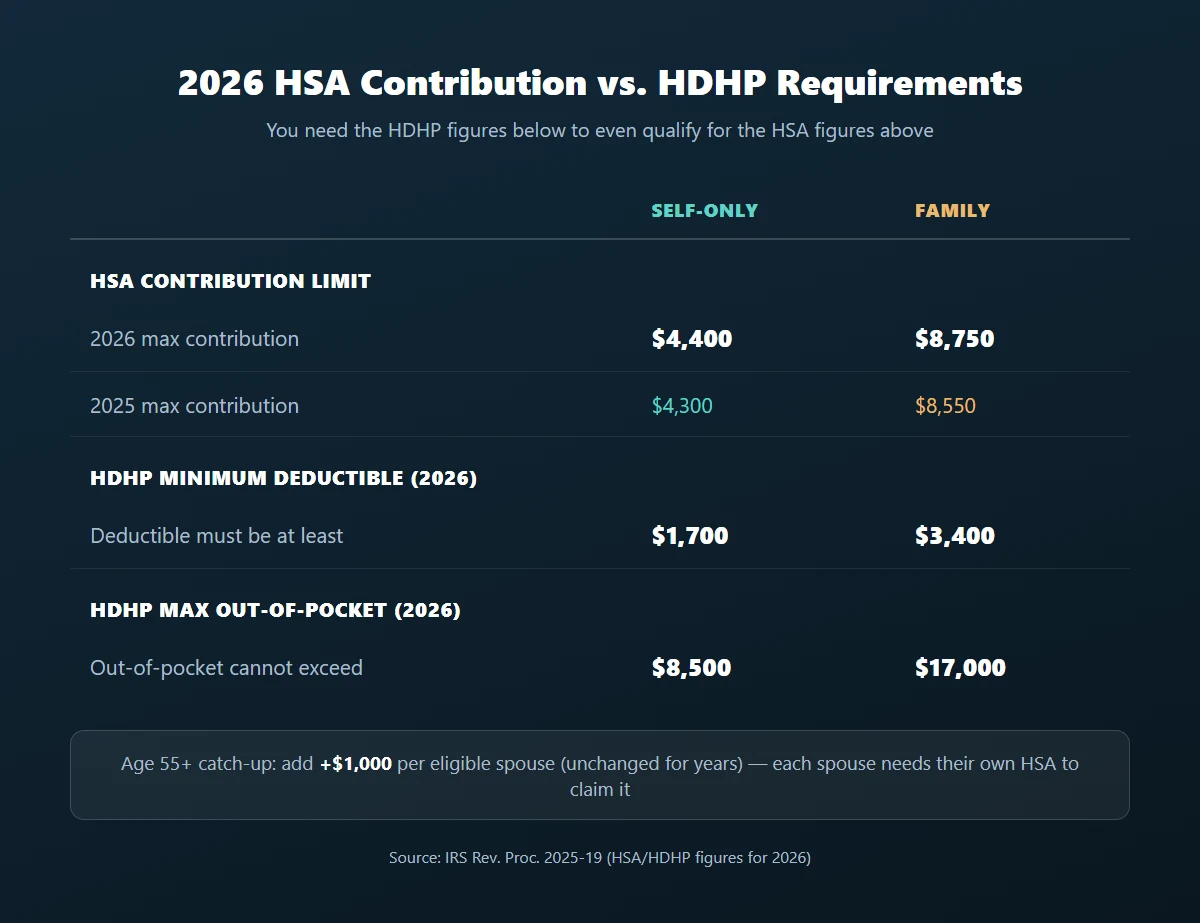
Here's a detail that trips up even benefits professionals: the HSA/HDHP numbers above and the FSA numbers earlier in this article come from two separate IRS documents. Rev. Proc. 2025-19 sets the 2026 HSA and HDHP figures. Rev. Proc. 2025-32 sets the 2026 FSA contribution and carryover figures. They're released around the same time each year and often get lumped together in secondary write-ups, but they're not the same ruling.
Source: KPMG tax alert distinguishing the two — https://kpmg.com/us/en/taxnewsflash/news/2025/05/tnf-rev-proc-2025-19-hsa-inflation-adjusted-amounts-for-2026.html
Can You Have an HSA and an FSA at the Same Time?
Not usually — but there's a specific exception. A standard, general-purpose health FSA counts as "other health coverage" under IRS rules, which disqualifies you from also having an HSA.
Source: HealthEquity, "HSA and LPFSA: Can you have both?" — https://www.healthequity.com/library/pairing-lpfsa-with-hsa
The exception is a Limited Purpose FSA (LPFSA), which only reimburses dental and vision expenses. Because it doesn't cover general medical costs, it doesn't count as disqualifying coverage — so you can run an HSA and an LPFSA side by side. In fact, some plans only offer an LPFSA specifically because you already have HSA-qualifying HDHP coverage.
Source: Gusto, "What is a Limited Purpose FSA?" — https://gusto.com/resources/glossary/limited-purpose-fsa
Where the Research Runs Into a Wall
Being straightforward about the limits of what's actually documented here: two things in this topic could not be fully verified.
First, no source found in this research gives a clean, national percentage of employers that offer neither carryover nor a grace period — only figures for how common each option is among plans that offer some protection. If you see a specific "X% of employers offer nothing" statistic elsewhere, treat it as an estimate rather than a directly measured figure.
Second, IRS Notice 2005-86 — a related notice about HSA eligibility during a cafeteria-plan grace period — could not be read in full for this research; the IRS-hosted PDF returned as an unreadable scan. Only its title and general subject were confirmed through search snippets, not the full text, so it's referenced here only by name, not by content.
What Should You Actually Do With This?
Nothing here tells you which account to pick or how to spend down a balance — that depends on your income, your medical costs, and your own plan's specific rules, none of which this article can see.
What it does tell you is what to go look up: check your Summary Plan Description or ask your benefits administrator one specific question — "does my FSA have carryover, a grace period, or neither?" — instead of assuming it works like an HSA. That one answer determines whether your December balance is safe, on a clock, or already gone.
This article explains IRS rules as published; it isn't tax or financial advice for your individual situation. For anything specific to your plan or your taxes, check your plan documents or a qualified benefits professional.
Frequently Asked Questions
Q. Does my FSA roll over each year?
A. Only if your employer's plan has adopted a carryover provision. If it has, up to a capped amount (2026 sourced by this research: $680) carries forward with no spending deadline. If your plan instead has a grace period, there's no dollar cap but a hard deadline (2 months and 15 days). If it has neither, unused funds are forfeited at year-end.
Q. What is the use-or-lose rule?
A. It's the IRS's default rule for health FSAs: unused contributions are forfeited when the plan year ends, unless the employer has adopted a carryover or grace-period exception.
Q. What happens to unused FSA funds?
A. Legally, they stay with the employer or the plan — they are not returned to you and are not sent to the government. Employers can use forfeited amounts to offset plan administrative costs or for the benefit of the plan's participants as a group.
Q. Can I have an HSA and FSA at the same time?
A. Not with a standard general-purpose FSA — it disqualifies you from HSA eligibility. You can pair an HSA with a Limited Purpose FSA (LPFSA), which only covers dental and vision expenses.
Q. Can my FSA roll over to a new employer?
A. No. An FSA is owned by the employer's plan, not by you individually, so it doesn't move with you when you change jobs — unlike an HSA, which does.
Q. HSA vs FSA: which one is right for me?
A. That depends entirely on your plan's rules and your own health spending, not on a universal answer — which is exactly why this article focuses on what the rules say rather than recommending one account over the other.


Comments
Post a Comment