How Much Is COBRA Insurance Monthly? It's 6.6x What You Paid
Your plan doesn't change the day you quit. Your network doesn't change. Your deductible doesn't change.
Last updated: 4 September 2026 · Figures and rules in this post are current as of this date.
What changes is who's paying for it.
While you're employed, your employer quietly covers the majority of your health premium — most people never see that number on a pay stub. The moment you leave, that share doesn't disappear from the bill. It just gets handed to you.
The numbers in this article are based on KFF's 2025 Employer Health Benefits Survey and federal COBRA regulations, current as of September 2026. Premiums and subsidy rules change yearly — check current figures before relying on them for a decision.
This is the fourth piece in our Paycheck Numbers series. We previously broke down what your employer actually pays beyond your salary and how much unemployment insurance really pays. This one picks up where a job ends: what happens to your health insurance bill.
Why does losing your job make health insurance cost so much more?
Because the employer's share of the premium — which is usually the bigger half — disappears, and someone has to make up the difference. That someone is now you.
According to KFF's 2025 Employer Health Benefits Survey, published October 22, 2025:
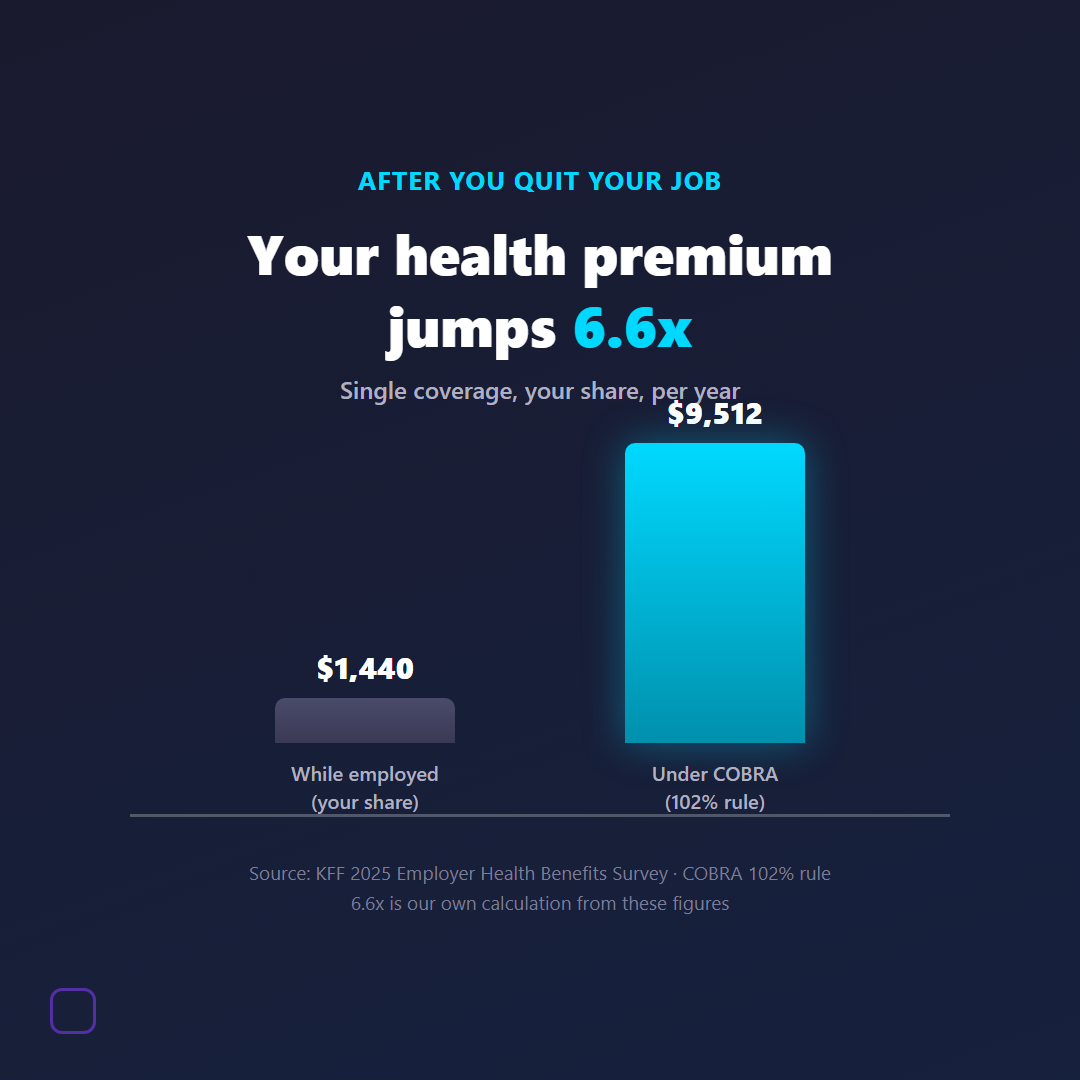
- Single coverage: the average annual premium was $9,325. Workers paid about 16% of that out of pocket — roughly $1,440 a year — while employers covered the remaining 84%, about $7,885.
- Family coverage: the average annual premium reached $26,993, up 6% from 2024. Workers contributed $6,850 a year (about 25-26%), with employers covering roughly $20,143, or about 74-75%.
Source: KFF, "Annual Family Premiums for Employer Coverage Rise 6% in 2025, Nearing $27,000, with Workers Paying $6,850 Toward Premiums Out of Their Paychecks," Oct 22, 2025
That 6% jump in family premiums outpaced both general inflation (2.7%) and wage growth (about 4%) over the same period. Premiums are rising faster than paychecks even before anyone loses a job.
Source: KFF 2025 Employer Health Benefits Survey
What exactly is COBRA, and who has to offer it?
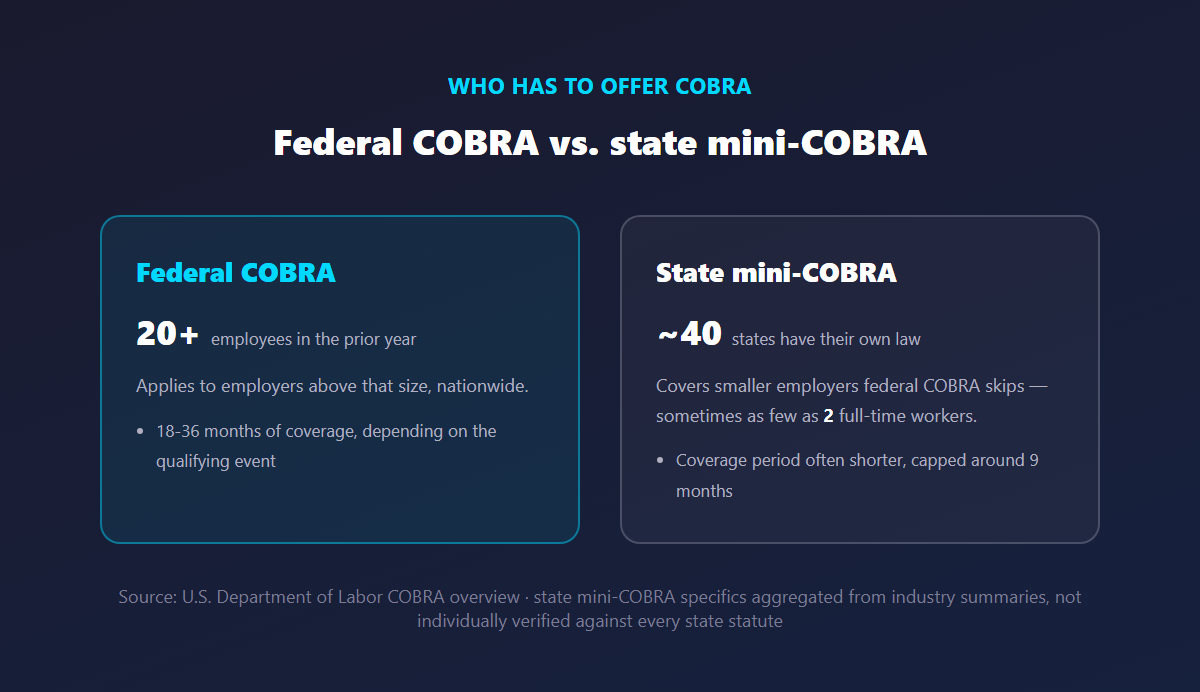
COBRA is a federal law, not an insurance plan of its own. It's short for the Consolidated Omnibus Budget Reconciliation Act of 1985, and it gives workers who lose job-based coverage the right to keep the exact same group plan for a limited time after a "qualifying event" — voluntary or involuntary job loss, reduced hours, divorce, death, or a few other life events.
Source: U.S. Department of Labor, "Continuation of Health Coverage (COBRA)"
Federal COBRA only applies to employers with 20 or more employees in the prior year. If your employer is smaller than that, federal COBRA doesn't apply to you — but roughly 40 states have their own "mini-COBRA" laws that extend similar rights to smaller employers, sometimes down to businesses with just two full-time workers. Mini-COBRA coverage periods tend to be shorter, often capped around 9 months, compared to 18-36 months under federal COBRA.
Source: U.S. Department of Labor COBRA overview; state mini-COBRA specifics aggregated from HR/compliance industry summaries and not individually verified against every state statute — check your specific state's law if this applies to you.
What is the 102% rule, and how much more do you actually pay?
Under COBRA, you don't just pay your old share plus the employer's old share — you pay that combined total plus a 2% administrative fee on top. That's the "102% rule," and it's written directly into federal regulation.
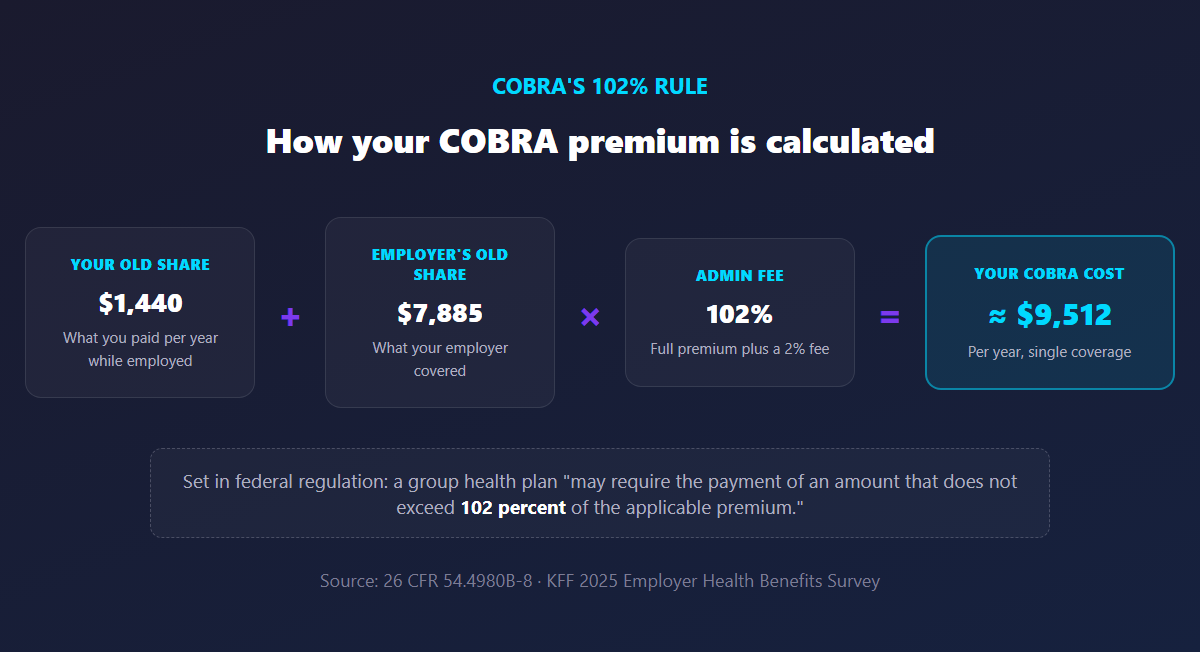
Source: 26 CFR 54.4980B-8, Electronic Code of Federal Regulations — "a group health plan... may require the payment of an amount that does not exceed 102 percent of the applicable premium for such period"
Here's the actual math, using the KFF figures above. These multipliers are our own calculation from the confirmed KFF and federal-regulation figures — KFF and the DOL do not publish a "4x" or "6.6x" statistic themselves.
| | While employed (your share) | Total premium | Under COBRA (102% of total) | Multiple |
|---|---|---|---|
| Single coverage | $1,440/year | $9,325/year | ≈ $9,512/year | ≈ 6.6x |
| Family coverage | $6,850/year | $26,993/year | ≈ $27,533/year | ≈ 4.0x |
The single-coverage jump is more dramatic than the family jump for a simple reason: employers cover a larger share of single coverage (84%) than family coverage (74-75%). The more your employer was quietly covering, the bigger the number looks once that coverage disappears.
There's also a higher rate for a narrower case: plans may charge up to 150% of the premium during a disability extension, once a beneficiary is past the initial 18 months.
Source: U.S. Department of Labor, "FAQs on COBRA Continuation Health Coverage for Workers"
Is COBRA or an ACA Marketplace plan cheaper in 2026?
There's no single answer, and right now it depends on unresolved legislation. Losing job-based coverage triggers a 60-day Special Enrollment Period on the ACA Marketplace (HealthCare.gov or your state exchange), so you don't have to wait for open enrollment.
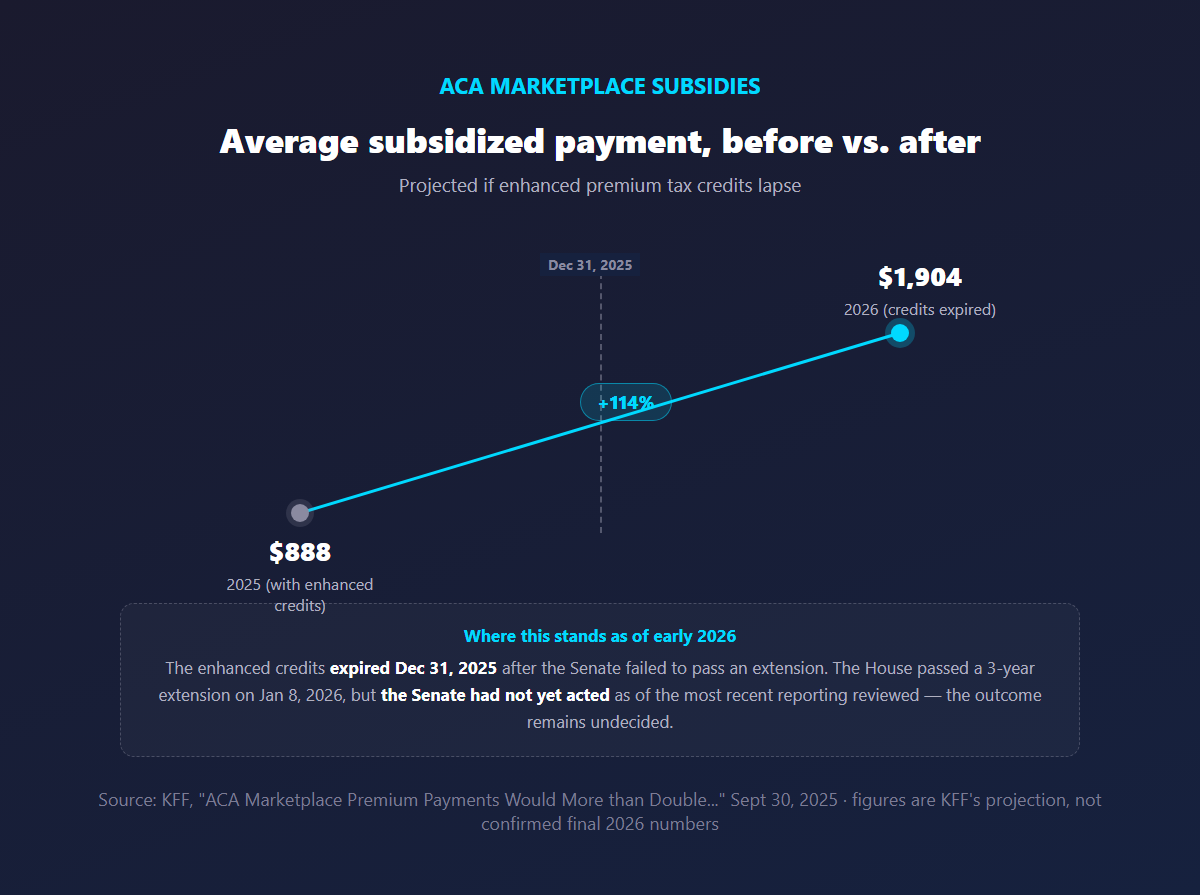
The Marketplace's key advantage over COBRA is income-based premium tax credits — COBRA premiums get no such subsidy. But the size of that advantage shrank significantly at the end of 2025.
- Enhanced premium tax credits, first introduced in 2021 and extended through 2025, were set to expire December 31, 2025.
- KFF projected that if the enhanced credits lapsed, the average annual payment for subsidized enrollees would rise 114%, from about $888 in 2025 to about $1,904 in 2026.
- The Senate failed twice to pass extension legislation in December 2025, and the enhanced credits did lapse as scheduled.
- On January 8, 2026, the House passed a three-year extension by a 230-196 vote, with 17 Republicans joining Democrats. As of the most recent reporting found in this research, the Senate had not yet acted on that bill or an alternative — a bipartisan group was reportedly working on separate legislation. The outcome remains unresolved.
Source: KFF, "ACA Marketplace Premium Payments Would More than Double on Average Next Year if Enhanced Premium Tax Credits Expire," Sept 30, 2025
Source: Health Affairs Forefront, Dec 2025; CNN Politics, Dec 18, 2025; Ballotpedia News, Jan 12, 2026
This matters directly for the COBRA-vs-Marketplace comparison: without the enhanced subsidies, Marketplace plans are a weaker deal than they were between 2021 and 2025, especially for anyone above 400% of the federal poverty level, who now gets no premium tax credit at all under the reverted rules. Several websites advertise specific dollar ranges for "subsidized Marketplace plans" (like "$200-$500/month"), but those figures come from sites we couldn't verify as authoritative sources, so we're not repeating them here as fact. What's confirmed is the structure — subsidies exist, they're income-based, and their generosity is currently a live legislative question, not a settled one.
How long does COBRA last — 18 months or 36?
It depends on why you lost coverage, not just that you lost it.
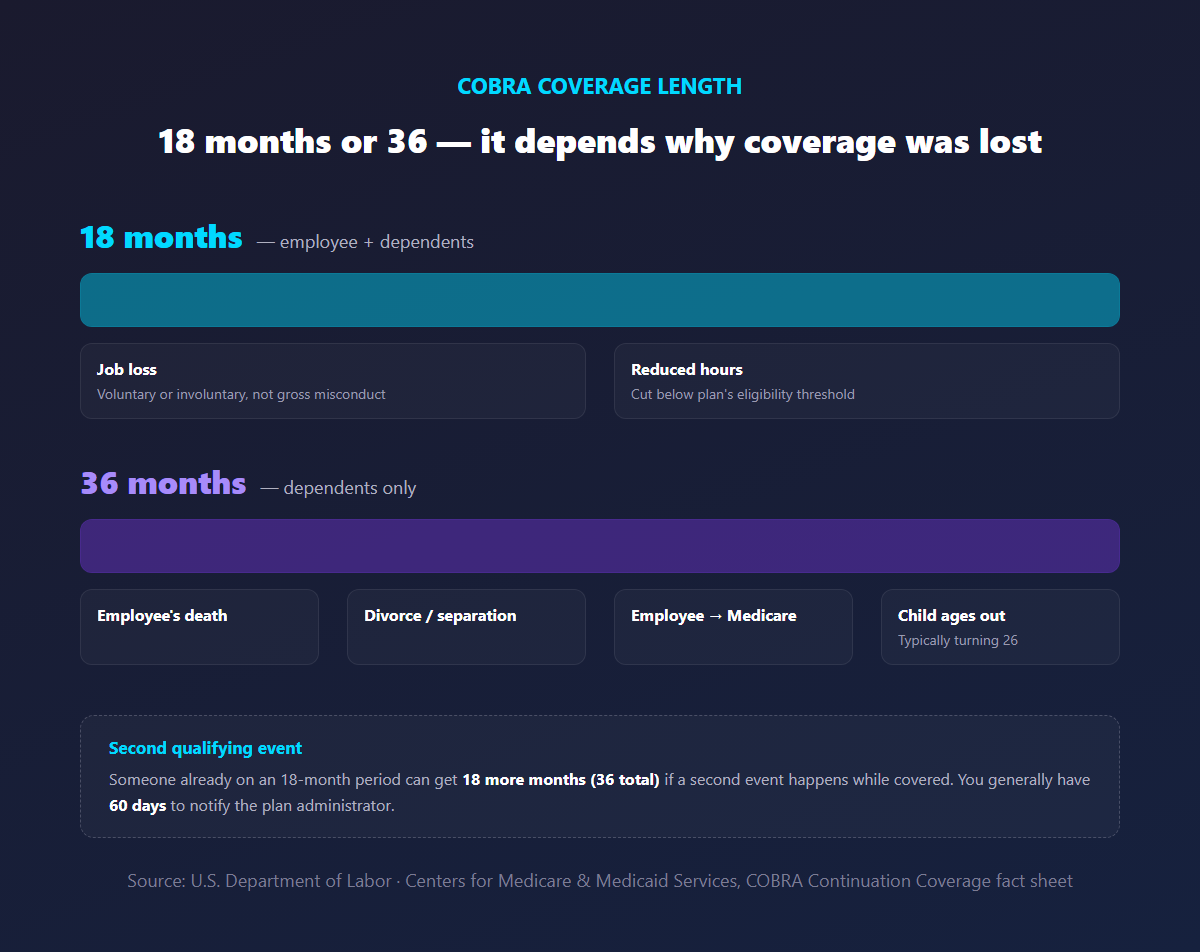
- 18 months: the standard period for the most common triggers — voluntary or involuntary job loss, or reduced work hours — covering the employee and all dependents, as long as the termination wasn't for gross misconduct.
- 36 months: applies to dependents (not the employee) when the qualifying event is the employee's death, divorce or legal separation, the employee becoming eligible for Medicare, or a dependent child aging out of the plan (typically turning 26).
- Second qualifying event: someone already on an 18-month COBRA period can get an additional 18 months (36 total) if a second qualifying event happens while already covered — such as death, divorce, Medicare eligibility, or a dependent losing eligibility. You generally have 60 days to notify the plan administrator of a divorce or a dependent's loss of eligibility to claim this extension.
Source: U.S. Department of Labor, "FAQs on COBRA Continuation Health Coverage for Workers"; Centers for Medicare & Medicaid Services, COBRA Continuation Coverage fact sheet
One nuance worth flagging: some secondary guides say that employees who retire (rather than being laid off or terminated) may only get the standard 18 months for themselves unless they separately qualify for Medicare. That specific distinction wasn't independently confirmed against a DOL or CMS primary source in our research, so treat it as something to verify with your plan administrator rather than a settled rule.
Frequently Asked Questions
Q. How long does COBRA last?
A. 18 months for the most common qualifying events (job loss, reduced hours). Dependents can get up to 36 months for events like the employee's death, divorce, or Medicare eligibility, and an 18-month period can extend to 36 months total if a second qualifying event occurs.
Q. Is COBRA or Marketplace insurance cheaper after losing a job?
A. It depends on your income and on unresolved federal legislation. COBRA costs 102% of the full group premium with no subsidy. Marketplace plans can qualify for income-based subsidies, but the enhanced version of those subsidies expired December 31, 2025, and whether they'll be restored for 2026 was still undecided in Congress as of the most recent reporting we reviewed.
Q. What is the 102% rule in COBRA?
A. It means your plan can charge you up to 102% of the full premium — the amount you used to pay plus the amount your employer used to pay, plus a 2% administrative fee. It's set in federal regulation, 26 CFR 54.4980B-8.
Q. How much does COBRA cost per month?
A. It depends entirely on your former group plan's total premium. Based on 2025 national averages, single coverage under COBRA works out to roughly $9,512/year (about $793/month), and family coverage to roughly $27,533/year (about $2,294/month) — but your actual plan's premium may be higher or lower than the national average.
Q. Does COBRA apply to small employers?
A. Federal COBRA only applies to employers with 20 or more employees. Smaller employers may be covered under a state "mini-COBRA" law instead, which usually offers a shorter coverage period, often around 9 months.
What should you actually compare before deciding?
There's no universal answer to whether COBRA or a Marketplace plan costs less after you leave a job — it depends on your former premium, your new income level, and, this year, on a piece of legislation that hasn't been resolved yet.
What's fixed and calculable is the COBRA side: your former group premium, times 102%. What's variable is the Marketplace side: your subsidy eligibility, which depends on your income and on whether Congress restores the enhanced tax credits that lapsed at the end of 2025.
Both COBRA and HealthCare.gov (or your state exchange) let you get an actual quote before committing to anything, and the 60-day Special Enrollment Period means there's no need to rush a decision the same week you lose coverage.
This article summarizes federal regulations and published survey data as of the sources cited above; it isn't personalized insurance or legal advice. For your specific situation, check current details with your plan administrator, HealthCare.gov, or a licensed insurance professional.
Thanks for reading — see you in the next one.


Comments
Post a Comment