Does the Airline Owe You Money for a Delayed Flight?
Your flight lands three hours late. You open your phone and type the question every traveler types.
Last updated: 2 November 2026 · Figures and rules in this post are current as of this date.
Does the airline owe me money?
For flights inside the United States, the answer is no. No federal rule requires an airline to pay cash for a delay.
Source: U.S. Department of Transportation, Airline Cancellation and Delay Dashboard FAQ (page last updated Sept. 11, 2025) — federal agency page. DOT's own words: "Each airline has its own policies about what it will do for delayed or cancelled passengers."
https://www.transportation.gov/airconsumer/airline-cancellation-delay-dashboard
We wanted to know how big that gap is, so we counted. Every domestic flight of 2025, 7,001,619 of them, straight from the government's own files.
Among the flights that landed three or more hours late, 45.2% (50,402 of 111,405) had an airline-fault box that read zero minutes.
That sounds like good news for airlines. It isn't, quite. The reason sits in one sentence on a government methodology page.
Rules and figures in this post are as of Nov. 2, 2026. It covers US domestic flights unless it says otherwise.
Does a US airline owe you money for a delayed flight?
No. Federal rules give you two narrower things: a refund if you choose not to travel after a significant delay, and cash if you were bumped from an oversold flight. For the delay itself, the rules pay nothing.
Someone did try to change that.
On Dec. 11, 2024, DOT published "Airline Passenger Rights" (89 FR 99760). It asked for comment on requiring airlines to give affected passengers cash compensation, free rebooking, and meals and lodging. It was an advance notice of proposed rulemaking, or ANPRM: a request for comment with no proposed rule text.
On Nov. 17, 2025, DOT withdrew it (90 FR 51230).
DOT gave three grounds: two executive orders on deregulation (14192 and 14219), its "best reading" of Section 512 of the FAA Reauthorization Act of 2024, and the competition language of 49 U.S.C. 40101. Section 512 tells DOT to direct airlines to set policies on reimbursing lodging, transportation and meals when a cancellation or significant delay is directly attributable to the carrier. DOT's reading: that section "does not authorize the Department to require reimbursements or compensations for flight disruptions."
About 350 comments came in. Airlines and airline associations unanimously opposed the idea. Airlines for America and IATA estimated annual costs to airlines of "$5 billion dollars or more." AirHelp, a claims company, estimated a similar regime would cost "each consumer under one dollar per ticket." Consumer groups pointed out that "no large U.S. airline currently guarantees cash compensation for significant flight disruptions."
Source: Federal Register doc. 2025-20042, "Airline Passenger Rights; Withdrawal" (90 FR 51230, Nov. 17, 2025) and doc. 2024-28930 (89 FR 99760, Dec. 11, 2024) — government notices, withdrawal read in full. The cost estimates are claims by trade groups and a claims company, as quoted by DOT. All three are interested parties.
https://www.federalregister.gov/documents/2025/11/17/2025-20042/airline-passenger-rights-withdrawal
https://www.federalregister.gov/documents/2024/12/11/2024-28930/airline-passenger-rights
What airlines promise on their own is a different list. In the withdrawal notice, DOT summarizes its dashboard of voluntary commitments. The 10 largest U.S. carriers, which carry more than 97 percent of domestic scheduled passengers (calendar-year 2024 data), all guarantee a meal and rebooking at no charge on the ticketed airline. Nine guarantee a hotel and ground transportation. Those promises cover controllable delays and cancellations, meaning ones the airline caused, like maintenance or crew problems, cabin cleaning, baggage loading or fueling.
DOT's summary lists no cash payment.
We could not read the dashboard's per-airline check marks, because the page loads them with JavaScript. We rely on DOT's own summary.
DOT's advice if your flight is long delayed is blunt: "ask airline staff if they will pay for meals or a hotel room or compensate you for your time. While some airlines offer these amenities to passengers, others may not."
Source: Federal Register 90 FR 51230-51232 (DOT summary of its dashboard); DOT dashboard FAQ, page last updated Sept. 11, 2025 — government sources. Airlines must follow the promises in their customer service plans, but the promises themselves are voluntary.
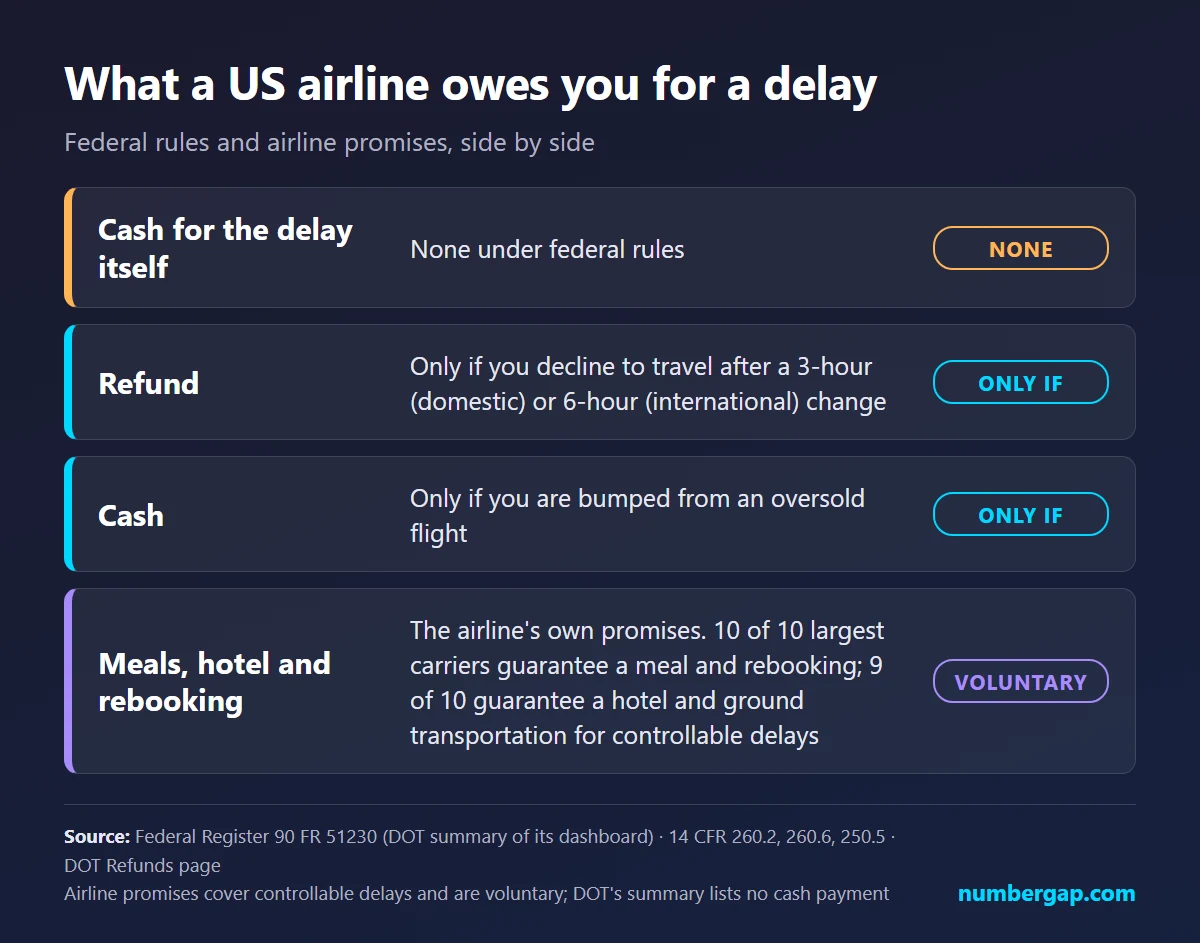
Flight delayed 3 hours: what are you entitled to?
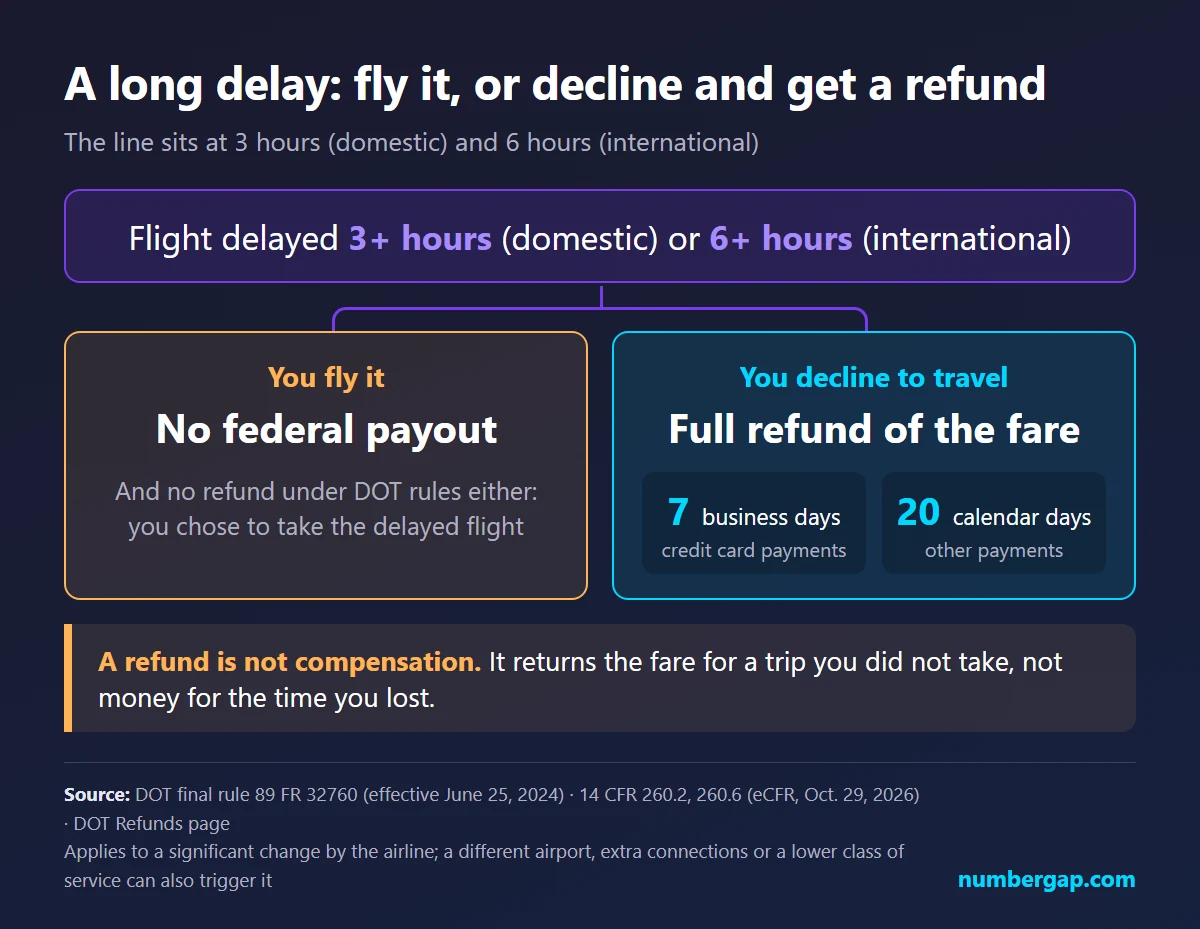
If you fly the delayed flight, nothing under federal rules. If you decide not to fly, a refund. The line sits at three hours for domestic itineraries and six hours for international ones.
The rule is 14 CFR 260.2. It counts a change of 3 or more hours (domestic) or 6 or more hours (international) to your scheduled departure or arrival as significant. A different airport, extra connections or a downgrade in class of service can also trigger it.
Then 14 CFR 260.6 says what you get. A full and prompt refund of the airfare, including taxes and ancillary fees, if you hold a nonrefundable ticket and "the consumer chooses not to" fly the significantly changed flight or accept rebooking, or accept a voucher or other compensation. If you don't respond, the refund is automatic. It must arrive within 7 business days for credit card payments and within 20 calendar days for other forms of payment.
An airline may offer a voucher as an alternative, but only with a clear notice of your right to a full refund, and the voucher must stay valid at least five years.
DOT's consumer page states the limit in one line:
"Consumer Traveled - If you chose to take a significantly delayed/changed flight or an alternative flight offered by the airline, you are not entitled to a refund under DOT rules."
A refund is the return of a fare for a trip you did not take. It is not money for the time you lost.
Source: DOT final rule "Refunds and Other Consumer Protections" (89 FR 32760, published Apr. 26, 2024, effective June 25, 2024); 14 CFR 260.2 and 260.6 (eCFR, current to Oct. 29, 2026); DOT Refunds page, last updated Nov. 7, 2025 — regulation text and agency guidance.
https://www.federalregister.gov/documents/2024/04/26/2024-07177/refunds-and-other-consumer-protections
https://www.ecfr.gov/current/title-14/chapter-II/subchapter-A/part-260
https://www.transportation.gov/individuals/aviation-consumer-protection/refunds
What about sitting on the tarmac? That is a separate protection, and it is not a payout either. For domestic flights, covered U.S. carriers must give passengers the opportunity to deplane before a tarmac delay exceeds three hours. For international flights, the line is four hours. Safety, security and air-traffic exceptions apply.
The remedy is a civil penalty paid by the airline to the government. In DOT Order 2024-5-17, issued May 15, 2024, DOT assessed Volaris $300,000 for failing to follow its contingency plan on lengthy tarmac delays. We found no passenger payout provision in the tarmac rule as we read it.
Source: 14 CFR 259.4(c) (eCFR current to Oct. 29, 2026); DOT Consent Order 2024-5-17 — regulation text and an agency order.
https://www.transportation.gov/sites/dot.gov/files/2024-05/Volaris%20Order%202024-5-17.pdf
One more duty is about information. For a flight scheduled to depart within 7 days, airlines must give status updates "30 minutes (or sooner) after the airline becomes aware of a status change."
When does US law actually pay cash? Only when you are bumped.
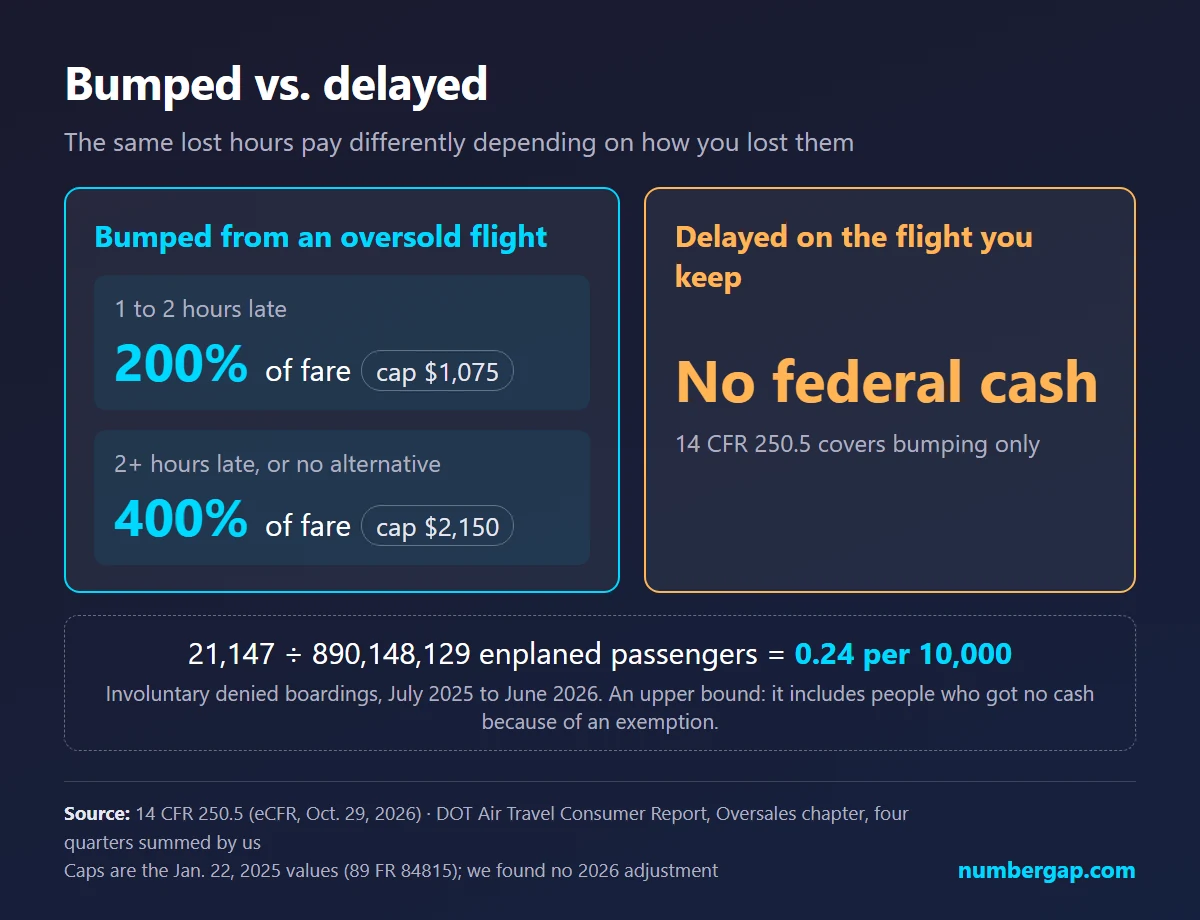
Federal rules require cash when an airline bumps you from an oversold flight and cannot get you there within an hour of your original arrival. The pay is 200% or 400% of your one-way fare, with dollar caps.
Here is how 14 CFR 250.5 works for a domestic flight:
- Rebooked to arrive within one hour of the original time: no compensation.
- Arrival more than one hour but less than two hours late: at least 200% of the fare, or $1,075, whichever is lower.
- Arrival two or more hours late, or no alternative offered: at least 400% of the fare, or $2,150, whichever is lower.
International flights leaving the US use the same percentages and caps, with the bands at one to four hours and four hours or more. "Fare" includes mandatory taxes and fees but not optional ancillary fees. The airline pays in cash or an immediately negotiable check on the day and at the place of the denied boarding.
Two kinds of bumping exist. If the airline asks for volunteers first, what it offers them is unregulated. DOT says: "There is no limit to the amount of money or vouchers that the airline may offer." It also says: "The business practice of bumping is not illegal." The 200% and 400% apply to people bumped against their will.
Source: 14 CFR 250.5, 250.6, 250.8 (eCFR current to Oct. 29, 2026); DOT Bumping & Oversales page, last updated Sept. 26, 2025 — regulation text and agency guidance. The caps rose from $775 and $1,550 in a rule published Oct. 24, 2024 and effective Jan. 22, 2025 (89 FR 84815). We searched the Federal Register for a 2026 adjustment and found none as of Nov. 2, 2026.
https://www.ecfr.gov/current/title-14/chapter-II/subchapter-A/part-250
https://www.federalregister.gov/documents/2024/10/24/2024-23588/periodic-revisions-to-denied-boarding-compensation-and-domestic-baggage-liability-limits
How many people does this cash reach? In the four quarters from July 2025 through June 2026, airlines reported 21,147 involuntary denied boardings against 890,148,129 enplaned passengers (marketing-carrier table). That is 0.24 per 10,000 passengers, or roughly one in 42,000.
Voluntary bumps ran about 13.6 times higher: 288,078.
Treat the 21,147 as an upper bound. DOT's count includes people who were bumped but did not qualify for compensation because of an exception. And the number is lopsided. The American Airlines network and Frontier accounted for 18,976 of the 21,147, about 90 percent. Delta reported zero in all four quarters. DOT publishes airline names in this table, which is why we can name them here, though not in the delay numbers later.
One caution on trend. The second quarter of 2025 had 7,648 involuntary bumps (0.33 per 10,000). The second quarter of 2026 had 3,376 (0.15). DOT's report does not explain the drop, so don't read it as a trend.
Source: DOT Air Travel Consumer Report, Oversales chapter, issues of Dec. 2025, March 2026 (revised May 14, 2026), June 2026 and October 2026 (revised Oct. 22, 2026) — official quarterly data. The four-quarter sum and rate are our arithmetic.
https://www.transportation.gov/sites/dot.gov/files/2026-10/October%202026%20ATCR%20revised%2010-22-2026.pdf
Put the two rules side by side. Get bumped and rebooked to arrive two hours late: 400% of your fare, capped at $2,150. Keep your seat on a plane that lands two hours late: nothing.
How often is a flight 3 hours late? We counted 7 million.
In 2025, about 1 in 62 arrivals on US domestic flights landed three or more hours late. That is 111,405 of 6,879,484 flights that arrived.
We downloaded the twelve monthly files of the Bureau of Transportation Statistics' on-time database, January through December 2025, and added them up. The database covers scheduled domestic service by the airlines that report to BTS, 7,001,619 flights in all. Of those, 102,876 were cancelled (1.469%) and 19,258 were diverted (0.275%). The other 6,879,484 arrived (98.256%).
Everything below uses those 6,879,484 arrivals as the base.
A thought experiment first, clearly labeled. The two-hour and three-hour lines below come from other places' rules: South Korea's standard for international flights and the EU's. They do not apply to US domestic flights. We used them as rulers.
| Arrived late by | Flights | Share of arrivals | About 1 in |
|---|---|---|---|
| 15 minutes or more | 1,534,638 | 22.307% | 4 |
| 1 hour or more | 562,554 | 8.177% | 12 |
| 2 hours or more | 231,272 | 3.362% | 30 |
| 3 hours or more | 111,405 | 1.619% | 62 |
| 4 hours or more | 60,108 | 0.874% | 114 |
| 6 hours or more | 24,669 | 0.359% | 279 |
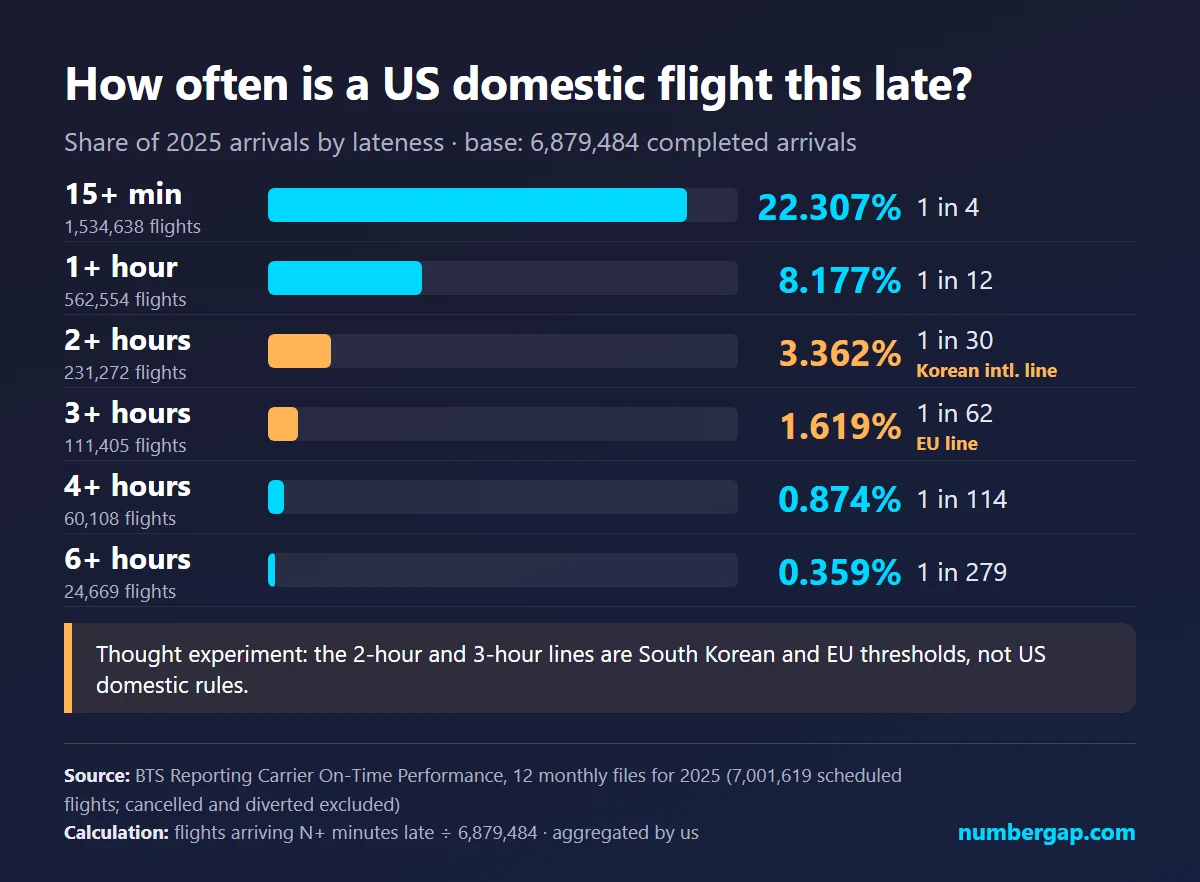
Government statistics count a flight as on time if it arrives less than 15 minutes after the scheduled time. That is the line the first row uses.
Source: BTS "Reporting Carrier On-Time Performance (1987-present)," twelve monthly files for 2025, downloaded Nov. 2, 2026 — federal agency data, aggregated by us. On-time definition: DOT Air Travel Consumer Report, Oct. 2026.
https://transtats.bts.gov/PREZIP/
One in 62 sounds rare. Across a year of US domestic flying, it was 111,405 flights.
What matters more is why those flights were late.
Why was the plane late? The biggest answer is a blank.
The largest share of delay minutes was filed under "late-arriving aircraft": 39.2%. And the government's own methodology page says airlines do not report what made that earlier flight late.
Here is the whole 2025 pile. The 1,534,638 flights that arrived 15 minutes or more late added up to 111,934,625 minutes of delay. That is 1,865,577 hours, about 213 years. Airlines sort those minutes into five boxes.
| Reported cause | Minutes | Share of delay minutes |
|---|---|---|
| Late-arriving aircraft | 43,862,971 | 39.2% |
| Air Carrier | 36,326,377 | 32.5% |
| National Aviation System (NAS) | 24,483,761 | 21.9% |
| Extreme Weather | 7,108,714 | 6.4% |
| Security | 152,802 | 0.1% |
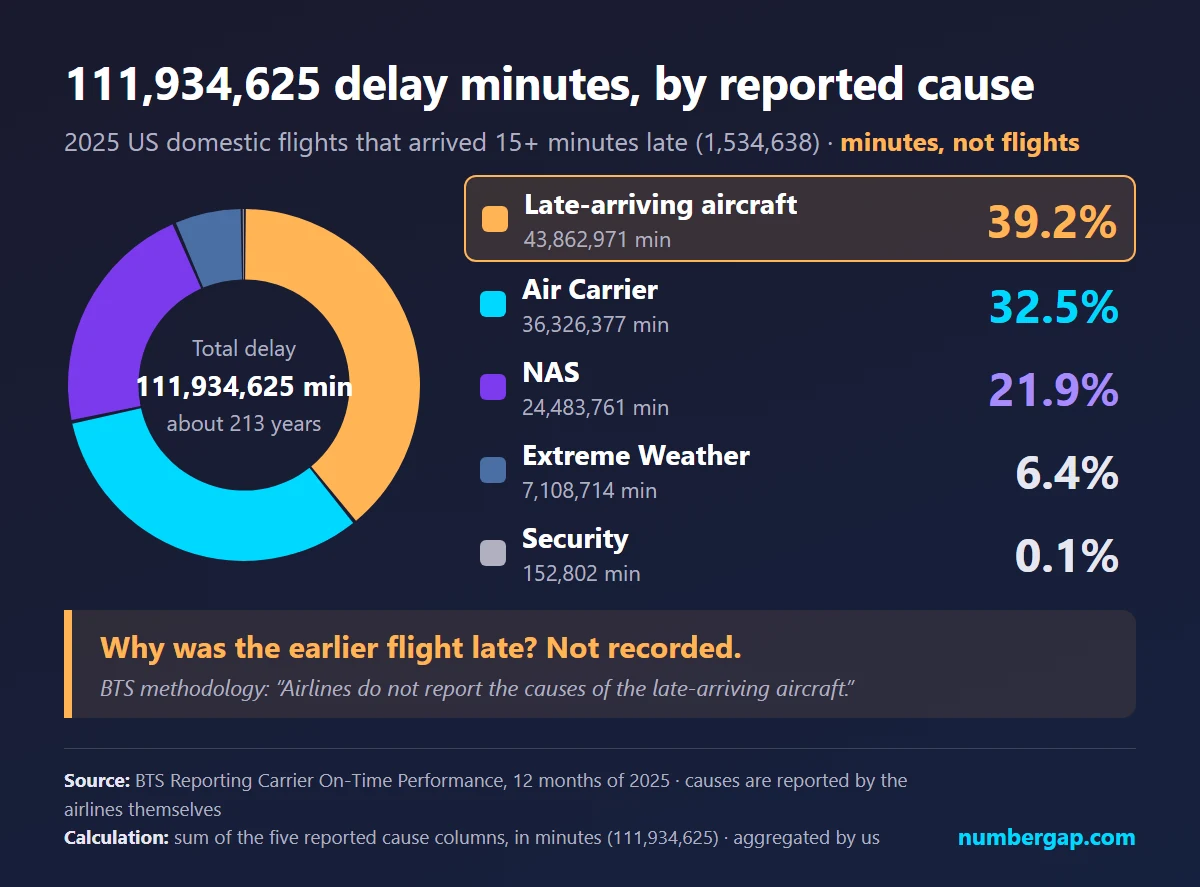
BTS defines the boxes in its own words. Air Carrier is "circumstances within the airline's control (e.g. maintenance or crew problems, aircraft cleaning, baggage loading, fueling, etc.)." NAS covers "non-extreme weather conditions, airport operations, heavy traffic volume, and air traffic control." And late-arriving aircraft is "A previous flight with same aircraft arrived late, causing the present flight to depart late."
Then we went looking for what makes the previous flight late. We searched the methodology page for it. One sentence answers, and it sits inside BTS's reply to the question of whether weather causes only 4 percent of delays:
"Airlines do not report the causes of the late-arriving aircraft but an allocation can be made using the proportion of weather related-delays and total flights in the other categories."
The biggest box has no cause of its own.
If the earlier flight was late because of a maintenance problem, the next flight's delay still goes under late-arriving aircraft. If it was late because of a storm, same box.
Source: BTS, "Understanding the Reporting of Causes of Flight Delays and Cancellations" (page dated Apr. 15, 2024), read Nov. 2, 2026 — federal agency methodology. Causes are reported by the airlines themselves, in categories created by the Air Carrier On-Time Reporting Advisory Committee.
https://www.bts.gov/topics/airlines-and-airports/understanding-reporting-causes-flight-delays-and-cancellations
One other rulebook writes this blind spot into its exemption list. South Korea's consumer dispute standard is a non-binding set of figures for settling airline claims. Its table pays a percentage of the fare for a late arrival, unless the airline proves one of five reasons. One of them is "aircraft connection," defined as a previous flight's delay or cancellation affecting the next connecting flight. Nothing in that definition asks why the earlier flight was late. (We read the table in its Dec. 27, 2024 version; the current edition's airline table is published only as images.)
The two systems are different. One is a settlement standard, the other a statistics code. The concept overlaps, and that is as far as we go.
What about cancelled flights?
Airlines also report a reason code for each cancellation. Of 102,876 cancelled domestic flights in 2025, the codes read:
- Weather: 61.6% (63,404)
- Carrier: 20.5% (21,073)
- NAS: 17.8% (18,349)
- Security: 0.0% (50)
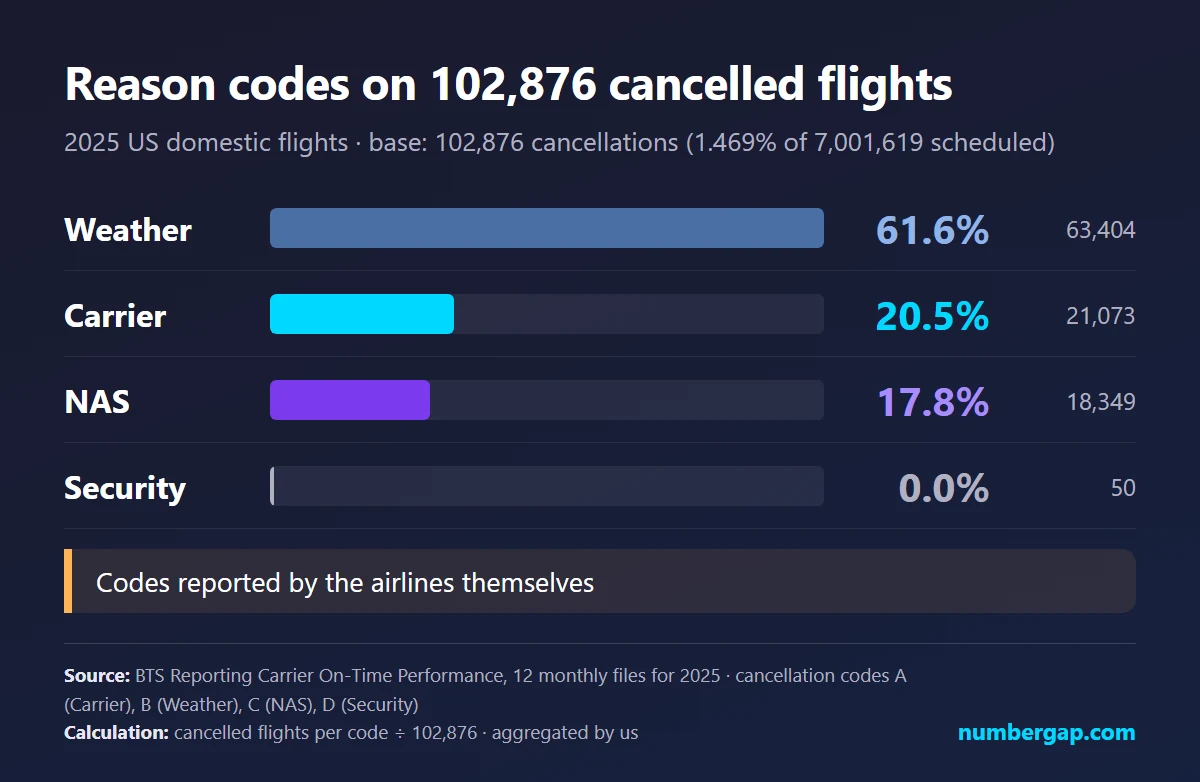
These are the airlines' own codes. As with delays, a code is a classification, not an audit.
Whose fault were the 3-hour delays? Nearly half say "zero airline minutes."
Among the 111,405 flights that landed three or more hours late, 50,402 (45.2%) show zero minutes in the airline-fault box. This is the same thought experiment as before: the three-hour line is an EU number, not a US rule.
First, the biggest single cause on each of those flights:
- Late-arriving aircraft: 44.0%
- Air Carrier: 33.2%
- NAS: 13.1%
- Extreme Weather: 9.6%
Then the box we cared about. We counted flights where the Air Carrier delay was exactly zero minutes.
| Arrival delay | Flights with zero airline-fault minutes | Flights | Share |
|---|---|---|---|
| 15 minutes or more | 729,327 | 1,534,638 | 47.5% |
| 2 hours or more | 109,108 | 231,272 | 47.2% |
| 3 hours or more | 50,402 | 111,405 | 45.2% |
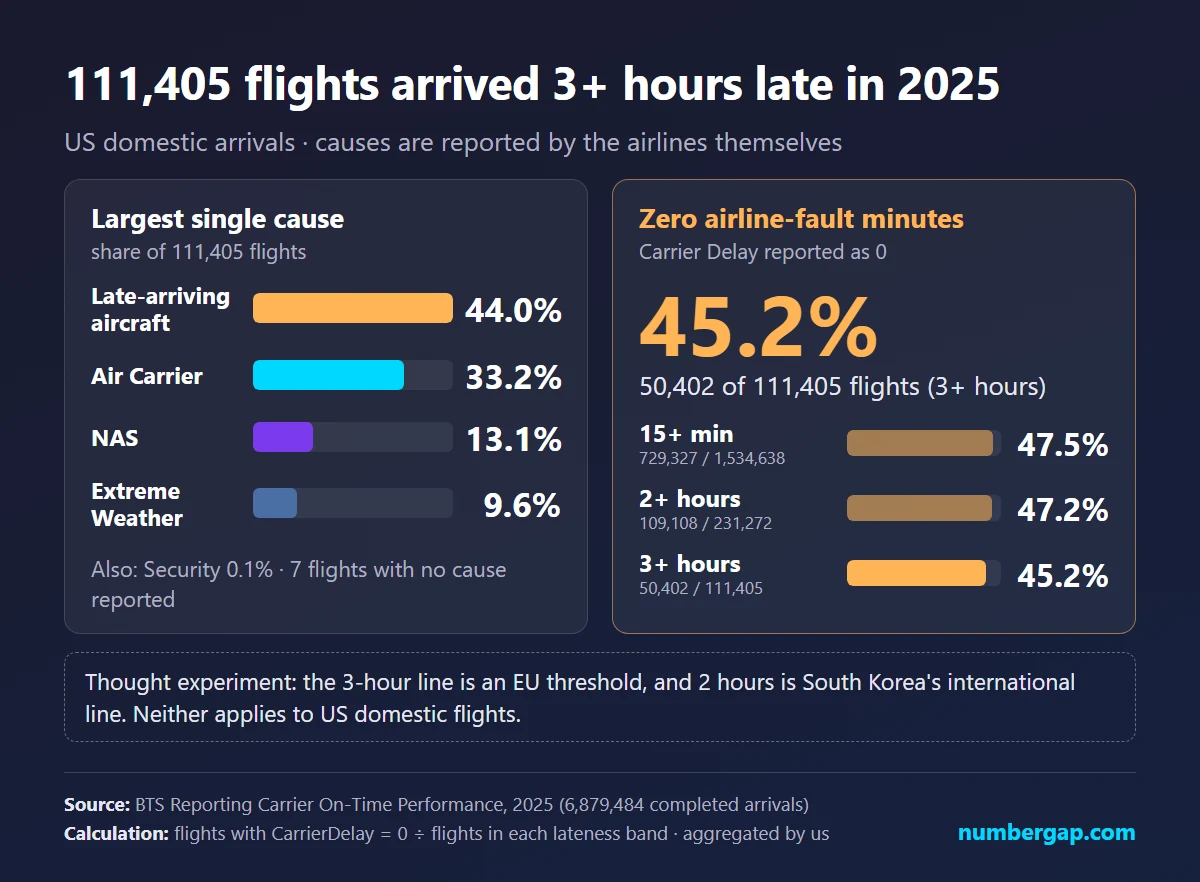
Do not read this as "the airlines were innocent." Zero means the airline put none of the delay in that box. It does not prove the airline did nothing wrong. The reason is the blank from the last section: why the earlier flight was late is not in the file.
We can still say what it means for the size of the gap. Suppose a rule paid only for delays the airline itself reported as its own. About 45.2% of the longest delays would fail at the door. No US rule works that way. It is a way to see how much of the pile sits in a box with no cause.
How far can you trust this count?
The arithmetic nearly holds. And the list of what the data cannot tell you matters more.
We checked the arithmetic first. We took all 1,534,638 flights that arrived 15 minutes or more late in 2025 and compared, flight by flight, the arrival delay minutes with the sum of the five cause minutes. Arrival delay minutes totaled 111,938,194. The five causes totaled 111,934,625. The gap is 3,569 minutes, 0.0032%. Fourteen flights did not match, 0.0009% of the 1,534,638.
That is not a perfect match, and we do not call it one. It is far too small to move any share in this post.
For June 2025 alone, one more thing showed up. The number of flights with cause minutes filled in (169,405) was exactly the number of flights 15 minutes or more late. BTS's rule that causes are reported only for those flights shows up in the data itself.
Here is what the count cannot do.
- It covers US domestic scheduled flights only. International flights and small carriers are not in it. Carriers report if they earn at least 0.5% of domestic scheduled passenger revenue. The 19,258 diverted flights are out of the arrival-delay counts.
- Causes are the airlines' own reports. BTS says so. This is not a third-party audit.
- Cause minutes exist only for flights 15 minutes or more late.
- The root cause of "late-arriving aircraft" is not in the data.
- Weather is split across two boxes. Extreme Weather is 6.4%, but writing "weather is only 6% of delays" is the calculation BTS itself says is wrong. BTS notes that in 2020, 45.8% of NAS delays were weather, and some late-arriving-aircraft delays are weather too. We did not allocate it, so we make no claim about weather's share.
- It is not a payout record. The count cannot tell you how many passengers were compensated.
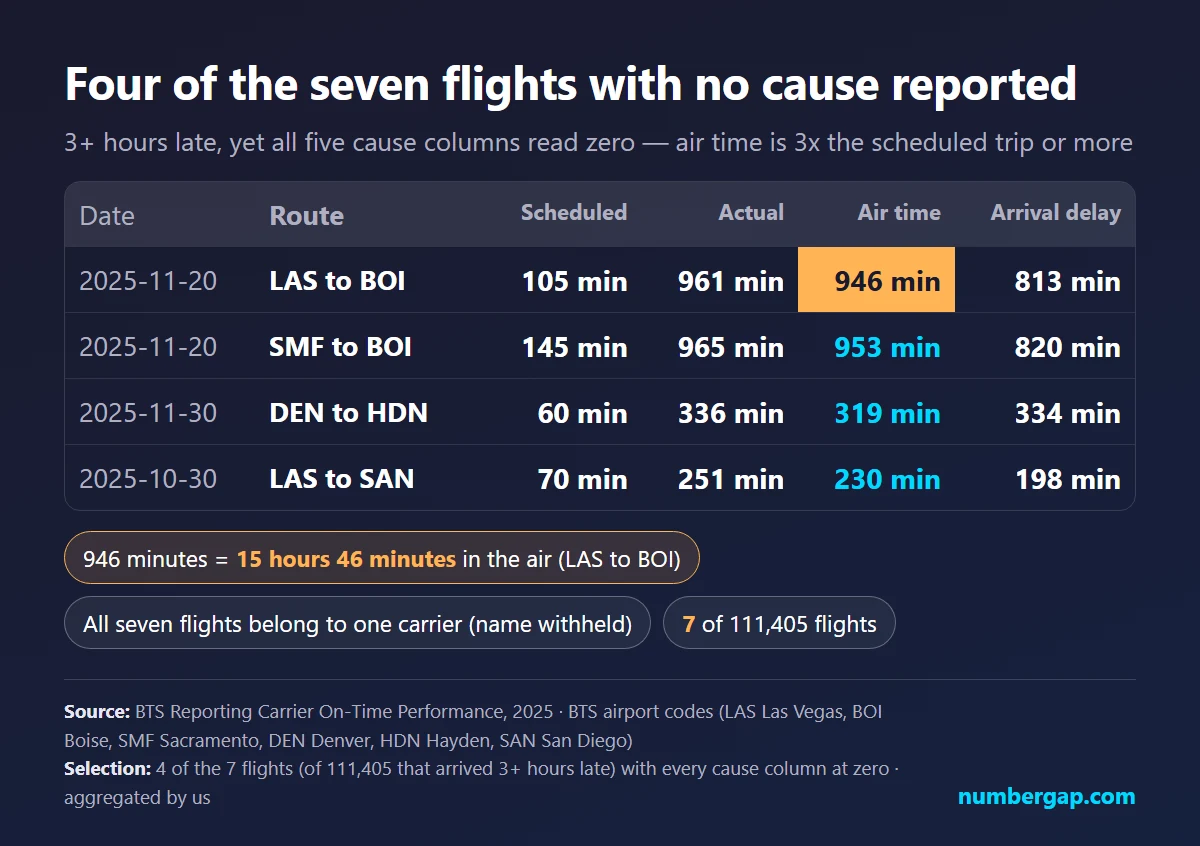
- Seven flights have no cause reported, and their own time columns do not add up. The five dominant-cause counts for 3-hour delays add to 111,398, seven fewer than 111,405. We opened those seven. All belong to one carrier, and six fall in October and November 2025. Their recorded flight times are physically impossible. A Las Vegas to Boise flight scheduled for 105 minutes shows 946 minutes in the air: 15 hours and 46 minutes. No such flight happened.
That looks like a reporting error. Seven of 111,405 moves no share in this post. But it is a visible example of what "self-reported" means.
If you have seen DOT's monthly Air Travel Consumer Report, one more caution. Its August 2026 table puts late-arriving aircraft at 39.1% of cause-coded delayed flights, by our arithmetic from DOT's counts. That counts flights in one month. We count minutes across a year. The numbers look alike, and they do not check each other.
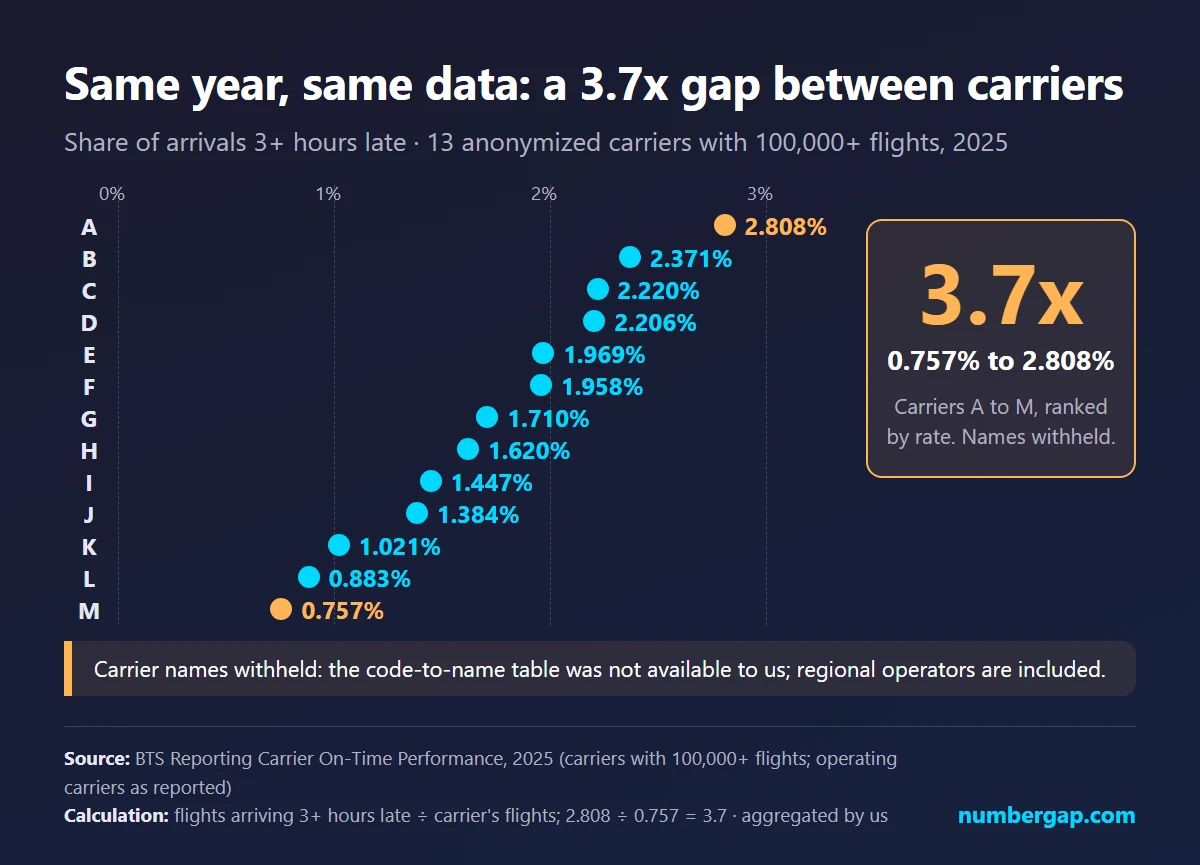
We also left airline names out of the delay numbers. Among the 13 reporting carriers with at least 100,000 flights, the share of arrivals 3 or more hours late ran from 0.757% to 2.808%, a 3.7-times spread. We could not get BTS's carrier-code-to-name table, and a name attached from memory is not evidence. The reporting carriers also include regional operators flying for the big brands.
Is there a rule that does pay for lateness? EU261, and who in the US is covered.
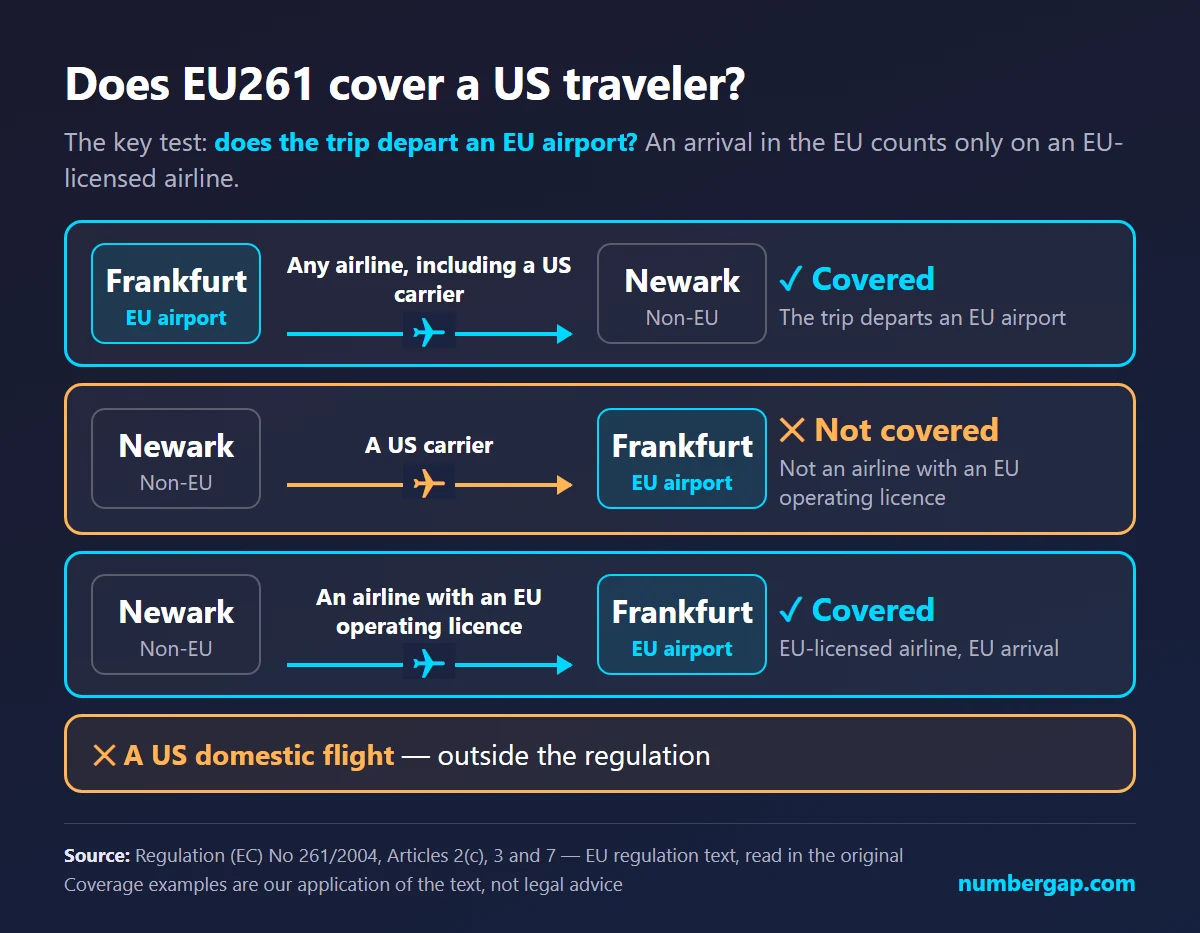
Yes, in Europe. Under EU Regulation 261/2004 (EU261), a passenger who arrives three or more hours late can claim a flat EUR 250, 400 or 600. It applies to flights leaving an EU airport on any airline, and to flights arriving in the EU only on an airline licensed by an EU country.
That is Article 3(1), which we read in the original text. For a US traveler it works out like this. The text of the regulation is clear; the application is our reading.
- Frankfurt to Newark: covered on any airline, including United, because the flight departs an EU airport.
- Newark to Frankfurt: covered only on an airline with an EU member-state operating licence, such as Lufthansa. Not on United.
- A US airline flying between two US cities: outside the regulation.
A US local-station report (KCTV5, July 13, 2026) describes the same rule in plain terms, though it gives no claim statistics.
The amount is fixed by distance, not by fare: EUR 250 for flights up to 1,500 km, EUR 400 for intra-EU flights over 1,500 km and other flights of 1,500 to 3,500 km, and EUR 600 for everything else. If a replacement flight gets you in within two, three or four hours of the original arrival (by distance band), the airline may cut the payment by 50%.
Source: Regulation (EC) No 261/2004, Articles 2(c), 3, 7 — EU regulation text, read in the original. Coverage examples are our application of the text, not legal advice.
https://publications.europa.eu/resource/cellar/439cd3a7-fd3c-4da7-8bf4-b0f60600c1d6
https://www.kctv5.com/2026/07/13/long-lines-last-minute-changes-little-known-rule-that-protects-americans-flying-europe/?outputType=amp
Where does the 3-hour line come from?
Not from the regulation. Article 6, which covers delays, provides assistance such as meals and communications, plus a refund option at five hours. Money appears only in Article 5 (cancellations) and Article 7.
The three hours came from a court. In Sturgeon (joined cases C-402/07 and C-432/07, Court of Justice of the EU, Nov. 19, 2009), the court said delayed passengers may be treated like cancelled ones when they "reach their final destination three hours or more after the arrival time originally scheduled by the air carrier." The test is measured at your final destination.
Airlines can escape by proving "extraordinary circumstances which could not have been avoided even if all reasonable measures had been taken" (Article 5(3)). Recital 14 lists political instability, weather incompatible with the flight, security risks, unexpected flight safety shortcomings and strikes.
A broken plane, though, is generally not an excuse. In Wallentin-Hermann v Alitalia (C-549/07, Dec. 22, 2008), the court held that technical problems that come to light during maintenance are not, in themselves, extraordinary. Only something like a hidden manufacturing defect revealed by the manufacturer or a competent authority, or sabotage damage, qualifies. Compliance with minimum maintenance rules does not by itself prove all reasonable measures were taken.
The regulation's text has no blanket exemption for a late inbound aircraft. Our reading is that a late inbound plane excuses the airline only if the original cause was itself extraordinary. We did not find a judgment on knock-on delays.
Source: Regulation (EC) No 261/2004, Articles 5-7, recitals 14-15 — EU regulation text. CJEU judgments: Sturgeon https://publications.europa.eu/resource/celex/62007CJ0402 and Wallentin-Hermann https://publications.europa.eu/resource/celex/62007CJ0549 — court texts, read in the original.
Is EU261 changing?
Not the money, and not yet in force. The European Parliament adopted the joint text agreed in conciliation by 646 votes to 12 with 3 abstentions (procedure file dated July 7, 2026). Compensation stays at EUR 250, 400 and 600 for arriving more than three hours late. Claims get a nine-month window from the actual departure date, and the airline must pay or justify refusal within 30 days.
Reports say the new rules take effect in "2027." One outlet gives Oct. 23, 2027, which we could not confirm in an official document. What a claimant can invoke today is the 2004 regulation plus case law.
Source: European Parliament Legislative Observatory, procedure 2013/0072(COD), document summary; Euronews, July 10, 2026; Sofia Globe, July 7, 2026 — legislative summary and press reports.
https://oeil.europarl.europa.eu/oeil/en/document-summary?id=1908627
https://www.euronews.com/2026/07/10/inside-the-eus-bittersweet-deal-to-update-air-passenger-rights
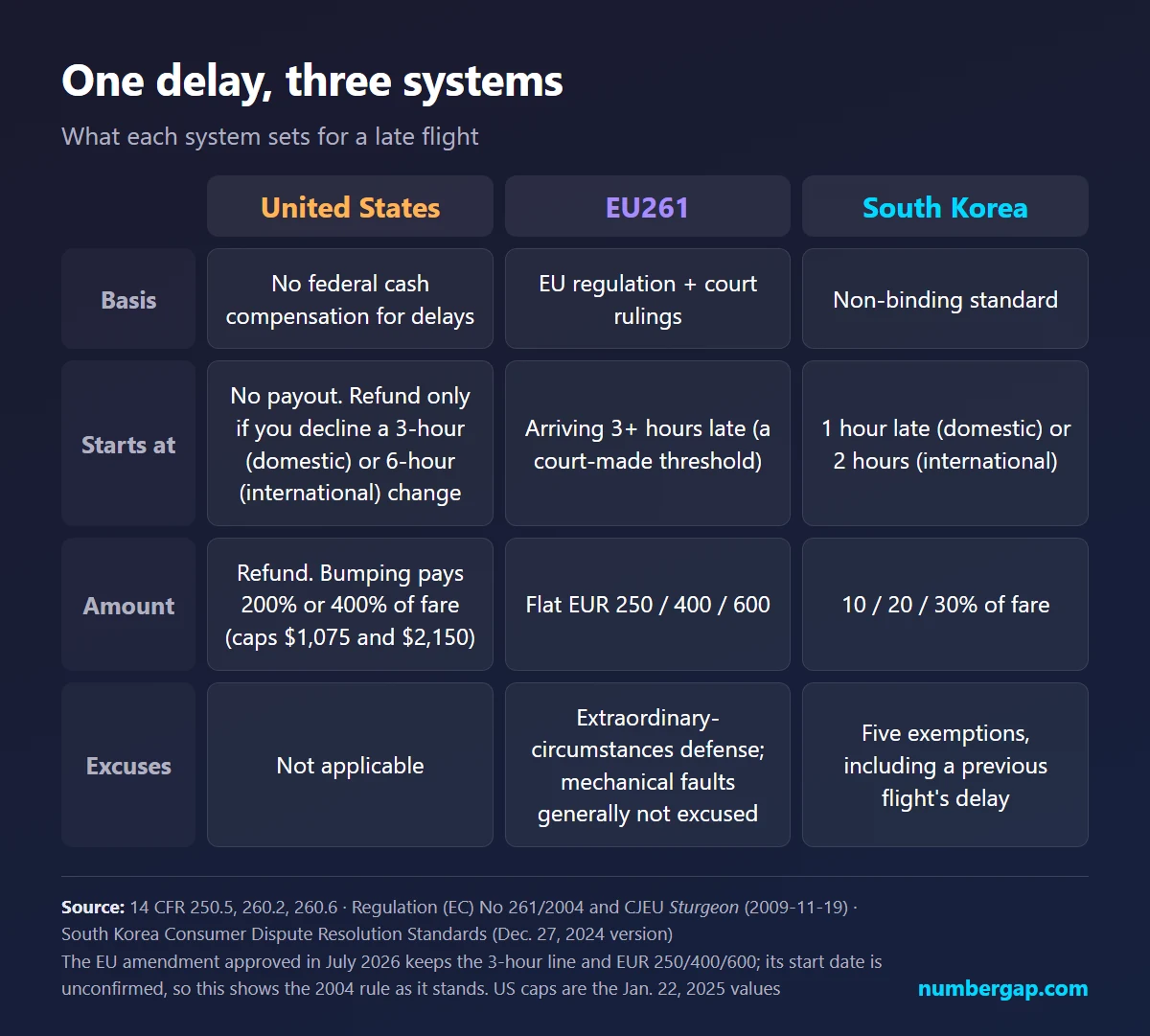
Same delay, three outcomes
Put the three systems on one page and the same late arrival lands in three different places. (South Korea's column reads its non-binding standard in the Dec. 27, 2024 version.)
Do claims companies like AirHelp get it for you, and what do they keep?
They keep a large share. When we searched this question in English, claims companies appeared among the top results, so this is likely the first page of fees you will see. Their own published fees run 30% to 50% of what they collect, and we found no independent data on how often claims succeed.
- AirHelp: "Standard fee 35% (VAT included)," plus 15% if legal action is needed, up to 50% in total.
- AirAdvisor: 30% of the sum collected before trial, VAT included, and 50% if external lawyers are needed. For refund and baggage claims it is 40%, with a flat minimum of EUR 90 on claims under EUR 225.
Both are the companies' own marketing pages, fetched Nov. 2, 2026.
On success rates and timelines, we looked for a regulator, a consumer organization or court statistics. We found none. Claims companies publish their own numbers, and we do not repeat them.
There is a free route. Article 16 of the regulation requires each member state to designate an enforcement body, and a passenger "may complain to any body designated." Article 15 bars airlines from waiving their obligations by contract.
Source: AirHelp, "AirHelp vs AirAdvisor" (company blog, undated); AirAdvisor price list — company marketing material. Regulation (EC) No 261/2004, Articles 15-16 — EU regulation text. The search observation reflects our own search on Nov. 2, 2026; results vary.
https://www.airhelp.com/en-int/blog/airhelp-vs-airadvisor/
https://airadvisor.com/en-us/pricelist
What did we look for and not find?
We went looking for a few things we could not find.
- A national total of what airlines actually paid out for delays. We found none.
- Independent EU261 claim success rates or typical processing times. Only company numbers exist.
- A 2026 adjustment to the bumping caps. The Federal Register shows the Jan. 22, 2025 increase to $1,075 and $2,150. We found nothing newer as of Nov. 2, 2026.
- Per-airline detail of DOT's voluntary commitments. The dashboard loads its check marks with JavaScript, and we could not read them.
- A court judgment on whether a late inbound flight excuses an airline under EU261.
Frequently Asked Questions
Q. Does the airline owe me money for a delayed flight?
A. For flights within the United States, no federal rule requires cash compensation for a delay. DOT's own guidance says each airline has its own policies. The federal rules give a refund if you decline to travel after a significant change, and cash if you are bumped from an oversold flight. Airlines may promise more voluntarily, such as meals and rebooking.
Q. Flight delayed 3 hours: what am I entitled to?
A. If you take the delayed flight, nothing under federal rules. If you decline it, a three-hour domestic or six-hour international change qualifies you for a full refund within 7 business days (credit card) or 20 calendar days (other payment). DOT advises asking airline staff about meals, a hotel or compensation, because some airlines provide them and others do not.
Q. Do airlines have to compensate for delays in the US?
A. No. DOT floated the idea in December 2024 through an advance notice asking for public comment, and withdrew it on Nov. 17, 2025. DOT's reading of the 2024 FAA law is that it does not authorize requiring reimbursement or compensation for flight disruptions.
Q. How long does a flight have to be delayed to get a refund?
A. Three hours or more for domestic itineraries and six hours or more for international ones (14 CFR 260.2), and only if you choose not to travel. If you fly the delayed flight, DOT says you are not entitled to a refund under its rules.
Q. How much do you get for being bumped from a flight?
A. For involuntary bumping from an oversold domestic flight: nothing if you are rebooked to arrive within an hour, at least 200% of the one-way fare (up to $1,075) if you arrive one to two hours late, and at least 400% (up to $2,150) if two hours or more late or no alternative is offered. Caps are as of Nov. 2, 2026; we found no 2026 adjustment.
Q. Does EU261 apply to US citizens?
A. It applies by route, not by passport. Flights departing an EU airport are covered on any airline. Flights arriving in the EU are covered only on airlines licensed by an EU member state. Arriving three or more hours late can mean EUR 250, 400 or 600 unless the airline proves extraordinary circumstances. This is our reading of the regulation, not legal advice.
Q. What does "late-arriving aircraft" mean in flight delay data?
A. It is a BTS delay-cause code for when a previous flight with the same aircraft arrived late, causing the present flight to depart late. BTS says airlines do not report the causes of the late-arriving aircraft, so the code does not tell you why the earlier flight was late.
Q. How much do flight delay claim companies charge?
A. By their own published pages, AirHelp charges 35% (VAT included), up to 50% with legal action. AirAdvisor charges 30% (VAT included), or 50% if external lawyers are needed. We found no independent success-rate data.
What should you do the next time a flight runs late?
Start with which rulebook your trip sits under. Then decide whether to travel at all, because the only federal payment for a delay is a refund for a trip you skip.
- Know the rulebook. US domestic: refund or bumping rules only. A flight leaving an EU airport, or arriving in the EU on an EU-licensed airline: EU261 may apply. Our reading, not legal advice.
- Decide before you board the delayed flight. If the delay hits 3 hours (domestic) or 6 hours (international) and you do not want to go, you can decline and claim the refund. If you fly it, no federal rule pays you.
- Ask staff what they will provide. Meals, rebooking and hotel are voluntary promises, so ask. Keep the airline's notices of the delay and its stated cause.
- For EU261, claim from the airline first. A claims company will take 30% to 50% of the payout. The enforcement body in the member state is the free route.
The count behind this post shows one odd thing. The longest delays pile up in a box that records no cause, and the one US rule that pays cash reaches, at most, about one in 42,000 passengers.
This post checks public rules and data. It is not legal advice. For your own claim, check with the airline, DOT, or an attorney. Laws and figures are as of Nov. 2, 2026.
Thanks for reading. We will see you in the next post.
Sources
U.S. government and regulation
- Federal Register 2025-20042, "Airline Passenger Rights; Withdrawal," 90 FR 51230, Nov. 17, 2025
- Federal Register 2024-28930, "Airline Passenger Rights" ANPRM, 89 FR 99760, Dec. 11, 2024
- Federal Register 2024-07177, "Refunds and Other Consumer Protections," 89 FR 32760, Apr. 26, 2024
- Federal Register 2024-23588, "Periodic Revisions to Denied Boarding Compensation and Domestic Baggage Liability Limits," 89 FR 84815, Oct. 24, 2024
- eCFR, 14 CFR Part 250 (Oversales), Part 260 (Refunds), Part 259 (Tarmac delays) — current to Oct. 29, 2026
- DOT, Airline Cancellation and Delay Dashboard (page last updated Sept. 11, 2025)
- DOT, Refunds (last updated Nov. 7, 2025) / DOT, Bumping & Oversales (last updated Sept. 26, 2025)
- DOT Air Travel Consumer Report, October 2026 (revised Oct. 22, 2026)
- BTS, Understanding the Reporting of Causes of Flight Delays and Cancellations / BTS on-time database files
- DOT Consent Order 2024-5-17, Volaris (tarmac delays)
EU and South Korea
- Regulation (EC) No 261/2004, original text — EU Publications Office
- Sturgeon, C-402/07 and C-432/07 / Wallentin-Hermann, C-549/07
- European Parliament Legislative Observatory, procedure 2013/0072(COD)
- Korea Fair Trade Commission, Consumer Dispute Resolution Standards (notice no. 2025-14, in force Dec. 18, 2025), via the National Law Information Center — the Dec. 27, 2024 consolidated edition was used for the airline table
Press and company sources
- Euronews, "Inside the EU's bittersweet deal to update air passenger rights," July 10, 2026
- The Sofia Globe, "European Parliament approves upgraded air passenger rights," July 7, 2026
- KCTV5, "Long lines, last-minute changes - and a little-known rule that protects Americans flying to Europe," July 13, 2026
- AirAdvisor fee schedule / AirHelp vs AirAdvisor — company marketing material


Comments
Post a Comment