Was Heathcliff Black? What Wuthering Heights Actually Says
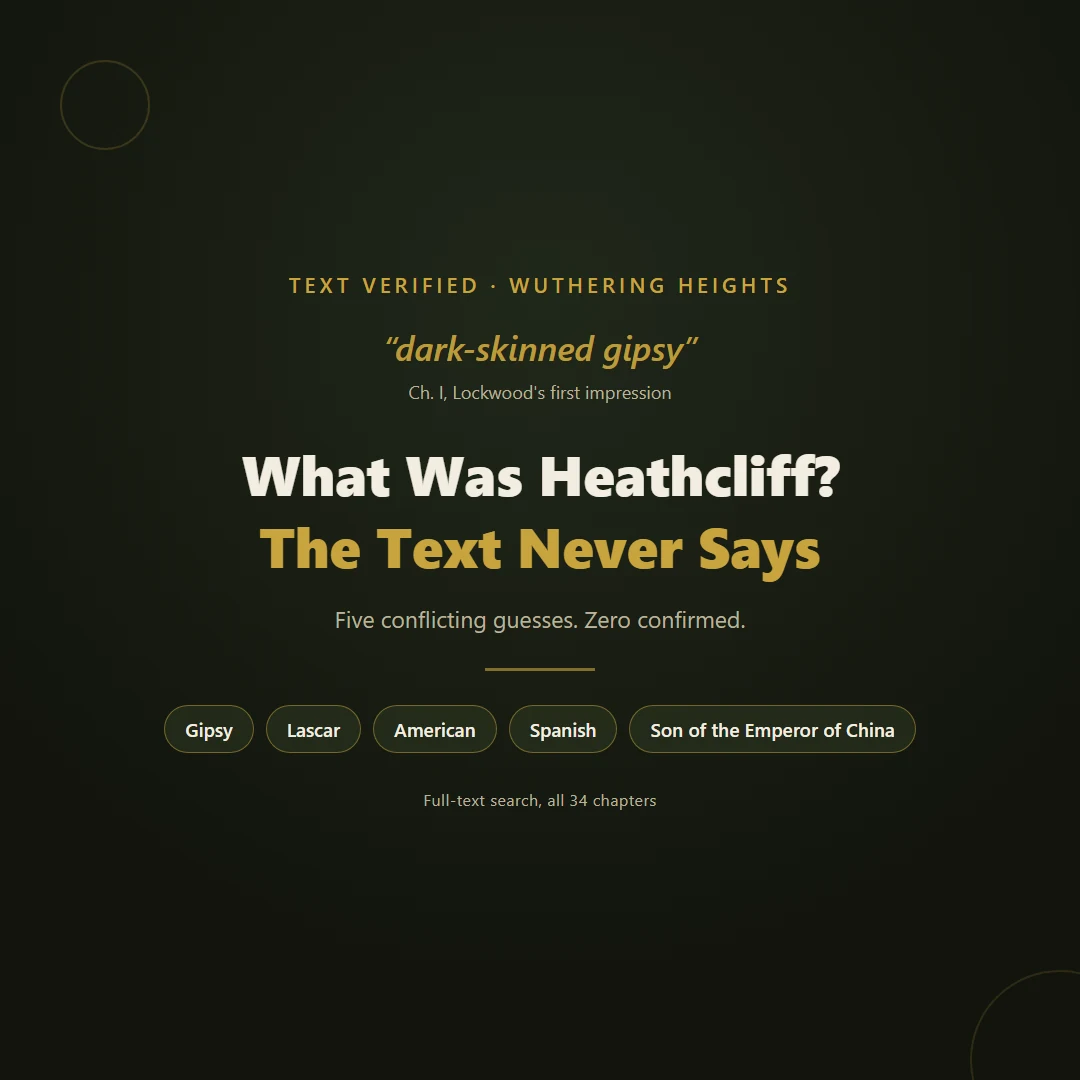
We went looking for the one moment Heathcliff talks about his own skin.
There's exactly one. In all 34 chapters.
Last updated: 20 September 2026 · Quotations and occurrence counts were checked against the source text on this date.
"I wish I had light hair and a fair skin."
Nelly Dean answers him.
"A good heart will help you to a bonny face, my lad... if you were a regular black."
That's it. Across the entire novel, that's the only time Heathcliff himself brings up his own coloring. [Confirmed — full-text search]
And yet people have argued for thirty years about whether he's Black, Romani, South Asian, or Irish. In 2026 the argument spilled into a casting controversy over a $80 million film.
So we went back to the primary text and checked, line by line, what Brontë's narrators actually say — and what they never do.
You Don't Need to Have Read the Novel — Eight Characters and the Plot
| Character | Who they are | Why they matter here |
|---|---|---|
| Heathcliff | An unidentified child the Earnshaws bring home from Liverpool, who grows up to seize both houses in the story | The character whose race and origin the text never settles |
| Catherine Earnshaw | Heathcliff's childhood companion, who loves him but marries Edgar Linton | Gets surprisingly little physical description herself |
| Edgar Linton | Catherine's husband, fair-haired and blue-eyed | The contrast Heathcliff envies |
| Isabella Linton | Edgar's sister, later married to (and abused by) Heathcliff | Fixed explicitly as blonde and fair-skinned |
| Hareton Earnshaw | Catherine's nephew, reduced to a servant by Heathcliff | Gets almost no physical description until he's an adult |
| young Catherine (Cathy) | Catherine and Edgar's daughter | The one character the text explicitly describes as mixed-lineage in appearance |
| Linton Heathcliff | Heathcliff and Isabella's son | Described as the physical opposite of his father — pale and frail |
| Nelly Dean / Lockwood | The housekeeper-narrator / the tenant-narrator | Neither one ever describes their own face |
The plot, spoilers included, eight lines
Old Mr. Earnshaw brings home an unidentified child from a trip to Liverpool, and the family takes him in at Wuthering Heights.
The boy inherits the name of the Earnshaws' own dead son, "Heathcliff," and grows up bonded to their daughter Catherine.
When Mr. Earnshaw dies, his son Hindley takes over and demotes Heathcliff to a servant.
Catherine marries the wealthy neighbor Edgar Linton instead of Heathcliff, who disappears for years and returns a gentleman.
Heathcliff executes a methodical revenge — taking Hindley's estate and son, marrying Isabella.
Catherine dies shortly after giving birth, and Heathcliff begs her ghost never to leave him.
A second generation — Catherine's daughter, Hareton, and Heathcliff's frail son Linton — gets pulled into the same revenge.
Heathcliff eventually loses the will to continue and dies alone at Wuthering Heights, having watched the younger pair fall in love.
Here's why a 179-year-old novel is still generating headlines.
The Man Who Found Him Describes Him First
The first thing said about Heathcliff comes from the man who brought him home.
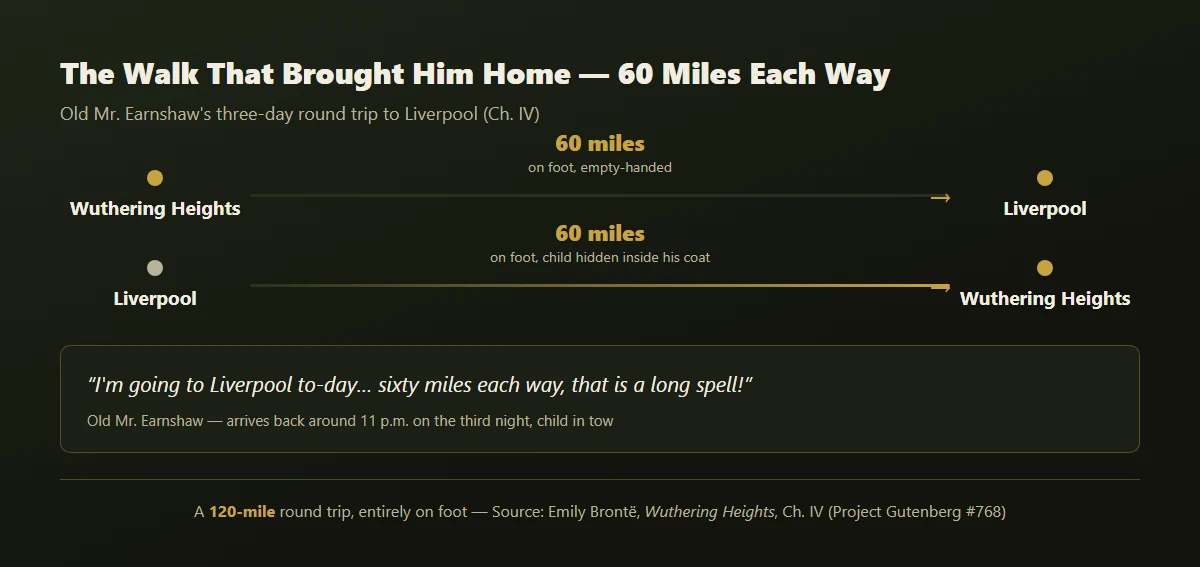
Old Mr. Earnshaw walks to Liverpool to buy gifts for his children — sixty miles each way, on foot.
"I'm going to Liverpool to-day... sixty miles each way, that is a long spell!"
Source: Emily Brontë, Wuthering Heights, Chapter IV (Project Gutenberg #768)
He returns on the third night around 11 p.m. with a child hidden inside his coat. As Nelly recalls it, he'd found the boy starving and homeless on the streets of Liverpool, "as good as dumb" — barely able to speak.
And the very first thing he says to justify bringing the child in is this.
"though it's as dark almost as if it came from the devil."
The man who found him is the one who says it. [Confirmed — text, Ch. IV]
His wife calls the boy "that gipsy brat." His son Hindley calls him "imp of Satan." And then there's the name.
"I found they had christened him 'Heathcliff': it was the name of a son who died in childhood, and it has served him ever since, both for Christian and surname."
Nelly recalls it plainly: the Earnshaws' own dead infant son had already been named Heathcliff, and the boy inherits that one word as both his first and last name. [Confirmed — text, Ch. IV]
By the novel's end, he is never "Heathcliff Earnshaw." Just Heathcliff. Family, and not family, built into the name itself.
The narrator Lockwood adds the impression that opens the book.
"He is a dark-skinned gipsy in aspect, in dress and manners a gentleman."
Dark-skinned in appearance, but a gentleman in manner and dress. The contradiction the novel runs on all the way through is right there in Chapter I.
The One Moment Heathcliff Talks About His Own Skin
Go back to the exchange we opened with. Seeing where it sits in the text explains why it's the only one of its kind.
Chapter VII. The Lintons are about to visit Wuthering Heights, and Nelly tells Heathcliff to wash and comb his hair. While she does, she teases him in front of a mirror.
"those thick brows... that couple of black fiends, so deeply buried, who never open their windows boldly, but lurk glinting under them, like devil's spies."
Catherine, seeing him freshly washed, adds her own line.
"how very black and cross you look!"
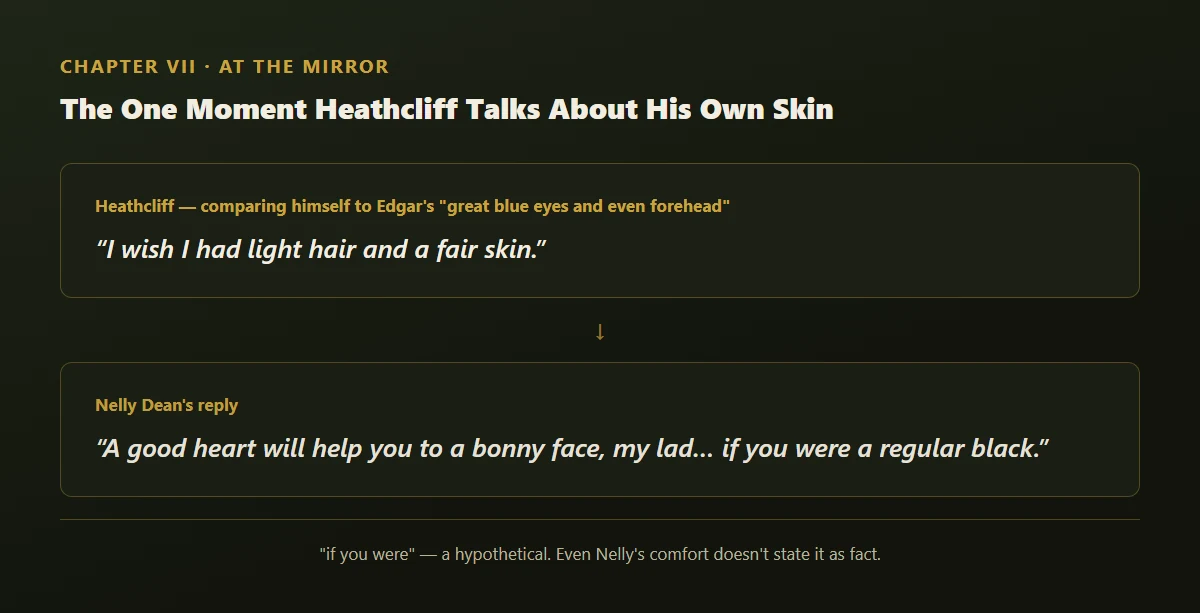
After all of that, Heathcliff compares himself to Edgar Linton — Edgar's "great blue eyes and even forehead" — and says the only thing he ever says about his own coloring.
"I wish I had light hair and a fair skin."
Nelly's answer follows.
"A good heart will help you to a bonny face, my lad... if you were a regular black; and a bad one will turn the bonniest into something worse than ugly."
It's comfort, but odd comfort — the phrase "if you were" implies Nelly doesn't think he already is.
In the same conversation, Nelly invents a story to cheer him up.
"Who knows but your father was Emperor of China, and your mother an Indian queen... you were kidnapped by wicked sailors and brought to England."
The text flags this as fiction in the very next line: "So I chattered on." [Confirmed — text, Ch. VII]
Everything the novel does with Heathcliff's identity is packed into this one scene. The word "black" keeps landing on him, but nobody — not even Nelly's comforting speech — claims it as settled fact. She calls her own story what it is: something she made up.
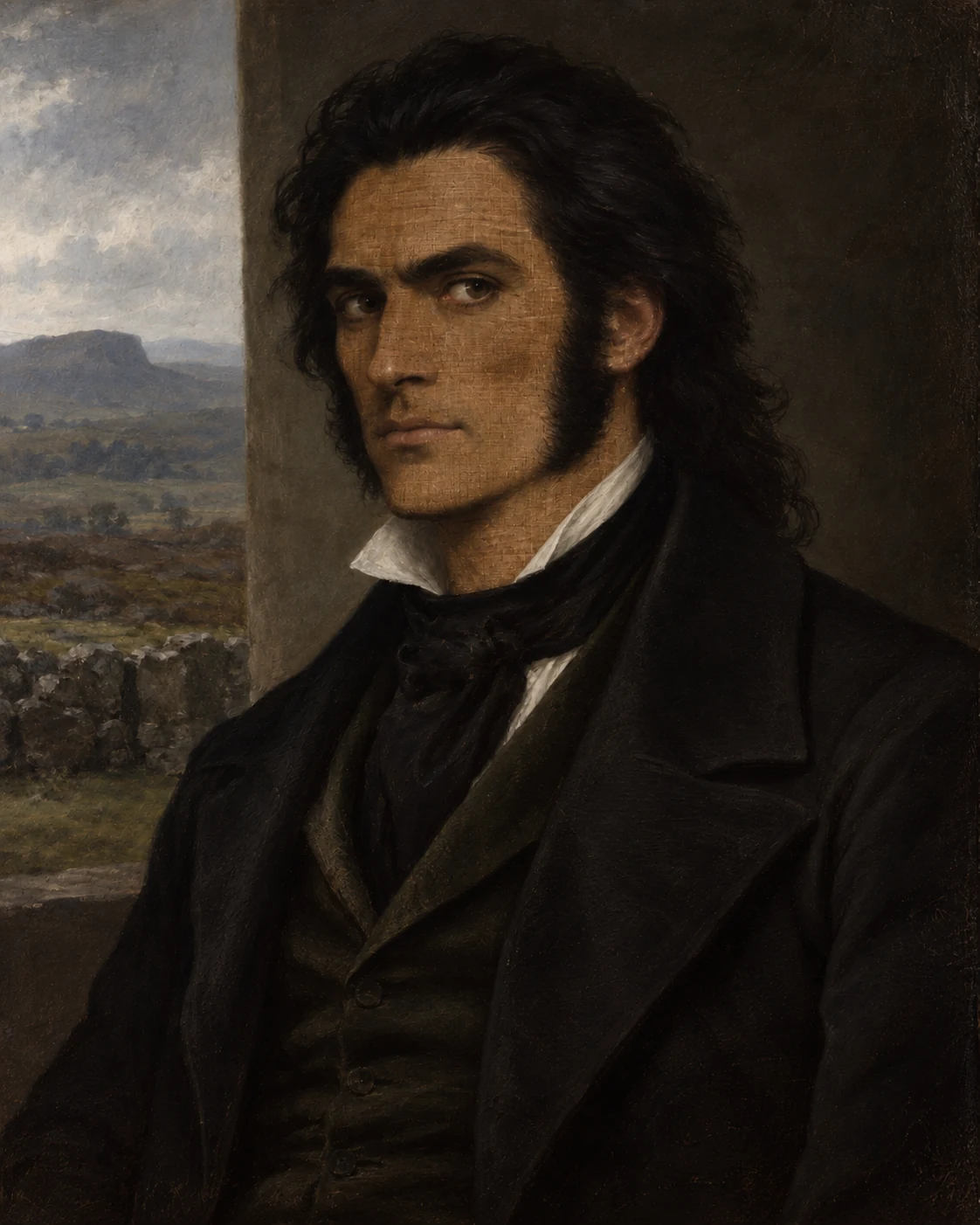
Everything here comes from the text: deep-set black eyes, thick brows that sink in the middle, long black hair, whiskers, sallow hollow cheeks, an erect and handsome figure. Only the skin is left as raw underpainting — because that is the one thing Brontë never settles. (AI-generated image)
Dark, Then Suddenly Pale — Not a Contradiction, a Reaction
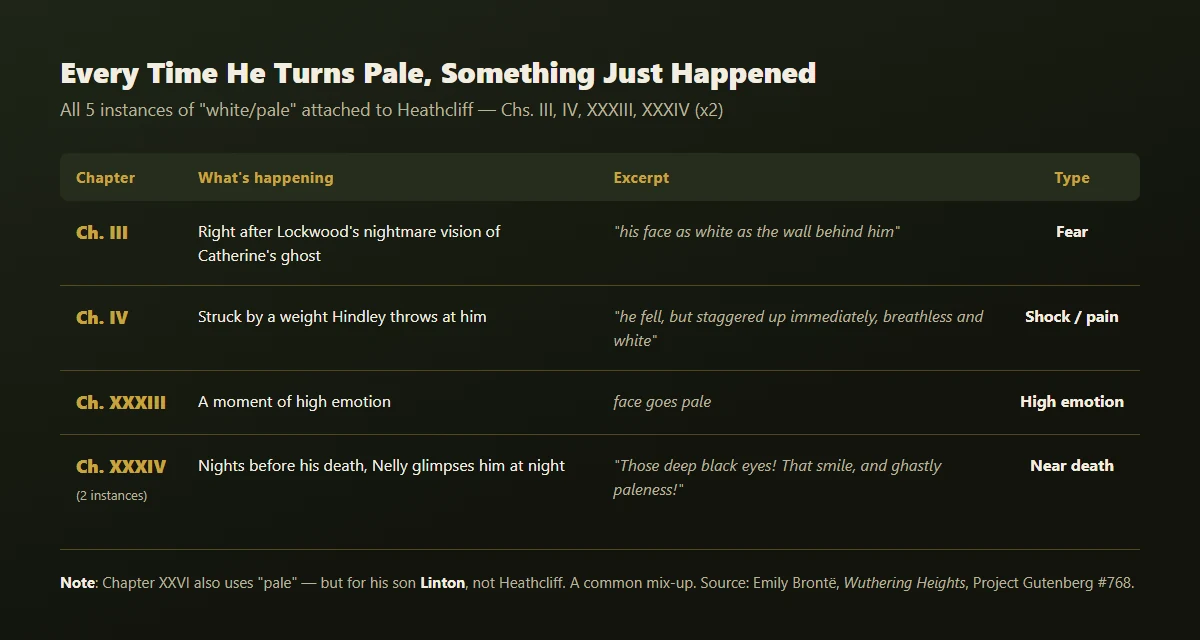
Chapter I calls Heathcliff a "dark-skinned gipsy." Elsewhere his face turns "white as a wall" or "pale." We traced every instance to see what's actually happening in each scene.
Chapter III, right after Lockwood's nightmare vision of Catherine's ghost:
"his face as white as the wall behind him."
Fear.
Chapter IV, right after being struck by a weight Hindley throws at him:
"he fell, but staggered up immediately, breathless and white."
Shock and pain.
Chapter XXXIV, days before the end. Nelly catches sight of his face at night — while he is still alive.
"Those deep black eyes! That smile, and ghastly paleness!"
The look of death, on a living face. The corpse gets its own description later.
And once more in Chapter XXXIII, his face goes pale in a moment of high emotion.
Every time "white" or "pale" attaches to Heathcliff, it's a temporary reaction — fear, shock, or death. It's never a claim about his natural skin tone.
"Dark-skinned" (an innate impression, Ch. I) and "turning pale under stress" (a physiological reaction, Chs. III/IV/XXXIII/XXXIV) sit on two different levels of the text. Read that way, the novel isn't contradicting itself. [Our interpretation — based on contextual cross-check]
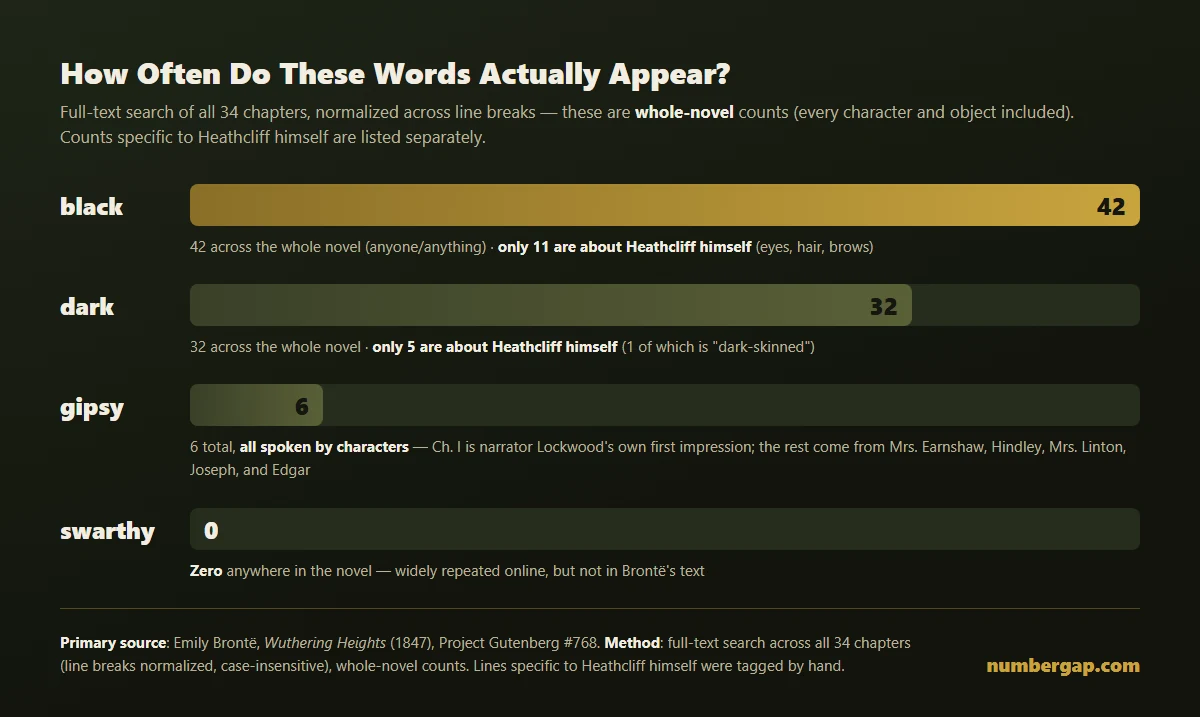
The Word "Swarthy" Isn't in the Book
One word keeps getting attached to Heathcliff in casual descriptions online: "swarthy."
We searched. All 34 chapters, normalized so no phrase gets split across a line break.
Zero.
The word "swarthy" does not appear anywhere in the text. [Confirmed — own tabulation]
What the novel actually repeats is "dark" (32 times, one of which is inside "dark-skinned") and "black" (42 times, mostly describing his eyes and hair). "Gipsy" appears 6 times — every single instance coming from another character calling him that, never the narrator stating it as fact. Lockwood uses it once in Chapter I; the rest come from Hindley, Mrs. Earnshaw, Joseph, and Edgar in separate scenes.
Where the "swarthy" claim actually originated, we couldn't trace in this research. What we can confirm is that it isn't in Brontë's sentences.
The Text Doesn't Describe Everyone Equally
To understand what's being withheld from Heathcliff, it helps to see what the novel gives everyone else.
Young Catherine (Cathy) is the only character the text explicitly describes as mixed-lineage in appearance.
"a real beauty in face, with the Earnshaws' handsome dark eyes, but the Lintons' fair skin and small features, and yellow curling hair."
Dark eyes from the Earnshaw side, fair skin from the Linton side, yellow curling hair — spelled out directly in Chapter XVIII. No other character in the book gets a mixed-heritage description this specific.
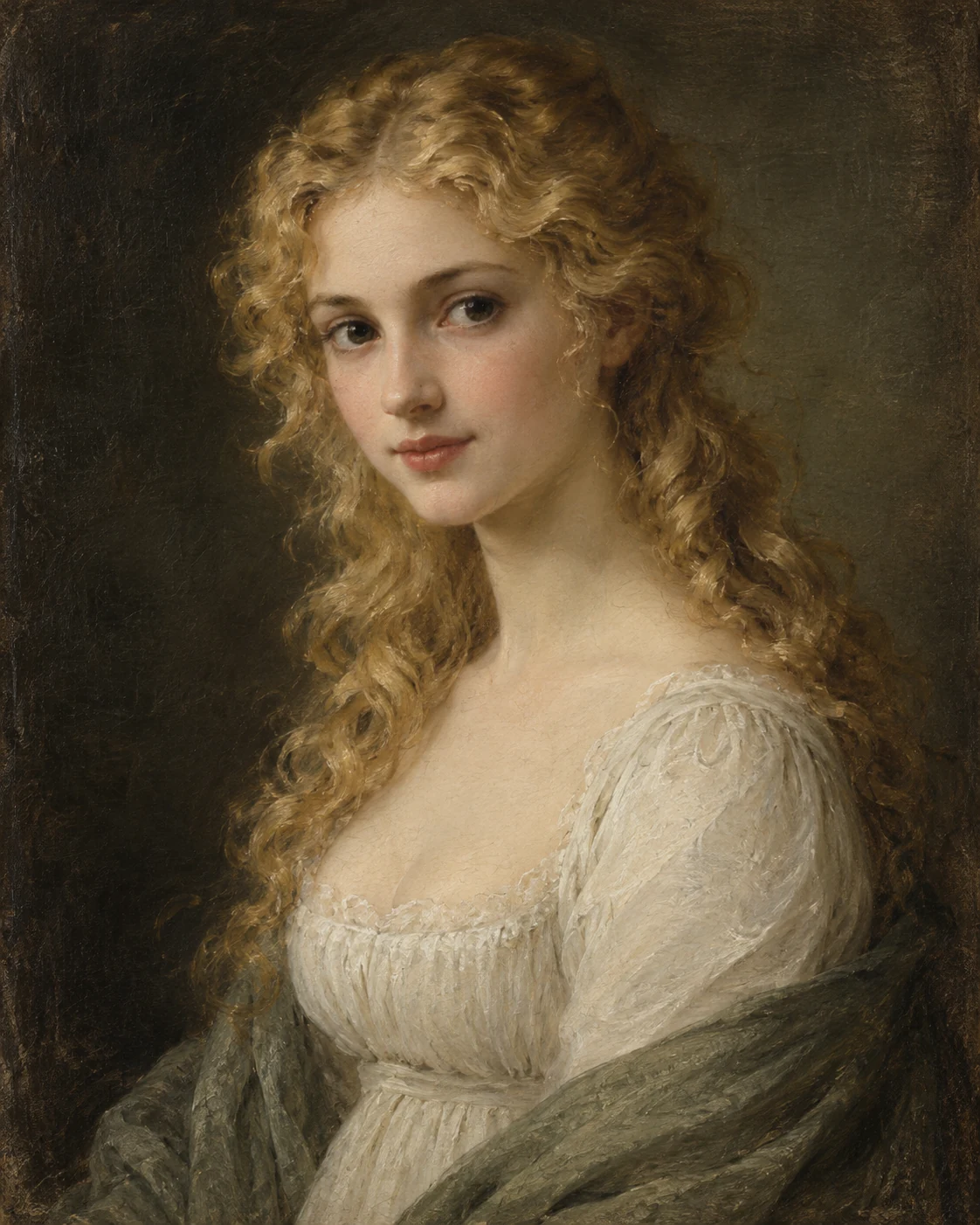
Nothing is left blank here. Chapter XVIII gives her eyes, skin, features and hair colour outright. The same novel tells us that much about some of its characters. (AI-generated image)
Isabella Linton is fixed by a single line from Catherine — "yellow hair and the whiteness of her skin." Linton Heathcliff, the son, is "a pale, delicate, effeminate boy" with "the white complexion and slim frame" — explicitly written as his father's opposite.
Hareton Earnshaw goes the other way. As a child he's just "little Hareton," with almost no description at all, until Chapter XXXIII finally notes his eyes are "precisely similar" to old Catherine Earnshaw's.
Nelly Dean and Lockwood, the two narrators, never describe their own faces once. A common limit of first-person narration.
Heathcliff sits in the middle of this range. "Black" recurs constantly — eyes, hair, brows — but no sentence from either narrator ever settles his race or ethnicity.
The character with confirmed mixed heritage gets the most specific features. The characters with no backstory get almost nothing. Heathcliff, the most speculated-about figure in the novel, sits in between — described often, defined never.
The "Age Twenty-Two" Line Isn't Catherine's Age
We got this one wrong in an earlier pass of our own research, and we're leaving that in.
Chapter IX contains this line:
"for a girl of twenty-two it was not injudicious."
At first we read this as Catherine's age — twenty-two, during her conversation with Nelly about marrying Edgar.
Rereading the text corrected us. The line isn't about Catherine at all. It's Nelly assessing herself — reflecting, after guiding Catherine through a "catechism"-style conversation, that for a twenty-two-year-old (herself), she hadn't handled it too badly. [Correction — verified against the text]
What the text does confirm as numbers:
- Hareton at 23, young Catherine at 18 — given together, late in the novel.
- Heathcliff having lived "a selfish, unchristian life" since he was "thirteen years old" — Nelly's words to him just before his death.
- Catherine, delirious with fever, imagining what it would have meant to be "wrenched from the Heights" at twelve years old (Ch. XII). That is Catherine speaking about herself — not a statement of Heathcliff's age.
The text never states, in numbers, how old Catherine or Heathcliff were when they died.
The commonly cited ages — Catherine dying at 18 or 19, Heathcliff at 37 or 38 — come from C. P. Sanger's 1926 essay "The Structure of Wuthering Heights," which reconstructs a full chronology from scattered internal clues.
Per Sanger's chronology, Catherine was born in 1765 and died March 20, 1784 — age 18. Heathcliff, per Sanger's math, "could not have been older than 38" and dies around 1802.
Those numbers came back into the news in 2026. Director Emerald Fennell aged Catherine up to "late 20s, early 30s" for her film, and cast Margot Robbie (born 1990, and 34 when the casting was announced in September 2024). Set against a teenage Catherine in the text, the age gap became its own casting controversy.
Source: Variety, "Margot Robbie Defends 'Wuthering Heights' Casting Jacob Elordi" (December 2025)
Four Competing Theories, None of Them Settled
Since the text won't settle the question, scholars have proposed their own answers. Four main theories exist.
1. Black African origin, via the Liverpool slave trade
Scholar Maja-Lisa von Sneidern argues in her 1995 paper that a child found abandoned in Liverpool at the point the novel's internal chronology implies (conventionally reconstructed as around 1771) would almost certainly have been racially "other," quite possibly Black.
Source: von Sneidern, "Wuthering Heights and the Liverpool Slave Trade," ELH 62.1 (1995)
The historical backdrop checks out independently. By the 1740s, Liverpool had overtaken London and Bristol as Britain's leading slave-trading port. Between 1793 and 1807, Liverpool ships carried out 84.7% of all British slave-trading voyages. Over the full period, Liverpool vessels are estimated to have transported roughly 1,171,171 enslaved people — nearly half of everyone British ships carried across the Atlantic.
Source: "Liverpool slave trade," Wikipedia; Cambridge University Press, Liverpool and Transatlantic Slavery
The year 1771 itself, though, is Sanger's reconstruction — not a date stated in the novel.
2. Irish Famine refugee
Literary critic Terry Eagleton, in his 1995 book Heathcliff and the Great Hunger (Verso), reads Heathcliff's Liverpool origin as evoking anxieties about Irish famine refugees.
The dates don't line up cleanly. The Great Famine began in the fall of 1845; Heathcliff's arrival in the novel, per convention, points to roughly 1771. Even taking the novel's own composition window — October 1845 to June 1846 — the mass influx of famine refugees into Liverpool (196,338 arrivals between November 1846 and May 1847 alone) hadn't happened yet when Brontë finished writing.
What makes this theory unusual is that Eagleton says so himself, in a footnote.
"I have indicated already that Heathcliff may not of course be Irish, and that even if he is, the chronology is awry as far as the Famine goes. But in this essay Heathcliff is Irish, and the chronology is not awry."
He's already acknowledged the chronology doesn't work — and then declares he'll read Heathcliff as Irish anyway, for the purposes of his essay. [Scholarly claim — Terry Eagleton, 1995. The chronological problem is acknowledged by the theory's own author]
3. Romani ("gipsy") origin
The word "gipsy" is applied to Heathcliff six times in the text, as confirmed above — always by other characters, never the narrator.
4. Other proposed origins — Spanish, South Asian, Lascar
These draw on old Mr. Linton's guess ("a little Lascar, or an American or Spanish castaway") and Nelly's "Emperor of China... Indian queen" comforting speech.
All four theories are built from the same handful of lines: "gipsy" (6x), one sentence about a Lascar/American/Spanish castaway, Nelly's "regular black" remark, and the single "dark-skinned" description. No scholar cited here claims the novel states Heathcliff's ethnicity outright. The consistent position across the field is that Brontë withheld a definite answer on purpose — and that withholding is itself what keeps academics arguing.
Source: Slate, Rebecca Onion, "Wuthering Heights: Is Heathcliff Black?" (Feb. 12, 2026)
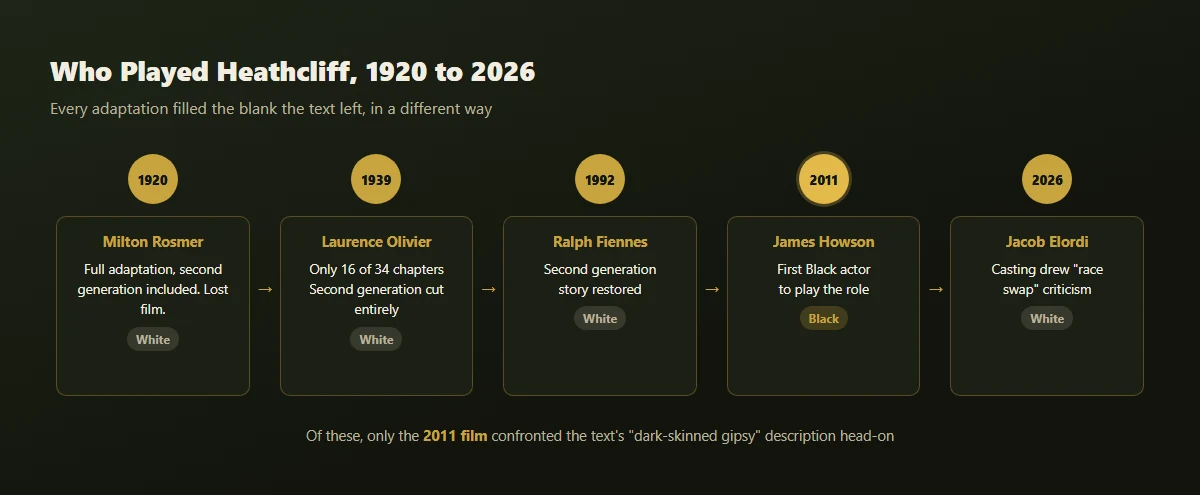
Who Filled In the Blank — 1920 to 2026
If the text won't answer the question, the screen has been answering it for a century. Follow the order, and it runs backward from what you'd expect.
1920 — the earliest adaptation is the one that stayed closest to the book.
The lost silent film (starring Milton Rosmer) is the only early adaptation confirmed to include the story's second generation — everything after Catherine's death. Its marketing didn't sell it as a love story either: "Emily Bronte's tremendous story of hate."
Source: Wikipedia, "Wuthering Heights (1920 film)"
The film itself no longer survives.
1939 — the Goldwyn version cut the book in half.
William Wyler's film adapts only 16 of the novel's 34 chapters and drops the entire second generation — the daughter, Hareton, the son Linton — completely.
Source: Letterboxd/Glasgow Film Festival, "Our Story So Far: Wuthering Heights (1939)"; Wikipedia
Hollywood at the time was operating under the Hays Code. Screen kisses were restricted; domestic abuse and alcoholism could only be implied. In the book, Heathcliff demands Hindley's colt to replace his own lame pony; in the film, that gets reversed into Hindley abusing Heathcliff — a change that makes Heathcliff more sympathetic.
Source: 3brothersfilm.com, "Table Talk: Wuthering Heights (1939)"
The originally planned ending showed Heathcliff's body collapsed in the snow. Producer Samuel Goldwyn demanded it be replaced with Heathcliff and Catherine's ghosts walking the moors together. Director Wyler hated the "ghost reunion" ending and refused to shoot it; it was filmed by someone else after both lead actors had already moved on to other projects, which is why the figures only appear from behind — body doubles.
Source: TV Tropes, "Trivia/WutheringHeights1939"
Critic John Sutherland argues this ending actually works against the novel's own intent — that contemporary readers would have read Catherine's ghost not as a gesture of eternal love, but as something closer to overwhelming, protective rage. Nearly every adaptation since has ended the same way, with some version of a ghostly reunion — a convention Goldwyn's ending effectively invented.
1992 — the Kosminsky film restored the second generation.
Ralph Fiennes' version is noted specifically for including the second generation's story, unlike the 1939 film. That this gets described as unusual says something: the 1939 cuts had, by that point, shaped decades of public assumption that "Wuthering Heights, on screen, means the first-generation romance."
2026 — a white actor again.
Director Emerald Fennell explained why she offered Jacob Elordi the role.
"looked exactly like the illustration of Heathcliff on the first book that I read."
She never specified which edition, which year, or which illustrator. Our own research couldn't trace it either.
Source: TheWrap, "Emerald Fennell Defends Casting Margot Robbie & Jacob Elordi in 'Wuthering Heights' After Fan Pushback" (Sept. 29, 2025)
The casting announcement drew "race swap" and "whitewashing" criticism. The core of it: the novel's racial ambiguity is tied directly to Heathcliff's status as an outsider, and casting him as unambiguously white erases that. Some critics argued the role should have gone to a Romani actor.
Source: ScreenRant, "Jacob Elordi's Wuthering Heights Casting Sparks Race Controversy: Experts Weigh In"; Variety (2026)
Fennell's public response amounted to "everyone who loves this book has their own personal connection to it." No direct rebuttal to the race criticism has surfaced in this research.
Getting It Right — The 2011 Andrea Arnold Film
Out of nearly a century of white casting, one film breaks the pattern.
Director Andrea Arnold, following the text's own "dark-skinned gipsy" and "a little Lascar" description, initially tried to cast from Britain's Romani community. Facing reluctance from that community, she widened the search to mixed-race, Indian, Pakistani, Bangladeshi, and Middle Eastern actors aged 16–21 in Yorkshire.
Source: Mix-d: Museum, "Wuthering Heights (2011) - Timeline"
An open casting call in Leeds found James Howson, who had no acting experience and was visiting a job center at the time. Arnold has said she wanted an unknown actor because Heathcliff needed to carry "anger underneath," a rawness a trained actor might not have. The result made Howson the first Black actor to play the role on screen.
Source: Mix-d: Museum; AV Club, "Andrea Arnold's Wuthering Heights remains the novel's truest adaptation"
Arnold went further. She updated the insults hurled at Heathcliff by Hindley and others to include modern racial slurs — an apparent attempt to give a modern audience the same jolt Brontë's original language gave 19th-century readers.
Source: Slate, "Andrea Arnold's Wuthering Heights reviewed" (2012)
Some critics describe this film as the only one to make Heathcliff "a visible Other" within his own world — the only Wuthering Heights adaptation to take the novel's racism seriously.
Set against every other major theatrical or TV adaptation (1939, 1954, 1970, 1992, 2009, 2026), all of which cast white actors, the 2011 film stands as the sole case that confronted the text's racial ambiguity directly.
Why the Screen Kept Filling It In With White Actors
No filmmaker on record has said, in so many words, "we cast a white actor for commercial reasons." What follows is circumstantial, and we're labeling it as our own interpretation.
1939 — built for a contract star.
The film was originally conceived as a vehicle for Merle Oberon, who was under contract with producer Samuel Goldwyn at the time.
"The project was initially intended as a vehicle for Merle Oberon, who was under contract with Goldwyn at the time."
Source: Wikipedia, "Wuthering Heights (1939 film)"
Goldwyn had first considered Vivien Leigh for Catherine, but Leigh insisted on playing Cathy or nothing, so the role went to Oberon — with makeup and glamorous close-ups Goldwyn specifically requested.
Source: TCM, tcm.com/articles/18607
Marketing leaned entirely into romance: "Strangest Love Story Ever Told!" "It strips bare the heart of a woman."
Source: 1939 United Artists Pressbook, archive.org
The box office was weak. Eight Oscar nominations, one win (cinematography). The film reportedly didn't turn a profit until a 1950 re-release — a widely repeated claim in film histories, though we could not confirm it against a primary studio ledger.
Source: EBSCO Research Starters — a claim treated as settled film history, not independently verified against a primary financial record
2011 — the film closest to the text had the weakest numbers.
Budget: £5 million. Worldwide gross: $1.7 million. This was, from the start, a low-budget art film — handheld camera, unknown and Black leads, a 4:3 aspect ratio.
Source: Wikipedia, "Wuthering Heights (2011 film)"
No source we found directly states that casting caused the weak box office. Limited release and an uncommercial visual style are plausible contributing factors, but this remains our inference, not a documented cause.
2026 — a lower bid, with a theatrical-release condition attached.
Netflix reportedly offered $150 million for distribution rights. Warner Bros. won the deal for less — $80 million — on the condition, pushed by Fennell and star/producer Margot Robbie, that the film get a theatrical release.
Source: Variety (Oct 2024), “Netflix Lost Margot Robbie’s ‘Wuthering Heights’ to Warner Bros. Despite $150 Million Offer”
The marketing tagline was "the greatest love story of all time." It drew immediate pushback — commenters pointed out the book is a revenge story, not a romance.
Source: Hello Magazine, 2026
The film opened to $34.8 million domestically over its first three days, with 76% of ticket buyers women, per PostTrak. Final worldwide gross settled around $242 million, a figure multiple outlets converge on.
Source: Fortune (Feb. 16, 2026); cross-checked against multiple outlets reporting "$241.7M–$242M" as the final tally
Book sales moved with it. U.S. print sales hit 180,000 copies in all of 2025 — more than double the prior year — then passed 100,000 copies in the first two months of 2026 alone, per Circana BookScan, the industry's standard sales-tracking service.
Source: Publishers Weekly, Feb. 18, 2026
In the UK, January 2026 sales rose 469% year over year (1,875 copies to over 10,600). That figure comes from Penguin Classics UK's own tracking, not Nielsen — several outlets have misattributed it, so we're flagging the correction here.
Source: Penguin Classics UK data, cross-referenced via multiple outlets including Express Tribune
Put together: 1939 was built around a contract star and sold as pure romance. 2026 chose a lower offer specifically to keep a theatrical release and star power intact. The film that stayed closest to the text's ambiguity, in 2011, performed the worst commercially. There's a reasonable case that star-system economics outweighed the text's racial ambiguity in casting decisions — but no filmmaker has said so directly, and we want that distinction on the record.
The Novel Has No Copyright — That's Part of the Story Too
Wuthering Heights is public domain. Anyone can adapt it without paying a licensing fee.
"Today, Wuthering Heights exists as public domain intellectual property, yet it remains a 'hot property' for film adaptations."
Source: hslegal.com.sg, Feb. 11, 2026
We found no source that directly proves a causal link between "no licensing fee" and "adapted nearly every decade for a century." What we can confirm: a studio can commission an entirely new interpretation without paying the estate, which is simply how public domain works. Worth keeping separate: the 2026 film's distribution-rights auction ($150M vs. $80M) was a deal over the finished movie, not the novel itself — the novel cost nothing either way.
Three Stories Worth Knowing
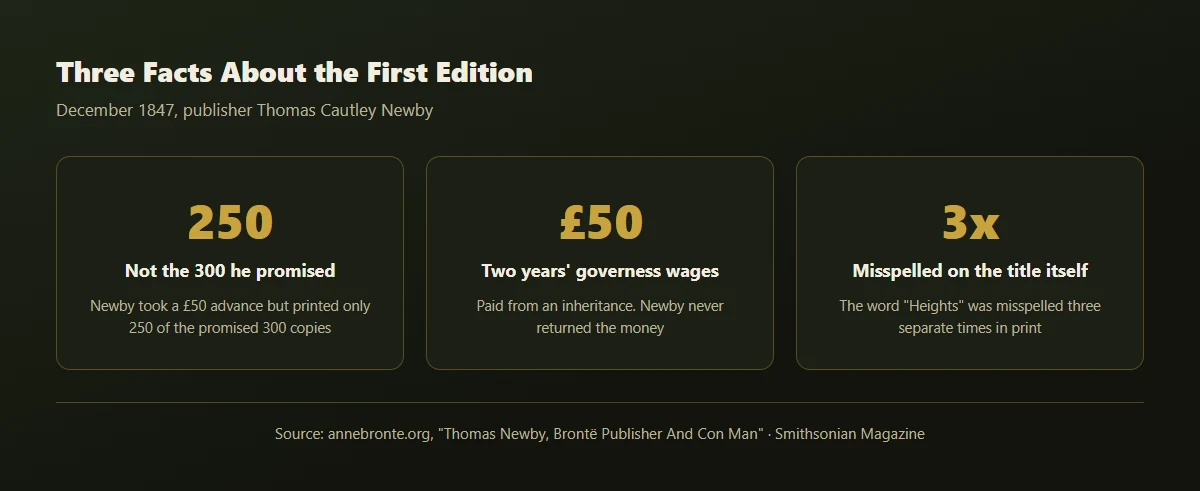
The first edition ran 250 copies — and even that was a cut corner.
In December 1847, publisher Thomas Cautley Newby demanded £50 upfront from Emily and her sister Anne — roughly two years' wages for a governess at the time. They paid it out of an inheritance from their aunt. Newby had promised 300 copies. He printed 250, and never returned the £50.
Source: annebronte.org, "Thomas Newby, Brontë Publisher And Con Man"
The printing itself was sloppy: wrong page numbers, missing punctuation, and the word "Heights" misspelled three separate times in the title itself.
Source: Smithsonian Magazine
Kate Bush wrote her famous song from the last ten minutes of a TV drama, not the novel.
Bush's 1978 single "Wuthering Heights" made her the first woman to top the UK singles chart with a self-written song. It's widely assumed to be a literary tribute to the whole novel.
Bush's own account, from a 1978 BBC interview, says otherwise.
"I just managed to catch the very last few minutes where there was a hand coming through the window and blood everywhere and glass."
That was the final scene of the BBC's 1967 TV adaptation — not the book. She goes on:
"So I borrowed the book and read a few pages, picking out a few lines. So I actually wrote the song before I had read the book right through."
She wrote the song before finishing the novel.
Source: Far Out Magazine, "Kate Bush made 'Wuthering Heights' without even reading the book"
The society that manages the pilgrimage site put up a plaque disowning it.
Top Withens, a ruined farmhouse on the Yorkshire moors, is widely marketed to tourists as "the setting of Wuthering Heights." The Brontë Society's own official plaque on the building says otherwise.
"This farmhouse has been associated with 'Wuthering Heights'... The buildings, even when complete, bore no resemblance to the house she described, but the situation may have been in her mind when she wrote of the moorland setting of the Heights." — The Brontë Society, 1964
The society had to state, in writing, that the building never matched the book — presumably because enough visitors kept asking.
Source: VisitHaworth.com, "Top Withens: Inspiration for Wuthering Heights?"
Frequently Asked Questions
Q. Was Heathcliff black in Wuthering Heights?
A. The narrators never confirm it. Lockwood calls him a "dark-skinned gipsy"; Nelly Dean tells him a good heart helps "if you were a regular black." Both are impressions or hypotheticals from characters, not narrated fact. The 2011 film cast the first Black actor, James Howson, in the role.
Q. Was Heathcliff a gypsy?
A. The word "gipsy" appears six times in the text, applied to him by other characters — never the narrator stating it as settled fact.
Q. Is Heathcliff described as swarthy in the novel?
A. No. A full-text search of all 34 chapters returns zero hits for "swarthy." The word is widely repeated online but isn't in Brontë's actual sentences.
Q. How old were Catherine and Heathcliff when they died?
A. The text never states either age as a number. The commonly cited figures — Catherine at 18, Heathcliff around 38 — come from C. P. Sanger's 1926 scholarly reconstruction of the novel's internal chronology, not from the book itself.
Q. Why did the 2026 film cast Jacob Elordi, who is white, as Heathcliff?
A. Director Emerald Fennell said he "looked exactly like the illustration of Heathcliff on the first book that I read," without specifying which edition. No commercial rationale has been confirmed in filmmakers' own statements.
Q. Who played Heathcliff in the 2011 film?
A. James Howson played the adult Heathcliff, with Solomon Glave as the young Heathcliff. Both actors are Black, making it the first screen adaptation to cast a Black actor in the role.
What to Check Next Time a Heathcliff Casting Debate Comes Up
The novel is public domain, free to read. Start at Chapter IV, where Old Mr. Earnshaw brings the boy home from Liverpool.
Five conflicting guesses about his origin are already scattered through those pages — gipsy, Lascar, American, Spanish, son of a Chinese emperor. And the only sentence where Heathcliff himself addresses his own skin is a single line in Chapter VII: "I wish I had light hair and a fair skin."
Emily Brontë left that blank 179 years ago. Every adaptation since, from the lost 1920 silent film to the 2026 blockbuster, has filled it in differently. Before deciding which one got it "right," it's worth checking what the text actually left open.
This series keeps comparing what the primary text actually says against what later adaptations filled in, and why.
Sources
Primary text
- Emily Brontë, Wuthering Heights, Project Gutenberg #768 — https://www.gutenberg.org/ebooks/768
- All 34 chapters (license text excluded), normalized to collapse line breaks before full-text search. Local copy:
source-text/pg768-en.txt
Scholarship
- Maja-Lisa von Sneidern, "Wuthering Heights and the Liverpool Slave Trade," ELH 62.1 (1995)
- Terry Eagleton, Heathcliff and the Great Hunger: Studies in Irish Culture (Verso, 1995)
- C. P. Sanger, "The Structure of Wuthering Heights" (1926)
- Slate, Rebecca Onion, "Wuthering Heights: Is Heathcliff Black?" (Feb. 12, 2026)
Film and casting
- Wikipedia — "Wuthering Heights (1920 film)," "(1939 film)," "(2011 film)," "(2026 film)," "Adaptations of Wuthering Heights"
- TCM, "Wuthering Heights (1939)" — tcm.com/articles/18607
- TV Tropes, "Trivia/WutheringHeights1939"
- 3brothersfilm.com, "Table Talk: Wuthering Heights (1939)"
- Mix-d: Museum, "Wuthering Heights (2011) - Timeline"
- Slate, "Andrea Arnold's Wuthering Heights reviewed" (2012)
- TheWrap (Sept. 29, 2025), Variety (Dec. 2025, 2026), ScreenRant — 2026 casting controversy
- Fortune (Feb. 16, 2026), Publishers Weekly (Feb. 18, 2026) — box office and book sales
Stories
- annebronte.org, "Thomas Newby, Brontë Publisher And Con Man"
- Smithsonian Magazine, "The First Edition of Emily Brontë's 'Wuthering Heights'..."
- Far Out Magazine, "Kate Bush made 'Wuthering Heights' without even reading the book"
- VisitHaworth.com, "Top Withens: Inspiration for Wuthering Heights?"
Copyright
- hslegal.com.sg (Feb. 11, 2026)


Comments
Post a Comment