Fan Death in Korea: Why This Sleeping Myth Won't Die
A friend of mine — Korean-American, mid-30s, not remotely superstitious about anything else — still won't fall asleep with a fan pointed at her face. When I asked why, she just shrugged: "My mom always said you can die from that."
Last updated: 4 September 2026 · Figures and rules in this post are current as of this date.
She's not making it up, and she's not alone.
According to an oral history collected by USC's Digital Folklore Archives, one informant describes almost the exact same scene: a mother who learned it from her own mother, still warning her kids to turn the fan off before bed — "in Korea, if you sleep with the fan on, there's a myth that you'll die" — even though, deep down, she doesn't fully believe it herself. It's a warning passed down half-seriously, generation to generation, the way you might tell a kid not to swallow gum.
So is there anything to "fan death," or is it just one of those things Korean households say out of habit? I went looking for where this idea came from and what the actual evidence shows.
What Exactly Does the "Fan Death" Myth Claim?
At its core, fan death is the belief — historically widespread in South Korea — that sleeping overnight in a closed room with an electric fan running can kill you.
English-language sources describe a few overlapping explanations for how this is supposed to happen, and they don't always agree with each other, which is itself a clue about how folklore like this spreads.
| Theory | What it claims |
|---|---|
| Hypothermia | Direct airflow plus the body's slowed metabolism during sleep drops body temperature enough to cause organ failure |
| Suffocation / oxygen depletion | In a sealed room, a sleeper "uses up" the oxygen, or the fan creates a localized vacuum that blocks proper breathing |
| Ozone / "chopped oxygen" | The spinning blades supposedly produce ozone or physically break apart oxygen molecules — a claim not considered medically credible |
| Dirty blades | Grime on old fan blades is blamed for making people sick |
Notice that these aren't compatible theories — a room can't simultaneously be short on oxygen and full of ozone from the same machine. That inconsistency is one of the first hints that we're dealing with folklore, not a documented medical mechanism.
How Old Is This Myth, Really?
Older than you'd probably guess. Documented warnings about electric fans in Korea go back close to a century, well before the 1970s energy crisis people often assume started it.
Writer Ken Jennings, in a piece for Slate, points to a 1927 Korean newspaper article titled "Strange Harm From Electric Fans." It warned readers of nausea, asphyxiation, and even facial paralysis, and claimed that "the rotating fan blades create a vacuum directly in front" of the device. Wikipedia's entry on fan death lines up with this, noting that stories about nausea, asphyxiation, and facial paralysis were already circulating in Korea in the 1920s and 1930s — right around the time electric fans were first introduced there.
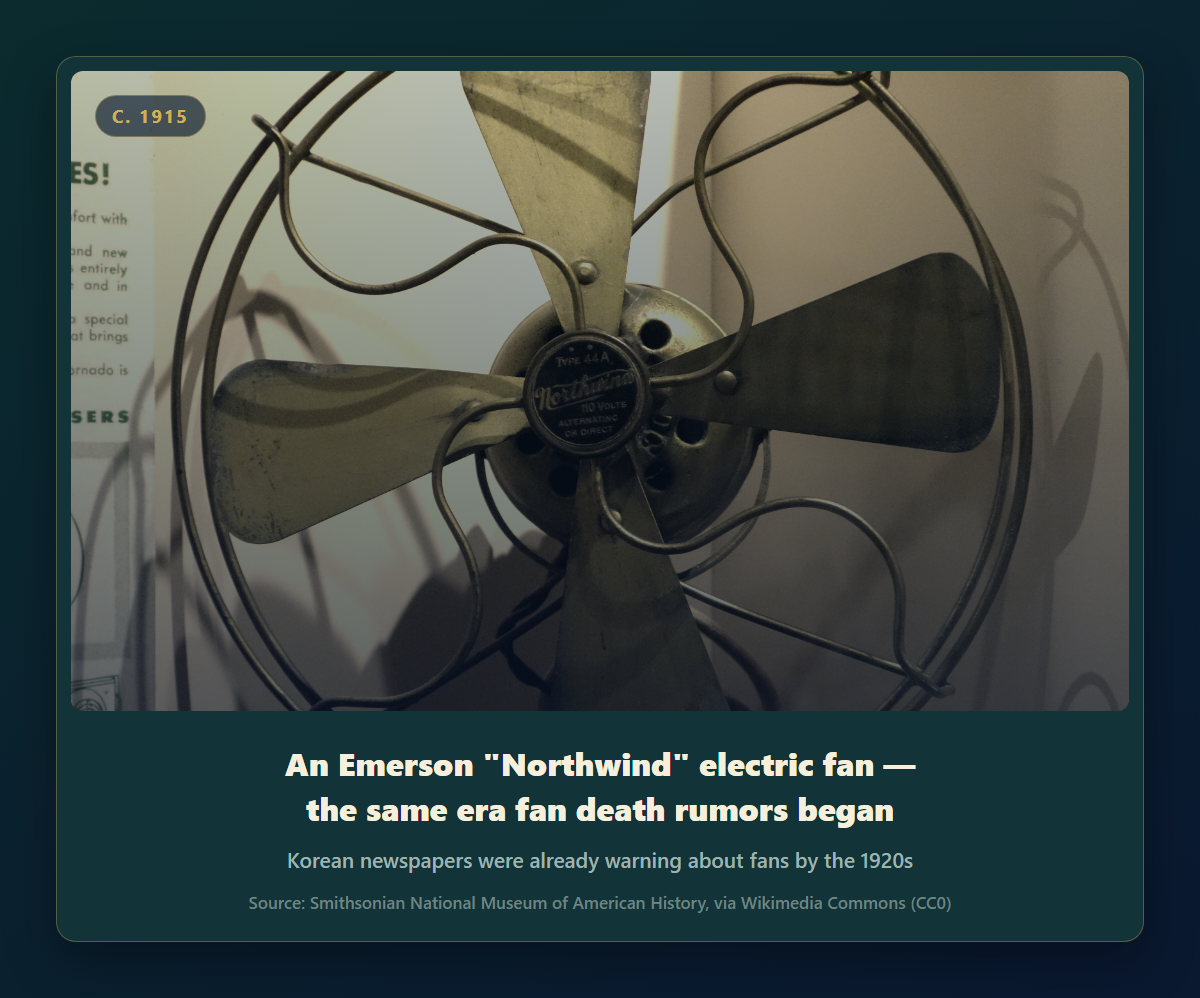
So the "vacuum" theory isn't a modern internet rumor. It's essentially a hundred years old, and it hasn't changed much since 1927.
Did the Korean Government Actually Invent This Myth?
Short answer: probably not, even though this is the explanation you'll hear most often. It's a great story — a government inventing a death myth to get people to unplug their fans and save electricity during the 1970s energy crisis. It's just very hard to square with the timeline.
Slate directly disputes it. The 1927 newspaper article predates the 1970s oil shocks by roughly fifty years, which makes outright government invention unlikely. Wikipedia's article reaches the same conclusion, citing Slate's reporting.
What Slate does find, instead, is something more mundane: in the 1980s and 1990s, epidemiological research looked at whether fans actually helped during heat waves in closed apartments and found they offered minimal cooling benefit. University of Miami climatologist Dr. Laurence Kalkstein found that fans can increase evaporation once temperatures climb into the mid-90s Fahrenheit, which can worsen dehydration risk in vulnerable people — a real, narrower phenomenon that Kalkstein says got mistranslated and stretched into something that sounded like it validated the broader "fan death" story. He's been clear that he doesn't believe fan death itself is real.
Here's what actually happened, as best the record shows: the South Korean government didn't invent fan death — but it also didn't do much to correct it. As late as 2006, "asphyxiation from electric fans and air conditioners" was still listed among the country's five dangerous summer hazards, and between 2003 and 2005, the government's injury-surveillance system logged 20 such cases. That official-sounding data point is likely one reason the myth kept getting repeated well into the 2000s — and it's also why many fans sold in Korea still ship with built-in timers and warning labels today.
So... Is There Any Truth to It?
No — not according to any of the medical or scientific sources reviewed here. Snopes states plainly that none of the three main folk theories "holds up to medical scrutiny."
Snopes makes a simple but effective comparative argument: people in plenty of other countries run fans overnight in closed rooms all the time and don't die from it. If there were something physically dangerous about a spinning fan and a shut door, it wouldn't be a phenomenon unique to one country.
Snopes also offers a more grounded explanation for why the myth persists: when someone dies unexpectedly overnight in a room where a fan happened to be running, it's tempting to connect the two things, even though they're independent events. The fan and the death share a room, not a cause. The more likely explanations, Snopes notes, are things like previously undiagnosed heart problems, or drug or alcohol use.
Case investigations back this up. Dr. Lee Yoon-song of Seoul National University, quoted in Gwangju News, looked into reported "fan death" cases directly and concluded that "the main cause of death was not from the fan itself." Most of the people involved had pre-existing conditions — heart disease, lung disease, alcoholism — that were the far more plausible explanation. His conclusion: fans simply don't have the power to create dangerously low oxygen levels or dangerous drops in body temperature.
One nuance worth keeping, though: a general heat-safety guideline (cited on Wikipedia) advises against relying on a fan alone in a closed room once the heat index passes about 32°C (90°F). That's real advice — but it's about heat exhaustion in extreme conditions, not the folk claim that a fan can directly kill a sleeping person. The two get conflated a lot in casual retellings, which muddies the picture.
Interestingly, further reporting from the Korean-language side of this story adds one more data point that doesn't show up much in English coverage: in 2010, South Korea's Supreme Court explicitly rejected the fan death theory in a ruling, citing testimony from the Korean Society of Forensic Medicine that fans don't consume oxygen and can't lower core body temperature to a fatal level. It's a detail that rarely makes it into English-language explainers, but it's essentially the legal system's version of the same conclusion Snopes and Dr. Lee reached independently.
Why Does a Debunked Myth Refuse to Die?
Because a scary, tidy explanation is usually more satisfying than a messy, boring one — and that's true everywhere, not just in Korea.
Gwangju News offers one folkloric theory for the myth's staying power: it may echo older beliefs about evil spirits stealing a sleeping person's breath, in the same family of superstition as cultures that once feared cameras could steal a person's soul. It's offered as interpretation rather than proven history, but it's a plausible thread — the idea that something invisible and mysterious "takes" you while you sleep is a very old kind of story.
There's also a simpler, more cynical explanation, and Gwangju News says it outright: a fan death story is a lot more interesting than a story about someone's undiagnosed heart condition. Headlines about a household appliance turning deadly get shared. Headlines about pre-existing illness don't.
Slate frames the ending of the story nicely: "A decade of Internet skepticism seems to have accomplished what the preceding 75 years could not: convinced a nation that Korean fan death is probably hot air."
Do Younger Koreans Still Believe This?
Less and less, according to the sources — but it hasn't disappeared, and there's a clear generational split.
Slate describes informal conversations with contacts in Korea that suggest younger Koreans have largely moved toward skepticism, with reactions shifting from quiet acceptance to something closer to "Can you believe my parents told us that?" Older generations, having grown up with decades of media coverage reinforcing the idea, are more likely to still take the warning seriously. Wikipedia echoes this same pattern — belief was widespread through the mid-2000s, with internet-driven skepticism gaining ground among younger Koreans since.
To be fully honest about the limits of the evidence here: none of the English-language sources reviewed for this piece include a dated, quantitative survey — like "X% of Koreans currently believe in fan death." What we have is qualitative reporting from journalists and folklorists, not polling data. So "younger people believe it less" is a well-supported trend, not a hard statistic.
Frequently Asked Questions
Q. Can sleeping with a fan on in a closed room actually kill you?
A. No credible medical or scientific source supports this. Snopes, a Seoul National University investigation into reported cases, and even a 2010 South Korean Supreme Court ruling all conclude that fans can't lower oxygen levels or body temperature enough to be fatal.
Q. Where did the fan death myth actually come from, if not the government?
A. The earliest documented warnings trace back to a 1927 Korean newspaper article, decades before the 1970s energy crisis that's commonly (and incorrectly) credited as the myth's origin.
Q. Is there any real health risk to sleeping with a fan blowing on you?
A. The "death" claim isn't supported, but general heat-safety guidance does note that relying on a fan alone (instead of air conditioning) once the heat index passes roughly 90°F (32°C) isn't enough to prevent heat-related illness. That's a heat-exhaustion precaution, not proof of the fan death myth.
Q. Is this belief unique to Korea?
A. Sources describe it as a South Korean phenomenon, with a similar belief that existed in Japan through the 1970s-1980s before fading out there. It's not something documented as a widespread belief elsewhere.
Ready to Stop Worrying About Your Fan Tonight?
Here's the short version: the fan death myth dates back to a 1927 newspaper article, not a 1970s government conspiracy, and every piece of medical, legal, and scientific evidence reviewed here — from Snopes to a Seoul National University investigation to South Korea's own Supreme Court — says a fan can't kill you while you sleep.
That doesn't mean airflow is meaningless. If you're sleeping in genuinely extreme heat, a fan alone may not be enough — that's about heat exhaustion, not fan death, and it's worth taking seriously on its own terms.
Tonight, go ahead and leave the fan running. Just maybe don't blame it if you wake up with a dry throat — that one's real, fan death isn't.
Have you run into this myth before?
- Grew up hearing it and half-believed it 😅
- Never heard of it until this post 🤯
- Already knew it was bunk 😎
Drop your number in the comments.


Comments
Post a Comment