What Does Dracula Look Like in the Book? Zero Fangs
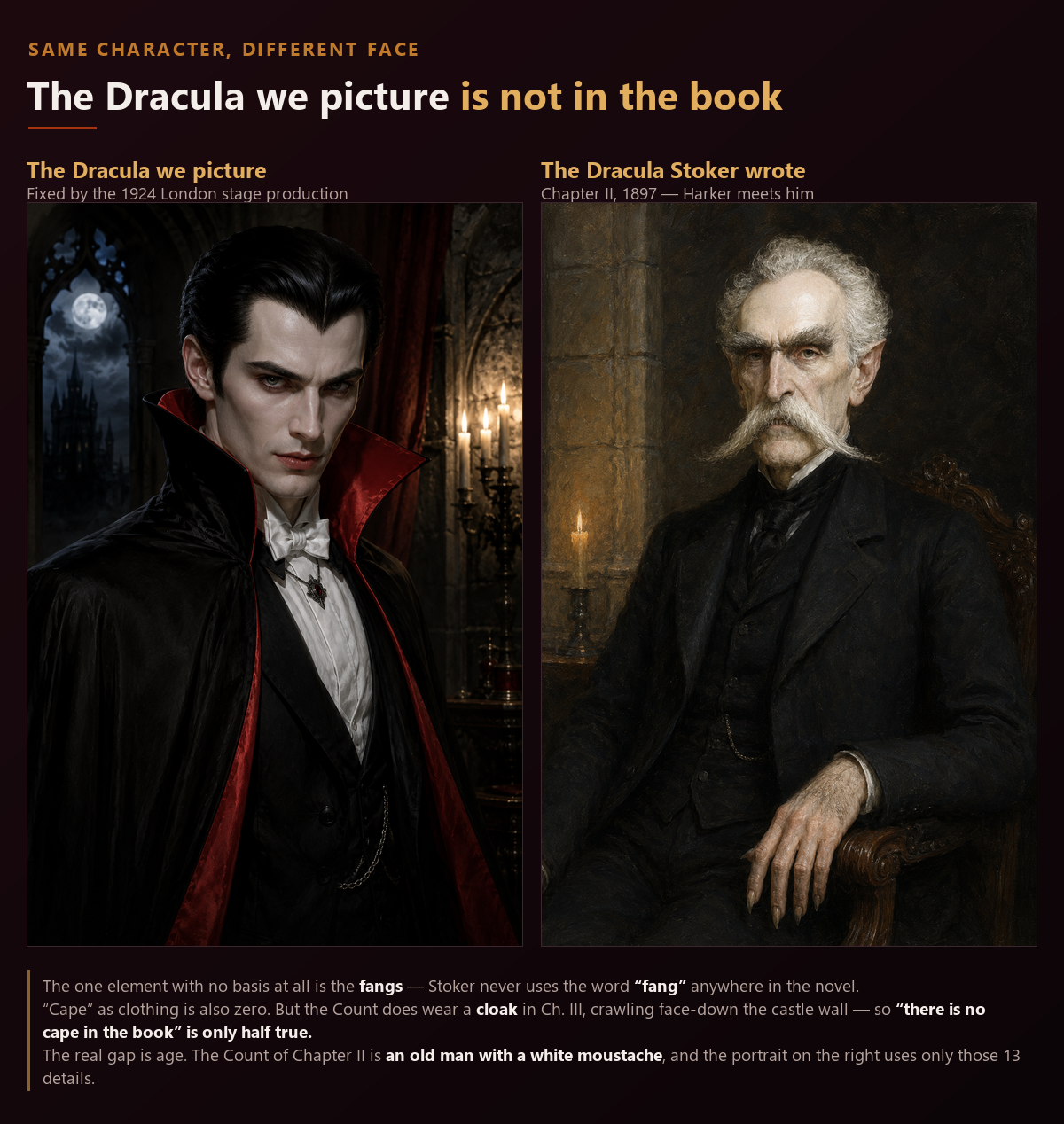
Every October, the same costume shows up on every shelf. Black cape with a stiff collar standing up behind the neck. Slicked hair. Two neat white fangs. A widow's peak.
Last updated: 27 August 2026 · Quotations and occurrence counts were checked against the source text on this date.
Here is the man Bram Stoker actually put at the castle door in 1897:
A tall old man.
A long white moustache.
Black from head to foot, "without a single speck of colour about him anywhere."
And a few pages later, when Jonathan Harker finally gets a close look at his host's hands, this: there is hair growing out of the middle of his palms.
So the question this piece is really asking isn't "was the book different?" It obviously was. The question is when, exactly, did the Dracula on the costume rack get built — because the cape, the fangs, and the death-by-sunlight all have dates on them, and every one of those dates comes after the novel.
⚠️ A note on method, because the numbers below are the whole point. I downloaded Project Gutenberg's Dracula (eBook #345), stripped the Gutenberg header and footer, the table of contents, and the publisher's ad pages bound into the back, and kept everything from the first line of Chapter I to "THE END." That comes to 160,810 words by whitespace count. Then I ran case-insensitive, word-boundary regex searches and read every single hit in context — which is the only reason I know that both appearances of the word "cape" are place names on a map. All counts are per the Project Gutenberg #345 text; editions of Dracula differ editorially, so that qualifier matters.
What does Dracula look like in the novel?
He is old, he has a heavy white moustache, and Stoker describes him in more physical detail than almost any other character in Victorian horror.
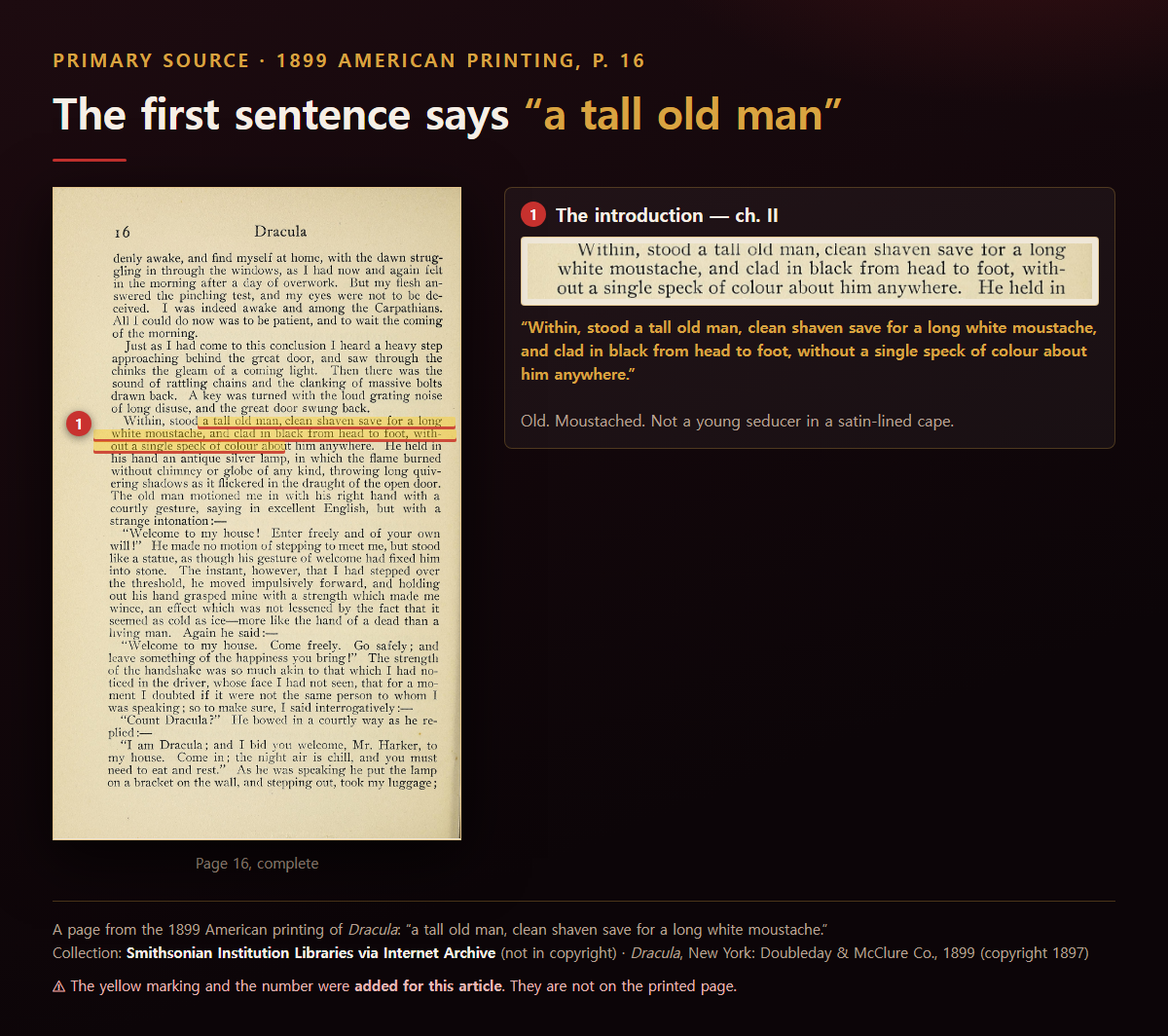
This is the sentence that introduces him, in Chapter II:
"Within, stood a tall old man, clean shaven save for a long white moustache, and clad in black from head to foot, without a single speck of colour about him anywhere."
Source: Bram Stoker, Dracula, ch. II — Project Gutenberg eBook #345 (public-domain primary text)
https://www.gutenberg.org/files/345/345-0.txt
Two of the biggest assumptions in pop culture die inside one sentence. He's old. He has facial hair.
And you don't have to take my word for the transcription. Here is the line as it was actually printed, in a copy held by the Smithsonian Libraries.
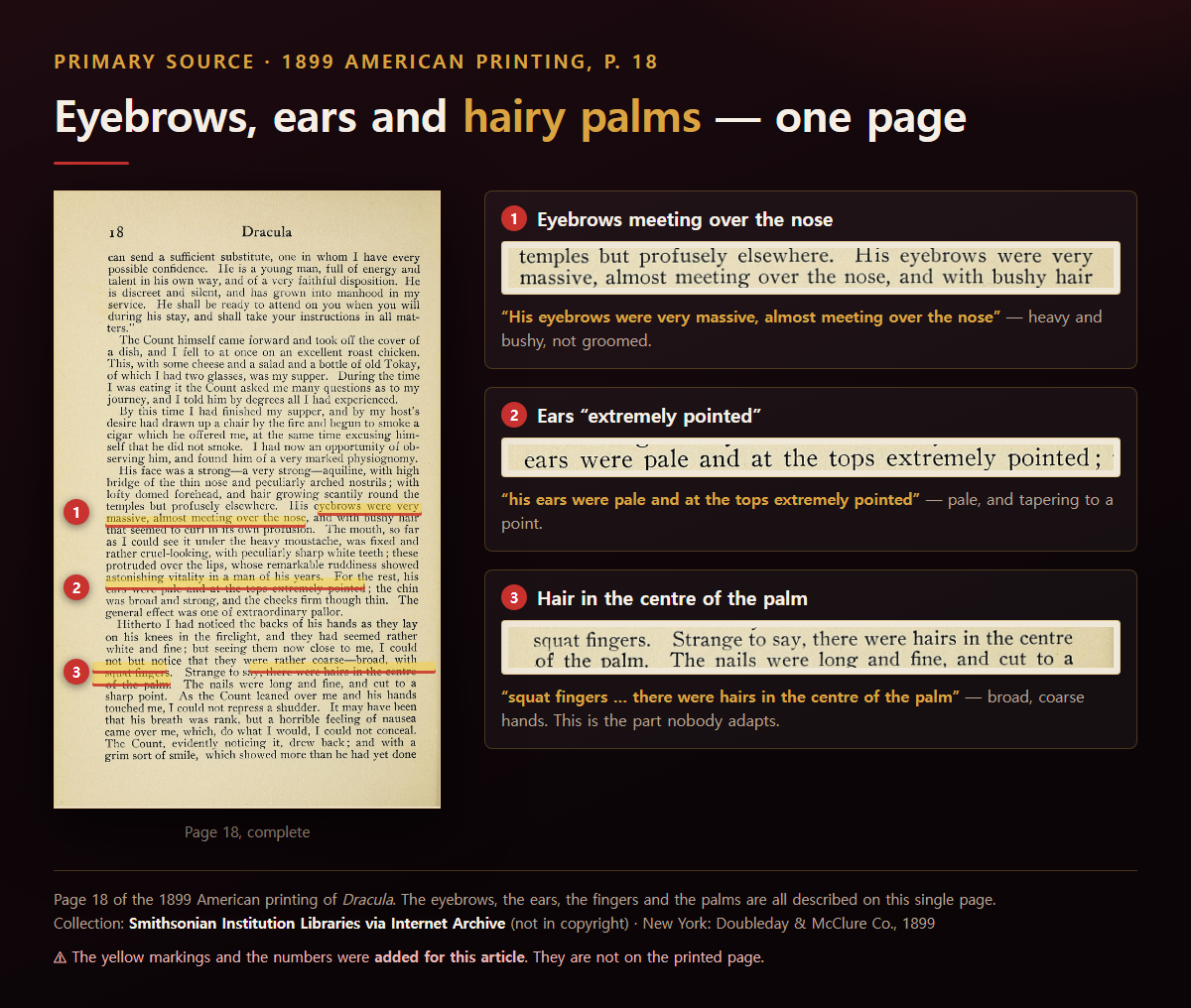
A few paragraphs later comes the densest physical description in the book:
"His face was a strong—a very strong—aquiline, with high bridge of the thin nose and peculiarly arched nostrils; with lofty domed forehead... His eyebrows were very massive, almost meeting over the nose... his ears were pale, and at the tops extremely pointed; the chin was broad and strong, and the cheeks firm though thin. The general effect was one of extraordinary pallor."
Source: Dracula, ch. II — Project Gutenberg eBook #345 (public-domain primary text)
Then the hands. This is the part nobody adapts.
"they were rather coarse—broad, with squat fingers. Strange to say, there were hairs in the centre of the palm. The nails were long and fine, and cut to a sharp point... It may have been that his breath was rank, but a horrible feeling of nausea came over me."
Source: Dracula, ch. II — Project Gutenberg eBook #345 (public-domain primary text)
Not long, tapered, aristocratic fingers. Broad, coarse, squat fingers, with hair on the palms and breath bad enough to make a healthy young solicitor gag.
Line the two versions up and there is almost nothing left in common:
| Feature | Stoker wrote | The costume-aisle version |
|---|---|---|
| Age | old — "a man of his years" | young |
| Facial hair | long, heavy white moustache | clean-shaven |
| Eyebrows | massive, bushy, nearly meeting over the nose | groomed |
| Ears | pale, tops extremely pointed | human |
| Fingers | squat, broad, coarse | long and tapered |
| Palms | hair growing out of them | smooth |
| Breath | rank | never mentioned; he's a seducer |
| Teeth | all of them sharp, protruding over the lips | two neat fangs |
The overlap is "wears black" and "is pale." That's it.
⚠️ You'll often see the hairy palms explained as a borrowing from European werewolf lore, where hair on the palm is a tell. I could not verify from a primary source — Stoker's own working notes, for instance — that he did that deliberately. So I'm reporting the sentence, not the intent. (Those notes exist, by the way: 124 pages of them at the Rosenbach Museum & Library in Philadelphia.)
How many times does the word "fang" appear in Dracula? Zero
Zero. Not once in roughly 160,000 words. Neither "fang" nor "fangs."
Here's the count sheet.
| Search term | Occurrences in the novel |
|---|---|
fang / fangs |
0 / 0 |
cape (garment) |
0 — the 2 hits are Cape Farewell and Cape Matapan |
cloak |
2 — only one is worn by Dracula |
collar |
2 — neither describes Dracula's clothes |
canine teeth |
4 |
eye-teeth |
1 |
teeth (all uses) |
42 |
garlic |
21 |
crucifix |
19 |
bat / bats |
11 / 6 |
stake |
20 — 13 literal, 7 the idiom "at stake" |
moustache |
6 — four of them Dracula's |
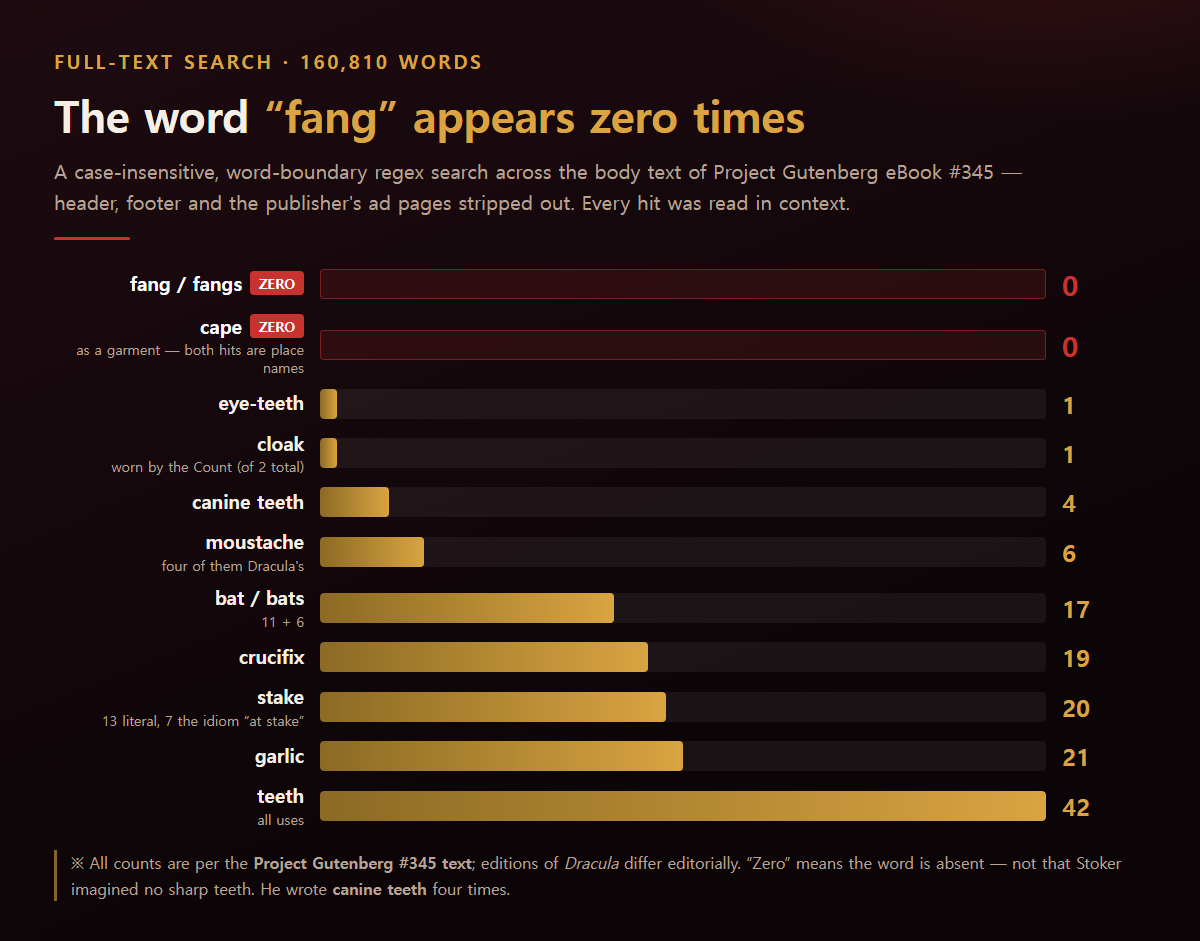
What Stoker wrote instead was "canine teeth" and, once, "eye-teeth."
"as his lips ran back over his gums, the long, sharp, canine teeth showed out strangely"
Source: Dracula, ch. II — Project Gutenberg eBook #345 (public-domain primary text)
And read the Chapter II line closely, because it isn't describing two elongated canines. It says his teeth were "peculiarly sharp" and that they protruded over the lips — plural, all of them. That's a predator's mouth, not a pair of prosthetics.
About the cape — this is where people overshoot
"There's no cape in Dracula" is a popular internet fact, and it's half right.
The garment is genuinely absent. Both hits for cape are geography — a headland in Greenland and one in Greece. collar appears twice and neither instance is about Dracula's clothing, which means the stand-up opera collar has no basis in the text at all.
But there is one cloak on him. Exactly one, in Chapter III:
"I saw the whole man slowly emerge from the window and begin to crawl down the castle wall over that dreadful abyss, face down with his cloak spreading out around him like great wings."
Source: Dracula, ch. III — Project Gutenberg eBook #345 (public-domain primary text)
Not swirling behind him at an opera house. Fanned out around a man crawling face-down over a cliff like a lizard.
Does sunlight kill Dracula in the book?
No. The rule in the novel is that his power ceases at daybreak — not that he burns.
The book's entire rulebook is Van Helsing's speech in Chapter XVIII, and the verb is precise:
"His power ceases, as does that of all evil things, at the coming of the day. Only at certain times can he have limited freedom."
Source: Van Helsing, Dracula, ch. XVIII — Project Gutenberg eBook #345 (public-domain primary text)
Ceases, not dies. By daylight he loses the shapeshifting and the supernatural strength. He does not combust.
And Stoker doesn't leave it as theory. He shows it twice.
Midday on Piccadilly (ch. XIII). After a funeral, the Harkers take a bus to Hyde Park Corner, sit in Rotten Row, and walk down Piccadilly past open shops. Jonathan goes white:
"'I believe it is the Count, but he has grown young. My God, if this be so!'"
Source: Dracula, ch. XIII — Project Gutenberg eBook #345 (public-domain primary text)
Late afternoon at the Piccadilly house (ch. XXIII). Cornered by the hunters, he dives through a window into a flagged courtyard, and the narration is explicit: "we saw him spring unhurt from the ground." Then he walks out through the stable. The next line: "It was now late in the afternoon, and sunset was not far off."
The closest the novel comes to confining him is Mina's memorandum in Chapter XXVI, where he is "confined as he is between dawn and sunset in his wooden box." Confined. Not destroyed.
How does Dracula die in the novel? A Kukri knife and a bowie knife
No stake ever touches him. He's killed by two blades — and by an American, in part.
The word stake turns up 20 times, and I checked all 20. Seven are the idiom ("a soul at stake"). Thirteen refer to an actual piece of sharpened wood, and that wood is used on Lucy (Chapter XVI, by Arthur) and on the three women in the castle (Chapter XXVII, by Van Helsing). For Dracula himself, a stake is proposed three separate times and never once used.
For the record, here's the real thing, from Lucy's scene: a round wooden stake "two and a half or three inches thick and about three feet long," charred hard in a fire and sharpened, driven with the heavy hammer households kept in the coal cellar for breaking lumps.
Now the actual ending, Chapter XXVII:
"The sun was almost down on the mountain tops... came the sweep and flash of Jonathan's great knife. I shrieked as I saw it shear through the throat; whilst at the same moment Mr. Morris's bowie knife plunged into the heart... the whole body crumbled into dust and passed from our sight."
Source: Mina Harker's journal, Dracula, ch. XXVII — Project Gutenberg eBook #345 (public-domain primary text)
Jonathan Harker's weapon is identified earlier in the book as a Kukri, the curved Gurkha knife from Nepal. The second blade belongs to Quincey Morris, the Texan — a bowie knife, the American frontier weapon. Dracula is finished off by two colonial-era blades, one of them straight out of the American West.
Three inversions sit in that one paragraph:
- The weapons are knives, not a stake.
- He dies while the sun is still up. The hunters are racing the sunset because his power comes back once it's gone — sunlight is their ally, not their weapon.
- He does crumble into dust. That part is genuinely Stoker's.
Are garlic, crucifixes, and mirrors in the original Dracula?
All three are real, and they're not incidental — garlic shows up 21 times and the crucifix 19.
The mirror. Harker is shaving when he realizes the Count is standing behind him:
"But there was no reflection of him in the mirror! The whole room behind me was displayed; but there was no sign of a man in it, except myself."
Source: Dracula, ch. II — Project Gutenberg eBook #345 (public-domain primary text)
He'd already noted, days earlier, that the castle contains no mirrors at all — he had to dig a shaving glass out of his own bag.
Garlic. Van Helsing has a bundle of white flowers shipped in and hangs them around Lucy's throat and over her window. Lucy is unimpressed: "Why, these flowers are only common garlic."
Crucifixes. From the innkeeper's wife pressing a rosary on Harker in Chapter I to the Piccadilly standoff in Chapter XXIII, where the Host and the crucifix drive the Count backward across the room.
Two more that survived the trip to the screen intact: he can't enter a home unless someone inside invites him in, and he can't cross running water except at slack or flood tide. Both are Van Helsing's, Chapter XVIII.
The bat, though, is shakier than you'd think. I read all 17 hits for bat and bats, and not one of them is a narrator watching the Count transform. Either a large bat appears and a character concludes afterward that it was him, or Van Helsing states it as a rule. Same structure for the wolf.
So when was the Dracula we picture actually born?
The tuxedo, the stand-up collar, the fangs, and death-by-sunlight all have separate dates — and all of them land after 1897.
Here's the sequence.
| Year | Event | What is documented |
|---|---|---|
| 1897 | Novel published | Old man, white moustache, pointed ears, hairy palms, squat fingers. fang = 0. Not killed by sun; killed by knives |
| 1901 | Stoker's own abridged paperback | Cover art shows Dracula crawling down the castle wall while Harker watches |
| 1922 | Nosferatu premieres in Berlin | Count Orlok: bald, hooked nose, rat-like teeth, pointed ears, claw nails. Destroyed by the rising sun |
| 1924 | Hamilton Deane's play, Derby, England | First authorized adaptation. Dracula in evening clothes, long cape, high collar |
| 1927 | Balderston revision, Broadway | Bela Lugosi, in his first major English-speaking role |
| 1931 | Dracula (Universal, Tod Browning) | Credited to the play, not the novel. Handsome nobleman, satin-lined cape. No fangs. Dies from a stake through the heart |
| 1953 | Drakula İstanbul'da (Turkey) | Cited as the first film to put fangs on a vampire |
| 1958 | Dracula (Hammer, Christopher Lee) | First color Dracula. Popularized blood-tipped fangs and red eyes |
| 2000 | Library of Congress | The 1931 film added to the National Film Registry |
| 2019 | Academy Museum of Motion Pictures | Acquires Lugosi's screen-worn cape, a partial gift from his family |
| 2024 | Nosferatu (Robert Eggers) | Orlok rebuilt as a decaying corpse |
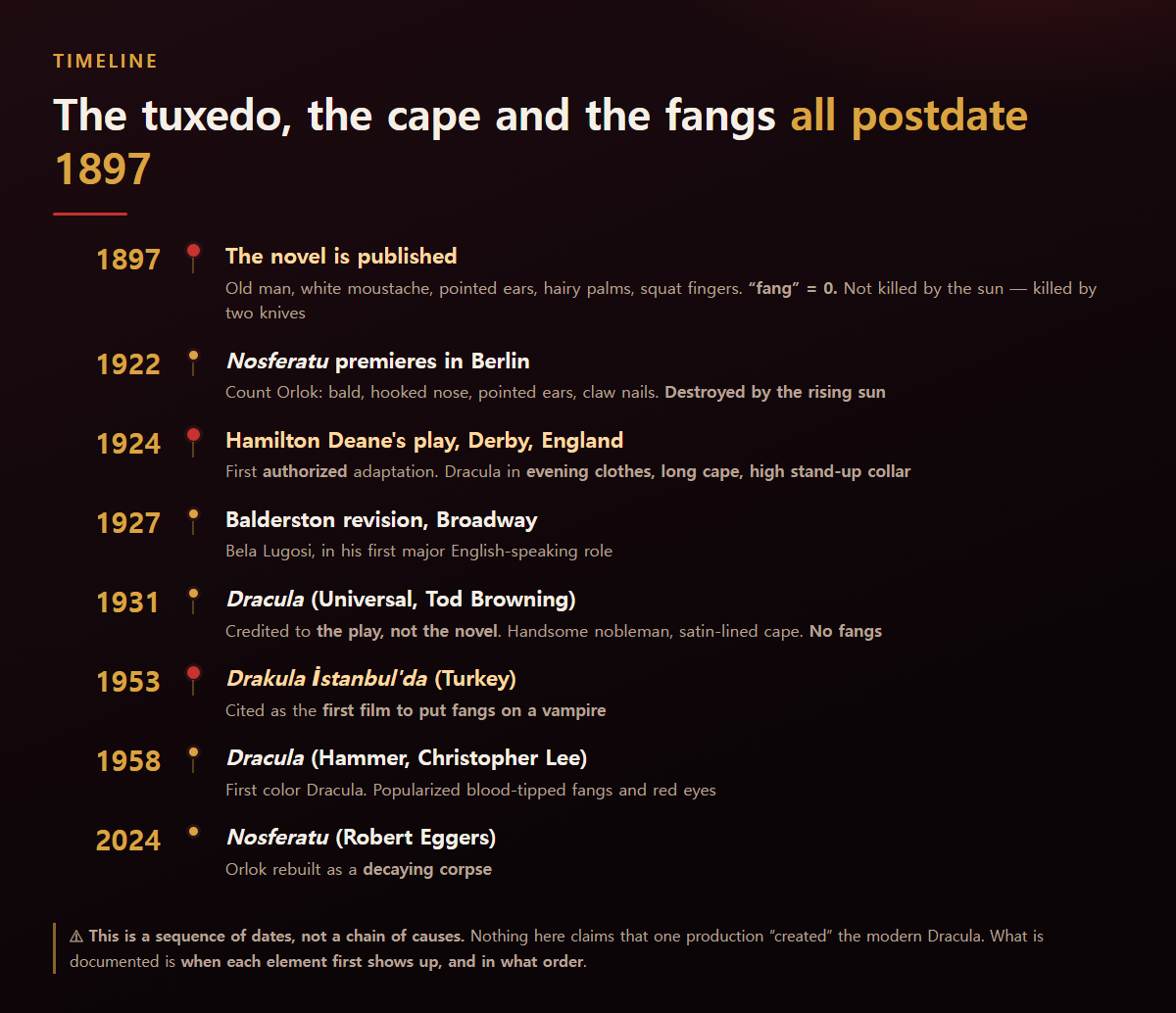
⚠️ That table is a sequence of dates, not a chain of causes. This article does not claim that any one production "created" the modern Dracula. What's documented is when each element first shows up and in what order.
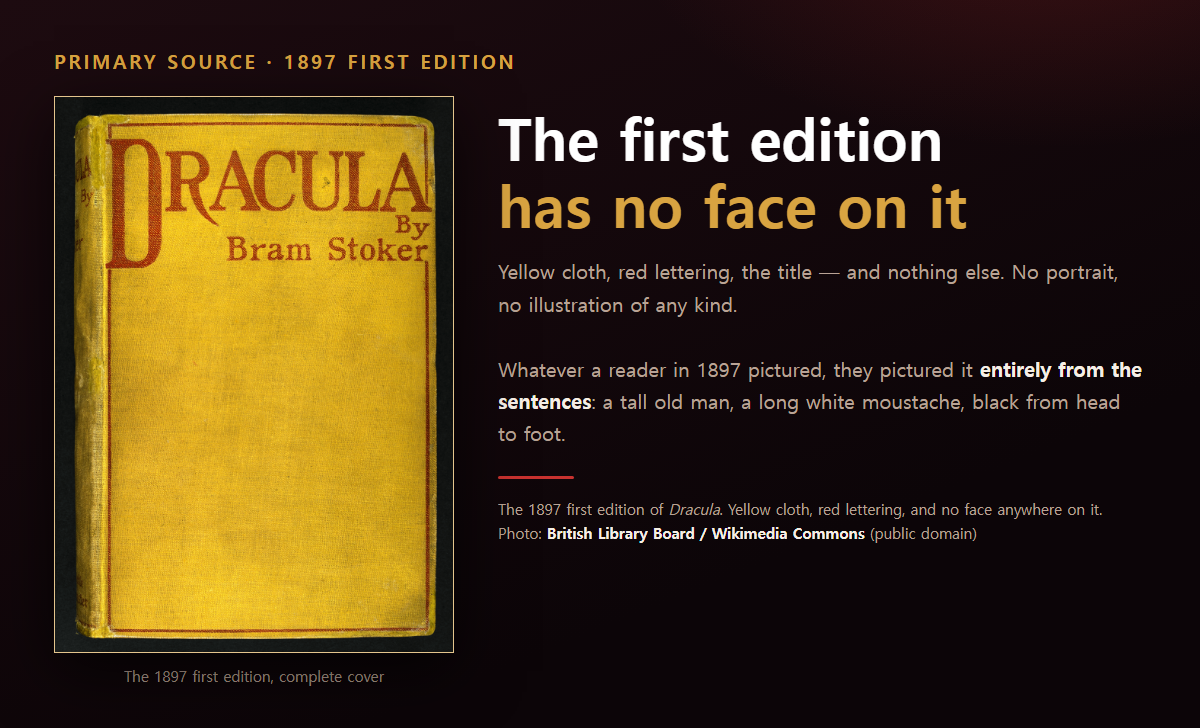
One detail makes the point better than the table does. The 1897 first edition has no face on it. Yellow cloth, red lettering, the title, and nothing else. Whatever readers pictured, they pictured it entirely from the sentences.
Four years later, on the cover of the 1901 abridgment, there finally is a picture: Dracula crawling face-down over the castle wall while Harker watches from a window. Of everything in the novel, the publisher chose the one moment where the cloak appears.
⚠️ You'll see that cover described as the first published illustration of Dracula. I couldn't verify "first" from a primary source, so I'm not claiming it — and no scan of usable resolution exists in the public domain, which is why it isn't pictured here.
Where did Dracula's cape and tuxedo come from?
From a stage in Derby, England, in August 1924 — and at least part of the design was a stagecraft problem, not a character choice.
Hamilton Deane's stage adaptation opened August 5, 1924 at the Grand Theatre in Derby. It was the first authorized adaptation of the novel; Florence Stoker granted permission while she was in the middle of suing the makers of Nosferatu and needed the income.
Deane's Dracula wore evening clothes with a long cape and a high stand-up collar. The stated rationale is wonderfully unglamorous: the vampire was supposed to vanish by magic, which meant the actor had to drop through a trapdoor — and something had to hide him while he did it.
Source: Wikipedia, "Dracula (1924 play)" — premiere date, authorization, costume rationale citing Scivally (2015) — encyclopedia / secondary source
https://en.wikipedia.org/wiki/Dracula_(1924_play)
John L. Balderston reworked the script for American audiences, and it opened October 5, 1927 at the Fulton Theatre on Broadway with Bela Lugosi in the title role — his first major English-speaking part.
Then comes the piece most people get backwards. Universal's 1931 Dracula is credited to the 1924 stage play, not to Stoker's novel. The revolting old man is gone; Lugosi's Count is a handsome, charming aristocrat in a satin-lined cape, to which the actor added an ornamental medallion.
Source: Wikipedia, "Dracula (1931 English-language film)" — stage-play credit, costume, death scene — encyclopedia / secondary source
https://en.wikipedia.org/wiki/Dracula_(1931_English-language_film)
The stake also gets carried out here. Van Helsing kills the Count with wood from the coffin lid, in daylight, at Carfax Abbey. In the novel that method is only ever proposed for Dracula and never used — so the accurate way to put it is that the film executed what the book left as a plan, rather than inventing it from nothing.
⚠️ Who actually created the cape is genuinely disputed. One account credits Deane with the design; Smithsonian Magazine reports that actor Raymond Huntley supplied his own costume — and hedges it with "reportedly." There's a second wrinkle: the Derby premiere starred Edmund Blake, with Deane himself playing Van Helsing, so saying Huntley wore it on opening night would be wrong. This article credits the stage, not a person.
Source: Smithsonian Magazine, "Why Does Dracula Wear a Tuxedo?", Jimmy Stamp, Oct. 31, 2012 — quotes Dracula scholar John Edgar Browning — press, expert-sourced
https://www.smithsonianmag.com/arts-culture/why-does-dracula-wear-a-tuxedo-the-origins-of-bram-stokers-timeless-vampire-101868474/
Did Bela Lugosi wear fangs?
He did not. Nobody on screen did until the 1950s — more than half a century after the novel.
Laid out in order, the gap is startling:
| Point in time | Status |
|---|---|
| 1897 novel | fang appears 0 times (counted directly) |
| 1931, Universal | Lugosi wore no fangs |
| 1953, Drakula İstanbul'da | Cited as the first fangs on film |
| 1958, Hammer's Dracula | Blood-tipped fangs and red eyes go mainstream |
The reason offered for the fangless decades is almost comically practical: before stage microphones, an actor had to project to the back of the house and enunciate — and fake fangs distort speech. The stage tradition went without them, and the film that adapted the stage tradition inherited the choice.
Source: Smithsonian Magazine, "How the Vampire Got His Fangs", Katya Cengel, October 2020 — press
https://www.smithsonianmag.com/arts-culture/history-vampire-fangs-180975783/
Hammer's 1958 Dracula is the one that made them permanent. It was the first Dracula in full color, and the fangs themselves were built by makeup head Philip Leakey in consultation with Christopher Lee, who asked for "more teeth."
Source: SlashFilm, "Year Of The Vampire: In Horror Of Dracula, Christopher Lee Gave The Genre Its First Real Teeth" — press
https://www.slashfilm.com/865399/year-of-the-vampire-in-horror-of-dracula-christopher-lee-gave-the-genre-its-first-real-teeth/
The sunlight death sits in a similar spot. In 1922, Murnau rewrote the final twelve pages of Nosferatu's screenplay, producing the ending in which Orlok is destroyed at sunrise — an idea that appears neither in Stoker's novel nor in Henrik Galeen's script.
I want to be careful about how strongly that gets stated. What I verified firsthand is only that the sunlight kill is absent from Stoker. "Nosferatu invented it" is a widely repeated secondary claim. So the honest version is: it isn't in the novel, and the earliest film usually identified with a vampire disintegrating in sunlight is Murnau's Nosferatu.
Source: Wikipedia, "Nosferatu" — premiere date, Murnau's rewrite, sunlight-death attribution (note 32) — encyclopedia / secondary source
https://en.wikipedia.org/wiki/Nosferatu
Worth noting: Nosferatu went uglier than the book, not prettier. Orlok's pointed ears and corpse-pallor come straight out of Stoker. What the film removed was the moustache and the hair.
The American footnote
Two facts say something about how completely the 1931 version replaced the 1897 one in the American imagination.
On December 27, 2000, the Librarian of Congress added Universal's Dracula to the National Film Registry as culturally, historically, or aesthetically significant.
Source: Library of Congress Information Bulletin, "New on the National Film Registry," January 2001 — U.S. government
https://loc.gov/loc/lcib/0101/significant_cinema.html
And in October 2019, the Academy Museum of Motion Pictures announced it had acquired Lugosi's screen-worn cape, a partial gift from the Lugosi family.
Source: Academy Museum of Motion Pictures / Oscars.org, October 2019 — institutional announcement
https://www.oscars.org/news/academy-museum-motion-pictures-announces-acquisition-bela-lugosis-iconic-cape-dracula
A garment that isn't in the book is now a museum object. That's how thoroughly the second version won.
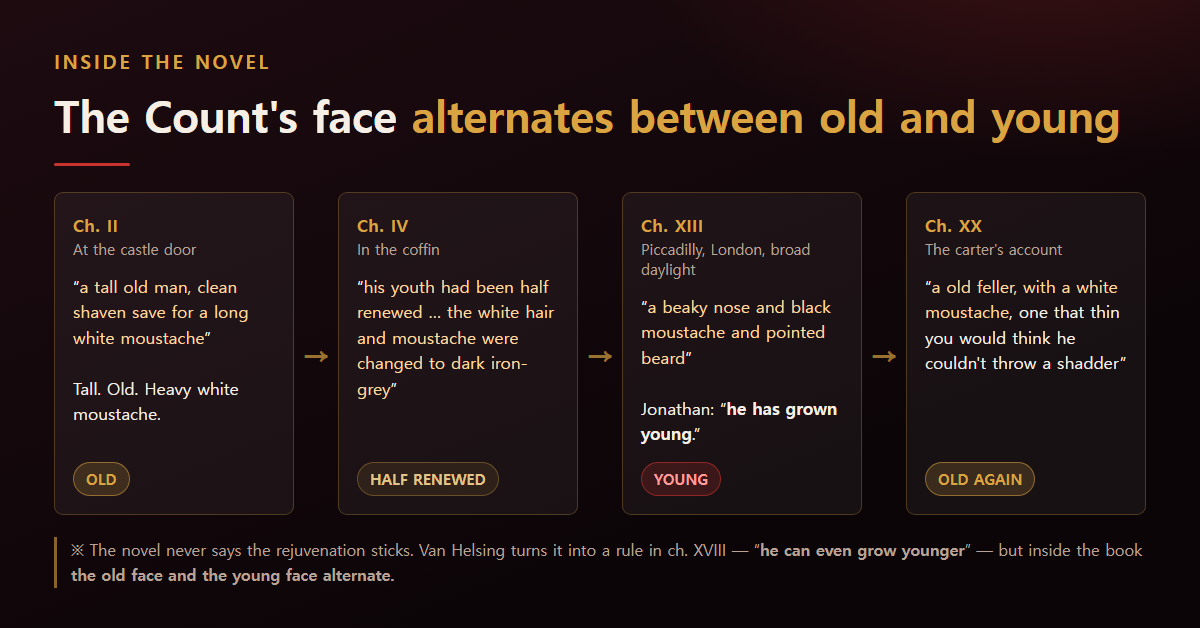
Blood makes him younger — and then he ages back
Both descriptions are in the novel. It isn't a contradiction; it's the mechanism.
In the coffin (ch. IV). Harker opens the box looking for a key:
"looking as if his youth had been half renewed, for the white hair and moustache were changed to dark iron-grey; the cheeks were fuller... He lay like a filthy leech, exhausted with his repletion."
Source: Dracula, ch. IV — Project Gutenberg eBook #345 (public-domain primary text)
In London (ch. XIII). The man Mina sees on Piccadilly is "a tall, thin man, with a beaky nose and black moustache and pointed beard." The white moustache is gone.
Van Helsing turns it into a rule (ch. XVIII): "we have seen amongst us that he can even grow younger."
But it runs the other way too. In Chapter XX, the carter who hauled the boxes describes his employer as "a old feller, with a white moustache, one that thin you would think he couldn't throw a shadder." The novel never says the rejuvenation sticks. The old face and the young face alternate.
What do Lucy and Mina look like in the book?
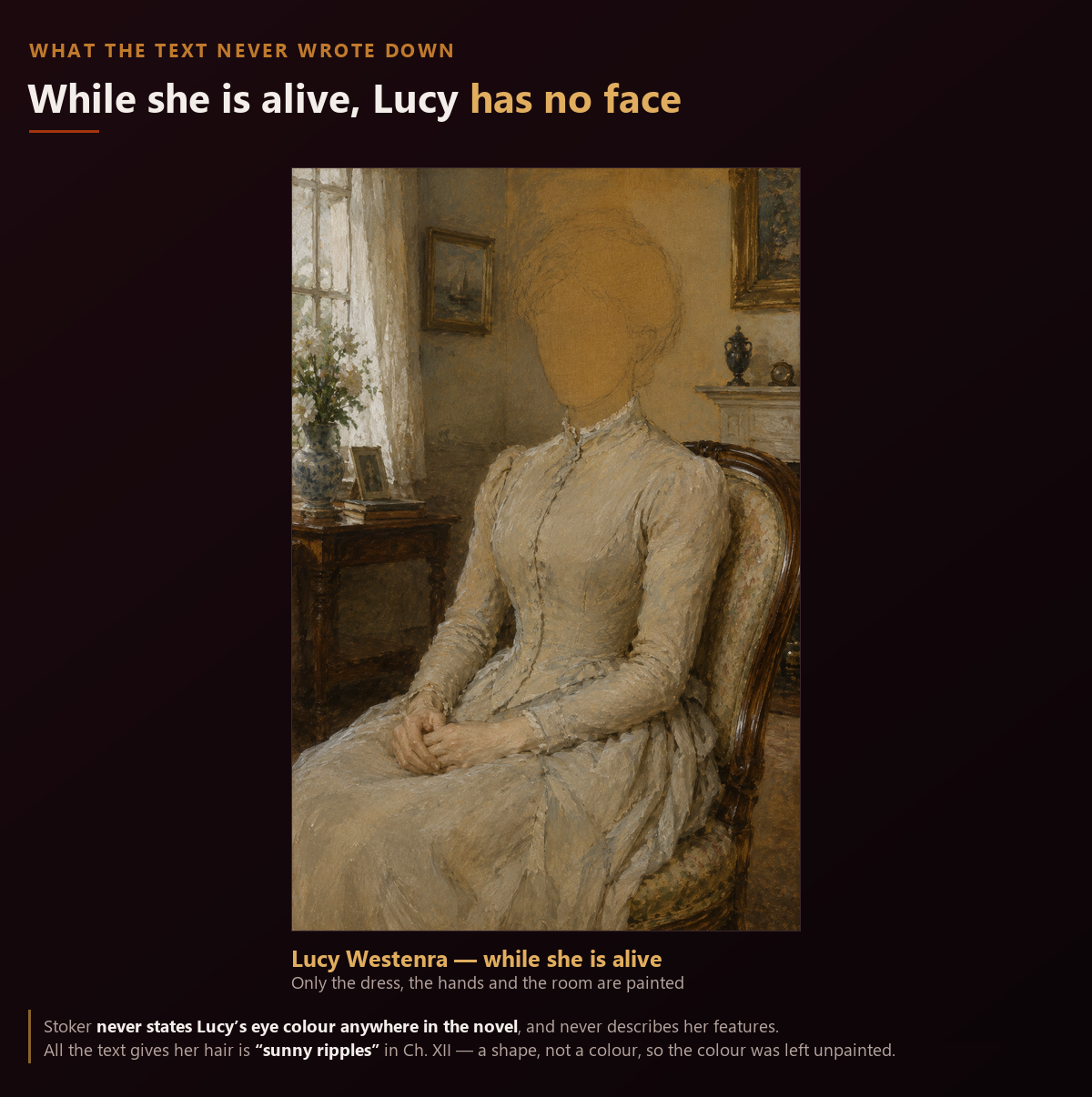
Thirteen catalogued features for the Count. One passing phrase for Lucy. And Stoker never tells you the eye color of either woman — not once, in the entire novel.
I counted the Count's face the same way I counted everything else. Aquiline nose, arched nostrils, domed forehead, eyebrows meeting over the nose, white moustache, sharp teeth, pointed ears, broad chin, thin cheeks, extraordinary pallor, squat fingers, hair on the palms, pointed nails. Thirteen.
So I ran the same search on the women — every hair-color and eye-color phrase in the text (golden hair, blue eyes, black hair, brown hair, green eyes) — and opened each hit to see whose face it actually belonged to.
Sorted by character, the text breaks down like this:
| Character | What the text actually gives you |
|---|---|
| Count Dracula | 13 catalogued features — moustache, eyebrows, ears, teeth, lips, nose, forehead, chin, cheeks, pallor, fingers, nails, palms |
| The three women in the castle (ch. III) | In one sentence: golden hair, eyes like pale sapphires, brilliant white teeth that shone like pearls, the ruby of their voluptuous lips — hair color and eye color, both |
| Lucy, while she is alive | Hair mentioned once (sunny ripples) · no eye color · no features. Everything else is a condition |
| Mina | No physical description at all — "looks a little too pale" is about as close as it gets |
| Lucy, after she turns | pointed teeth, a bloodstained, voluptuous mouth, and "eyes in form and colour" |
Source: full-text search of Dracula — Project Gutenberg eBook #345 (public-domain primary text)
⚠️ One trap worth flagging, because it's easy to misattribute. The line "Big, dark blue eyes are set widely apart" belongs to Van Helsing (ch. XIV) — it's Mina describing him. Those are not Lucy's eyes.
The one line Stoker gives Lucy
Her hair comes up exactly once, the night before she dies, after Van Helsing has quietly brushed it:
"He had even brushed Lucy's hair, so that it lay on the pillow in its usual sunny ripples."
Source: Dr. Seward's diary, Dracula, ch. XII — Project Gutenberg eBook #345 (public-domain primary text)
Read the phrasing: its usual. It's a glance in passing, not a description — and it names no color.
Everything else attached to Lucy is a health reading rather than a face:
"it does not touch her looks; she is a trifle stouter, and her cheeks are a lovely rose-pink. She has lost that anæmic look which she had."
Source: Dracula — Project Gutenberg eBook #345 (public-domain primary text)
Rose-pink cheeks are a chart, not a portrait. She's drained, she goes white; she's transfused, the color comes back. Lucy's cheeks rise and fall all novel long.
Mina gets even less:
"Mina is fast asleep, and looks a little too pale; her eyes look as though she had been crying."
Source: Dracula — Project Gutenberg eBook #345 (public-domain primary text)
Too pale, and eyes that look like she's been crying. That's the whole inventory.
Then she turns — and the description arrives
This is where the text splits.
The three vampire women in the castle get color immediately, all in a single paragraph in Chapter III: great wavy masses of golden hair, eyes like pale sapphires, brilliant white teeth that shone like pearls, and the ruby of their voluptuous lips.
Source: Dracula, ch. III — Project Gutenberg eBook #345 (public-domain primary text)
And Lucy gets a face only after she becomes one of them.
"the pointed teeth, the bloodstained, voluptuous mouth—which it made one shudder to see—the whole carnal and unspiritual appearance"
Source: Dracula — Project Gutenberg eBook #345 (public-domain primary text)
Then comes the strangest sentence in the whole business:
"Lucy's eyes in form and colour; but Lucy's eyes unclean and full of hell-fire, instead of the pure, gentle orbs we knew."
Source: Dracula — Project Gutenberg eBook #345 (public-domain primary text)
That is the first time Stoker says Lucy's eyes have a form and a color.
He never says what the color is. Not there, not anywhere else in the book — while the blonde vampire back at the castle got eyes like pale sapphires on sight.
Same woman. Same pose. Same canvas. One variable: human or not.
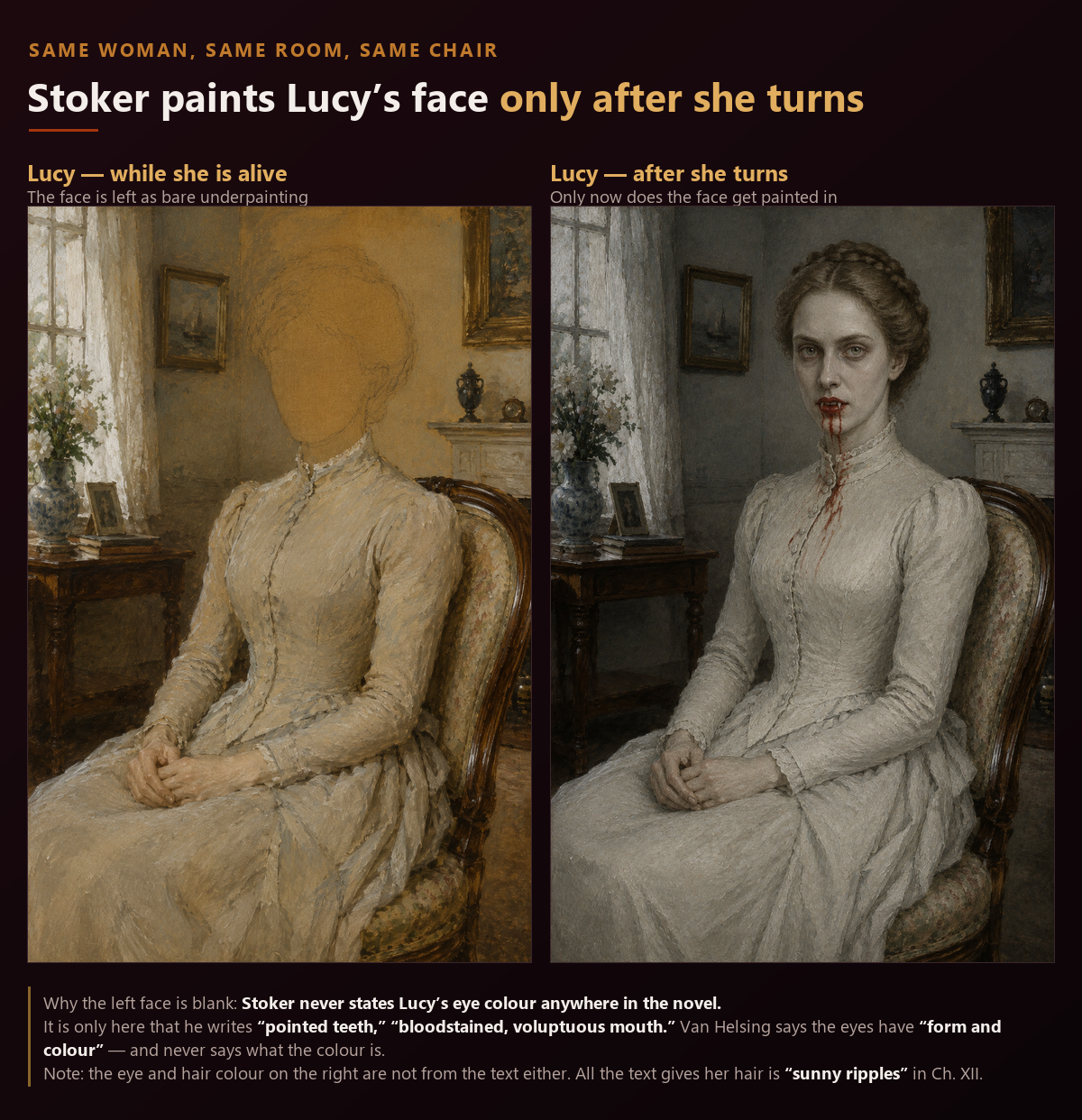
⚠️ If you picture vampire Lucy as alluring, you're reading against the text. The word
voluptuousrepeats, but what the narrator reports feeling is disgust:made me shudder,hate and loathing,foul Thing,devilish mockery. The blood-smeared mouth and the blood soaking her shroud are literally on the page.
What I'm not claiming
Everything above is a pattern observed in the text: almost no color while these women are human, color once they aren't.
Why Stoker wrote it that way, I could not verify. Victorian convention, personal habit, deliberate device — I found no primary evidence pointing to any of them. So I'm not going to write a sentence like "this is how Stoker saw women." What's established is that the text reads this way. That's the finding.
Lucy vs. Mina — the four things readers mix up
| Lucy Westenra | Mina Harker | |
|---|---|---|
| Bitten by the Count | Yes | Yes |
| Becomes a vampire | Yes | No |
| Killed with a wooden stake | Yes (ch. XVI, by Arthur) | N/A |
| How she ends the novel | Destroyed as a vampire | Still human |
The stake goes into Lucy — the Count, as we saw, dies by Kukri and bowie knife. Mina is bitten and scarred on the forehead, but she survives it, and Van Helsing gets the last word on that:
"See! the snow is not more stainless than her forehead! The curse has passed away!"
Source: Van Helsing, Dracula, ch. XXVII — Project Gutenberg eBook #345 (public-domain primary text)
Where it stands now
The two most recent versions went in opposite directions, and neither one went back to Stoker.
Robert Eggers' Nosferatu (2024) rebuilt Orlok as a moving, decaying corpse — sparse hair, rotting skin, the actor completely buried in prosthetics. Luc Besson's Dracula: A Love Tale went the other way entirely, reframing the character around a 400-year romance rather than horror.
One pushed toward rot, the other toward romance. Neither is the book. Stoker's Dracula is an old man with hair growing out of his palms and breath foul enough to turn a young man's stomach. As far as I can tell, nobody has ever filmed that.
Where this article's limits are
A few things I want on the record rather than buried.
"Zero" is a word-search result. The absence of the word fang isn't the same as the absence of the idea — Stoker wrote "canine teeth" four times. What holds up is that his description (all the teeth sharp, protruding over the lips) is meaningfully different from two neat points.
Counts are edition-dependent. The 1897 British first edition and later printings differ editorially. Everything here is measured against the Project Gutenberg #345 text.
The hairy palms have no verified source. The werewolf-lore explanation is common, but I found no primary evidence of Stoker's intent.
"Nosferatu invented sunlight death" is a secondary claim. What I verified directly is only that it's absent from the novel.
The cape's designer is disputed — Deane versus Huntley — so I credited the stage rather than a person.
The 1901 cover may or may not be the first illustration of Dracula. I couldn't confirm "first," so I didn't write it.
Why Stoker left the women's faces undescribed, I could not establish. Period convention or deliberate device — I found no primary evidence either way. What I verified is only that the text is written that way.
Frequently asked questions
Q. What does Dracula look like in the book?
A. A tall old man, clean-shaven except for a long white moustache, dressed entirely in black. His eyebrows nearly meet over the nose, his ears are pale with extremely pointed tops, his fingers are broad and squat, his nails are filed to points, and there is hair in the centre of his palms. Stoker also notes that his breath is rank.
Q. Does the word "fang" appear in Dracula?
A. No — zero times in about 160,000 words. Stoker wrote "canine teeth" (4 times) and "eye-teeth" (once). The Chapter II description says all his teeth were sharp and protruded over the lips, not that two canines were elongated.
Q. Does sunlight kill Dracula in the book?
A. No. Van Helsing says his power "ceases" at daybreak, not that he dies. Dracula walks down Piccadilly at midday, and in Chapter XXIII he jumps through a window in the late afternoon and springs up "unhurt."
Q. How does Dracula die in the novel?
A. Jonathan Harker's Kukri knife shears through his throat and Quincey Morris's bowie knife goes into his heart, while the sun is still on the mountain tops. Then his body crumbles into dust. The wooden stake is used on Lucy and on the three women in the castle — never on him.
Q. Where did Dracula's cape come from?
A. From Hamilton Deane's 1924 stage adaptation in Derby, England, which put him in evening clothes with a long cape and high collar. The collar is reported to have served a practical purpose: hiding the actor as he dropped through a trapdoor. As a garment, "cape" appears zero times in the novel.
Q. Did Bela Lugosi wear fangs in Dracula?
A. No. Fangs start showing up in 1950s films — Drakula İstanbul'da (1953) is the usual first citation — and Hammer's 1958 Dracula with Christopher Lee made them standard.
Q. Are garlic, crucifixes, and mirrors in the original Dracula?
A. Yes, all three. Garlic appears 21 times, crucifix 19, and the no-reflection scene is in Chapter II. The "must be invited in" rule and the "can't cross running water" rule are also Stoker's.
Q. Does Dracula turn into a bat in the book?
A. It's stated as a rule, but no narrator ever watches it happen. All 17 mentions of bats are either a bat being seen and later assumed to be the Count, or Van Helsing describing the ability.
Two things to watch for next time you see him
I'll skip the grand summary. One sentence covers it:
Stoker described the whole face. Later hands didn't fill in a blank — they replaced what was already there.
That's what makes this one different from the earlier pieces in this series. With Pride and Prejudice, the text was silent. With The Odyssey, the text spoke and the painters ignored it. With Sherlock Holmes, three objects got added on top of a face Doyle had already drawn. With Dracula, the face itself got swapped out.
So the next time a Dracula shows up on screen, watch two specific things.
The moustache and the hands.
Stoker's Count has a long white moustache, broad squat fingers, and hair growing out of the middle of his palms. The odds that the version in front of you has any of that are close to zero — and that single fact tells you everything about what happened between 1897 and now.
This series keeps counting who filled in what the original text left blank.
Note on sources: all counts and word totals come from a direct full-text search of Project Gutenberg's public-domain Dracula (eBook #345) and are specific to that text. All quotations are from the public-domain original. Artifact images come from Wikimedia Commons (photography credit: British Library Board) and the Internet Archive (contributed by Smithsonian Institution Libraries, "Not in copyright").


Comments
Post a Comment