Why Is My HOA Fee So High? 1 in 4 Dollars Goes to Reserves
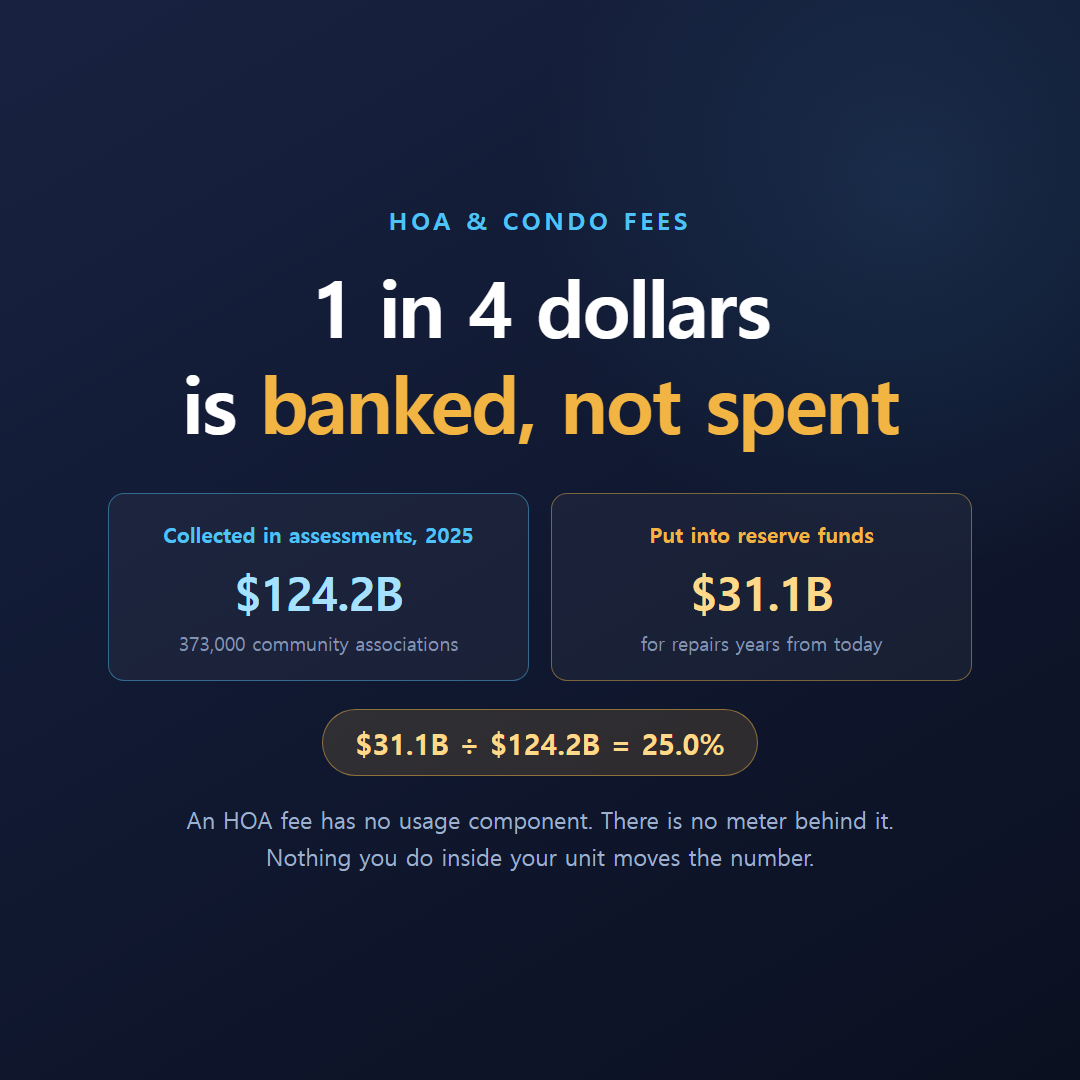
You turn the thermostat down.
You swap the bulbs.
The HOA fee arrives, unchanged, to the penny.
Last updated: 27 August 2026 · Figures and rules in this post are current as of this date.
That is not a coincidence, and it is not your association being stubborn. An HOA fee has no usage component at all. There is no meter behind it. It is a budgeted number, set once a year by a board, and nothing you do inside your unit moves it.
So the useful question is not "how do I lower my HOA fee." It is: what part of this bill was ever mine to influence?
We traced every number below to a document you can open yourself — the Census Bureau's own analysis, the industry's national statistical review, the actual PDF behind the "74% of HOAs are underfunded" headline, and Fannie Mae's Selling Guide.
Figures current as of August 27, 2026. The underlying reports are dated where cited. Fee data refreshes annually; we update the numbers rather than the year in the headline.
What does an HOA fee actually pay for?
Four things — operations, professional services, amenities, and reserves — and the last one is a quarter of the money.
Your association's assessment covers utilities for common areas, service contracts and staff, management and legal and audit and insurance, the pool and clubhouse, and reserves: money set aside now for a roof, elevator, or repaving project years from today.
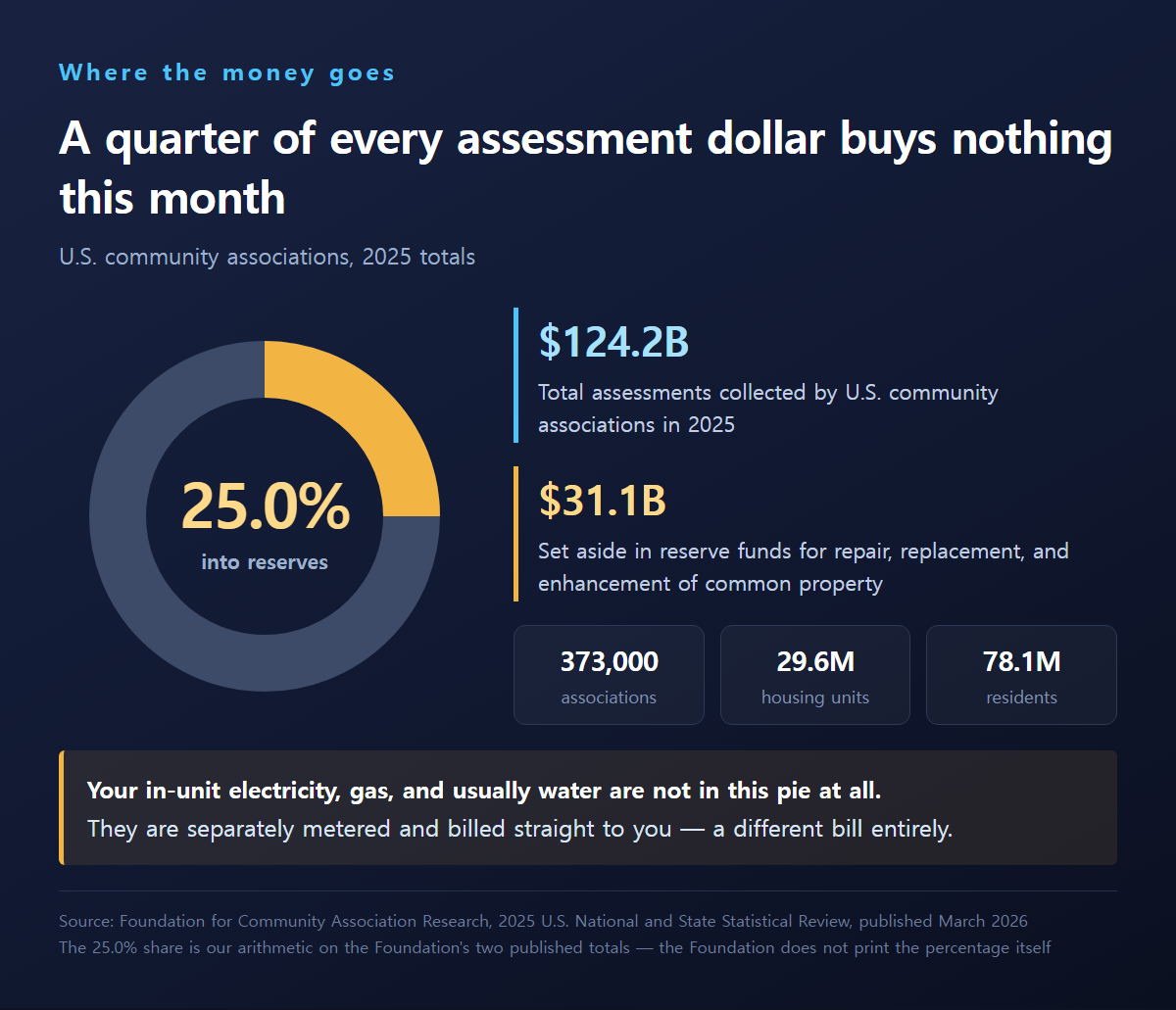
Here is the national scale of that last bucket. In 2025, U.S. community associations collected $124.2 billion in assessments and put $31.1 billion of it into reserve funds for repair, replacement, and enhancement of common property.
Source: Foundation for Community Association Research, 2025 U.S. National and State Statistical Review, published March 2026 — the industry's own national compilation
https://foundation.caionline.org/wp-content/uploads/2026/03/2025StatisticalReviewFoundation.pdf
$31.1B ÷ $124.2B = 25.0%. One dollar in four is not buying you anything this month. It is pre-paying for a roof you may never live under. (That ratio is our arithmetic on the Foundation's two published totals — the Foundation does not print the percentage itself.)
For scale: 373,000 community associations, 29.6 million housing units, 78.1 million residents — 35.2% of all U.S. housing, holding $13.1 trillion in home value. The Foundation projects 374,000 to 377,000 associations in 2026. Homeowners associations are roughly 58-63% of the total, condominium communities 35-40%, cooperatives 2-4%.
Now notice what is not on the list of what your assessment buys: the electricity, gas, and usually the water inside your own unit. In most condos and virtually all single-family HOAs, in-unit utilities are separately metered and billed straight to you. The thermostat lever you reach for touches a different bill entirely.
What is the average HOA fee in the U.S.?
About $135 a month at the median — but four different "averages" circulate, and they measure four different things.
| Figure | What it actually measures | Source | Status |
|---|---|---|---|
| $135/month | Median fee among households that pay one | U.S. Census Bureau, 2024 ACS 1-year estimates | Government statistic |
| $135/month | Median fee on for-sale listings carrying a fee | Realtor.com 2025 HOA Report | Private listings data, stated method |
| $243/month | Mean, attributed to the 2023 American Housing Survey | Repeated by aggregator sites | Could not verify |
| $272/month | "National average" from 203,000+ user submissions | A commercial HOA-fee site | Self-selected sample |
The two $135 figures are not two studies confirming each other. One counts households; the other counts listings. Different universes that happen to land on the same number.
And that $243 figure? We looked for a Census publication of it and did not find one. It appears to be a third party's own tabulation of American Housing Survey microdata. Do not attribute it to the Census Bureau, and be skeptical of any article that does.
Source: U.S. Census Bureau, "Condo or Homeowners Association Fees Topped $500 Monthly for About 3 Million Households," 2025-09-11 — federal statistical agency, 2024 ACS 1-year estimates
https://www.census.gov/library/stories/2025/09/condo-hoa-fees.html
One more caution the Census itself raises: starting with the 2024 ACS, the condominium questions were rewritten to include HOA status and fees, and HOA fees were folded into "selected monthly owner costs" for the first time. The Bureau states plainly that users should not compare the relevant variable beginning in 2024 to pre-2024 data. Any chart showing a smooth multi-year ACS fee trend through 2024 is comparing two different definitions.
Source: U.S. Census Bureau, ACS User Note on the change to condominium questions, December 2025 — federal agency technical documentation
https://www.census.gov/programs-surveys/acs/technical-documentation/user-notes/2025-07.html
Why does one HOA fee cost $50 and another costs $500?
Because "an HOA fee" is not one product. The spread across communities is roughly tenfold, and it dwarfs anything your own behavior could produce.
From the Census Bureau's 2024 analysis:
- 21.6 million of the nation's 86.6 million owned households paid a condo or HOA fee — about one in four.
- National median: $135/month.
- About 5.6 million households (26%) paid under $50 a month.
- About 3 million households paid over $500 a month.
- Households with a mortgage: median $120. Households without a mortgage — typically older owners, often in condos: median $184.
- In New York, 64% of fee-paying homeowners paid more than $500 a month. In D.C. and Hawaii, roughly half did.
- Lowest participation: Maine, North Dakota, Rhode Island, South Dakota, Wisconsin.
Source: U.S. Census Bureau, America Counts, 2025-09-11, using 2024 ACS 1-year estimates — federal statistical agency
https://www.census.gov/library/stories/2025/09/condo-hoa-fees.html
Listing data tells the same story about direction. Realtor.com counted weekly snapshots of for-sale listings carrying a fee above $0:
| 2019 | 2024 | 2025 | |
|---|---|---|---|
| Share of listings with an HOA fee | 34.3% | 41.9% | 43.6% |
| Median monthly fee | $108 | $125 | $135 |
By property type in 2025: condos and townhomes 84.8%, single-family homes 33.4%, new construction 67.9% versus existing homes 38.9%. By state, Nevada is highest at 68.3% of listings and South Dakota lowest at 12.3%. The most extreme local market was Edwards, Colorado — 89.9% of listings, median $525/month.
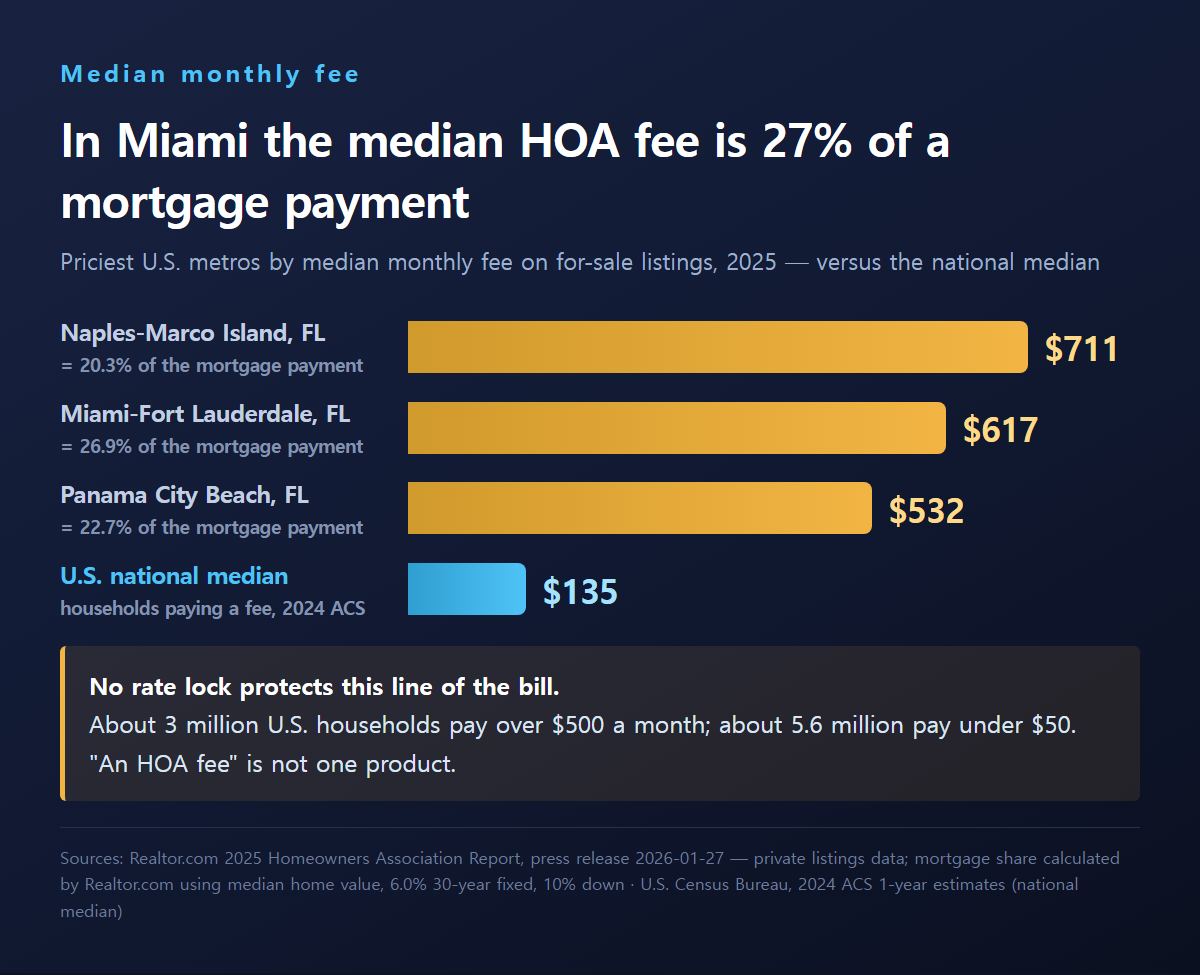
The priciest metros by median fee: Naples-Marco Island, FL at $711 — 20.3% of the estimated monthly mortgage payment — Miami-Fort Lauderdale at $617 (26.9% of the mortgage payment), and Panama City Beach, FL at $532 (22.7%).
Source: Realtor.com 2025 Homeowners Association Report, press release 2026-01-27 — private listings data; mortgage share calculated by Realtor.com using median home value, 6.0% 30-year fixed, 10% down
https://www.prnewswire.com/news-releases/nearly-44-of-us-homes-for-sale-now-carry-hoa-fees-as-dues-continue-to-climb-realtorcom-finds-302670435.html
Read the Miami figure again. In that metro the median HOA fee equals more than a quarter of the median mortgage payment — and no rate lock protects it.
Is my HOA underfunded? Where the "74%" number really comes from
The statistic is real and published — but it comes from one firm's own client base, and that firm says in print not to treat it as a national statistic.
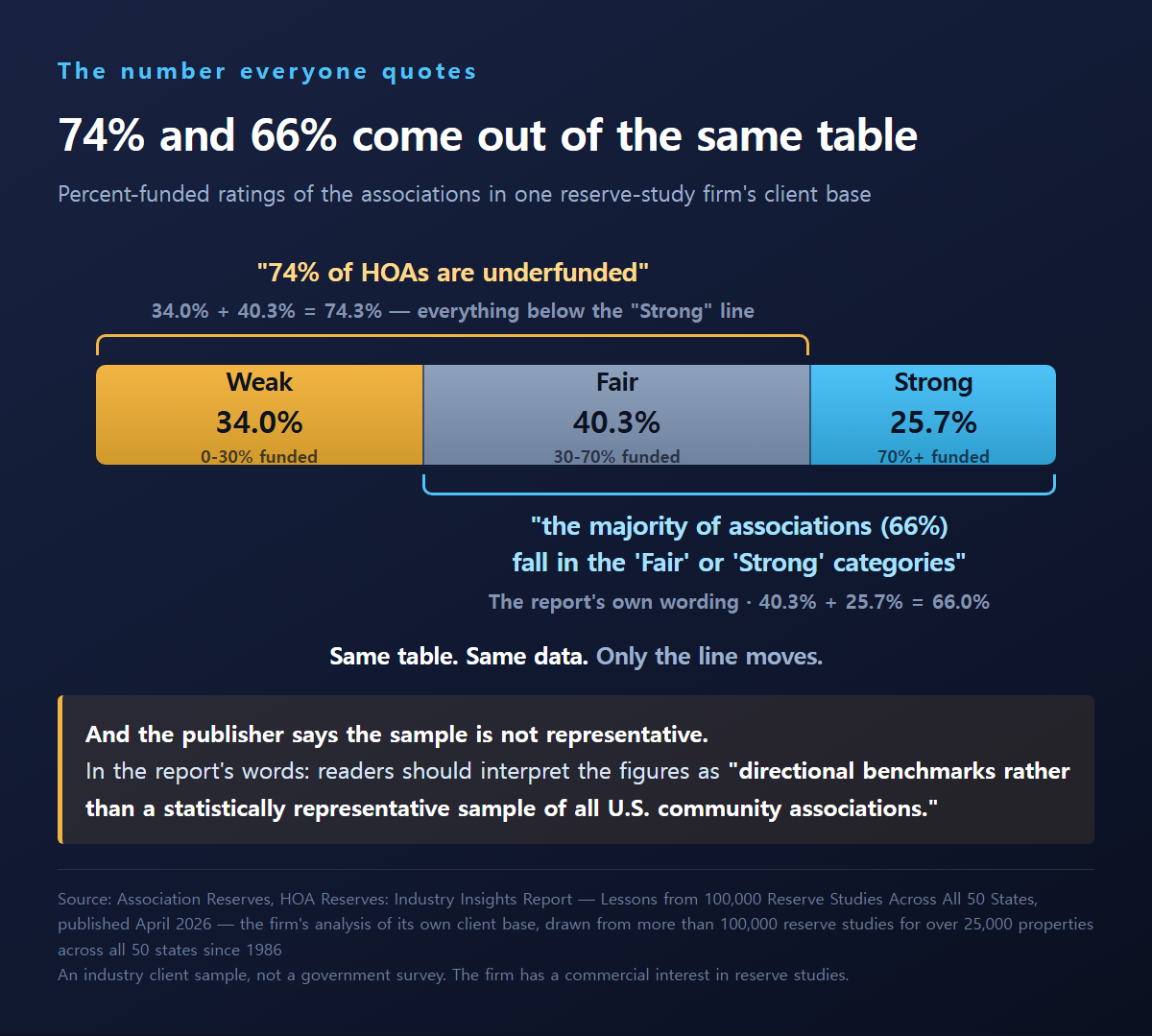
You have seen the headline: 74% of HOAs are underfunded. Here is the actual table it comes from.
| Percent funded | Rating | Share of associations | What the report says it means |
|---|---|---|---|
| 0-30% | Weak | 34.0% | "High likelihood of special assessments; deferred maintenance is common" |
| 30-70% | Fair | 40.3% | "Moderate risk; need to monitor projects and spending carefully" |
| 70%+ | Strong | 25.7% | "Low risk of special assessments; generally well-positioned and financially stable" |
34.0% + 40.3% = 74.3%. That is the famous number: everything below the 70%-funded "Strong" threshold.
Two things almost never survive the retelling.
First, the same table is also published the other way. The report's own wording: "the majority of associations (66%) fall in the 'Fair' or 'Strong' categories." Both statements are true from the identical data. Whichever one you read first was a framing choice by whoever wrote the article.
Second, the sample is not representative, and the publisher says so. In the report's words: "The data in this report is drawn entirely from the Association Reserves client base... it reflects associations that have engaged a professional Reserve Study provider, a group that may be more financially proactive than the broader industry average. Readers should interpret the figures as directional benchmarks rather than a statistically representative sample of all U.S. community associations."
So: a named firm's analysis of more than 100,000 reserve studies for over 25,000 properties across all 50 states since 1986. Substantial. But it is an industry sample, not a government survey, and it should never be described as one.
Source: Association Reserves, HOA Reserves: Industry Insights Report — Lessons from 100,000 Reserve Studies Across All 50 States, published April 2026 — a reserve-study firm's analysis of its own client base; the firm has a commercial interest in reserve studies and states the sample is not representative
https://www.reservestudy.com/wp-content/uploads/2026/05/2026-04-29-100000-Industry-Insights-Report-FINAL.pdf
A few other figures from the same report are worth carrying with you:
- Deferring costs real money. For a $250,000 roof, the report compares three routes: budgeted reserve funding $231,823; special assessment $250,000 (+$18,177); bank loan $320,071 (+$88,248). Reserve funding wins because the money earns interest while it waits.
- Adequate reserve funding runs 15-45% of an association's total annual budget in the firm's 2025 client data, up from a 15-40% range with a roughly 25% midpoint in 2015. The report attributes the shift to 2021-2024 construction-cost inflation outrunning budget growth.
- Associations that refresh their reserve study at least every three years get roughly half as many new special-assessment recommendations as five-year updaters. The report cautions this likely reflects better governance as well as better information.
- Even the firm's longest-tenured clients (25+ studies) average 71.4% funded and still fluctuate, because boards turn over every one to four years and managers every three to five.
Can my HOA hit me with a special assessment out of nowhere?
Yes — that is exactly the mechanism by which an underfunded reserve becomes your problem, all at once.
A special assessment is a one-time charge outside the annual budget, levied when a big repair arrives and the reserve fund cannot cover it. The connection to percent funded is not theoretical: associations in the 0-30% funded band have, in the report's own language, a "high likelihood of special assessments," while those above 70% are described as insulated from that risk.
Insurance alone is already pushing associations toward this. In a Foundation for Community Association Research snap survey of nearly 900 community association leaders representing at least 10,000 associations:
- More than 90% reported property and casualty premiums increased at their most recent renewal.
- 11% experienced a cancellation or non-renewal.
- To pay for it, 50% raised regular assessments, 43% drew on operating funds, and 7% imposed a special assessment.
- Among risk-management professionals surveyed, 96% reported significant premium increases among clients and 83% reported significant policy cancellations.
Source: Foundation for Community Association Research snap survey, published 2023-04-27 — an industry association's survey of its own member leaders, not a probability sample of all associations
https://blog.caionline.org/insurance-coverage-challenges/
How big do these get? Here we have to be careful. Ranges of "$30,000 to $150,000 per unit" circulate widely on law-firm and real-estate-service pages with no stated methodology, and we could not trace them to any survey or dataset. We are not repeating them as fact.
What we can point to is a specifically reported case: residents of Regency Gardens Condominiums in Orlando faced a one-time special assessment of up to $22,000, while monthly HOA fees "would nearly triple."
Source: ResiClub Analytics, 2024-08-31 — reporting on a single named association; one case, not a national average
https://www.resiclubanalytics.com/p/spiking-hoa-fees-special-assessments-shake-floridas-housing-market
Why did my HOA fee go up when I did nothing?
Because three separate forces — a building collapse, a lender rule, and state law — all push the same direction, and none of them is inside your unit.
Surfside changed the price of living in a condo. After the June 2021 Champlain Towers South collapse, Florida enacted Senate Bill 4-D on May 26, 2022, requiring structural milestone inspections and a Structural Integrity Reserve Study (SIRS) — with reserves boards could no longer vote to waive. A SIRS applies to residential condominium buildings three or more habitable stories tall and covers roof, load-bearing structure, fire protection, plumbing, electrical, waterproofing, and windows and doors.
HB 913 took effect July 1, 2025 and adjusted the regime: it raised the component cost threshold from $10,000 to $25,000, consolidated the component list to eight categories, narrowed applicability to habitable stories, and allowed boards to fund reserves using loans, lines of credit, or special assessments with proper approval. The SIRS completion deadline of December 31, 2025 can extend to December 31, 2026 for associations coordinating with a milestone inspection due by then. HB 913 also requires independent insurance appraisals every 36 months.
Source: Industry summary of Florida HB 913, effective 2025-07-01 — a management company's summary, not the statute; verify specific deadlines against the Florida statute before relying on a date
https://castlegroup.com/blog/floridas-new-sirs-law-hb-913-the-key-2025-deadline-extension-reserve-rule-changes-you-need-to-know/
And the price showed up in the fees. Redfin's analysis of the 43 largest U.S. metros found that in the three months ending July 31, 2024, the median monthly HOA fee rose:
| Metro | Year-over-year change in median HOA fee |
|---|---|
| Tampa | +17.2% (steepest of 43 metros) |
| Orlando | +16.7% |
| Fort Lauderdale | +16.2% |
| West Palm Beach | +12.8% |
| Jacksonville | +7.6% |
| Miami | +5.7% |
| Median across all 43 metros | +5.7% |
Over the same period, condo sale prices fell 7% year over year in Jacksonville and 3% in Miami, where condo sales dropped 9% and new listings rose 27%.
Source: Redfin analysis reported 2024-08-31 via ResiClub Analytics — brokerage data on listings and closed sales
https://www.resiclubanalytics.com/p/spiking-hoa-fees-special-assessments-shake-floridas-housing-market
Sit with that for a second. Owners in Tampa saw their fees jump 17% because a building fell down 1,000 miles away and a legislature responded to it. No thermostat setting was ever going to touch that.
Two more floors push in the same direction even where no disaster occurred:
Fannie Mae. For a condo project to be eligible under a Full Review, the lender must verify that the HOA budget provides for replacement reserves of at least 10% of the budget, calculated by dividing the annual budgeted replacement reserve allocation by annual budgeted assessment income. A reserve study can substitute only if funded reserves meet or exceed the study's own recommendations — and the Guide states that a reserve study "may not be used to waive the 10% reserve requirement." Practically: a board that underfunds reserves risks making its own building unfinanceable, which hits every owner's resale price. The pressure to raise fees is structural, not discretionary.
Source: Fannie Mae Selling Guide B4-2.2-01, version dated 08/05/2026, read 2026-08-27 — the lender rulebook itself
https://selling-guide.fanniemae.com/sel/b4-2.2-02/full-review-process
California. Civil Code § 5550 requires the board, at least once every three years, to have a reasonably competent and diligent visual inspection of the accessible areas of the major components the association must maintain, as part of a reserve study — triggered when the replacement value of major components is at least half the association's gross budget. The board must also review that study annually and adjust.
Source: California Civil Code § 5550 — state statute
https://codes.findlaw.com/ca/civil-code/civ-sect-5550/
What can you actually control?
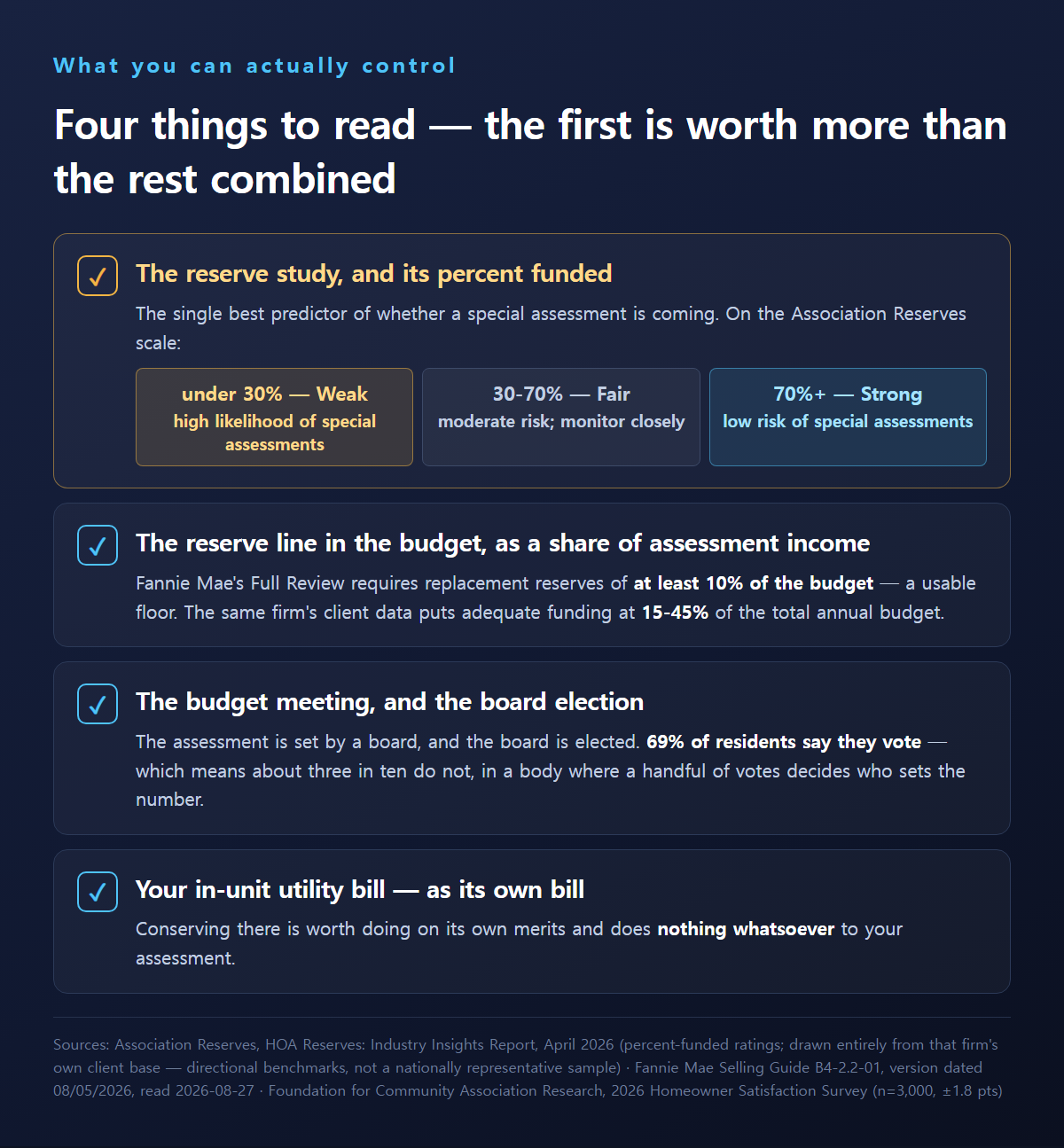
Governance levers, not thermostat levers. There are four, and the first one is worth more than the other three combined.
1. Read the reserve study and its percent funded — before you buy, and every year after. It is the single best predictor of whether a special assessment is coming. Using the Association Reserves scale: 70%+ is "Strong," 30-70% is "Fair," under 30% is "Weak" with a high likelihood of special assessments.
2. Read the reserve line in the budget as a share of assessment income. Fannie Mae's own 10% test is a usable floor benchmark, and the same firm's client data puts adequate funding at 15-45% of the total annual budget. If your association is far below that, you are looking at a future special assessment being quietly deferred into your lap.
3. Vote, and show up to the budget meeting. The assessment is set by a board, and the board is elected. In the Foundation's 2026 survey, 69% of residents said they vote in their association elections — which also means about three in ten do not, in a body where a handful of votes decides who sets the number.
4. Stop treating in-unit utilities as an HOA strategy. They are a separate bill. Conserving there is worth doing on its own merits and does nothing whatsoever to your assessment.
For what it is worth, most owners are not miserable about any of this. The Foundation's nationally representative survey (Zogby Analytics, consistent methodology for 21 years), fielded February 26 to March 14, 2026, n = 3,000, margin of error ±1.8 points, found:
- 86% rate their overall community association experience as very good, good, or neutral (63% very good or good)
- 82% believe their board serves the community's best interests
- 75% say their community manager delivers value
- 81% were told the property was in an association when considering the purchase, up from 78%
- 41% said the association made them more interested in buying, up from 38%
Source: Foundation for Community Association Research, 2026 Homeowner Satisfaction Survey — nationally representative survey commissioned by the industry's own foundation
https://foundation.caionline.org/research/survey_homeowner/
What we could not verify
Three things we chased and did not land. Saying so is the point of this site.
1. We did not compute the fee distribution ourselves. We tried to pull ACS table B25142 ("Monthly Homeowners Association and/or Condominium Fee") directly from the Census API to tabulate it. As of August 27, 2026 the API returns "Missing Key" without a registered API key. So the distribution figures above are the Census Bureau's own published analysis, not our tabulation. We are not going to imply otherwise.
2. The "$243 average HOA fee" attributed to the American Housing Survey. We could not find a Census publication of that number. Treat it as an unverified secondary calculation.
3. Fannie Mae's reserve requirement going to 15% in 2027. Multiple industry blogs state the 10% replacement-reserve requirement rises to 15% for loan applications on or after January 4, 2027. The Selling Guide version dated 08/05/2026, which we read directly on 2026-08-27, states 10% with no mention of an upcoming change. Until Fannie Mae publishes it, the 15% figure is unverified — do not budget around it.
One framing caution as well: some outlets call the 74% figure "the highest underfunding rate ever recorded." The April 2026 report gives the 34.0/40.3/25.7 split and notes an earlier two-year high-inflation stretch when 82% of its clients were underfunded. "Highest ever recorded" is a secondary characterization, not a quote from the report.
Frequently asked questions
Q. What is the average HOA fee per month?
A. The median U.S. household that pays one paid $135/month in 2024, per the Census Bureau's 2024 ACS analysis. The mean is meaningfully higher because the distribution has a long right tail — about 3 million households pay over $500 a month while about 5.6 million pay under $50.
Q. What does an HOA fee actually pay for?
A. Operations (common-area utilities, contracts, staff), professional services (management, legal, audit, insurance), amenities (pool, clubhouse, recreation), and reserves for future capital repairs. Nationally, reserves took 25.0% of all assessments collected in 2025 ($31.1B of $124.2B). In-unit electricity, gas, and usually water are billed to you separately and are not part of it.
Q. What is a good percent funded for an HOA?
A. On the Association Reserves scale, 70% or above is rated "Strong" with a low likelihood of special assessments; 30-70% is "Fair"; under 30% is "Weak." Only 25.7% of the associations in that firm's client sample were at 70% or above. Note that this is an industry client sample, not a national statistic.
Q. How do I know if my HOA is underfunded?
A. Ask the board for the most recent reserve study and read the percent funded figure. Then check the budget's reserve allocation against annual assessment income — Fannie Mae requires at least 10% for condo project eligibility, and reserve professionals put adequate funding at 15-45% of the total annual budget.
Q. Can my HOA raise fees without a vote of the owners?
A. Boards set the annual budget, and that budget sets the assessment. Governing documents and state law determine what owner approval, if any, is required and what caps apply — that varies by state and by association, and we did not verify it state by state here. Check your association's declaration and bylaws, and your state statute.
Q. Why did my HOA fee go up in Florida?
A. Post-Surfside law is the largest single reason. SB 4-D (2022) required milestone inspections and a Structural Integrity Reserve Study with non-waivable reserves; HB 913 adjusted the rules effective July 1, 2025. Redfin measured the result: median HOA fees rose 17.2% year over year in Tampa and 16.7% in Orlando in the three months ending July 31, 2024, against a 5.7% median across the 43 largest metros.
Before your next board meeting, pull one document
If you came here looking for a way to lower your HOA fee, the honest answer is that the lever most people reach for does not connect to anything. The assessment has no usage component. There is no version of turning the lights off that lowers it.
But there is one document that tells you what is coming, and most owners have never opened it.
Ask for the reserve study and find the percent funded number. One number, usually on the first page or two.
- 70% or above: your association is in the group rated least likely to hit you with a special assessment.
- 30 to 70%: worth watching the capital projects list and the funding plan.
- Under 30%: this is where large one-time charges tend to come from, and it is worth asking the board what the plan is — before the roof asks first.
That single number will tell you more about your future housing costs than a year of careful thermostat management.
This article summarizes published data and public rules. It is not legal, financial, or tax advice — your association's governing documents and your state's statutes control your specific situation.
Sources
- Condo or Homeowners Association Fees Topped $500 Monthly for About 3 Million Households — U.S. Census Bureau, America Counts, 2025-09-11 (2024 ACS 1-year estimates)
- ACS User Note: Change to Condominium Questions — U.S. Census Bureau, December 2025
- 2025 U.S. National and State Statistical Review (PDF) — Foundation for Community Association Research, March 2026
- HOA Reserves: Industry Insights Report — Lessons from 100,000 Reserve Studies (PDF) — Association Reserves, April 2026
- Nearly 44% of U.S. Homes for Sale Now Carry HOA Fees — Realtor.com 2025 HOA Report, 2026-01-27
- B4-2.2-01/02, Full Review Process — Fannie Mae Selling Guide, version dated 08/05/2026
- California Civil Code § 5550
- Florida's New SIRS Law (HB 913) — industry summary of the statute
- Insurance coverage: Communities report significant challenges with rising premiums — FCAR snap survey, 2023-04-27
- Homeowner Satisfaction Survey — Foundation for Community Association Research, 2026 wave
- Spiking HOA fees and special assessments shake Florida's housing market — ResiClub Analytics, 2024-08-31 (Redfin 43-metro data)


Comments
Post a Comment