How Much Does a Wedding Really Cost? The Missing Median
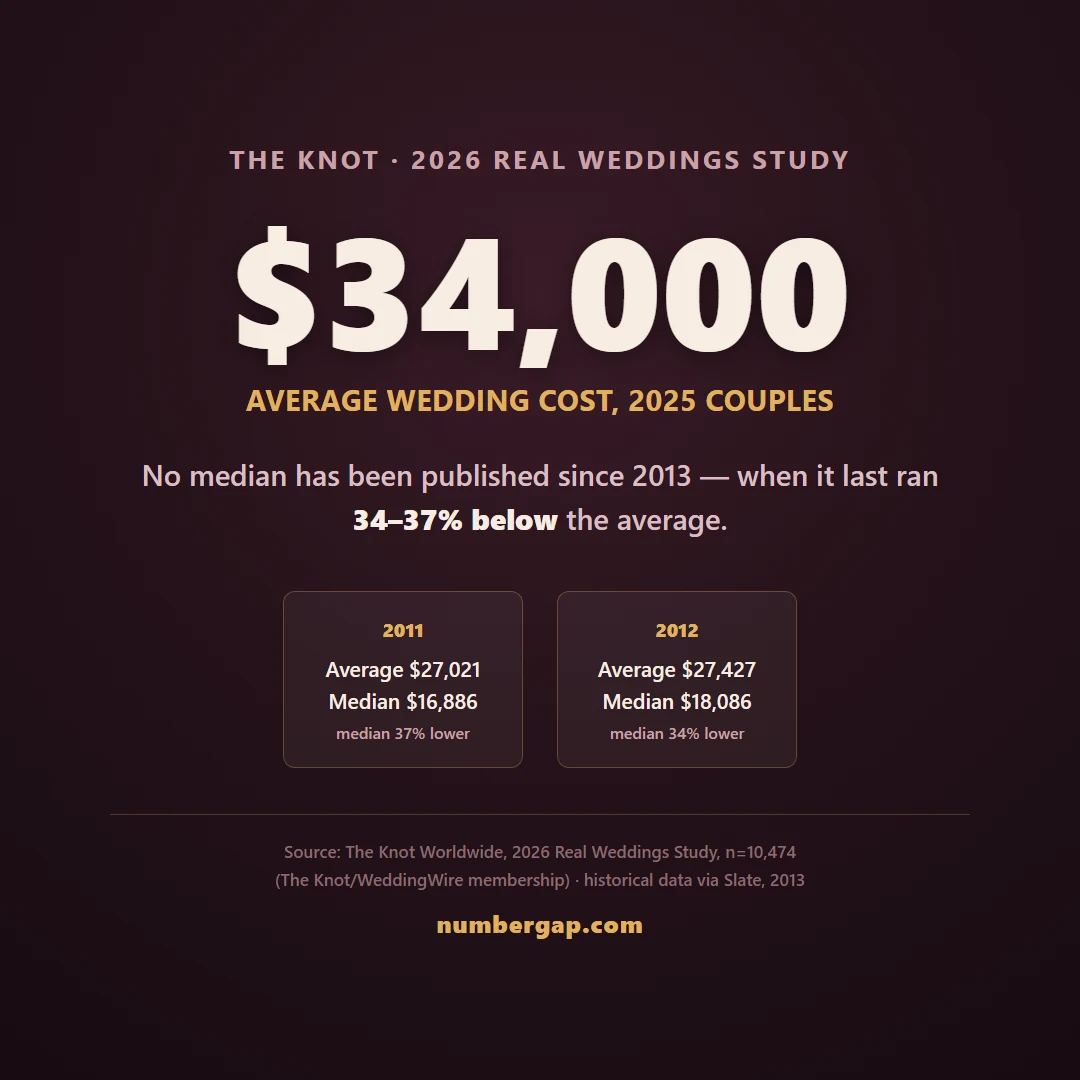
Every year, one number travels through hundreds of articles, morning shows, and personal-finance blogs: the average American wedding costs $34,000.
Last updated: 15 September 2026 · Figures and rules in this post are current as of this date.
It comes from one source. The Knot's 2026 Real Weddings Study, covering couples who married in 2025, based on 10,474 responses.
Nobody disputes that The Knot collected those numbers. The question is who answered.
We pulled the press release itself — not a summary of it, the actual methodology paragraph — and one sentence in it explains almost everything about why this number behaves the way it does.
How Much Does the Average Wedding Actually Cost in the US Right Now?
$34,000, per The Knot Worldwide's 2026 Real Weddings Study. That figure covers venue, catering, bar service, photography, videography, flowers, décor, music, the dress, and the cake — a couple's core wedding-day vendor spending.
Source: The Knot Worldwide, "2026 Real Weddings Study" press release, Feb. 2026
It does not include the engagement ring, the honeymoon, or the rehearsal dinner. Those get tracked separately, and adding them back in can push a couple's total spending another $10,000 to $15,000 higher.
Average guest count in the study was 117, at roughly $292 to $300 a head.
None of that is in dispute. What's worth pausing on is who was asked.
Who Actually Answered This Survey?
Here's the sentence, straight from the press release's own methodology paragraph:
"Respondents were recruited via email invitation from The Knot and/or WeddingWire membership throughout the year 2025."
Read that again. Not a random sample of Americans who got married. People who had already created an account on a wedding-planning website or a vendor marketplace — platforms whose entire business model is connecting couples with paid vendors.
To be fair to The Knot: they didn't bury this. It's right there in their own methodology section, in plain language. Nobody had to file a records request to find it.
The problem isn't that the sampling method is hidden. It's that the number travels without it. By the time $34,000 shows up in a morning-show segment or a budgeting article, the sentence about who was surveyed has almost always been dropped.
Wedding planner and journalist Elisabeth Kramer, who has covered the industry for seven years, put it plainly in a 2023 piece: The Knot "is, obviously, not exactly impartial on the results," since it's one of the largest vendor marketplaces in the business.
Source: Elisabeth Kramer, elisabethkramer.com, Feb. 14, 2023
Is There a Median Wedding Cost?
Not anymore — at least not one The Knot publishes.
We searched the current methodology page for the word "median." It isn't there. Not once, anywhere in the document.
That matters because The Knot used to publish both numbers, average and median, side by side.
| Year | Average | Median | Gap |
|---|---|---|---|
| 2011 | $27,021 | $16,886 | Median is 37% lower |
| 2012 | $27,427 | $18,086 | Median is 34% lower |
Source: Will Oremus, Slate, "Average Wedding Cost: Published Numbers Are Totally Inaccurate," 2013, citing The Knot's own historical data
In both years where the figures sat next to each other, the median ran roughly a third below the average. That's a big gap for one dollar figure to be doing all the work of describing "what a wedding costs."
Since 2013, no current median has been published — not by The Knot, not by Zola, not by WeddingWire. Numbers like "$10,000" that circulate online today are third-party guesses, not sourced to any current official study.
If that same historical gap still held and you applied it to today's $34,000 average, you'd land somewhere around $22,000. That's our own extrapolation, not a published figure — nobody at The Knot has confirmed a current median anywhere near that number.
So why stop publishing it?
The Quote That Accidentally Explains the Problem
In 2013, journalist Will Oremus asked Rebecca Dolgin — at the time editor-in-chief of TheKnot.com — exactly that question. Her answer, on the record:
"If the average cost in a given area is, let's say, $35,000, that's just it — an average. Half of couples spend less than the average and half spend more."
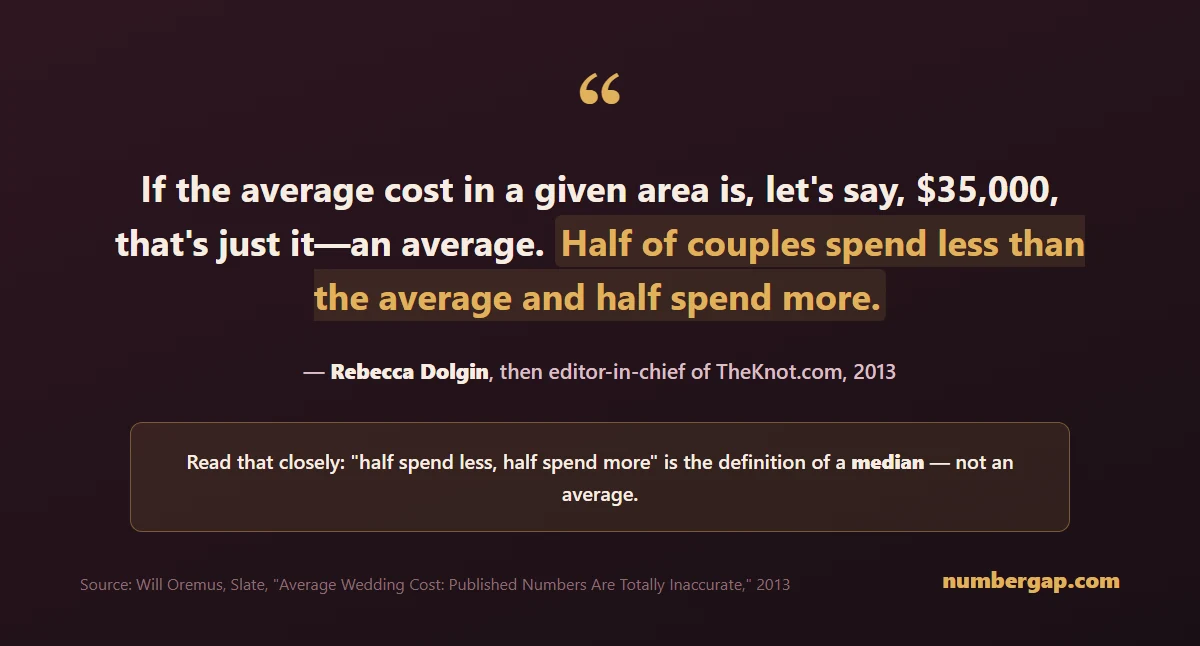
Read that sentence slowly. "Half spend less and half spend more" isn't a description of an average. It's the definition of a median.
The company's own data at the time said the two figures were 35% apart. If half of couples had genuinely been spending below $35,000 and half above it, the average and the median would have landed close to the same place. They didn't.
This isn't a case for mocking anyone. Dolgin may simply have misspoken in an interview — plenty of people use "average" and "median" as if they're interchangeable, because in casual conversation they usually get away with it. What it does show is that the confusion runs deeper than a marketing choice. The person publicly defending the number appears to have been picturing the wrong statistic while she explained it.
So Is $34,000 Inflated?
Not by as much as the sampling bias alone would suggest — and that's the part that complicates a tidy story.
The Wedding Report, a separate research firm that says it supplements its own surveys with Census, CDC, and Bureau of Labor Statistics data rather than relying only on platform members, put its 2025 range at $32,004 to $39,116.
Source: wedding.report, "2025 Average Wedding Cost Estimate"
That range brackets The Knot's $34,000 almost exactly. Zola, running its own member survey of over 11,500 couples, landed at $36,000.
Three different methodologies — one openly platform-based, one claiming broader independence, one built entirely on its own users — all arrive within a few thousand dollars of each other.
That doesn't clear The Knot of the sampling problem. But it does undercut the simplest version of the story, the one where "The Knot inflated the number because of who it surveys." If that were the whole explanation, an independent-leaning source like The Wedding Report should have landed meaningfully lower. It didn't.
The likelier explanation: anyone willing to sit down and fill out a detailed post-wedding cost survey — regardless of which company runs it — tends to be a more organized, higher-spending planner than the typical person who gets married. That's a general survey-response bias, not something unique to one company.
What none of these three sources do, though, is publish a median. The average is the only number any of them puts a spotlight on.
Where Did "Two Months' Salary" for a Ring Actually Come From?
If the average wedding number has a cousin, it's the ring rule — spend two months' salary on an engagement ring. It sounds like tradition. It's an ad campaign.
In 1938, Harry Oppenheimer of De Beers met with the advertising agency N.W. Ayer & Son. Ayer's strategy wasn't a straightforward pitch — it was planting romantic diamond stories in newspapers and magazines until the idea felt like it had always existed.
The specific "months of salary" benchmark shifted over the campaign's life, and the exact timeline is genuinely fuzzy in the sources we found — some describe an escalation from one month to two in the US over later decades; others describe one month (UK), two months (US), and three months (Japan) as different figures set for different markets around the same time. Both versions show up across retellings, and neither traces back to a primary De Beers document we could access directly. What's well documented either way is that the benchmark itself — however many months — was invented copy, not inherited custom.
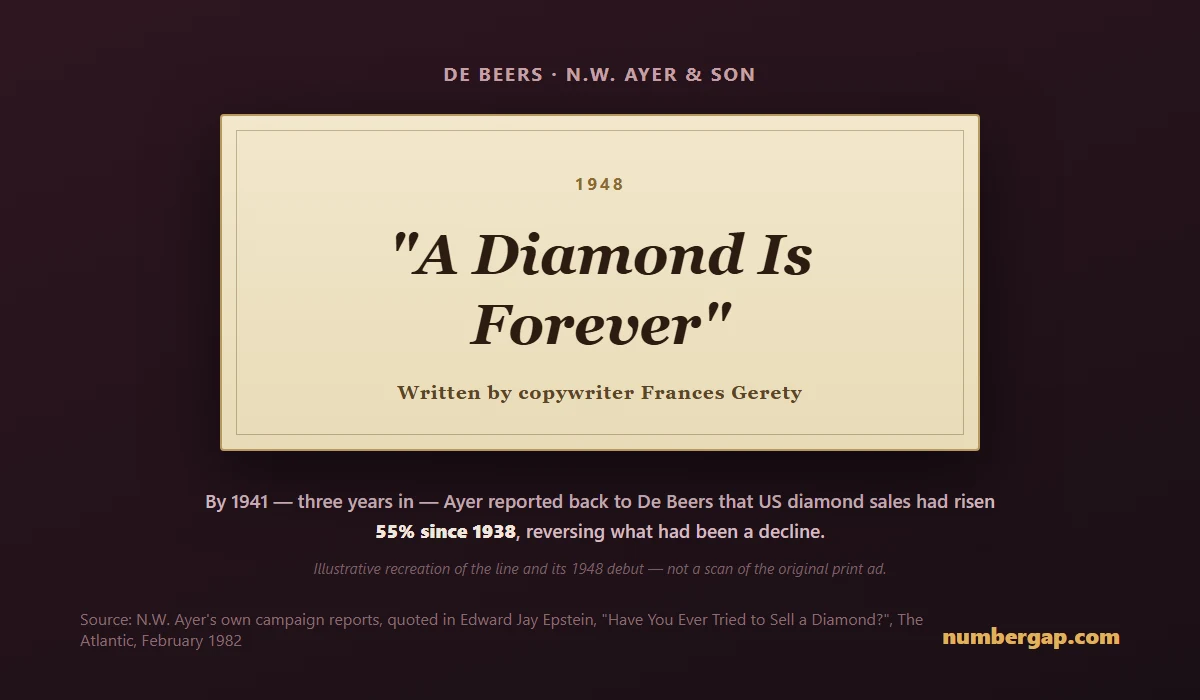
It worked fast. By 1941 — three years in — Ayer reported back to De Beers that US diamond sales had risen 55% since 1938, reversing what had been a decline. By the end of the 1950s the agency was describing the result in its own files: "To this new generation a diamond ring is considered a necessity to engagements by virtually everyone." Both figures come from N.W. Ayer's own reports, quoted in Edward Jay Epstein's 1982 Atlantic investigation of the diamond trade.
You will also see it said that diamond rings went from about 10% of first-time American brides before the campaign to roughly 80% by 1990, and that US wholesale diamond sales grew from $23 million in 1939 to $2.1 billion by century's end. Those numbers are repeated everywhere. We could not trace either one to a primary source — every version we found cites another retelling. We are leaving them here labeled rather than stating them as fact.
The line that made the campaign immortal came from one person, on one deadline.
Frances Gerety, a copywriter at N.W. Ayer's Philadelphia office, wrote "A Diamond Is Forever" late one night in 1947 — reportedly after realizing she'd forgotten to write a closing line for a De Beers presentation the next morning. Colleagues objected to the grammar; "is" instead of "will be" read strangely to them. She held her ground. The line debuted in ads in 1948. Advertising Age named it the top advertising slogan of the 20th century in 1999. Gerety spent 27 years on the De Beers account. She never married.
The White Dress Wasn't Her Idea, Either
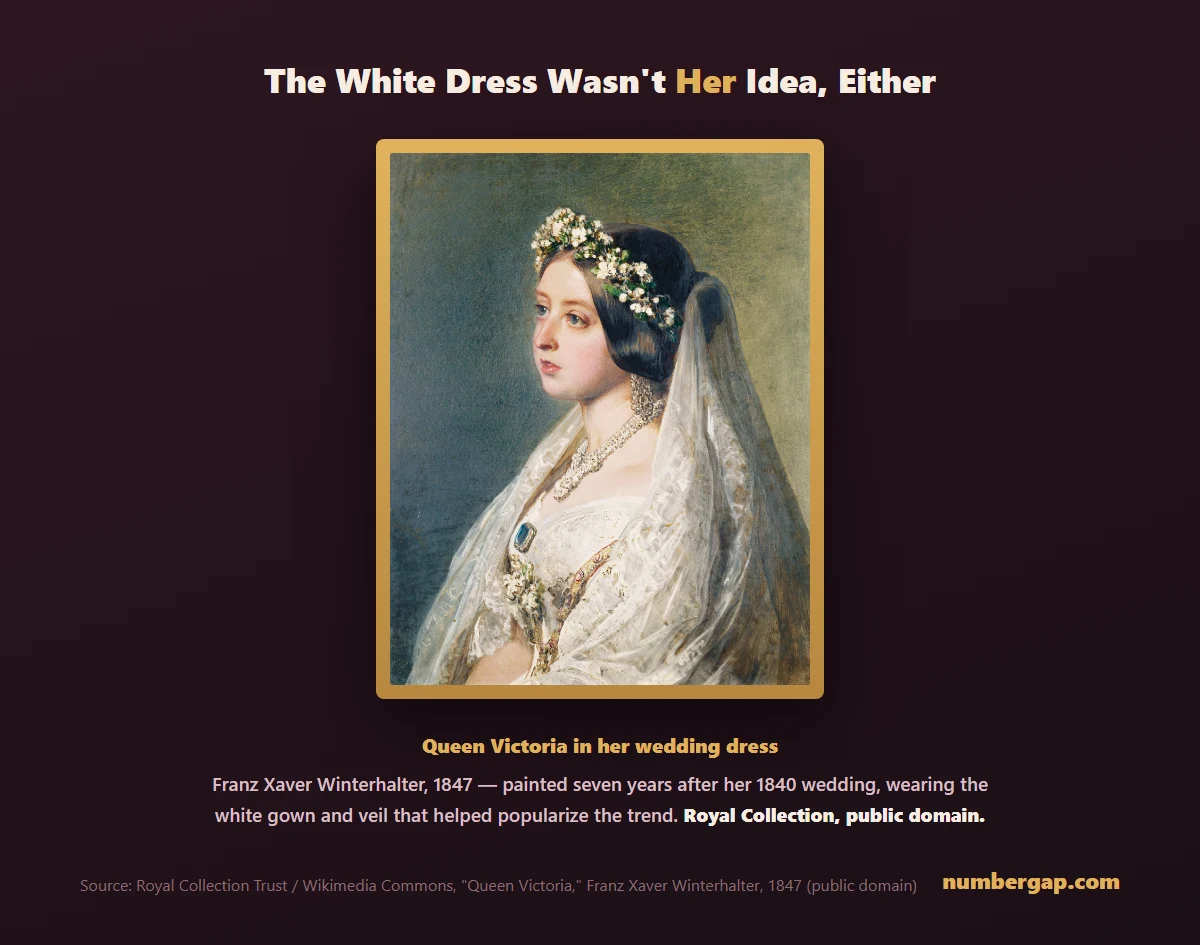
Queen Victoria gets credit for inventing the white wedding dress. She didn't, quite — and the correction is more interesting than the myth.
White had already appeared at weddings among wealthy families for centuries before 1840, including earlier royal brides. What made Victoria's dress different wasn't the color. Royal brides were expected to marry in elaborate state robes; Victoria instead chose a plainer white gown of Spitalfields silk and Honiton lace, breaking with that specific custom rather than inventing white bridalwear from nothing.
Smithsonian Magazine's own headline gets the credit right: she "dreamed up" the trend, in the sense of popularizing it through the new mass-print coverage of her wedding — not in the sense of being the first person ever to marry in white.
For decades afterward, most ordinary brides — especially poorer ones — kept marrying in colored dresses they could wear again. A white dress you'd only wear once was a luxury most households couldn't justify.
Source: Smithsonian Magazine; Victoria & Albert Museum, "The Victoria Connection" and "Wedding Colour"
Is the "Wedding Tax" Real?
Yes — and unlike most of what circulates about wedding costs, this one was tested with an actual experiment, not a survey.
In 2016, Consumer Reports sent secret shoppers into five metro areas — Atlanta; Colorado Springs, Colorado; southeastern Maine; Minneapolis; and Ventura, California. Each shopper called the same vendors twice: once describing the event as a wedding, once as an identical-sized 50th wedding anniversary party.
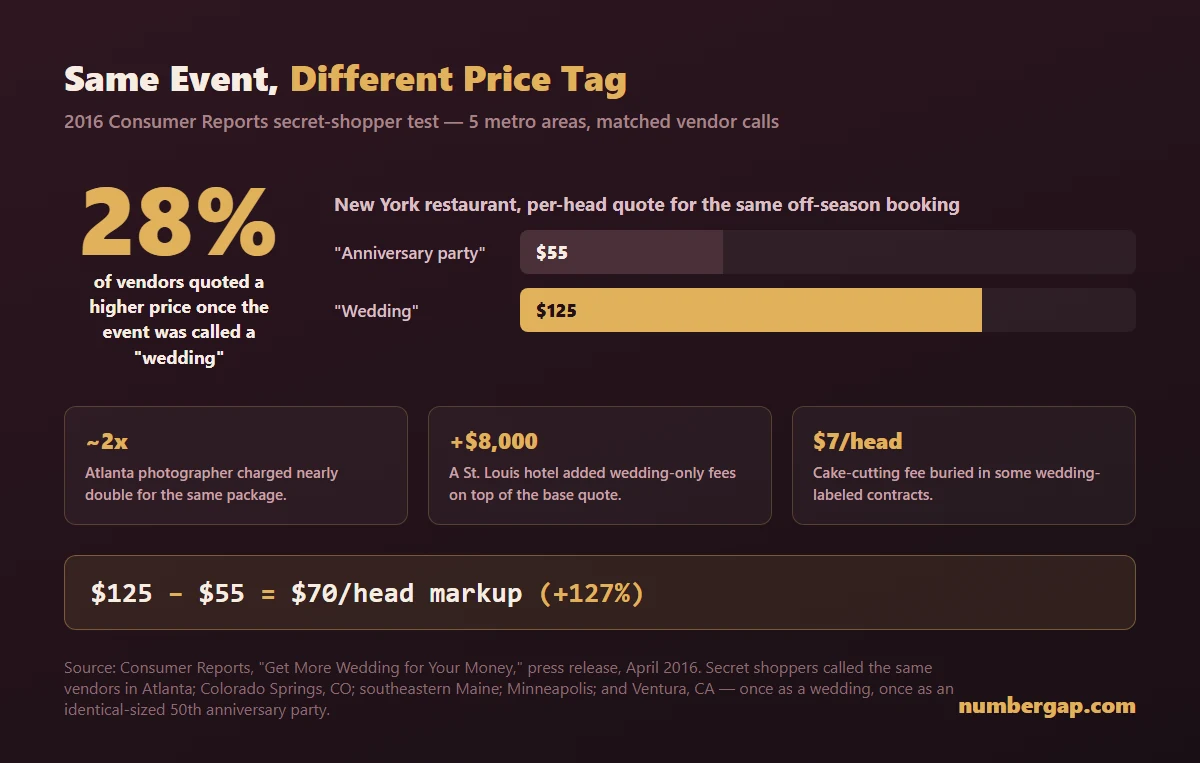
28% of vendors quoted a higher price for the identical event once it was labeled a wedding.
Source: Consumer Reports, "Get More Wedding for Your Money," press release, April 2016
Specific examples from the investigation: an Atlanta photographer charged nearly double for what was, on paper, the same package. A St. Louis hotel added more than $8,000 in wedding-only fees. A New York restaurant quoted $55 a head for one event and $125 a head for the wedding version of the same off-season booking. Some contracts buried a $7-per-person cake-cutting fee.
Vendors interviewed afterward pushed back on calling it pure markup — weddings, they argue, involve tighter no-second-chances timelines and more staffing coordination than a standard party, so some of the gap reflects a genuinely different service. That debate is real and unresolved.
What isn't in dispute is the 28% figure itself. It was measured, not estimated.
Does Wedding Spending Really Predict Divorce?
This is the study everyone cites and almost nobody reads.
Economists Andrew Francis-Tan and Hugo Mialon, then at Emory University, surveyed 3,151 ever-married American adults about their wedding spending and current marital status. Their paper — "'A Diamond Is Forever' and Other Fairy Tales" — found that ceremony spending above $20,000 was associated with roughly 3.5 times higher divorce risk compared to couples who spent $5,000 to $10,000. It also found that having 200 or more guests was associated with 57% lower divorce risk.
Source: Francis-Tan & Mialon, "'A Diamond Is Forever' and Other Fairy Tales," Economic Inquiry, vol. 53(4), 2015
We pulled the actual paper, not a summary of it. The authors' own caveat is right there in the text: this is a correlational study. They do not claim, and explicitly do not argue, that spending money causes divorce. They flag unmeasured confounders — financial stress, personality, the quality of the relationship going in — as more likely explanations, and they specifically note their concern that media coverage was oversimplifying the finding into a "spend less, stay married" headline.
That's exactly what happened. Multiple outlets ran versions of the causal headline anyway. The guest-count finding — the one suggesting community and social support might matter more than budget — got far less attention than the more clickable spending number.
What This Piece Could Not Verify
- The exact timeline of the De Beers "months of salary" benchmark — whether it escalated from one month to two in the US over time, or whether one/two/three months were simply different country-specific figures from the start. Sources disagree; no primary De Beers document was accessible to settle it.
- Who first put "bridezilla" into print. Word-history research credits Martha Woodham's 1995 book with the earliest confirmed use; a separate, less rigorous claim attributes it to a 1995 Boston Globe column by Diane White. We could not confirm the Globe claim against a primary archive.
- Whether the 1477 ring Archduke Maximilian gave Mary of Burgundy was genuinely the first diamond engagement ring, or simply the earliest one well-documented enough to survive as the standard industry story.
- The original source of a widely repeated $7,800 figure for average 1984 wedding costs — a 2012 Christian Science Monitor article cites it without naming its own source.
- What today's actual median wedding cost is. No 2025 or 2026 figure has been published by The Knot, Zola, or WeddingWire. The roughly $22,000 estimate above is ours, based on applying the last confirmed average-to-median gap to the current average — not a number any of these companies has confirmed.
Frequently Asked Questions
Q. How much does the average wedding cost in the US?
A. $34,000, according to The Knot Worldwide's 2026 Real Weddings Study, covering couples who married in 2025. Zola's 2026 survey put it at $36,000, and The Wedding Report's independent estimate ranged from $32,004 to $39,116.
Q. What is the median wedding cost?
A. No company currently publishes one. The Knot stopped after 2013, when its own figures showed the median running 34–37% below the average. Numbers like "$10,000" circulating online are third-party estimates, not official figures.
Q. Does the $34,000 average include the engagement ring or honeymoon?
A. No. The Knot tracks those separately. Adding them back in can push total spending another $10,000 to $15,000 higher than the core $34,000 figure.
Q. Is The Knot's wedding cost survey accurate?
A. It accurately reflects what its own respondents reported. The methodology issue is who those respondents are — people recruited from The Knot's and WeddingWire's own membership, not a random sample of everyone who gets married. The Knot discloses this in its own methodology section.
Q. How many couples were surveyed for The Knot's 2026 report?
A. 10,474 US couples who married between January 1 and December 31, 2025.
Q. Is there really a "wedding tax" where vendors charge more for weddings?
A. Consumer Reports tested this directly in 2016 with matched secret-shopper calls and found 28% of vendors quoted a higher price for an identical event once it was labeled a wedding rather than an anniversary party.
Q. Does spending more on a wedding really predict divorce?
A. A 2015 Emory University study found a correlation between higher ceremony spending and higher divorce risk — but the authors themselves state it's correlational, not causal, and warn against reading it as proof that spending money causes divorce.
Q. Who invented "two months' salary" for an engagement ring?
A. De Beers and its ad agency, N.W. Ayer & Son, starting with a 1938 campaign. Before it, there was no cultural norm tying ring price to salary — only about 10% of first-time brides got a diamond ring at all.
Q. Did Queen Victoria invent the white wedding dress?
A. Not exactly. White wedding wear predates her 1840 wedding. What she changed was breaking royal custom by wearing a plain white gown instead of state robes — and mass-print coverage of her wedding turned that choice into a lasting trend.
Q. Why did The Knot stop publishing a median wedding cost?
A. The company hasn't given a fully documented reason beyond editor Rebecca Dolgin's 2013 comment that an average is "just an average" — a comment that, read closely, actually describes what a median is, not what an average is.
So What Should You Actually Budget?
Not $34,000 as a target, and not our estimated $22,000 as a floor. Both numbers describe a national average or an unpublished guess — neither describes your wedding, your city, or your guest list.
What's actually useful here: ask vendors for a written quote before mentioning the word "wedding," if you're comfortable doing so — Consumer Reports' 28% gap suggests it can matter. Get ring and honeymoon costs as separate line items from the start, since the widely quoted averages don't include them. And treat any headline number that isn't labeled "median" as describing the spending of couples with more money to spend than most — because, per The Knot's own past data, that's roughly what it's been.
If The Knot, Zola, or anyone else ever publishes a current median again, we'll update this.
Sources
- The Knot Worldwide, "2026 Real Weddings Study" press release, businesswire.com, Feb. 2026
- Elisabeth Kramer, "Need Data on How Much a Wedding Costs? Consider This," elisabethkramer.com, Feb. 14, 2023
- Will Oremus, "Average Wedding Cost: Published Numbers Are Totally Inaccurate," Slate, 2013
- Zola, "The First Look Report 2026" / "Inside the Zola Wedding Cost Index," zola.com
- The Wedding Report, "2025 Average Wedding Cost Estimate" and methodology page, wedding.report
- Andrew M. Francis-Tan & Hugo M. Mialon, "'A Diamond Is Forever' and Other Fairy Tales: The Relationship between Wedding Expenses and Marriage Duration," Economic Inquiry, vol. 53(4), 2015 (also SSRN working paper, Sept. 15, 2014)
- Consumer Reports, "Get More Wedding for Your Money," press release, April 2016
- CBS News, "Brides and grooms, beware of higher 'wedding pricing,'" 2016
- Racked, "The Wedding Tax Is Totally Real Except When It Isn't," June 8, 2017
- Media Shower, Campaign Asia, WBUR "Here & Now," Gemporia, The Drum — De Beers/N.W. Ayer campaign history, cross-referenced
- Smithsonian Magazine, "Queen Victoria Dreamed Up the White Wedding Dress Trend"
- Victoria & Albert Museum, "The Victoria Connection" and "Wedding Colour"
- Word Histories, "'Bridezilla': meaning and origin," Sept. 25, 2023
- Oxford English Dictionary, "bridezilla, n."
This piece reports on published surveys, press releases, and academic research. It is not financial advice for planning your own wedding budget.


Comments
Post a Comment