How Much Does It Cost to Raise a Child? $300K vs $320K
Every "cost of raising a child" headline you've seen this year cites a number somewhere between $300,000 and $320,000.
Last updated: 7 September 2026 · Figures and rules in this post are current as of this date.
Almost none of them tell you where that number actually comes from.
It turns out nearly all of them trace back to the same government survey — one that hasn't been updated since 2017.
That survey is the U.S. Department of Agriculture's "Expenditures on Children by Families" report, better known as the cost of raising a child study. It has been the source of nearly every "raising a kid costs $X" headline in American media for over a decade. Understanding what that report actually said — and what different outlets have done to it since — explains why the "current" number keeps changing depending on which article you happen to click.
How Much Does It Actually Cost to Raise a Child?
The USDA's last full report put the number at $233,610 — but that figure needs a label most articles leave off.
$233,610 is the total cost, in 2015 dollars, for a middle-income, married-couple family to raise a child from birth through age 17. It assumes 2015 price levels held constant across all 17 years.
Source: USDA press release, "Families Projected to Spend an Average of $233,610 Raising a Child Born in 2015," January 9, 2017
https://www.usda.gov/about-usda/news/press-releases/2017/01/09/families-projected-spend-average-233610-raising-child-born-2015
The same press release also gave a second number: $284,570. This is not the same kind of figure. It's USDA's own economists projecting forward what parents would actually spend in future dollars each year from 2015 through about 2032 (when a 2015-born child turns 17), using an assumed average inflation rate of roughly 2.2% a year.
$233,610 and $284,570 are not two versions of the same total — they answer two different questions. One is "what would this have cost at 2015 prices." The other is "what will parents actually pay in the dollars of each future year." Mixing them up matters, because $284,570 already has inflation baked in once. Reflating it again with a CPI calculator counts inflation twice — more on that below.
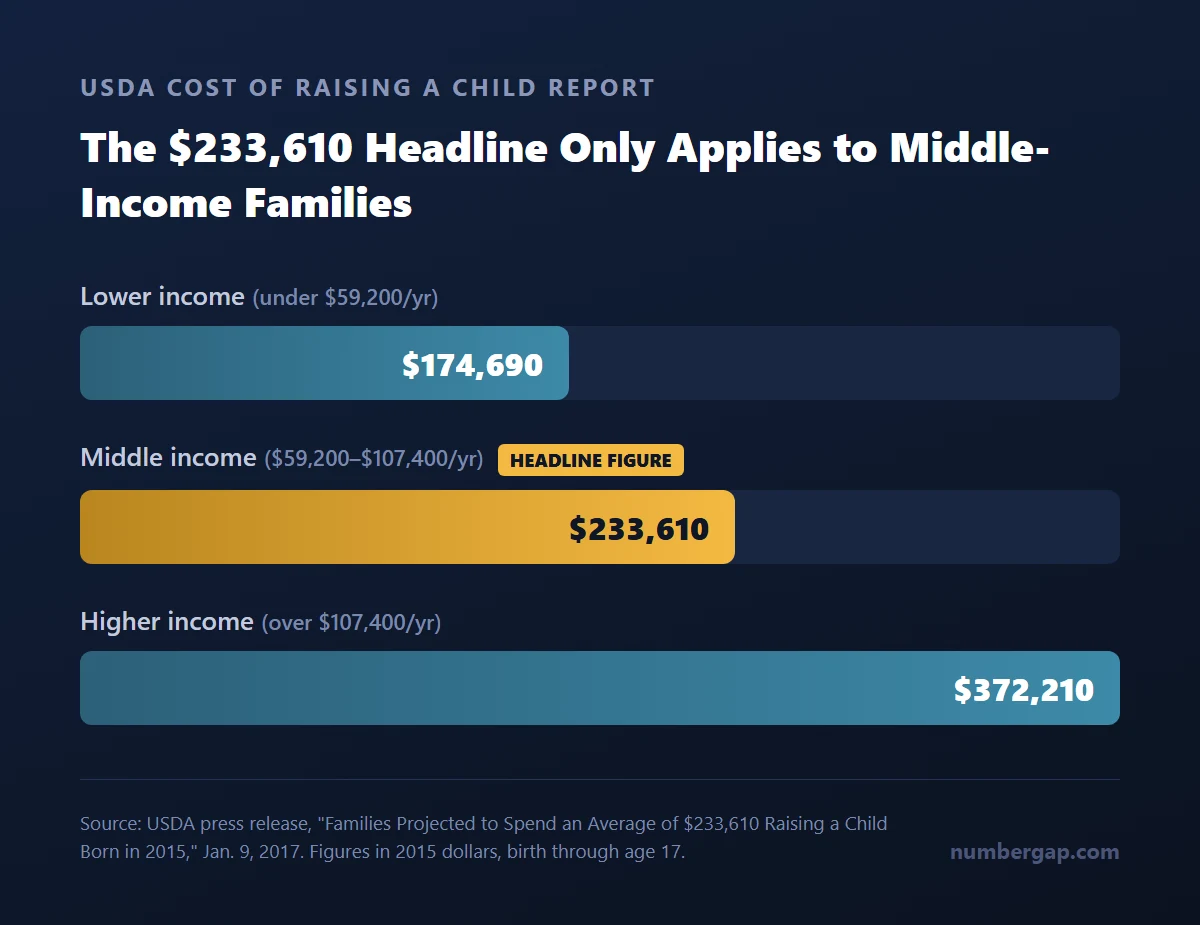
USDA also broke the $233,610 figure down by household income:
- Lower income (under $59,200/year): $174,690
- Middle income ($59,200–$107,400/year): $233,610 — the headline figure
- Higher income (over $107,400/year): $372,210
Source: USDA press release, January 9, 2017; cross-confirmed by CNN Money, January 9, 2017
https://money.cnn.com/2017/01/09/pf/cost-of-raising-a-child-2015/index.html
By expense category, for a middle-income married couple: housing 29%, food 18%, childcare and education 16%, transportation 15%, health care 9%, and the remaining 13% split between clothing and miscellaneous costs.
Regionally, the urban Northeast came out most expensive at $264,090 for a middle-income family (rising to $407,490 for higher-income Northeast families), with rural areas running about 27% lower than that.
Source: USDA press release, January 9, 2017 (regional figures); TheStreet, citing the 2015 USDA report
https://www.thestreet.com/personal-finance/cost-to-raise-child-14814957
One warning worth flagging here: a different Northeast figure, $282,480, circulates online too — but that's from USDA's earlier 2013-data report (released 2014), not the final 2015 report. The two vintages get mixed together constantly. If an article doesn't say which year's report it's citing, treat the number with caution.
Why Hasn't USDA Updated This Number Since 2017?
Because no successor report exists — but it's important to be precise about what that does and doesn't mean.
As of September 2026, USDA's own site returns only the 2017-vintage report (covering 2015 data), its associated legacy pages, and an interactive calculator built on that same data. No newer edition, covering a later birth-year cohort, has been published in roughly nine years.
What can't be confirmed: no source found in researching this article — including USDA's current pages — contains an explicit statement that USDA has formally discontinued the report series. The agency's own status page for the program returned access errors during this research, so a first-party "we ended this" announcement could not be directly verified or ruled out.
The accurate way to describe this is: USDA has not published an update since 2017. Treating that as an official discontinuation would be overstating what's actually documented.
For context on how often USDA used to update this: the prior edition, covering a child born in 2013, was released in August 2014 and estimated $245,340. That roughly annual publishing rhythm simply stopped after the 2015-data edition.
Source: USDA press release, "Parents Projected to Spend $245,340 to Raise a Child Born in 2013," August 18, 2014
https://www.usda.gov/about-usda/news/press-releases/2014/08/18/parents-projected-spend-245340-raise-child-born-2013-according-usda-report
Why Do Today's Estimates Range From $300,000 to $320,000+?
Because outlets are starting from two different USDA numbers and applying different math to each one — and almost none of them say which.
Four of the most-cited current figures, and what each one actually did:
| Source | Figure | What it actually did |
|---|---|---|
| USAFacts (updated May 2024) | $300,322 (2023 dollars) | Reflated the $233,610 2015 baseline using standard annual-average CPI-U |
| US News & Northwestern Mutual (both Sept. 19, 2025) | ~$320,000 / $320,661 (April 2025 dollars) | Reflated the $233,610 baseline using monthly (not annual) CPI-U |
| Brookings Institution (Aug. 2022) | $310,605 | Re-ran USDA's own $284,570 future-inflation projection using a higher assumed rate (4% vs. USDA's 2.2%) |
| LendingTree (April 2026) | $303,418 (over 18 years) | Built an entirely separate estimate from Census, BLS, MIT Living Wage, and Child Care Aware data — no USDA figure involved at all |
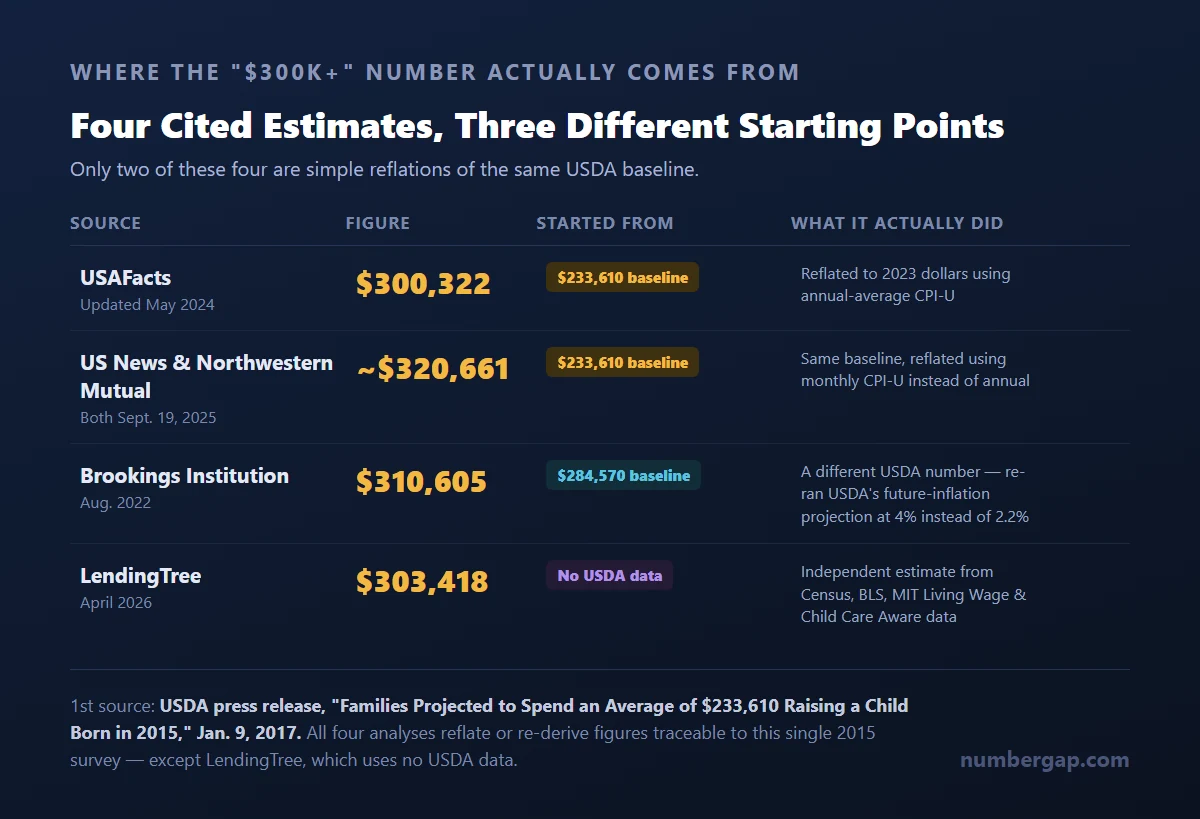
Only two of these four are simple, "clean" reflations of the original $233,610 baseline. Brookings starts from the other number ($284,570) and reprojects it with a different inflation assumption — it is not a CPI reflation of either figure, and treating it as one produces confusion about why it doesn't match USAFacts or US News.
LendingTree is its own animal entirely: its $303,418 figure has no USDA DNA in it at all. It happens to land close to the CPI-reflated numbers, but that appears to be coincidence, not confirmation. LendingTree's own year-over-year totals have swung a lot — an earlier version of its study (cited by ABC News in April 2025) implied roughly $389,000 over 18 years, entirely independent of anything USDA-related.
Source: LendingTree, "It Costs an Additional $303,418 to Raise a Child Over 18 Years, Up 1.9%," April 2026
https://www.lendingtree.com/debt-consolidation/raising-a-child-study/
Do These "Independent" Sources Actually Agree With Each Other?
Not as independently as they look.
US News & World Report and Northwestern Mutual both published their "cost of raising a child" articles on the exact same date — September 19, 2025 — and both use nearly identical wording: "The amount from 2015 USDA data was $233,610. Our analysis used the Bureau of Labor Statistics Consumer Price Index (CPI) inflation calculator... $233,610 in January 2015 is equivalent to $320,661 in April 2025."
Source: U.S. News & World Report, September 19, 2025
https://money.usnews.com/money/personal-finance/articles/how-much-does-it-cost-to-raise-a-child
Source: Northwestern Mutual, September 19, 2025
https://www.northwesternmutual.com/life-and-money/how-much-does-it-cost-to-raise-a-child/
Same publish date. Same underlying calculation. Nearly the same footnote text.
That doesn't mean either outlet did anything wrong — reflating a public figure with a public CPI calculator is a legitimate, simple method. But if you've seen "$320,000" repeated across multiple "different" articles and taken that repetition as two sources independently confirming each other, that's not quite what happened. It looks much more like the same analysis, published in two places on the same day.
This is worth keeping in mind any time a number seems to be "confirmed" by multiple outlets. Same publish date and matching footnotes are a signal to check whether you're looking at one calculation or two.
We Reflated the Original Number Ourselves — Here's What We Found
Using the U.S. Bureau of Labor Statistics' own CPI-U annual averages, we ran the same reflation math USAFacts describes — and it lines up almost exactly.
| Year | CPI-U annual average |
|---|---|
| 2015 | 237.017 |
| 2023 | 304.702 |
| 2024 | 313.689 |
| 2025 | 321.943 |
Source: U.S. Bureau of Labor Statistics, CPI-U series CUUR0000SA0
https://data.bls.gov/timeseries/CUUR0000SA0
Applying the formula $233,610 × (CPI target year ÷ 237.017):
- 2023: $233,610 × (304.702 / 237.017) ≈ $300,322
- 2024: $233,610 × (313.689 / 237.017) ≈ $309,180
- 2025: $233,610 × (321.943 / 237.017) ≈ $317,315
Our 2023 result — $300,322 — matches USAFacts' published figure to the dollar. That's strong confirmation USAFacts reflated the $233,610 baseline using plain annual-average CPI-U, with no hidden adjustments.
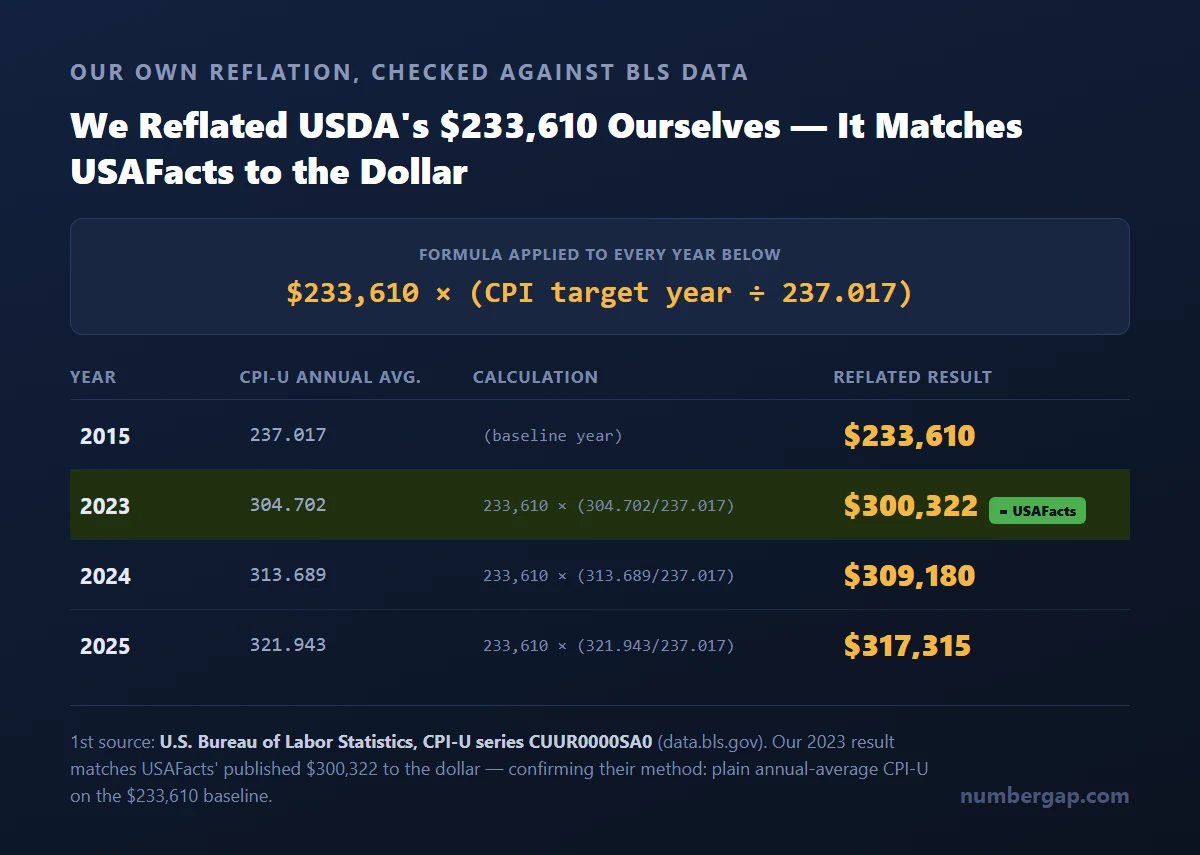
Our 2025 estimate ($317,315) comes close to, but doesn't exactly match, US News/Northwestern Mutual's $320,661 — because they used monthly CPI-U (January 2015 vs. April 2025) rather than annual averages. Different month, slightly different number. Same method, same baseline.
We also checked whether anyone reflates the other number, $284,570, with plain CPI — which would double-count inflation. Doing that math ourselves ($284,570 × 1.2856 ≈ $365,836 for 2023) doesn't match any commonly cited figure we found. So while the risk of double-counting is real in theory, we didn't find evidence that major outlets are actually doing it. The more accurate description of the confusion is that outlets are quietly starting from two different USDA numbers, not that anyone is inflating one number twice.
What This Number Doesn't Include
Even the highest current estimate leaves out some of the biggest costs of actually having and raising a kid.
College is not in there. The USDA estimate — and every reflation of it — covers birth through age 17 only. Tuition, room, and board are a separate expense entirely.
Neither is the cost of having the baby. USAFacts separately notes average hospital childbirth charges of $27,938 in 2020 (and $11,218 in 2000) as a distinct cost, not part of the $233,610/$284,570 totals.
Source: USAFacts, "How much does it cost to raise a child?"
https://usafacts.org/articles/how-much-does-it-cost-to-raise-a-child/
What we couldn't confirm: whether the USDA figure accounts for parents' lost income — reduced work hours, career costs of caregiving, and so on. Given that the survey is built from direct household spending data (the Consumer Expenditure Survey), it's very likely limited to out-of-pocket costs only. But no source directly states that opportunity cost is excluded, so this should be treated as likely, not confirmed.
FAQ
Q. How much does it cost to raise a child in the US?
A. The last full government estimate, from USDA in 2017, put it at $233,610 in 2015 dollars for a middle-income married couple (birth through age 17). Reflated to current dollars using CPI, that lands somewhere between about $300,000 and $320,000 depending on the exact method and year used — see the table above.
Q. Is $233,610 or $284,570 the real cost of raising a child?
A. Neither is "more real" — they answer different questions. $233,610 is the total in 2015 price levels. $284,570 is USDA's own projection of what parents would spend in future dollars through 2032, assuming about 2.2% average annual inflation.
Q. Why did USDA stop publishing the cost of raising a child report?
A. No source found states an official discontinuation. What's confirmed is that no new edition has appeared since the 2015-data report was released in 2017 — roughly nine years without an update.
Q. Does the cost of raising a child include college?
A. No. The USDA estimate and its various reflations cover birth through age 17 only. College costs, and the cost of childbirth itself, are separate and not included.
Q. Why do US News and Northwestern Mutual have almost the same number?
A. Both published on the same date (September 19, 2025) using nearly identical wording and the same CPI reflation method applied to the same $233,610 baseline. It's best read as one analysis appearing in two places, not two independent confirmations.
So Which Number Should You Actually Use?
Pick the version that matches the question you're actually asking.
If you want a rough, current-dollar version of USDA's original estimate, the CPI-reflated numbers — about $300,000 to $317,000 depending on the year — are the cleanest, most transparent option, and you can reproduce the math yourself with the table above.
If you want to know what having a kid changes about your specific budget right now, a marginal-cost estimate like LendingTree's is a better fit than a reflated 2015 total — just don't expect it to line up with USDA's number, because it isn't measuring the same thing.
And if you see a headline number without a year attached to it, or without saying which USDA figure it started from, treat it the way you'd treat any recycled statistic: ask which base year, and which method, before you repeat it.


Comments
Post a Comment