Security Deposit Not Returned? Check the Deadline First
In 2013, Zillow asked 2,031 American adults how long a landlord has to return a security deposit.
Last updated: 25 October 2026 · Figures and rules in this post are current as of this date.
Eighty-two percent of renters said 60 days. So did 76% of landlords.
Zillow's answer, in the same press release: in most states, 14 to 30 days.
We read the statutes ourselves. Among the states we checked, exactly one sets a 60-day deadline. Arkansas.
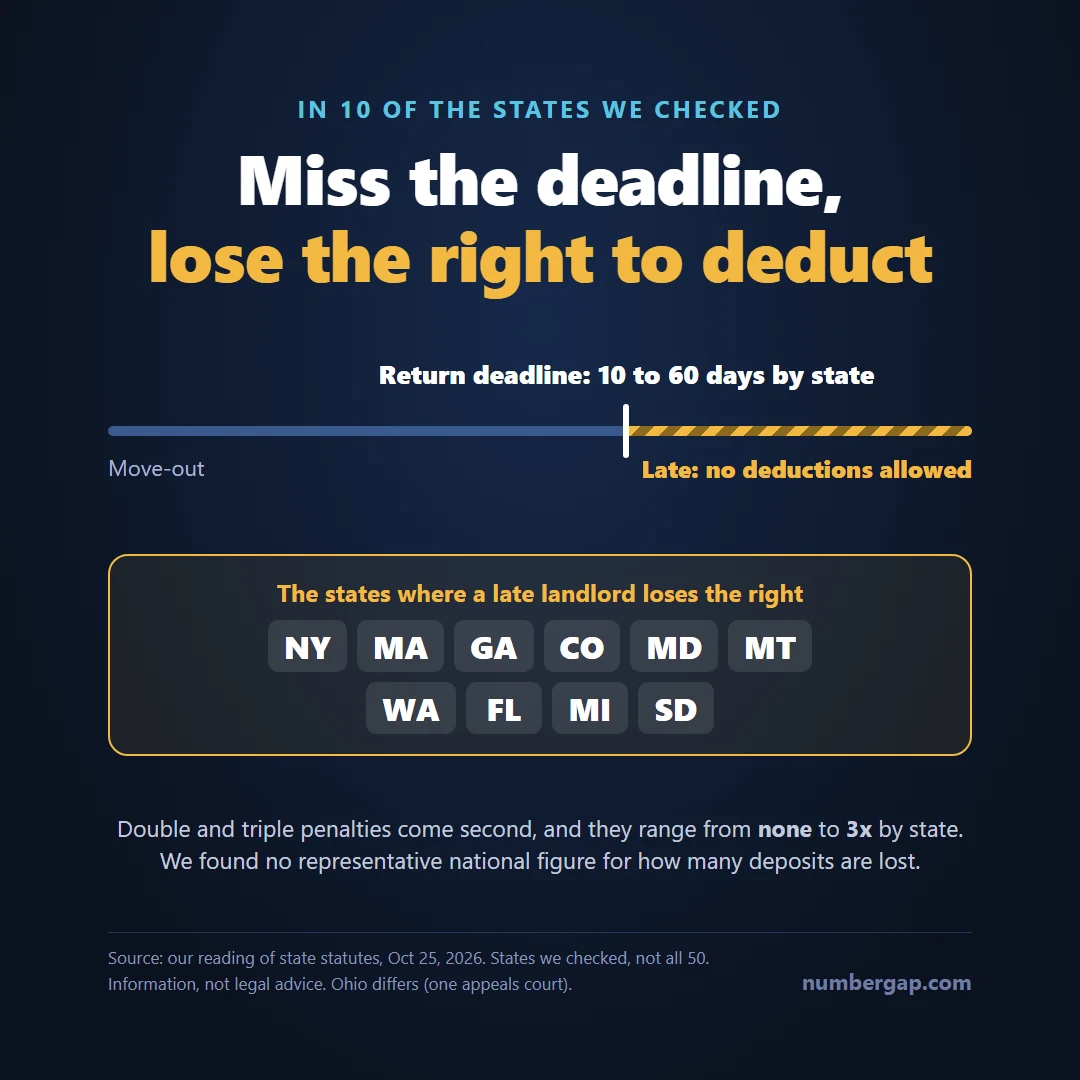
So the deadline most people believe in barely exists. The one that does exist works differently from what the headlines suggest. People talk about the double or triple penalty. In ten of the states we checked, a landlord who misses the deadline loses something bigger: the right to deduct anything at all.
We also went looking for the national number, the share of renters who lose deposit money. That search ended at a wall.
This post reflects the statutes and sources we checked on October 25, 2026. State law changes, and several states changed theirs in 2025 and 2026. We did not survey all 50 states, so nothing below says "in the country." It says "in the states we checked."
This is information, not legal advice. We can tell you what a statute says. We cannot tell you what it means for your lease or your landlord. For your own deposit, contact your state attorney general's consumer office, a local legal aid office, or a licensed attorney in your state.
How Long Does a Landlord Have to Return a Security Deposit?
It depends on the state. Among the states we checked, the deadline runs from 10 days in Montana to 60 days in Arkansas, and 30 days is the most common answer.
Montana's 10 days applies only when there is nothing to deduct. If the landlord is deducting, Montana also allows 30. The rest of the range looks like this.
| State | Deadline to return the deposit or send an itemized list | Miss it, and the landlord loses the right to deduct? |
|---|---|---|
| Montana | 10 days if nothing is deducted; otherwise 30 | Yes, for damage and cleaning |
| New York | 14 days | Yes |
| Arizona | 14 days, not counting weekends and legal holidays | No forfeiture rule found in the text we read |
| Florida | 15 days if no claim; 30 days to send notice of a claim | Yes |
| California | 21 days | Bad faith only |
| Minnesota | 21 days, after the tenant gives a mailing address | No forfeiture rule found |
| Wisconsin | 21 days | No forfeiture rule found |
| South Dakota | 21 days (2026 change), after the tenant gives a mailing address | Yes |
| Texas | 30 days, after the tenant gives a written forwarding address | Bad faith only, and missing day 30 is presumed bad faith |
| Georgia | 30 days | Yes |
| Washington | 30 days | Yes |
| Ohio | 30 days | Not automatic (one appeals court) |
| Massachusetts | 30 days | Yes |
| New Jersey | 30 days | No forfeiture rule found |
| North Carolina | 30 days, with a final accounting allowed at 60 | Willful failure only |
| Colorado | 1 month; a lease may extend it up to 60 days | Yes |
| Nevada | 30 days | Entire deposit owed |
| Illinois | 30 days to itemize; otherwise full deposit within 45 | Full deposit owed |
| Michigan | 30 days to mail the list; 45 days to sue or return the balance | Yes |
| Oregon | 31 days | No forfeiture rule found |
| Virginia | 45 days | Willful failure only |
| Maryland | 45 days | Yes |
| Arkansas | 60 days | No forfeiture rule found |
Source: State statutes and administrative rules, read October 25, 2026, from official sites where they would open and otherwise from state-code mirrors, FindLaw reproductions and Wayback copies. The Georgia, Oregon, New Jersey, North Carolina and Arkansas rows rest on reproductions dated 2023 to 2024, and Colorado's row is the text from before its 2026 law. Pennsylvania, Connecticut and D.C. are not confirmed, so we left them out. Recheck the current code before relying on a row.
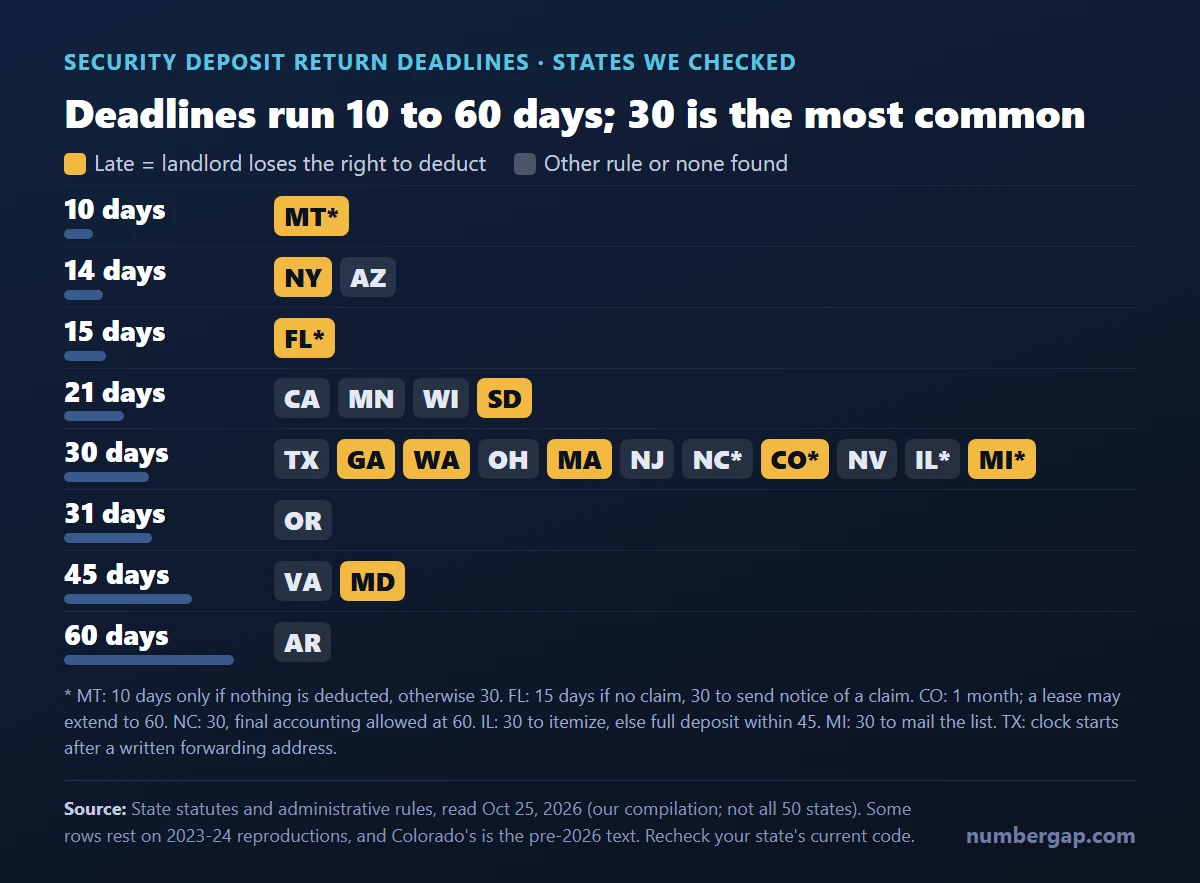
The clock itself has fine print. In Texas, the landlord's duty to refund or itemize starts only after the tenant gives a written forwarding address, though the tenant does not lose the refund by failing to. Michigan wants the forwarding address within four days of moving out. Minnesota and South Dakota start the clock after the landlord has the tenant's mailing address.
So the first thing to check is not the number of days. It is when the clock started.
Now go back to Zillow's poll.
Zillow ran it with Ipsos in August 2013, on a nationally representative sample. Its press release called the 60-day answer a misconception. It measured what people believe, not what landlords do. It is more than twelve years old, and Zillow sells rental listings.
But it tells you something. If the number most renters and landlords carry in their heads is wrong for nearly every state we verified, a lot of deposit disputes probably start with two people counting from different clocks. That last part is our inference, not something the poll measured.
Source: Zillow Rentals press release, February 21, 2014 (Ipsos online poll, August 14-15, 2013, 2,031 U.S. adults; 604 renters, margin of error plus or minus 4.0 points; 180 landlords, plus or minus 7.3) — an industry source, and old data. Our comparison to 60 days uses the statute table above. North Carolina allows a final accounting at 60 days when a claim can't be determined in 30, and Colorado lets a lease extend the deadline to 60, so "only Arkansas" means only Arkansas sets 60 as the basic deadline.
What Happens If a Landlord Misses the Deadline?
In ten of the states we checked, the landlord loses the right to deduct anything. Those states are New York, Massachusetts, Georgia, Colorado, Maryland, Montana, Washington, Florida, Michigan and South Dakota.
The statutes say it plainly. New York: a landlord who misses 14 days "shall forfeit any right to retain any portion of the deposit." Georgia: missing the list and statement deadlines "shall work a forfeiture of all the landlord's rights to withhold any portion of the security deposit or to bring an action against the tenant for damages." Washington: the landlord is "liable to the tenant for the full amount of the deposit."
Source: N.Y. Gen. Oblig. Law § 7-108(1-a); O.C.G.A. § 44-7-35(b); RCW 59.18.280(2). Official site or reproduction as noted in the table above.
Read that again, because it is the part nobody puts in a headline.
In those ten states, the landlord does not have to be malicious. The landlord has to be late.
Texas works a little differently, and it is a useful example. The famous penalty there is bad-faith retention: $100, three times the portion wrongfully withheld, and the tenant's attorney's fees. But the statute adds a presumption. A landlord who misses the 30-day deadline is presumed to have acted in bad faith. And the landlord carries the burden of proving that what it kept was reasonable.
Source: Tex. Prop. Code §§ 92.109(a), (b), (d) — statute text via a state-code mirror.
California, North Carolina and Illinois get close to the same place by different routes. California takes away the right to claim any of the deposit when the landlord fails in bad faith to itemize, and puts the burden on the landlord to prove its deductions were reasonable. North Carolina voids the right to retain after a willful failure. Illinois requires the full deposit back within 45 days when there is no itemized statement with receipts.
Ohio is the exception we found
Not every state works this way, and we found a case that shows it.
In Lavrich v. Snyderburn, 2025-Ohio-2636, an Ohio trial court had awarded a tenant $4,000 on a $2,000 deposit because the landlord skipped the 30-day itemization. On July 28, 2025, the Eleventh District Court of Appeals reversed. It held the missed itemization was not "fatal" to the landlord's right to keep proper deductions or to counterclaim, and sent the case back to work out how much was properly withheld.
That is one decision from one intermediate appeals court. It does not set Ohio law for the whole state. We would not generalize beyond "an Ohio appeals court has held."
Source: Lavrich v. Snyderburn, 2025-Ohio-2636 (Ohio 11th Dist. Ct. App., Geauga County, July 28, 2025) — court opinion, read via a Wayback copy of the court's reporter site. Ohio's statute, R.C. 5321.16(B)-(C), provides for damages equal to the amount wrongfully withheld plus attorney's fees.
Tenants have clocks too
The deadline cuts both ways, and this is where people get hurt.
Michigan gives the tenant seven days to respond by mail to the landlord's damage notice or forfeit the amount claimed. Arizona gives 60 days from the mailing of the itemized list to dispute it, or the tenant waives further claims. Georgia wants a move-in damage list and a move-out list within three business days, and a tenant who signs the final list without a specific objection can lose the later claim.
Source: MCL 554.609, 554.611; A.R.S. § 33-1321(D); O.C.G.A. § 44-7-33 — statute text, with the Michigan and Georgia versions read through a Wayback copy and a FindLaw reproduction.
Our own read of all this: in most of the states we checked, the deadline decides the case, not the multiplier. We think that because the forfeiture rules and the burden of proof sit on the landlord's side of the statute. That is our interpretation, not a finding from any study.
Do Landlords Really Pay Double or Triple for Keeping a Deposit?
On paper, in many states they might. In practice, the best outcome data we found suggests courts rarely deliver it.
First, the paper. Among the states we checked, the multiplier ranges from none at all to three times.
| State | Deposit cap in the deposit statute | Penalty beyond the amount wrongfully withheld |
|---|---|---|
| California | 1 month (2 for a natural-person landlord with no more than 2 properties and 4 units) | Up to 2x for bad faith, plus actual damages |
| New York | 1 month | Up to 2x if willful |
| Maryland | 1 month | Up to 3x, plus attorney's fees |
| Arizona | 1.5 months | 2x |
| New Jersey | 1.5 months | 2x |
| Michigan | 1.5 months | 2x |
| North Carolina | 1.5 months month-to-month; 2 months for longer terms | None |
| Virginia | 2 months | None; actual damages plus fees if willful |
| Arkansas | 2 months (exempts individual owners of 5 or fewer units) | 2x |
| Colorado | Our sources conflict on the 2026 cap, so we print no figure | 3x for willful retention, plus fees |
| Nevada | 3 months | Up to an equal amount added |
| Massachusetts | First month plus last month plus a deposit plus lock and key at move-in | 3x for failing to return on time |
| Texas | None found | $100 plus 3x, bad faith only |
| Georgia | None found | 3x, unless a bona fide error |
| Washington | None found | Up to 2x if intentional |
| Illinois | None found | 2x |
| Oregon | None found | 2x |
| Wisconsin | None found | 2x |
| Ohio | None found | Equal amount, plus fees |
| Minnesota | None found | Amount withheld again, plus up to $500 punitive for bad faith |
| South Dakota | None found | Up to $200 punitive for bad faith |
| Florida | None found | Attorney's fees to the prevailing party |
| Montana | None found | None; fees at the court's discretion |
Source: The same statutes as above, read October 25, 2026. "None found" means we read the deposit section and saw no cap; another part of a state's code could contain one, so check your state attorney general's page or a court self-help page before you rely on it. Illinois's statute says "twice the amount of the security deposit due" and does not say whether that comes on top of the deposit, so we quote it and add no total. Massachusetts triples the deposit for failing to bank it properly, failing to transfer it to a successor, or failing to return it within 30 days; a missed sworn list costs the landlord the right to keep any of the deposit instead.
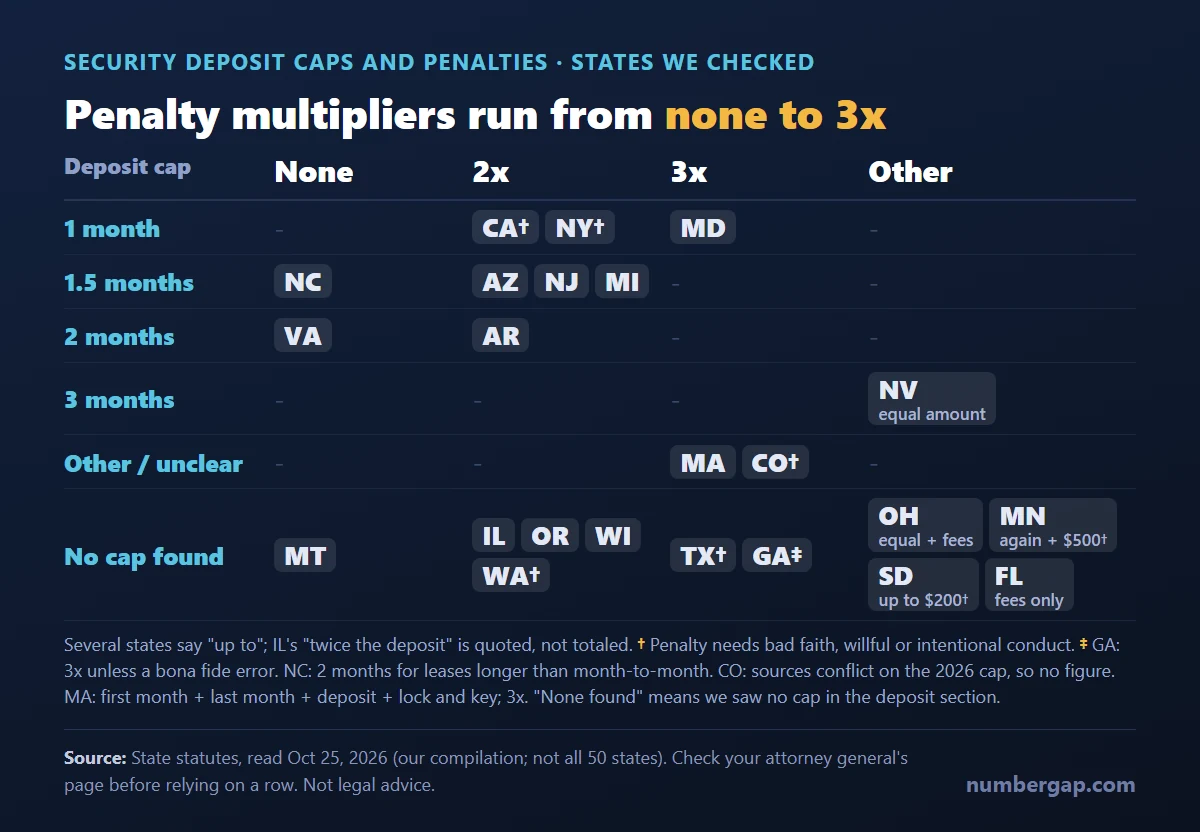
Now the evidence on whether those multipliers show up.
In 2013, the advocacy group Tenants Together studied small-claims courts in three California courthouses. Tenants prevailed in more than 70% of deposit cases that went to judgment. But courts assessed the statutory penalty in only 3.5% of tenant-filed deposit cases.
California's statute allows up to twice the deposit for bad faith. In that sample, judges rarely used it.
We would not push this too far. Tenants Together is an advocacy group. The data are from 2013 and one state. And California has since changed its law, with photographs required from 2025 and a different cap for small individual landlords. The number tells you something about the gap between the statute book and the small-claims room. It does not describe 2026.
Source: Tenants Together, "No Deterrent: Improper Security Deposit Withholding in California" (May 8, 2013), executive summary read via a Wayback copy — advocacy group; the courthouse study is separate from the group's member survey.
Still, set that 3.5% beside the forfeiture rules. A penalty the court rarely assesses is a weak lever, at least in that sample. A deadline that costs the landlord its deductions without anyone proving bad faith, in the states where forfeiture is automatic, is a stronger one.
What Counts as "Normal Wear and Tear" on a Security Deposit?
Texas and Georgia define it in their statutes, and Colorado's 2026 law expands its definition. Most states use the phrase without defining it.
Texas: "deterioration that results from the intended use of a dwelling," excluding deterioration from "negligence, carelessness, accident, or abuse" by the tenant. The statute adds that a landlord may not keep any part of the deposit to cover it.
Georgia's deposit section bars deductions for "ordinary wear and tear which occurred as a result of the use of the premises for the purposes for which the premises were intended, provided that there was no negligence, carelessness, accident, or abuse."
Elsewhere the phrase appears without a definition. Virginia says "reasonable wear and tear." Minnesota says "ordinary wear and tear excepted." Maryland says damage "in excess of ordinary wear and tear." Massachusetts excludes "reasonable wear and tear."
Source: Tex. Prop. Code §§ 92.001(4), 92.104(b); O.C.G.A. § 44-7-34(a); Va. Code § 55.1-1226(A); Minn. Stat. § 504B.178 subd. 3; Md. Real Prop. § 8-203(f); M.G.L. c. 186 § 15B(4)(iii).
So what about carpet and paint, the two items renters argue about most?
Colorado is the only state we found that wrote a number into the law. Its new statute, HB25-1249, took effect January 1, 2026. Under the legislature's own summary of the act as enacted, a landlord "does not have actual cause to retain any amount from a security deposit for the replacement of carpet or painting unless there is substantial and irreparable damage to the carpet, or substantial damage to the paint, that exceeds normal wear and tear and did not preexist the tenancy."
And carpet cannot be deemed substantially and irreparably damaged "if it has not been replaced with new carpet within the 10 years preceding the termination of the lease."
Ten years. It is the only numeric useful-life rule we found anywhere.
The act also adds a presumption: a landlord who keeps 125% or more of actual damages is presumed to have kept an unreasonable amount. And the landlord carries the burden of proving the damages.
Source: Colorado General Assembly summary of HB25-1249 as enacted (Wayback snapshot of December 30, 2025). The void-clause and 14-day documentation details come from a law-firm summary (Otten Johnson, October 16, 2025). The governor signed the bill June 3, 2025, per that firm. We could not read the enrolled text because the signed PDF is an image scan, and our sources disagree on whether the act changed Colorado's deposit cap, so we print no cap figure.
Elsewhere the rules on carpet and paint are narrower.
Wisconsin's rule note says a landlord "may not withhold from tenant's security deposit for routine painting or carpet cleaning, where there is no unusual damage caused by tenant abuse." California bars charging for professional carpet cleaning "unless reasonably necessary to return the premises to the condition it was in at the inception of tenancy, exclusive of ordinary wear and tear." Washington bars withholding for carpet cleaning unless the landlord documents wear beyond ordinary use.
Oregon goes the other way. A landlord there may deduct for machine carpet cleaning if the carpet was cleaned or replaced after the prior tenancy and the written lease allows it. Ordinary wear and tear is still excluded.
Source: Wis. Admin. Code ATCP 134.06 and its official note (the note is explanatory, not operative text); Cal. Civ. Code § 1950.5; RCW 59.18.280(1)(c); ORS 90.300(7) (FindLaw reproduction dated January 1, 2023 — verify the current text).
One limit on all of this. We found no state that gives a depreciation schedule for paint. If someone tells you "the state says paint lasts three years," ask for the statute. We could not find one.
What Percentage of Security Deposits Are Never Returned?
We could not find a representative national measurement, and we looked.
The numbers that circulate come from real surveys, but none of them answers the question.
| Figure | Where it comes from | Why it doesn't answer the question |
|---|---|---|
| 60% reported unfair withholding of some or all of a deposit | Tenants Together member survey, California, 2013 | Members of an advocacy group, not a random sample; one state |
| 26% say they have lost a security deposit | Rent.com survey of 1,000 renters, undated | Fieldwork date not shown |
| Landlords keep 36.1% of deposits on average | "Porch" survey, undated | Undated, sample unknown |
| 42% received their full deposit back | Repeated on landlord-software pages | We could not find it in any Zillow material, though some copies attribute it to Zillow |
| 56% of renters who paid a full deposit got it all back | Generation Rent, April 2025 | United Kingdom, and 1,375 supporters of an advocacy group |
Source: Tenants Together 2013 report (advocacy group); Rent.com and Porch surveys as quoted by secondary pages; Baselane compilation of the 42% figure; Generation Rent, April 2025. We treat the Rent.com, Porch and 42% figures as unverified.
We went looking for the Zillow source behind the 42%. We read what Zillow published on deposits, including its Consumer Housing Trends material. It covers how many renters pay a deposit, roughly 85% to 93%, and how large it is, with a median of $600 to $750 in the 2021 data. It does not cover refunds.
We did not find the 42% in anything Zillow published that we could read.
The Zillow survey we can verify measured a belief, not an outcome. And the question it asked was about the deadline, not about the money.
Are Security Deposit Alternatives Like Jetty or LeaseLock Worth It?
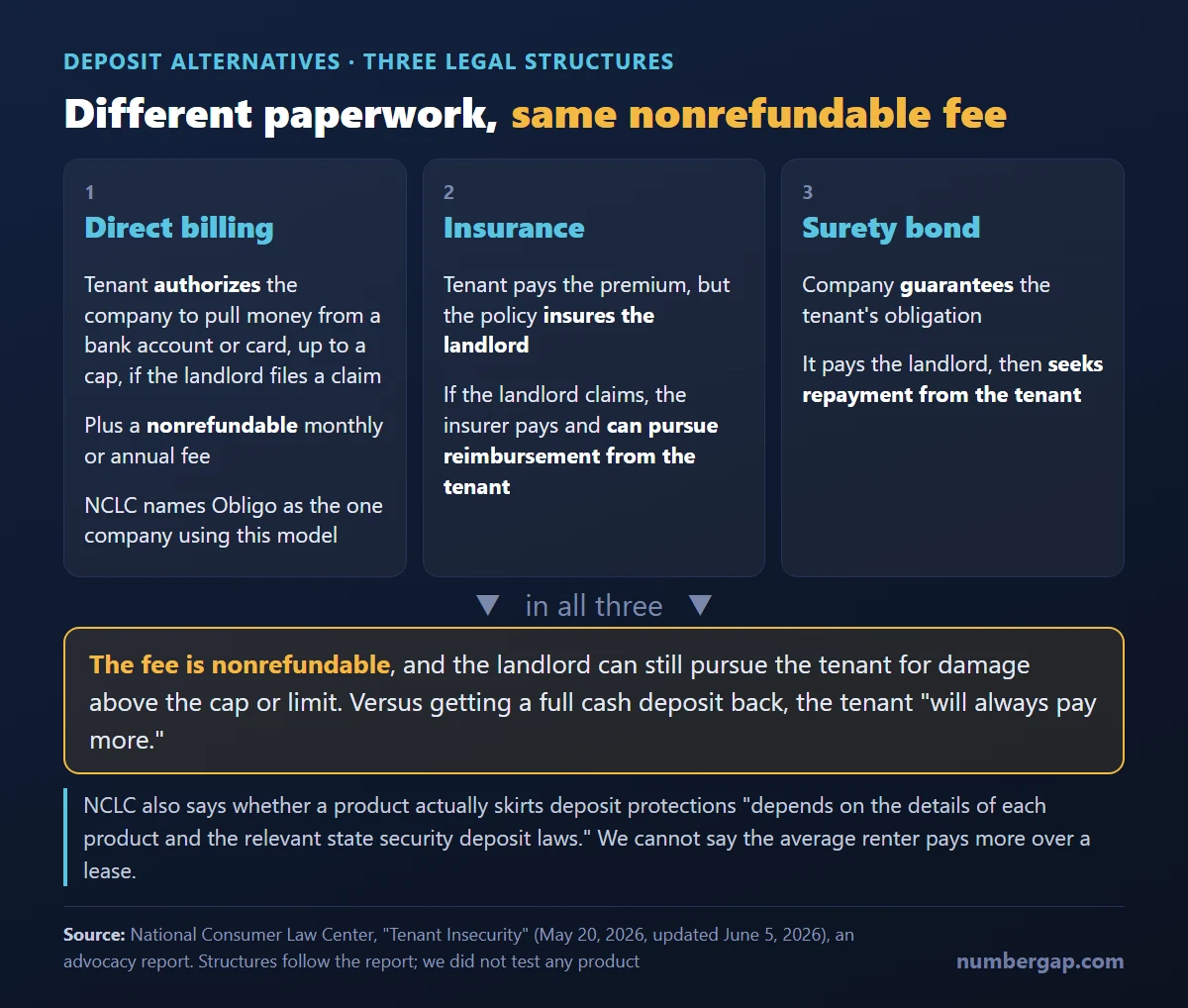
Compared with a cash deposit you would have gotten back in full, no. Under the products' own structures, the fee is nonrefundable and the landlord can still pursue the tenant for damage.
The National Consumer Law Center's May 2026 report sorts these products into three legal structures. NCLC is an advocacy group, but its structural descriptions track the companies' own terms.
- Direct billing. The tenant authorizes the company to pull money from a bank account or card, up to a cap, if the landlord files a claim. Plus a nonrefundable monthly or annual fee. NCLC identified Obligo as the one company using this model.
- Insurance. The tenant pays the premium, but the policy insures the landlord. If the landlord claims, the insurer pays and can pursue reimbursement from the tenant.
- Surety bond. The company guarantees the tenant's obligation, pays the landlord, then seeks repayment from the tenant.
In all three, the report says, "the landlord retains the right to pursue the tenant for alleged damages that exceed" the cap or limit.
On the fee, NCLC does not hedge: "Compared to a tenant who receives their full security deposit back at the end of the tenancy, a tenant who uses a security deposit alternative product will always pay more." The money, it says, "is simply gone at the end of the tenancy."
Source: National Consumer Law Center, "Tenant Insecurity: How Security Deposit 'Alternatives' Raise Tenants' Costs and Erode Their Protections" (May 20, 2026, updated June 5, 2026) — advocacy report. Its reasoning follows from the nonrefundable-fee structure it documents.
Advertised prices run low. Rhino says rates "start as low as $4 a month." Homebody says that instead of a $1,000 deposit, you pay about $130 over the lease. Tenants posting on Reddit report $22 a month or $375 up front for Jetty, and up to $65 a month for Qira. Those Reddit figures are anecdotes.
NCLC also notes some companies adjust fees using personal information, and that a New York rate filing for a Rhino-affiliated bond program lists credit score among the rate factors.
We should say what we cannot say. We cannot tell you the average renter pays more over a lease than a cash deposit would have cost. Single examples exist, such as a tenant who paid $1,016.58 in fees over three years against a $900 traditional deposit, as reported by Vice and cited in the NCLC report. They are examples, not averages.
What regulators and courts have done
Here the record has two entries, and one is only an allegation.
The first is a settlement. On January 24, 2022, Maryland's attorney general settled with LeaseLock over what the office called "deposit waiver products" that violated the state's Security Deposit Law. Attorney General Brian Frosh said: "LeaseLock's program effectively had tenants paying their security deposits monthly, but, at the end of the lease, tenants got nothing back."
The settlement requires LeaseLock to return the monthly payments landlords collected from Maryland tenants, unless claims for unpaid rent or damage beyond ordinary wear and tear were made at the end of the tenancy. It bars the product in Maryland unless changes to the Security Deposit Law permit it. LeaseLock had already stopped offering it there during the investigation.
Source: Maryland Attorney General press release, January 24, 2022 — official source, read via a Wayback copy.
The second is a lawsuit. On October 6, 2026, four renters from Florida, North Carolina, California and Nevada filed a class action against Jetty Insurance Agency in the U.S. District Court for the Southern District of New York. These are allegations only. According to a trade publication's account of the complaint, the renters allege that payments are nonrefundable and must be repurchased yearly, that tenants stay liable for landlord claims, and that fees were set by an undisclosed algorithm. The article reports no response from Jetty and no ruling.
Source: Insurance Business, "Insurer Jetty hit with class action," October 8, 2026 — trade press. We did not see the complaint or the docket.
On the legal side, Maryland's statute lets a tenant buy a surety bond instead of a deposit only if the landlord agrees, and caps the bond at two months' rent. Nevada has a similar rule. Massachusetts passed a law in 2024 authorizing regulations for a fee in lieu of a deposit, including a cap of one month's rent on total fees. We could not confirm that any regulations have been issued.
NCLC adds a hedge worth keeping: whether these products actually skirt the traditional protections "depends on the details of each product and the relevant state security deposit laws." That is the honest summary. The pitch is a convenience. Whether it is a good deal for a given tenant depends on the product, the state, and how long you stay.
Why Can't Anyone Say How Much Deposit Money Renters Lose?
Because the measurement doesn't exist in any public dataset we could reach. We tried.
We expected the American Housing Survey to settle it. It is the federal government's main survey of housing, run by HUD and the Census Bureau, with a 2023 national file you can download for free. We downloaded the file, which has 3,214 columns, and searched every column name for terms like DEP, SEC, MOVE and FEE.
Nothing about security deposits. The public file has no variable for it.
So we tried the other doors.
| Where we looked | What we found |
|---|---|
| American Housing Survey 2023 national file | No deposit variable in any of 3,214 columns |
| CFPB complaint database | Our automated request returned "Access Denied," so we could not test it |
| Legal Services Corporation court statistics | County filings by broad case type, with no "security deposit" category |
| Washington State Attorney General complaints | Open data, but deposit-coded complaints against residential landlords were tiny: 21 in 2024, 42 in 2025, 16 so far in 2026 |
| CourtListener (appellate opinions) | Counts of opinions citing a statute, such as 71 for a Texas query; says nothing about small claims |
Source: Census Bureau/HUD American Housing Survey 2023 national public use file; CFPB Consumer Complaint Database; LSC Baseline Court Statistics (May 4, 2023); Washington State AG "Complaint By Practice" dataset (data.wa.gov, through October 23, 2026); CourtListener search API. Our column search and complaint counts are our own tabulations.
The Washington count deserves a caveat. Most landlord complaints there are coded "Landlord/Tenant - Residential" without a deposit subcode, so deposit complaints are undercounted. And a complaint is not an outcome.
What can we compute from open data? The dollar size of the exposure. Census Reporter's API serves the 2024 American Community Survey median gross rent by state, free and with no key. We multiplied it by each state's cap.
| State | Cap | 2024 median gross rent | Cap times rent |
|---|---|---|---|
| California | 1 month | $2,104 | $2,104 |
| New York | 1 month | $1,634 | $1,634 |
| Maryland | 1 month | $1,721 | $1,721 |
| Arizona | 1.5 months | $1,672 | $2,508 |
| New Jersey | 1.5 months | $1,800 | $2,700 |
| Virginia | 2 months | $1,646 | $3,292 |
| Nevada | 3 months | $1,709 | $5,127 |
Source: U.S. Census Bureau, American Community Survey 2024 1-year estimates, table B25064, pulled through the Census Reporter API; caps from the statutes above — our calculation. Median gross rent includes utilities and the caps apply to contract rent, so read the last column as an order of magnitude, not as what a given landlord can charge.
That table tells you how much could be at stake in a state. It does not tell you how often the money is lost.
For that, we found no public data. Not from the federal housing survey, not from the consumer bureau's database (which refused our request), not from the court statistics we reached, which have no deposit category. If a post tells you "X% of deposits are never returned," ask where the number comes from. We looked, and we could not find a source that holds up.
Frequently Asked Questions
Q. How long does a landlord have to return a security deposit?
A. Among the states we checked, from 10 days in Montana (only when nothing is deducted) to 60 days in Arkansas. New York and Arizona use 14 days, California, Minnesota and Wisconsin 21, and most others 30. Virginia and Maryland allow 45. Check when the clock starts in your state, since some require a written forwarding address first.
Q. What happens if a landlord doesn't return a security deposit on time?
A. In New York, Massachusetts, Georgia, Colorado, Maryland, Montana, Washington, Florida, Michigan and South Dakota, a landlord who misses the itemization deadline loses the right to deduct anything. In Texas, missing 30 days is presumed to be bad faith. Several states add double or triple damages. Ohio is different: one appeals court held a missed itemization is not automatically fatal to the landlord's deductions.
Q. Can a landlord keep a security deposit for normal wear and tear?
A. The states whose rules we read on this point bar it, including Texas, Georgia, New York, California, Washington, Wisconsin and Colorado. Texas and Georgia define normal wear and tear in the statute, and most other states use the phrase without a definition.
Q. Can a landlord charge for carpet cleaning or repainting?
A. It varies. Wisconsin's rule note says routine painting and carpet cleaning cannot be deducted. California bars professional carpet cleaning unless reasonably necessary beyond ordinary wear. Oregon allows machine carpet cleaning in some conditions if the lease says so. Colorado's 2026 law limits carpet and paint deductions to substantial damage, and carpet not replaced in the previous 10 years cannot count as substantially and irreparably damaged.
Q. How much can a landlord charge for a security deposit?
A. It depends on the state. Among the states we checked, caps run from 1 month (California, New York, Maryland) to 3 months (Nevada), and Massachusetts lets a landlord collect first month, last month and a deposit at move-in. We found no cap in the deposit statute for Texas, Florida, Washington, Minnesota, Ohio, Illinois, Oregon, Georgia, Montana or Wisconsin. Confirm with your state attorney general before assuming a state has none.
Q. Does a landlord have to pay interest on a security deposit?
A. Rarely by default, and the rules differ. New York requires an interest-bearing account for landlords of six or more units and lets the landlord keep 1% a year as an administration expense. Massachusetts pays 5% a year, or the bank rate if lower, after the first year. Maryland pays the greater of the one-year Treasury yield or 1.5%. Minnesota pays 1%. Washington requires a trust account but lets the landlord keep the interest by default. We found no interest or separate-account requirement in California's or Texas's deposit sections.
Q. What if my landlord says they never got my forwarding address?
A. In Texas the landlord has no duty to refund or itemize until you give a written forwarding address, though you don't lose the refund by failing to. Michigan requires one within four days of moving out. Minnesota and South Dakota start the clock after the landlord has your mailing address. Put it in writing, with a date.
Q. What percentage of renters get their security deposit back?
A. There is no reliable national figure. The numbers that circulate come from advocacy-group member surveys, undated polls and unattributed compilations, and none is representative.
Q. Are security deposit alternatives like Obligo, Jetty or LeaseLock worth it?
A. Under all three legal structures described by the National Consumer Law Center, the fee is nonrefundable and the landlord can still pursue the tenant for damage. Maryland's attorney general settled with LeaseLock in 2022. A class action against Jetty filed October 6, 2026 contains allegations only.
Q. What is the security deposit deadline in Texas, Georgia and North Carolina?
A. Texas: 30 days after you surrender the premises, once you've given a written forwarding address. Georgia: 30 days after the landlord gets possession, plus a move-out damage list within three business days. North Carolina: 30 days, with a final accounting allowed at 60 when a claim can't yet be determined. North Carolina's remedy is among the weakest we read, since it has no multiplier. Georgia's and Texas's are among the strongest.
What to Do This Week If Your Deposit Is Late
The penalty is the headline. The deadline is the mechanism.
If your deposit is late, here are four things you can do before anything else.
- Find your state's actual deadline. Look for the statute on your state legislature's site, or on your attorney general's or court's self-help page. Check when the clock starts.
- Put your forwarding address in writing, with a date. Several states start the clock only after the landlord has it.
- Ask for the itemized statement in writing. In many of the states we checked, that statement is what the deadline is about.
- Keep your photos and receipts. California now requires landlords to photograph the unit at move-in, after move-out and after repairs. Your own photos still help.
For your specific deposit, contact your state attorney general's consumer office, a local legal aid office, or a licensed attorney in your state. We can read statutes. We can't read your lease.
If this helped, we'll see you in the next post.
Sources
Statutes, rules and court opinions
- California Civil Code § 1950.5 — California Legislature code via mirror, updated January 1, 2026
- New York General Obligations Law § 7-108 — NY State Senate
- Texas Property Code § 92.109 and related sections — state-code mirror
- Florida Statutes § 83.49 (2025) — Florida Senate
- Washington RCW 59.18.280 and RCW 59.18.270 — Washington State Legislature
- Virginia Code § 55.1-1226 — Virginia LIS
- Minnesota Statutes § 504B.178 — Minnesota Revisor of Statutes
- Arizona A.R.S. § 33-1321 — Arizona Legislature
- Maryland Real Property § 8-203 — Maryland General Assembly
- Massachusetts G.L. c. 186 § 15B — Wayback snapshot, December 18, 2025
- Ohio R.C. 5321.16 — Wayback copy
- Illinois 765 ILCS 710/1 — Wayback copy
- Michigan MCL 554.602 to 554.613 — Wayback copies
- Nevada NRS chapter 118A — Wayback copy, revised June 29, 2024
- Montana MCA 70-25-201 to -206 — Wayback copy
- North Carolina G.S. 42-52 and 42-55 — Wayback copy
- Wisconsin ATCP 134.06 and Wis. Stat. 100.20 — Wayback copies
- Colorado HB25-1249 summary as enacted — Colorado General Assembly, Wayback snapshot of December 30, 2025
- South Dakota 2026 Senate Bill 4, enrolled — South Dakota Legislature
- Lavrich v. Snyderburn, 2025-Ohio-2636 — Ohio 11th District Court of Appeals
- Georgia O.C.G.A. §§ 44-7-31 to -35, Arkansas Code §§ 18-16-304 to -306, Colorado 38-12-103, New Jersey 46:8-19, -21.1, -21.2, Oregon ORS 90.300, North Carolina G.S. 42-50, -51 — FindLaw reproductions of state codes, each "current as of" a 2023 to 2025 date
Surveys, research, advocacy and data
- Maryland Attorney General press release, LeaseLock settlement, January 24, 2022 — Maryland Office of the Attorney General
- Zillow Rentals press release, February 21, 2014 (Ipsos poll, August 2013) — Zillow; industry source
- Tenants Together, "No Deterrent," executive summary — advocacy group
- NCLC, "Tenant Insecurity," May 2026 and NCLC state policy sheet, August 2026 — National Consumer Law Center (advocacy)
- Insurance Business, "Insurer Jetty hit with class action," October 8, 2026 — trade press
- Otten Johnson, "Changes to the Colorado Security Deposit Statute to take Effect January 1, 2026" — law firm
- Census Reporter API, ACS 2024 1-year, table B25064 — U.S. Census Bureau data
- AHS 2023 National PUF — HUD/Census Bureau
- Washington State AG "Complaint By Practice" dataset — State of Washington
- CourtListener search API — Free Law Project
- LSC Baseline Court Statistics, May 4, 2023 — Legal Services Corporation


Comments
Post a Comment