Was the Little Mermaid a Redhead in the Original Story?
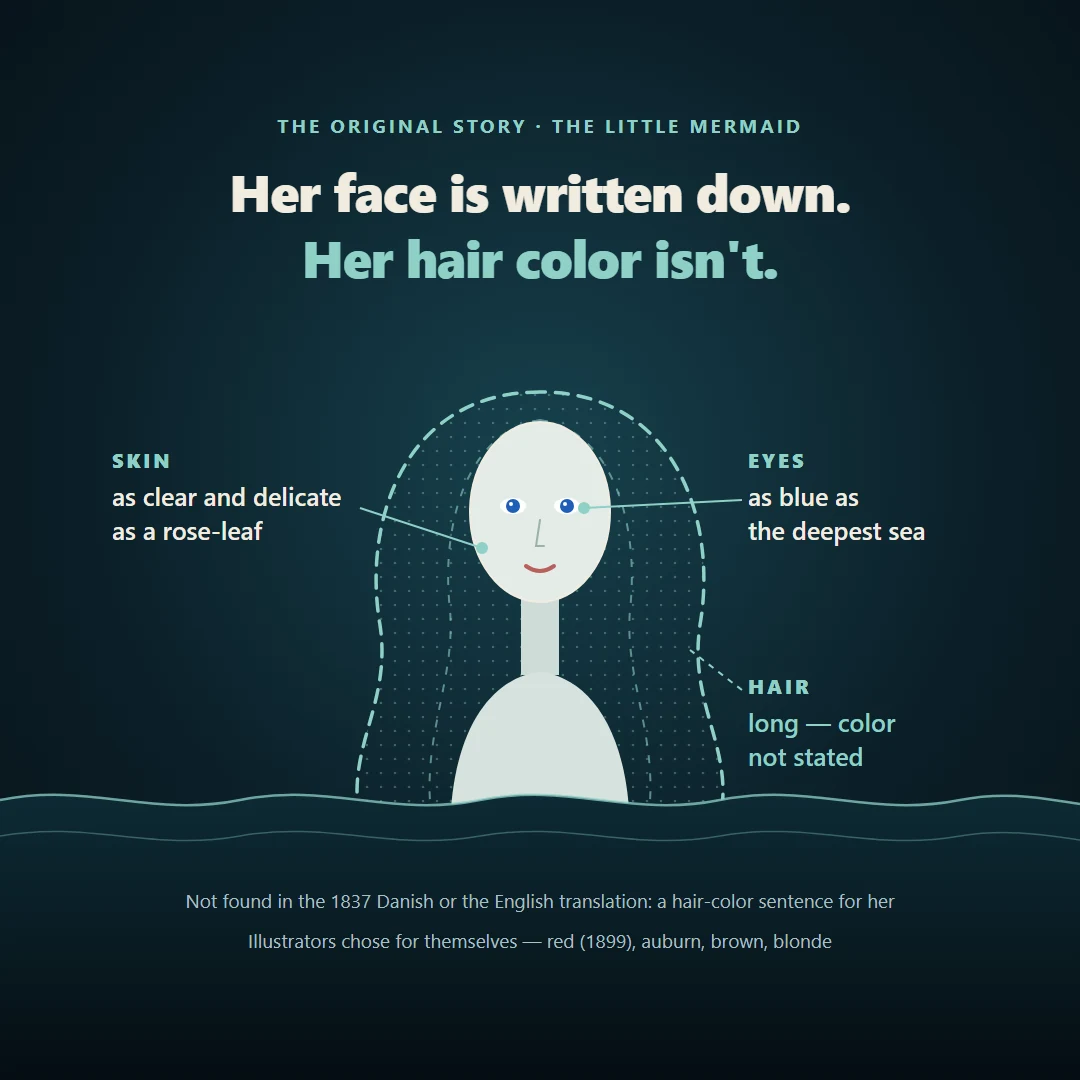
We searched Andersen's "The Little Mermaid" for her hair color.
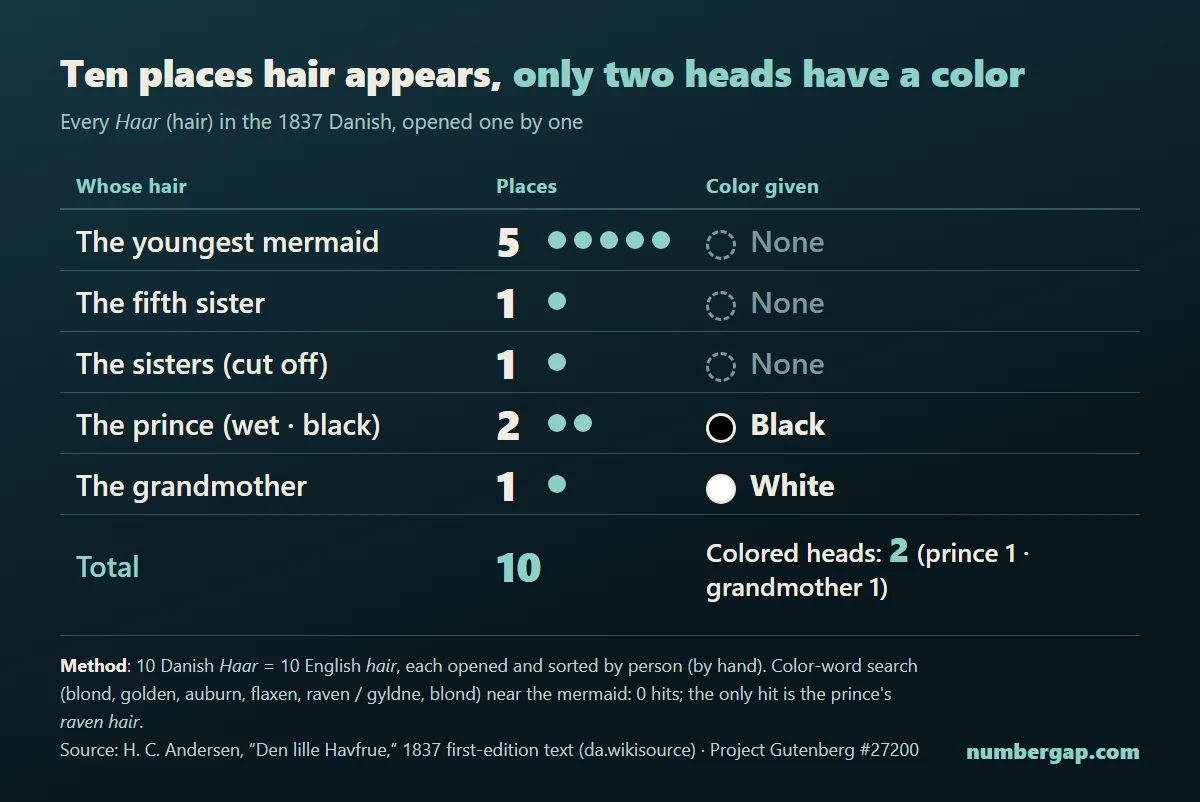
The word "hair" shows up ten times in the English translation most people read. It shows up ten times in the 1837 Danish too. Two heads have a color: the grandmother's white hair and the prince's black hair.
Last updated: 24 October 2026 · Quotations and occurrence counts were checked against the source text on this date.
The mermaid's hair appears four times in English, five in Danish. It never has a color.
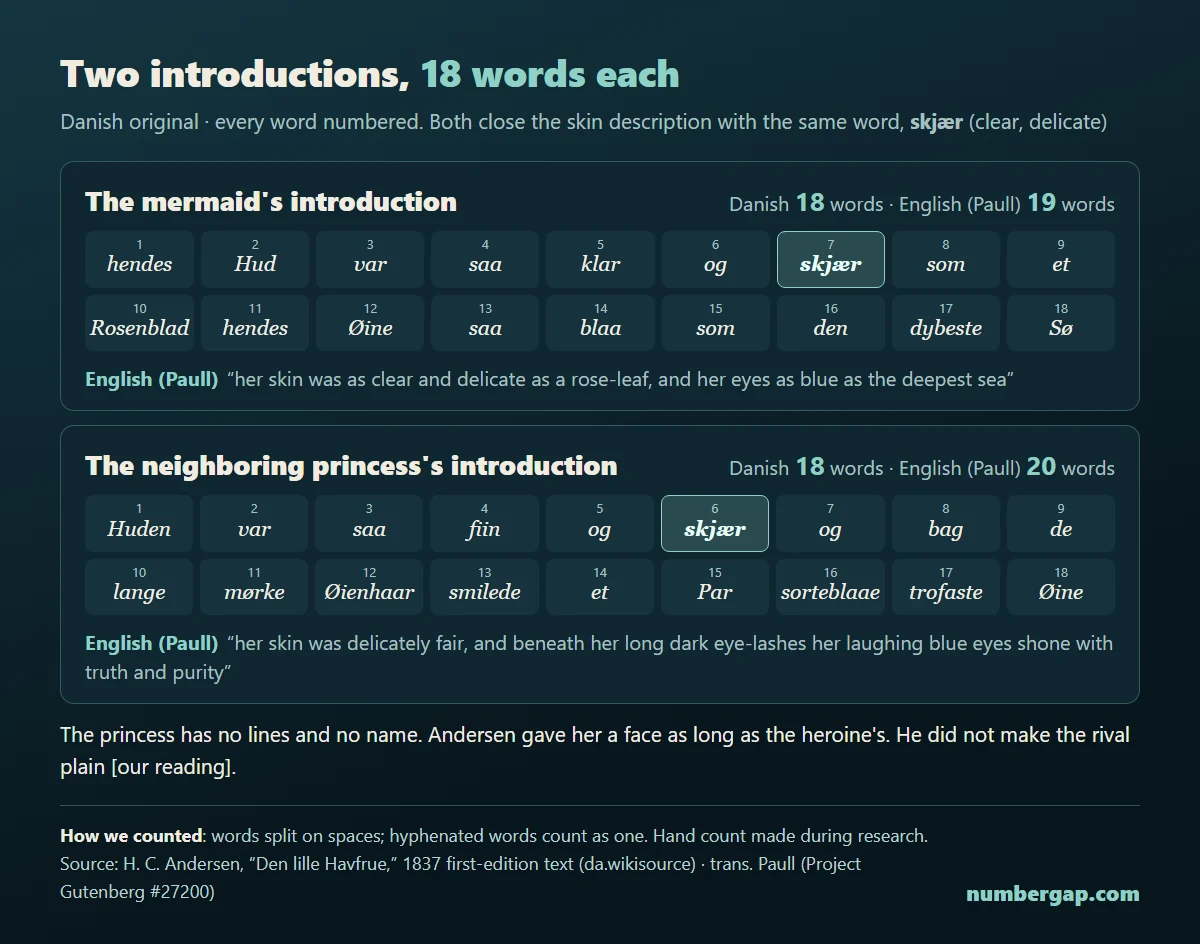
That doesn't mean Andersen skipped her face. He did the opposite. This is how he introduces her:
"her skin was as clear and delicate as a rose-leaf, and her eyes as blue as the deepest sea"
Source: H. C. Andersen, "The Little Mermaid," trans. H. B. Paull (Project Gutenberg #27200). The Danish original reads: hendes Hud var saa klar og skjær som et Rosenblad, hendes Øine saa blaa, som den dybeste Sø (1837 first edition text, da.wikisource).
Skin and eyes are there. Hair color isn't.
Yet the Little Mermaid in your head has a hair color. Who painted it?
The Little Mermaid Original Story in Eight Lines (Spoilers Ahead)
This section gives away the ending. If you know the story, skip to the next heading.
First, a fact. Nobody in the original has a name. Not the mermaid, not the prince. "Ariel" appears zero times in the text. Every name in the table below is a label we made up.
| Character | Who | Why it matters here |
|---|---|---|
| The youngest mermaid | Youngest of the sea king's six daughters. Surfaces at fifteen and sees a prince on a ship | Our subject. Her face is written down; her hair color is not |
| The prince | The man she saves from a shipwreck | The only character with both hair color and eye color on the page |
| The neighboring princess | The woman the prince marries. Raised in a temple | No name, no lines of dialogue, a full description |
| The grandmother | The sea king's mother. Explains mermaid lifespans and souls | Her white hair is one of only two colored heads |
| The five sisters | Older mermaids who surface before her | They show up on the wedding night with a knife they traded their hair for |
| The sea witch | Gives her legs, takes her voice | Not one line describing how she looks |
- The sea king has six daughters. Each may rise to the surface at fifteen. The youngest listens hardest to her sisters' stories of the human world.
- On her first night up, she sees a prince on a ship. A storm breaks the ship apart and she carries him ashore. She hides and watches a girl from a temple find him first.
- Her grandmother tells her mermaids live three hundred years, then turn to foam. Humans have immortal souls. A mermaid can only earn one through a human's love.
- She goes to the sea witch. The witch gives her legs and takes her voice. Every step will feel like walking on knives. If the prince marries someone else, her heart will break the first morning and she will become foam.
- She arrives at the palace unable to speak. The prince loves her the way you love a dear child.
- He travels to meet a neighboring king's daughter and decides she is the girl from the temple who saved him. They are engaged.
- On the wedding night, on the ship, her sisters rise from the water. They gave their hair to the witch for a knife. If she stabs the prince and his blood touches her feet, she gets her tail back.
- Before dawn she throws the knife into the sea, then throws herself in. Whether the story ends there, we check below against the text.
What Does the Little Mermaid Look Like in the Original Story?
Rose-leaf skin, eyes as blue as the deepest sea. Andersen opens with her face.
The sentence just before it says the youngest was "the prettiest of them all" (den yngste var den smukkeste af dem allesammen). So the order is: the verdict, then skin, then eyes, and last of all the tail. The sentence we quoted continues:
"but, like all the others, she had no feet, and her body ended in a fish's tail."
Source: "The Little Mermaid," trans. Paull. Danish: men ligesom alle de andre havde hun ingen Fødder, Kroppen endte i en Fiskehale.
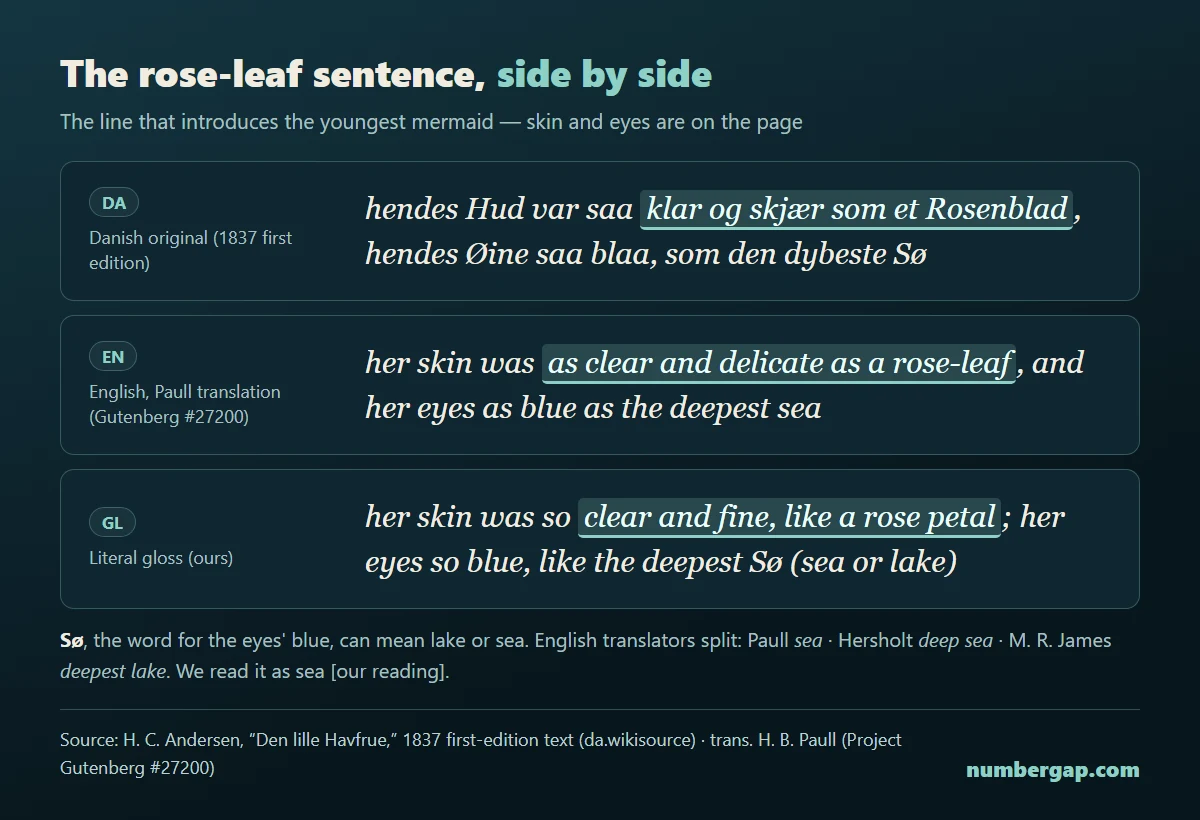
One catch. The Danish word in "the deepest sea," Sø, can mean lake or sea. English translators split. Paull wrote sea, Hersholt deep sea, M. R. James deepest lake.
Sø appears 25 times in the story. Every time, it is a place with ships, storms or icebergs. We read it as sea. [Our reading]
What does her face do in the story?
It is the last thing she has left to trade on. The witch has just said she will take the mermaid's voice. The mermaid asks what she gets to keep.
"Your beautiful form, your graceful walk, and your expressive eyes; surely with these you can enchain a man's heart."
"It shall be," said the little mermaid.
Source: "The Little Mermaid," trans. Paull.
Form, walk, eyes. All appearance. She agrees.
Later the prince has a name for her: "my dumb foundling, with those expressive eyes." The eyes do speak. But the person he longs for is not the mermaid. It is the temple girl who found him on the shore.
How many times does the text describe her?
We collected every phrase that attaches a color, shape or beauty judgment to her body. There are 29. [Our count, hand-curated; a different rule could move it by one or two]
The number matters less than what is inside it. Skin gets exactly one description, the rose-leaf line. Eyes get five, and two of those name a color: both blue. Her mouth is red in the Danish ("rosy" in Paull). Her hands, arms and legs are white. She has a small face, a delicate body, and one moment of being "pale as death."
Hair appears five times in the Danish. Color: none.
We will follow that thread in the next section.
Meanwhile, here is the face. This time there is enough on the page to paint.
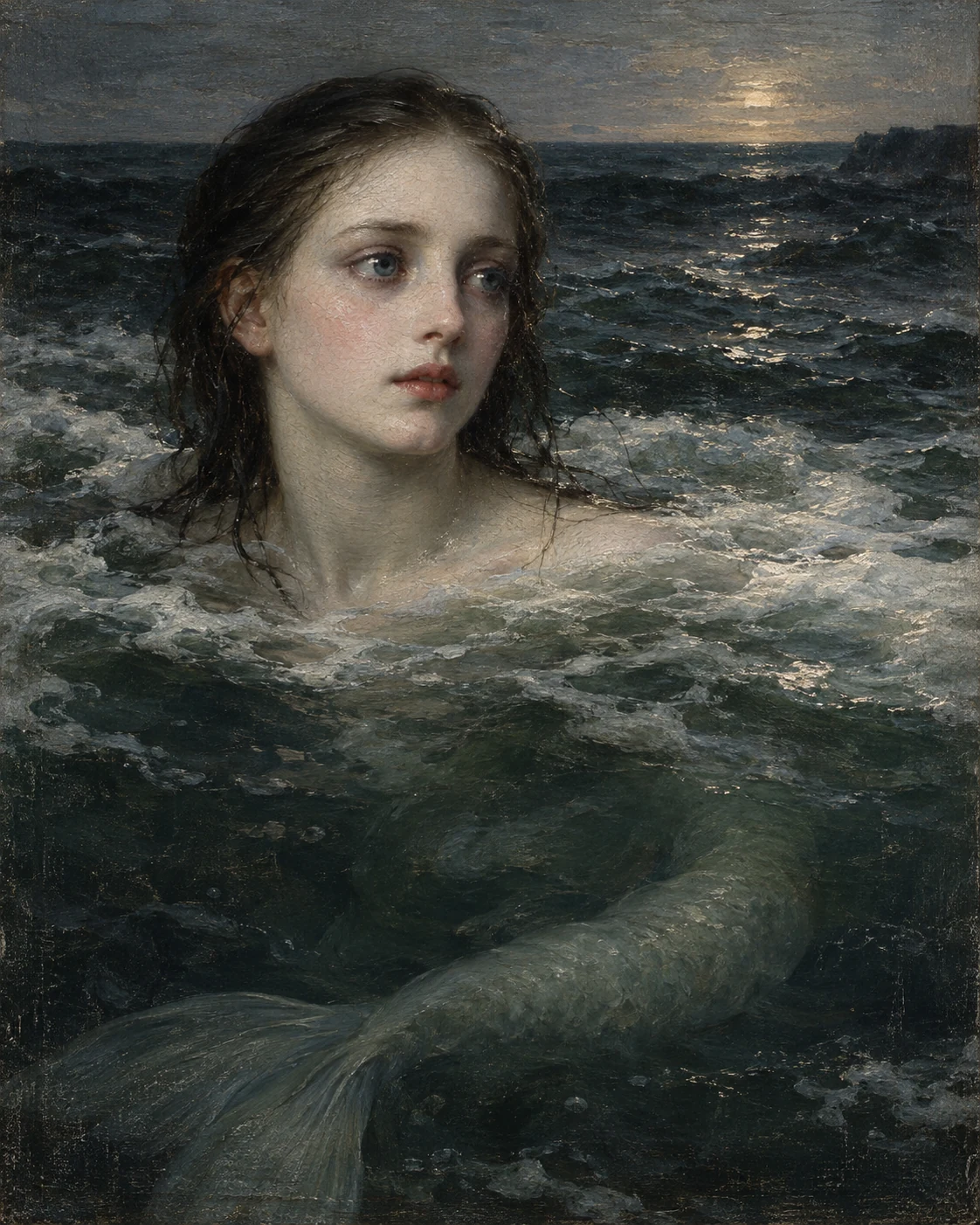
The youngest mermaid, painted from what the text says: rose-leaf skin, eyes as blue as the deepest sea, a red mouth, a small face, long hair. In earlier editions of this series, we often left blank whatever the text withheld. Here there is almost nothing to leave blank. Almost. The text gives no hair color, so whatever color you see in this painting comes from the painter, not from Andersen. (AI-generated image)
How is the neighboring princess described?
One more person gets a long description, and she is not the heroine. She is the princess the prince marries.
The day she arrives, the mermaid is waiting to see her face. Then this:
"Then the little mermaid, who was very anxious to see whether she was really beautiful, was obliged to acknowledge that she had never seen a more perfect vision of beauty. Her skin was delicately fair, and beneath her long dark eye-lashes her laughing blue eyes shone with truth and purity."
Source: "The Little Mermaid," trans. Paull. Danish: Huden var saa fiin og skjær, og bag de lange mørke Øienhaar smilede et Par sorteblaae trofaste Øine!
"Was obliged to acknowledge." The sentence belongs to the mermaid. The rival's face reaches us through her eyes.
We counted. The sentence introducing the mermaid's skin and eyes runs 18 words in Danish. The sentence introducing the princess's skin and eyes runs 18 words in Danish. In English it is 19 against 20.
They even open the same way. The mermaid: Hud var saa klar og skjær. The princess: Huden var saa fiin og skjær. Skin was so-and-so, and then the same word, skjær (clear, delicate). [Counted by us during research]
The princess never says a word in the story. She has no name. The prince speaks to her; she doesn't reply. Andersen gave a woman with no lines and no name a face as long as the heroine's.
So "only the heroine is beautiful" is the wrong thing to remember about this story. He did not make the rival plain. He made the mermaid admit her. [Our reading]
What Hair Color Does the Original Little Mermaid Have?
None. The original gives her long hair and no color, in Danish and in English.
We searched "hair" in the English (ten hits) and Haar in the Danish (ten hits), then opened every one. Whose hair is it? What is the hair doing?
| Whose hair | Danish 1837 | Color given |
|---|---|---|
| The youngest mermaid | 5 | None |
| The fifth sister | 1 | None |
| The sisters (cut off) | 1 | None |
| The prince | 2 (wet hair; black hair) | Black |
| The grandmother | 1 | White |
| Total | 10 |
We also hunted for color words near her. In English: blond, golden, auburn, flaxen, raven, curls, tresses. In Danish: gyldne, blond, Lokker, Krøller. One hit: the prince's "raven hair."
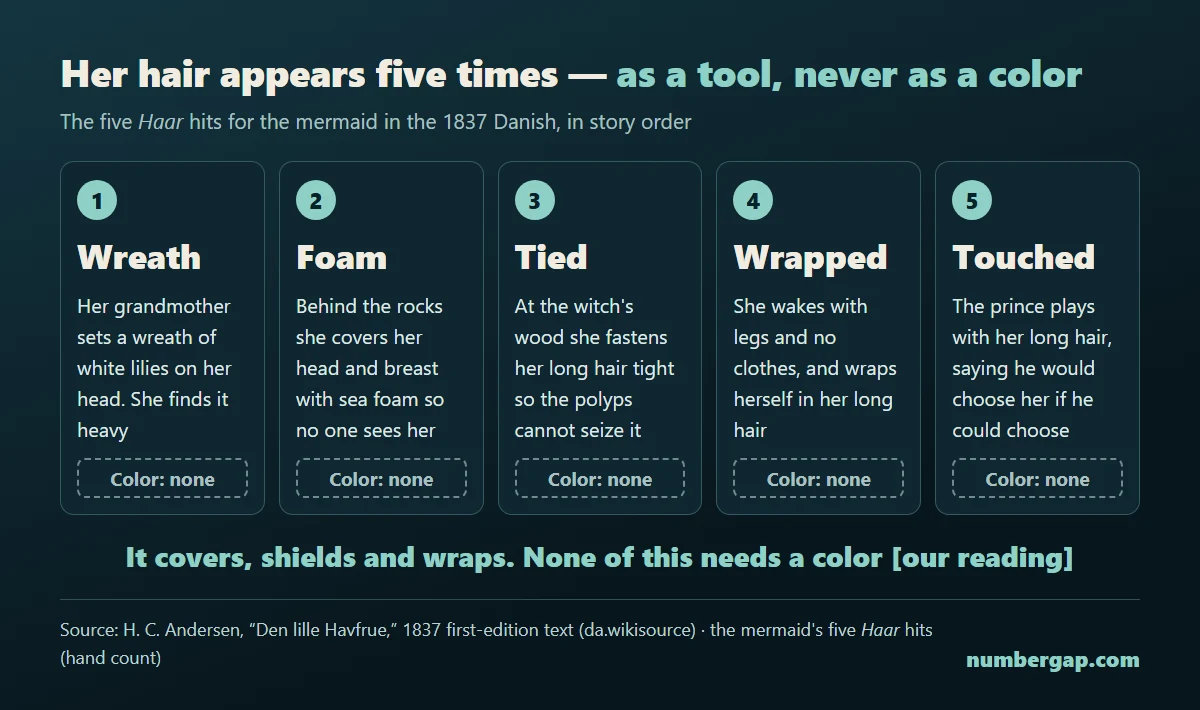
What does her hair do, five times?
No color. But it never sits still.
One. Just before she first surfaces at fifteen, her grandmother puts "a wreath of white lilies in her hair, and every flower leaf was half a pearl." The mermaid finds it heavy and would happily shake it off.
Two. She leaves the prince on the sand and hides behind rocks. "She covered her head and neck with the foam of the sea so that her little face might not be seen." (The Danish says her hair and breast. More on that below.)
Three. At the entrance to the witch's wood, where polyps grab anything that passes: "She fastened her long flowing hair round her head." So they can't seize it.
Four. She wakes up with legs and no clothes. "She wrapped herself in her long, thick hair."
Five. The prince plays with her "long waving hair." In the same breath he says he cannot love the princess and would rather choose her.
Her hair covers, shields and wraps. It doesn't need a color for any of that. It shows up as a tool. [Our reading]
Whose hair does have a color?
The other five hits.
The grandmother's hair is white, but not to show off a color. Her granddaughters say it on the wedding night: "Our old grandmother moans so for you, that her white hair is falling off from sorrow."
The sisters' hair is gone, traded for a knife. "As ours fell under the witch's scissors." In this story, hair is also currency.
And then the prince. His hair is wet when she pulls him from the storm. On the wedding night on the ship, this is the line:
"The prince kissed his beautiful bride, while she played with his raven hair, till they went arm-in-arm to rest in the splendid tent."
Source: "The Little Mermaid," trans. Paull. Danish: Prindsen kyssede sin deilige Brud, og hun legede med hans sorte Haar.
It is the only young head in the story with a color. The person touching it is the bride.
The prince touched the mermaid's hair, and it has no color. The bride touches the prince's hair, and it does. The text adds nothing about that contrast.
Where did "long, thick, waving" come from?
If you read the story in English, you may remember "long, thick, flowing." Stylist used nearly that phrase in 2015. Those adjectives aren't in the Danish.
Where Paull has "long, thick hair," the Danish says store, lange Haar ("big, long hair"). Where Paull has "long waving hair," the Danish says plain lange Haar ("long hair"). There is no Danish word for "waving." M. R. James has "masses of long hair." Hersholt has "long hair." [Confirmed: three translations compared]
Some of the picture in your head came from the translator's adjectives.
Stylist (December 10, 2015) wrote that Andersen "does not specify" Ariel's hair color. The same piece quoted Chloë Grace Moretz telling Entertainment Tonight about a film project: "We're going over the Hans Christian Andersen novel so I actually have blonde hair." We found no blonde in the novel. We found no red one either.
Source: Sejal Kapadia Pocha, "Ariel will have blonde hair in The Little Mermaid remake…", Stylist, 2015-12-10 — a press article quoting a second source. We did not check the original interview.
https://www.stylist.co.uk/beauty/ariel-will-have-blonde-hair-in-the-little-mermaid-remake-and-fans-arent-happy/137633
One line we couldn't settle
One more passage might be hair. The mermaid hides in the reeds by the prince's palace. When the wind catches her "long silvery-white veil," anyone who sees it thinks a swan is lifting its wings.
The text never says the veil is her hair. We didn't count it among the ten, and we didn't call it hair.
Her hair has length and it has uses.
It has no color.
Who Gave the Little Mermaid Her Hair Color? Four Illustrators, Four Colors
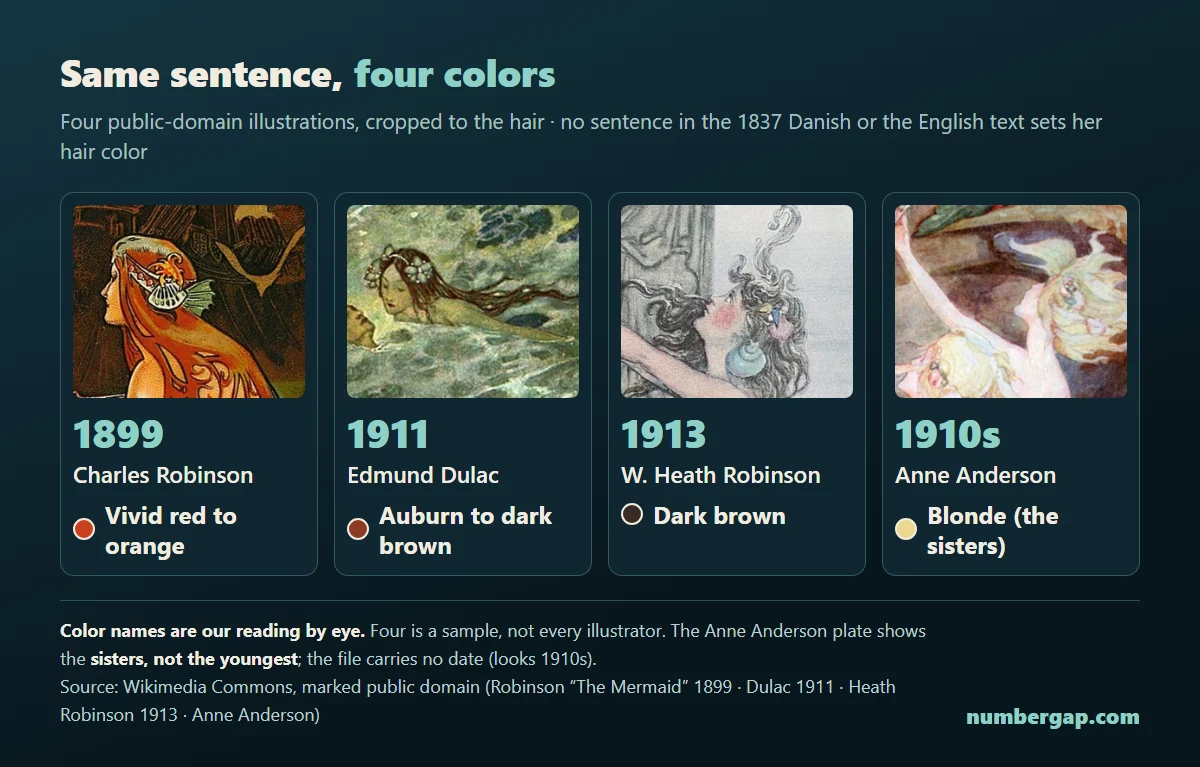
Each illustrator gave her a different one. In the four public-domain illustrations we looked at, her hair is red, auburn-to-dark-brown, dark brown, and blonde. The original left the square empty and each artist filled it differently.
Text can leave a blank. Color pictures can't. If you draw hair, you have to choose.
Vilhelm Pedersen, who first illustrated Andersen's tales in 1849, never had to answer. His pictures were pencil drawings cut into wood blocks and printed in black and white. No color in the print, nothing to choose. [Source: Wikipedia "Vilhelm Pedersen," Norway's SNL, SurLaLune — secondary sources]
Color printing changed that. We downloaded four original images that Wikimedia Commons marks as public domain, and looked at them ourselves.
Two caveats up front. The color names are our reading by eye, and other people may call them something else. And four is a sample. We haven't compared Harry Clarke (1916), Hans Tegner (1900) or others.
Charles Robinson (1899): vivid red
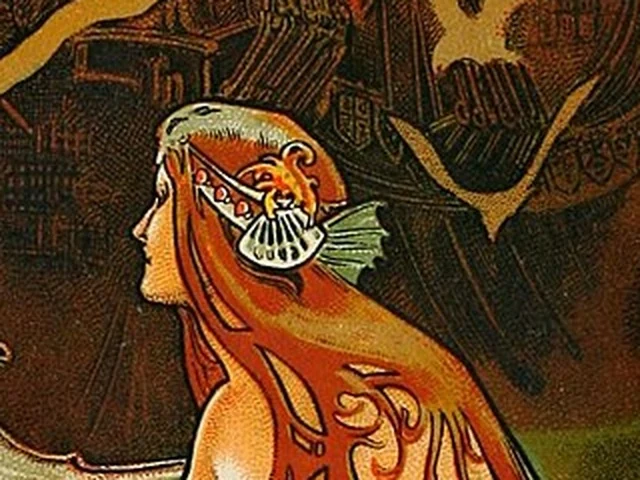
Charles Robinson, "The Mermaid," 1899. Source: Wikimedia Commons (marked public domain). Cropped from the original to show the head.
She rises from the water beside a ship, hair down to her waist. The color runs from red to orange. It is the clearest of the four. This is the least arguable reading.
Edmund Dulac (1911): auburn to dark brown
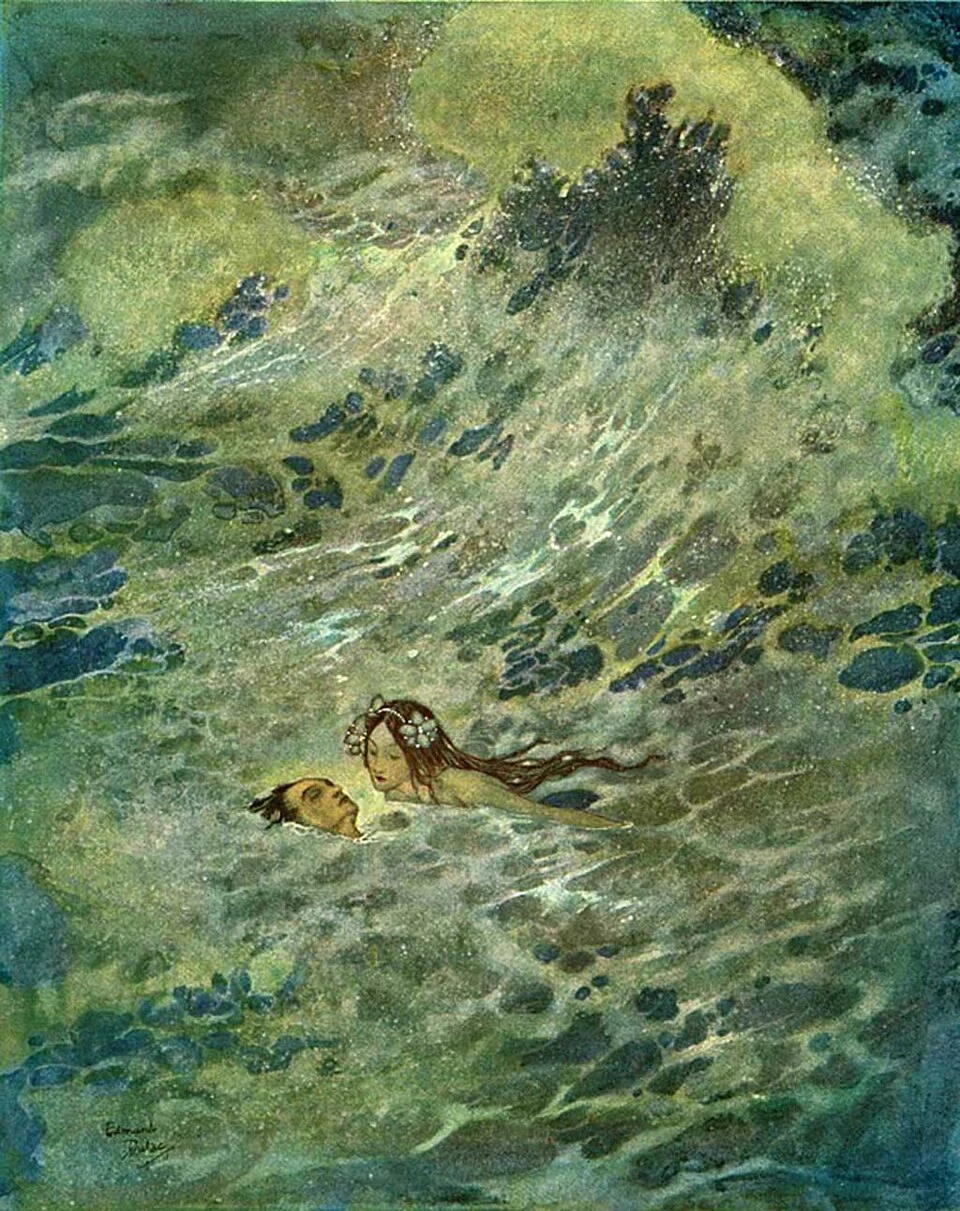
Edmund Dulac, color plate from "Stories from Hans Andersen" (Hodder & Stoughton), 1911. Source: Wikimedia Commons (marked public domain).
The storm rescue. Her long hair streams loose in the current. It reads somewhere between auburn and dark brown. White flowers sit in it.
W. Heath Robinson (1913): dark brown
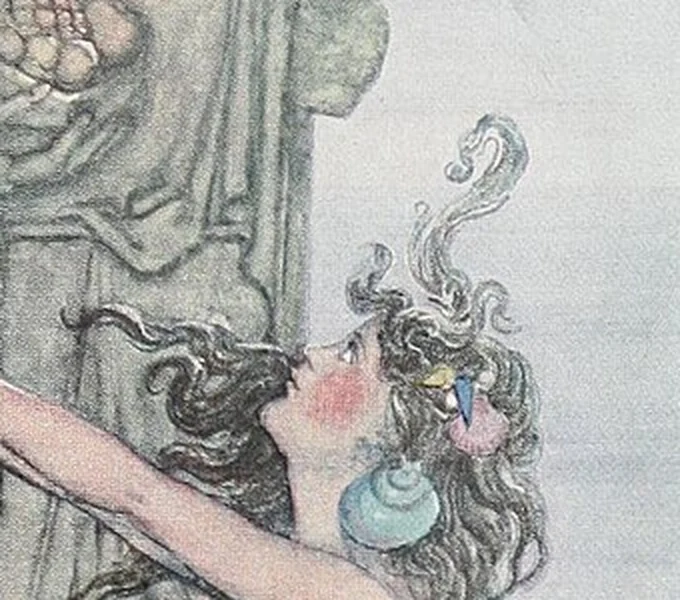
W. Heath Robinson, illustration for Andersen's fairy tales, 1913. Source: Wikimedia Commons (marked public domain). Cropped from the original to show the head.
A mermaid holds up a shell in front of a statue. Her hair is a tousled curl, dark brown. Some will say black.
Anne Anderson: blonde
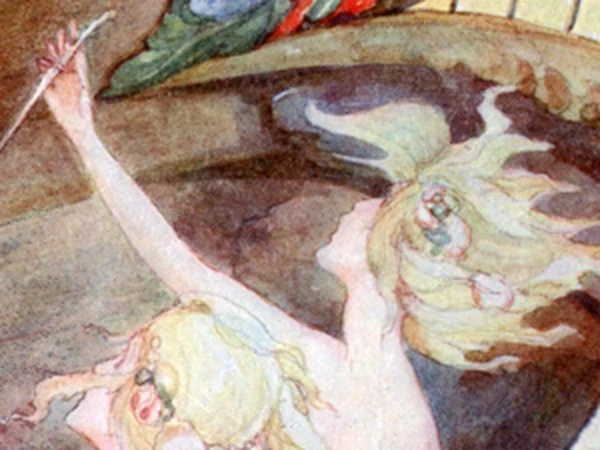
Anne Anderson, "The Little Mermaid's Sisters." Source: Wikimedia Commons (marked public domain). Cropped from the original to show the head. The file carries no date; it looks like the 1910s, but we could not confirm.
This picture shows the sisters, not the youngest. The caption on Commons reads "They sacrificed their hair to save her," yet the sisters' hair flows long in the picture. So we won't call this the mermaid's hair. What is clear is how this artist drew mermaid hair. Every mermaid in the picture is blonde.
Same text, four colors
| Artist | Year | Mermaid hair (our reading) |
|---|---|---|
| Charles Robinson | 1899 | Vivid red to orange |
| Edmund Dulac | 1911 | Auburn |
| W. Heath Robinson | 1913 | Dark brown |
| Anne Anderson | 1910s, apparently | Blonde (the sisters in the picture) |
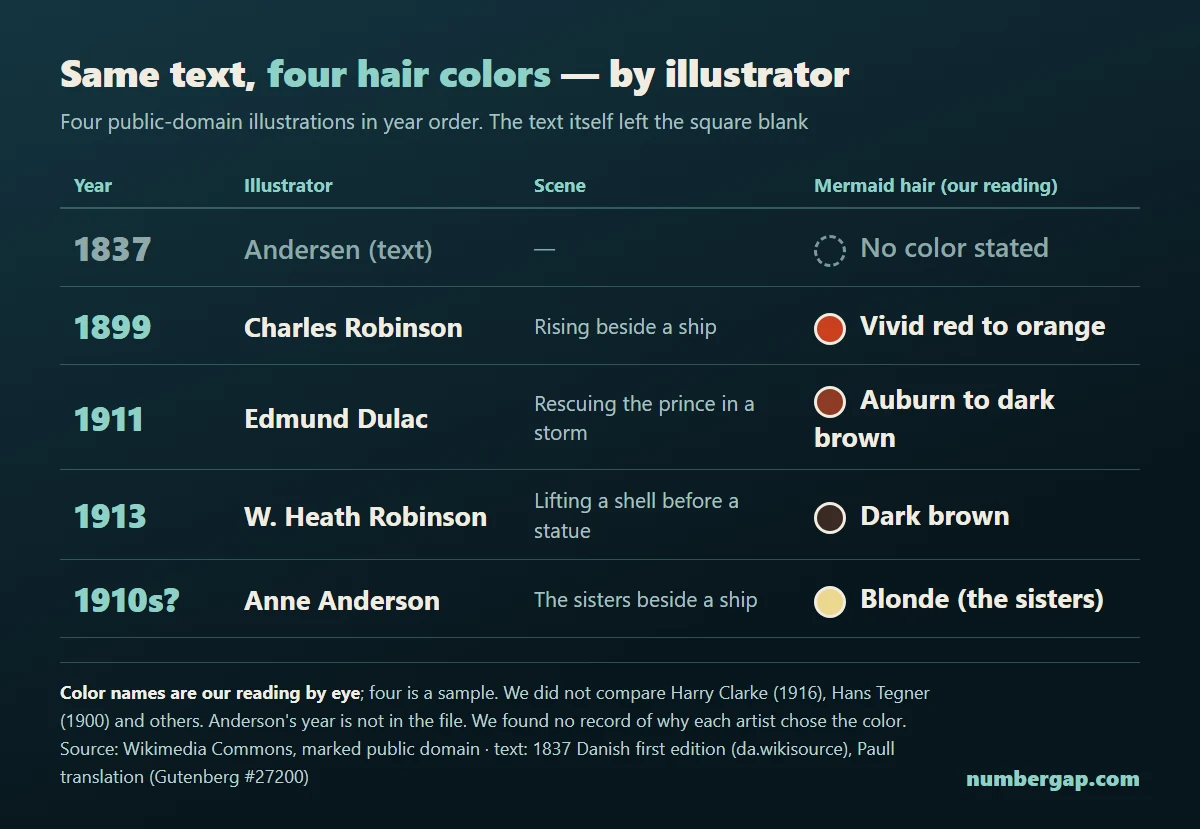
We found no record of why each artist chose their color. One fact stands. None of the translations we read gives a hair color, and the illustrators still had to choose.
So where does the color most people picture come from? Many point to a 1989 movie.
Why Is Ariel a Redhead? What the Director Said, and What He Didn't
Co-director Ron Clements said she was always going to be a redhead. He gave no reason. The popular explanation, "to tell her apart from the blonde mermaid in Splash," is one we couldn't trace to anyone on the film.
Who said "to tell her apart from Splash"?
We went looking for the person who said it.
Part of it is true. Splash (1984) was a Disney-label movie with a blonde mermaid, Daryl Hannah. And it did get in the way of the film. When Clements pitched Andersen's story at a January 1985 brainstorm, Disney was developing a Splash sequel and passed, reportedly as "too similar." A day or two later, Jeffrey Katzenberg read Clements's two-page treatment and approved development.
Source: Josh Spiegel, "The Little Mermaid Launched Disney Animation Into A New Era," SlashFilm, 2019-06-04 — a press article. Some outlets say the obstacle was Splash itself, not the sequel.
https://www.slashfilm.com/566841/the-little-mermaid-revisited/
But a hurdle for the greenlight is a different thing from a reason for the hair.
The hair explanation, "red to set her apart from Hannah, and because red is green's complementary color," shows up in two articles: Inside the Magic (March 15, 2020) and CBR (March 2020). Both say they are quoting Disney's own blog, Oh My Disney. Neither links to it. We looked for the post and didn't find it.
So that explanation comes from outlets re-quoting a Disney blog. Neither the director nor a designer is on record saying it, as far as we found.
What did the director actually say?
At a press event for the film's 30th anniversary in February 2019, Clements spoke to CinemaBlend. We opened the article and read it.
"John Musker and I, we wrote the original script. And our intention was always that she would be a redhead."
Source: Sean O'Connell, "Why Toymakers Were Originally Horrified The Little Mermaid's Ariel Had Red Hair," CinemaBlend, 2019-02-12 — an interview article quoting the director.
https://www.cinemablend.com/news/2466802/why-toymakers-were-originally-horrified-the-little-mermaids-ariel-had-red-hair
No reason is given. Just: it was always red. That is thirty years of hindsight, and we haven't seen the original script.
What he said next is better.
Who wanted her blonde?
Two people objected, according to Clements.
The first was the toy company, Tyco.
"… they saw that she was a redhead, they were horrified. They said, 'All of our research,' at that time, 'shows that redheaded dolls have never sold. They don't sell.'"
Clements says he told them, "Well, I'm sorry, but she's going to be a redhead." But the toy company was so panicked, he says, that the very first Ariel dolls were not redheads. They were strawberry blonde. People wanted the dolls with red hair, so the company remade them.
The second was Jeffrey Katzenberg, then chairman of Disney's studio.
"Jeffrey Katzenberg had different ideas, I think. ... a lot of what he saw early on was black-and-white animation footage, which are just pencil drawings. And she sort of looks blonde. ... when he first saw that she was a redhead, he was concerned. And I remember him saying at the time, 'Everybody knows all mermaids are blonde.' I don't know exactly where that came from. [laughs]"
Source: the same CinemaBlend article. The Tyco doll anecdote was also covered by Jake Rossen, Mental Floss, 2019-02-13, quoting the same interview.
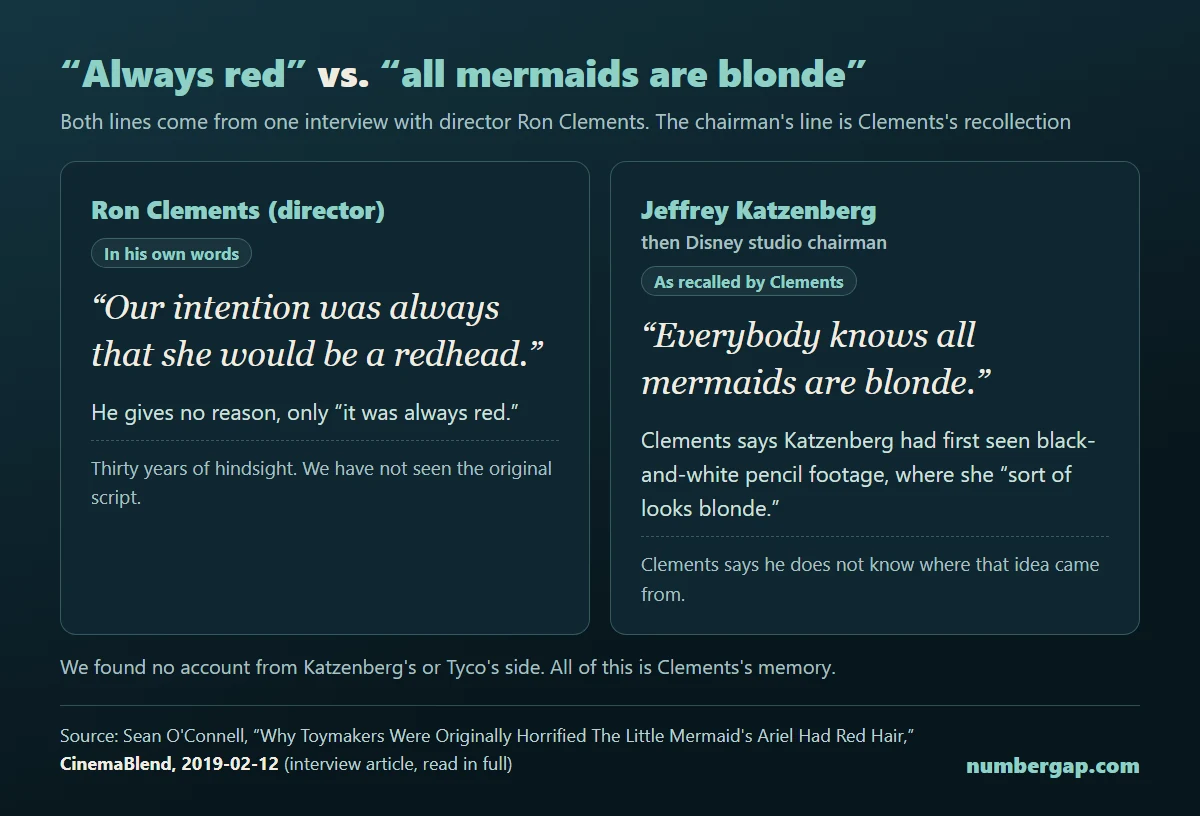
Here is the problem Clements had, if we take his account. The studio chairman first saw her in pencil drawings, and the hair in those drawings looked blonde. The toy company cited its own research to say red doesn't sell. In the middle, the director had to hold on to red. Everything here comes from Clements. We could not find the Katzenberg or Tyco side.
Red hair was already on the page in 1899
Now go back to the last section.
Charles Robinson painted the mermaid's hair vivid red in 1899. That is 90 years before Disney's film.
We have no evidence that Disney saw that picture. This isn't about influence. Two ideas just don't fit the history of illustration.
"Disney invented the red-haired mermaid." Red was on the page in 1899. How many red mermaids appeared between 1899 and 1989, we didn't research.
"All mermaids are blonde." Of the four we looked at, one is blonde, and those are the sisters. Katzenberg's "everybody knows" doesn't show up in the pictures we pulled up. Clements himself says he doesn't know where the idea came from.
If both are wrong, what is left is this. The original left a blank. Different eras filled it with different colors. In 1989, a director held on to red against pushback. If his account is right.
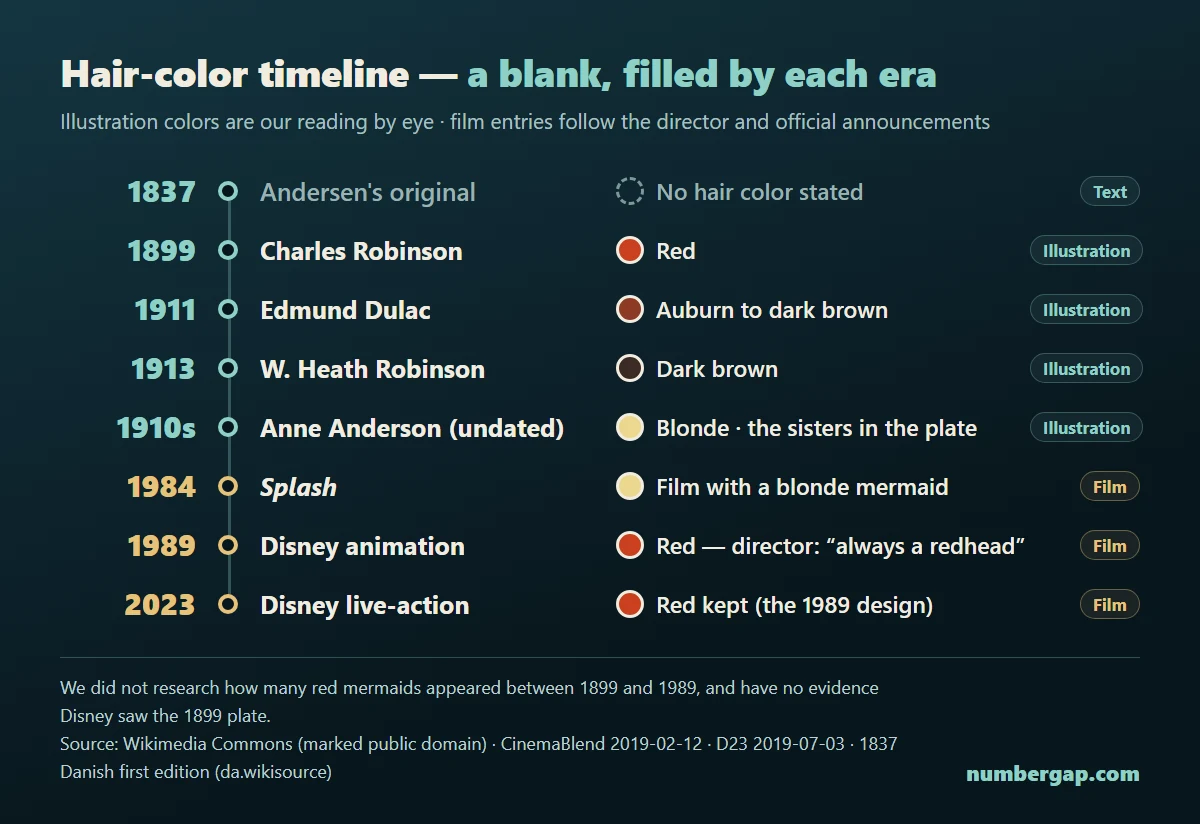
The blanks were not only hair
The original left more than one square empty.
The name. Nobody in Andersen's story has one. "Ariel" came from Clements's treatment in January 1985. Asked why, he said:
"I called her 'Ariel' in the treatment. I'm not sure why but I sort of liked that name."
Source: Jim Korkis, "Ariel's Tale," MousePlanet, 2021-07-28 — a trade-press interview roundup. The article does not say when the interview took place.
https://mouseplanet.com/ariels-tale/8003/
We heard that the name came from The Tempest or the film Footloose. We found no evidence for either.
The witch's face. The original sea witch has no face, no age and no hair on the page. What the text does say about her body is "large, spongy bosom" (store, svampede Bryst), and snakes crawling on it. Here is one account of how that blank got filled. Rob Minkoff, an animator then and later co-director of The Lion King, told NBC News that the script described a Joan Collins type, and that he suggested a different approach based on the drag performer Divine from John Waters's films. He says Musker came back and said Howard Ashman liked the drawing.
Source: Elaina Patton, "How an outrageous drag queen found mainstream fame in 'The Little Mermaid,'" NBC News, 2023-05-26 — Rob Minkoff's recollection as relayed by the reporter.
That is one person's memory. We found no statement in the articles we read where Disney confirmed it. Divine died in 1988, before the film came out.
Did Disney change everything? What it kept
"Disney changed the whole story" leaves out one thing. It kept the biggest piece on purpose.
The trade: voice for legs. Musker says it caused debate among executives.
"Can you have the star of your movie actually lose their voice for a significant amount of time?"
Executives worried that the lead would have no dialogue for the middle of the film. Clements's reply, as he recalls it:
"That's a fairy tale thing that goes back to fairy tales from the beginning."
Source: Lauren Duca, HuffPost, 2014-11-17 — interview with Musker and Clements.
https://www.huffpost.com/archive/ca/entry/the-little-mermaid-fairy-tale_n_6096200
The ending they changed, and Clements says why: "It just seemed it would be tough to do that ending and keep a Disney kind of feeling." (Quoted from MousePlanet, where it is secondhand.)
How does that ending read in the original?
What happened with the 2023 live-action film? (Facts only)
This section states what's confirmed and what was said. It doesn't take a side.
On July 3, 2019, Walt Disney Studios announced Halle Bailey as Ariel in the live-action film. Director Rob Marshall's statement named "spirit, heart, youth, innocence, and substance—plus a glorious singing voice." It did not mention race or hair color. [Source: D23, 2019-07-03]
The hashtag #NotMyAriel spread on social media, and many people spoke in support. Freeform, a Disney-owned channel, posted an open letter. One sentence read: "Danish mermaids can be black because Danish people can be black." That letter came from the channel, not Disney corporate. [Source: NBC News, 2019-07-08]
The live-action Ariel has red hair. Camille Friend, the film's head of hair, told Variety that she wrapped Bailey's locs in red extensions instead of using a wig. [Source: Carolyn Jenkins, Looper, 2023-06-01, citing Variety; we did not read Variety itself]
We can add one confirmed fact. Andersen's text names no hair color, and it contains no word for race or ethnicity. The red hair the 2023 film kept comes from the 1989 animation, not from Andersen. This piece goes no further than that.
How Does the Original Little Mermaid End? The Sentence After the Sea Foam
It doesn't end at the foam. In the original, the mermaid turns to foam, then rises to the daughters of the air, and the story's last sentence is spoken by one of them.
We went to quote that sentence. The Danish text we had downloaded ended like this:
…da maae vi græde Sorgens Graad,
On a comma. The final sentence of the story.
We opened the original Wikisource page. One more line sat after it. Our first extraction had cut off the last sentence. We found it during research and repaired the file, and every Danish count in this piece uses the repaired text. If we had missed it, we'd have written the ending without checking its last sentence.
What happens after the foam?
On the wedding night, she throws the knife her sisters gave her into the sea.
"…the water turned red where it fell, and the drops that spurted up looked like blood. She cast one more lingering, half-fainting glance at the prince, and then threw herself from the ship into the sea, and thought her body was dissolving into foam."
That's the ending we know. The witch predicted foam, and the mermaid thinks it's happening. The next sentence is why this section exists:
"The sun rose above the waves, and his warm rays fell on the cold foam of the little mermaid, who did not feel as if she were dying. She saw the bright sun, and all around her floated hundreds of transparent beautiful beings."
Source: "The Little Mermaid," trans. Paull. The Danish says følte ikke til Døden, "did not feel death."
She asks where she is. "Among the daughters of the air," one answers. They have no immortal soul either, but they can earn one by good deeds. Three hundred years of them. And now, by her own deeds, so can she.
The soul no longer depends on the prince's love. It depends on what she does.
She lifts her arms toward the sun and feels tears for the first time. (Paull writes "glorified eyes" there. The Danish says klare Arme, "clear arms.") Unseen, she kisses the bride's forehead and smiles at the prince. [Confirmed against the Danish text]
Who speaks the last sentence?
One of the daughters of the air whispers it.
"'And we may even get there sooner,' whispered one of her companions. 'Unseen we can enter the houses of men, where there are children, and for every day on which we find a good child, who is the joy of his parents and deserves their love, our time of probation is shortened. The child does not know, when we fly through the room, that we smile with joy at his good conduct, for we can count one year less of our three hundred years. But when we see a naughty or a wicked child, we shed tears of sorrow, and for every tear a day is added to our time of trial!'"
Source: "The Little Mermaid," trans. Paull. In the Danish the last clause is og hver Taare lægger en Dag til vor Prøvetid!
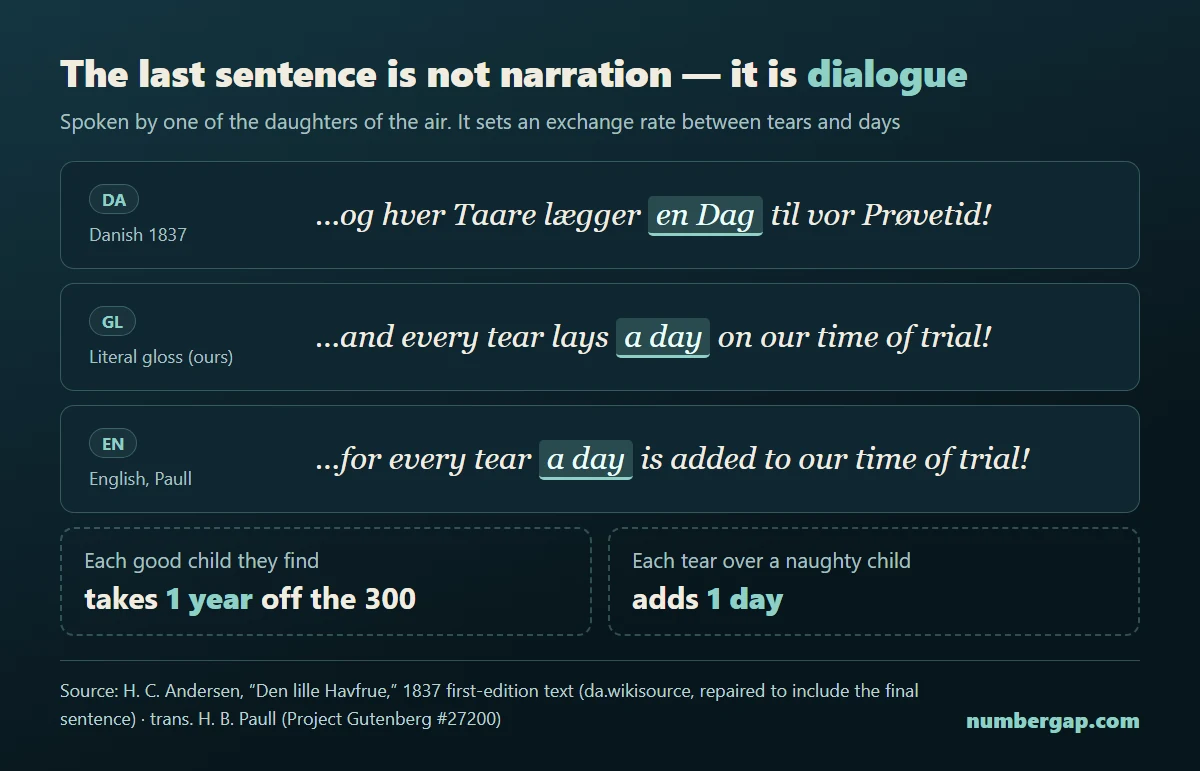
The last sentence of the story is not the narrator's. It's dialogue. And there's an exchange rate: a good child takes a year off, and every tear over a bad child adds a day.
Follow the tears. Early on we're told "the mermaids have no tears, and therefore they suffer more." Later, as the prince talks about the temple girl, she "sighed deeply, but she could not shed tears." At the end, she feels tears for the first time.
A story that begins by saying mermaids can't cry ends on a sentence that prices tears. [Our reading]
Even the director read it as ending in foam. Clements, in 2014:
"In the end, she loses the prince and she turns into sea foam."
Source: Lauren Duca, HuffPost, 2014-11-17.
How many times does she walk on knives?
Counting knife similes only, four. Depending on what you count, five or six.
- The witch's prediction. "At every step you take it will feel as if you were treading upon sharp knives."
- Just after the transformation: "the points of needles or sharp knives."
- Dancing for the prince: "as if she trod on sharp knives."
- The wedding-eve dance: "Her tender feet felt as if cut with sharp knives." She barely notices, because "a sharper pang had pierced through her heart."
Add the scene on the mountain where her feet bleed, and you reach five. Add the night she soothes her burning feet in the sea, six. Separate from the knives, a "two-edged sword" image appears three times: the witch's prediction, the potion itself, and the moment she drinks it.
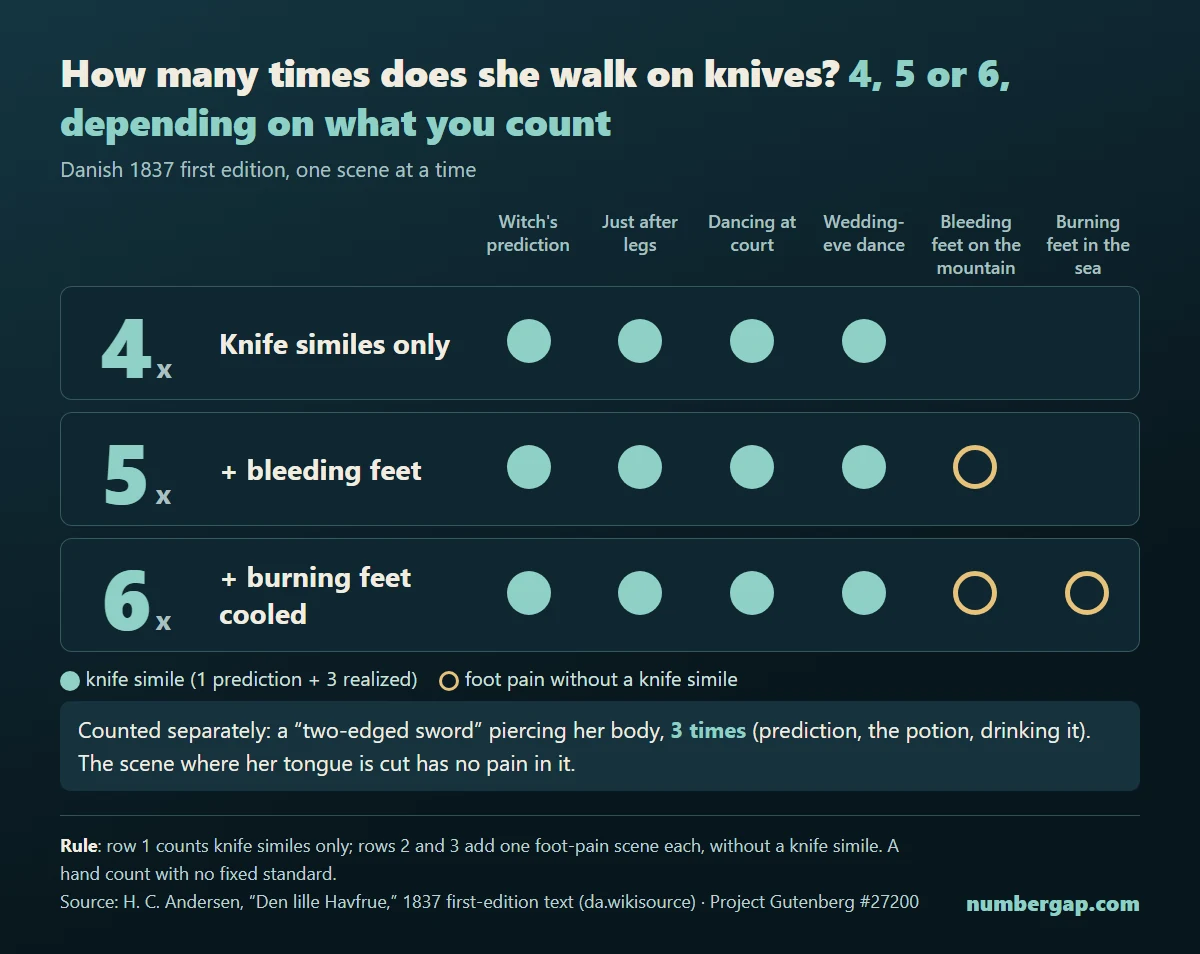
Counting pain, we noticed something odd. The scene where her tongue is cut has no pain in it.
"'There it is for you,' said the witch. Then she cut off the mermaid's tongue, so that she became dumb, and would never again speak or sing."
Source: "The Little Mermaid," trans. Paull.
No blood, no scream. The witch's blood goes into the potion; the mermaid's blood shows up only on her feet.
The first pain in the story is for decoration. Her grandmother clamps eight oysters to her tail. "But they hurt me so," the mermaid says. "Pride must suffer pain," the old lady answers (Paull's wording; the Danish says one must suffer for finery). When she gives up her voice, the largest thing she has, the text records no pain. That's our observation, and the text gives no reason. [Our reading]
Is the original Little Mermaid really dark? How the first readers took it
In February 1837, Andersen was writing to someone who hadn't liked his first fairy tales: the writer B. S. Ingemann.
His opening line, in our translation of the Danish: you will soon get a new booklet of children's tales, which you don't care for anyway. The same letter says the new one, "The Little Mermaid," is better than "Thumbelina" and, [...] "the only one of my works that moved me myself while I wrote it." (The [...] marks a gap in the scholarly edition that quotes the letter.) He also set his mermaid against Fouqué's Undine, whose soul depends on a human's love. His mermaid, he wrote, took "a more natural, more divine path." Two days later Ingemann replied in some surprise: he had loved the second booklet, and his objection was to the first.
Source: Erik Dal, ed., H.C. Andersens Eventyr, vol. 7, commentary (C. A. Reitzel, 1990) — a scholarly critical edition that quotes the letters directly.
https://tekster.kb.dk/text/adl-texts-hcaeventyr07val-shoot-idm139890599716016
Opinion on the ending split from the start.
Carsten Hauch wrote privately to a friend on May 22, 1837: he read it with pleasure, but his main objection was that a mermaid who feels like that already had a soul and needn't earn one. Fouqué's Undine seemed to him truer, and so more beautiful. Andersen never heard it from him.
There was just one public review of the booklet, in Kjøbenhavnsposten on July 18, 1837. It rated "Thumbelina" and "The Little Mermaid" highest. It found one flaw: at the end of the mermaid story, the narrator's last appeal to the young listeners leaves the realm of poetry. The review doesn't quote the line. We read it as the closing passage about children, tears and days. [Our reading]
Henriette Hanck wrote on September 22, 1837 that she lent the last booklet to an acquaintance, who swore she read "The Little Mermaid" five times and cried every time. On one page lay a large tear with face powder in it. Hanck wrote that it really annoyed her that the little mermaid should be mourned with a made-up tear (begrædes med en sminket Taare).
Fredrika Bremer, the Swedish writer, wrote to Andersen on April 21, 1839. The work is full of deep, beautiful poetry, she said, but she agreed with him that it was not for children. "I would certainly have gone mad over the little mermaid, had I read it as a child." We could not confirm where Andersen said it wasn't for children.
Source: Erling Nielsen, "Eventyrenes modtagelseskritik," H.C. Andersens Eventyr, vol. 6 (ed. Erik Dal, 1990) — a scholarly edition that prints reviews and letters of the time in the original.
https://tekster.kb.dk/text/adl-texts-hcaeventyr06val-shoot-idm139779800515456
"Too painful for a child" is not a modern complaint. It was in a letter two years after publication.
What Did the English Translation Change? God Was Cut Three Times
The English text most people read has no "God" in it. The Danish has Gud three times.
When you search for the story online, you'll mostly find Mrs. H. B. Paull's translation (published by Warne; library records say 1872 and 1883). We checked four free sites, Gutenberg, Wikisource and two others, and all four carry the same Paull wording. (Wikipedia's infobox names Mary Howitt, 1845, as the English translator, but the widely reproduced text is not hers.) We compared Paull with M. R. James (1930) and Jean Hersholt (1949).
| Spot | Danish 1837 | Paull | James 1930 | Hersholt 1949 |
|---|---|---|---|---|
| God's sun | Guds Sol | "the sun" | "God's sun" | "God's sun" |
| God's kingdom | Guds Rige | "kingdom of heaven" | "heavenly kingdom" | "kingdom of God" |
| Who shortens the trial | forkorter Gud | no subject ("is shortened") | "God shortens" | "God shortens" |
| Foam over | Haar og Bryst (hair and breast) | "head and neck" | "hair and bosom" | "hair and shoulders" |
| Nakedness | ganske nøgen | "no clothes" | "quite naked" | "naked" |
| What she lifts | klare Arme (clear arms) | "glorified eyes" | "bright arms" | "clear bright eyes" |
| To the prince | smilte til ham (smiled) | "fanned the prince" | "on him she smiled" | "smiled upon the Prince" |
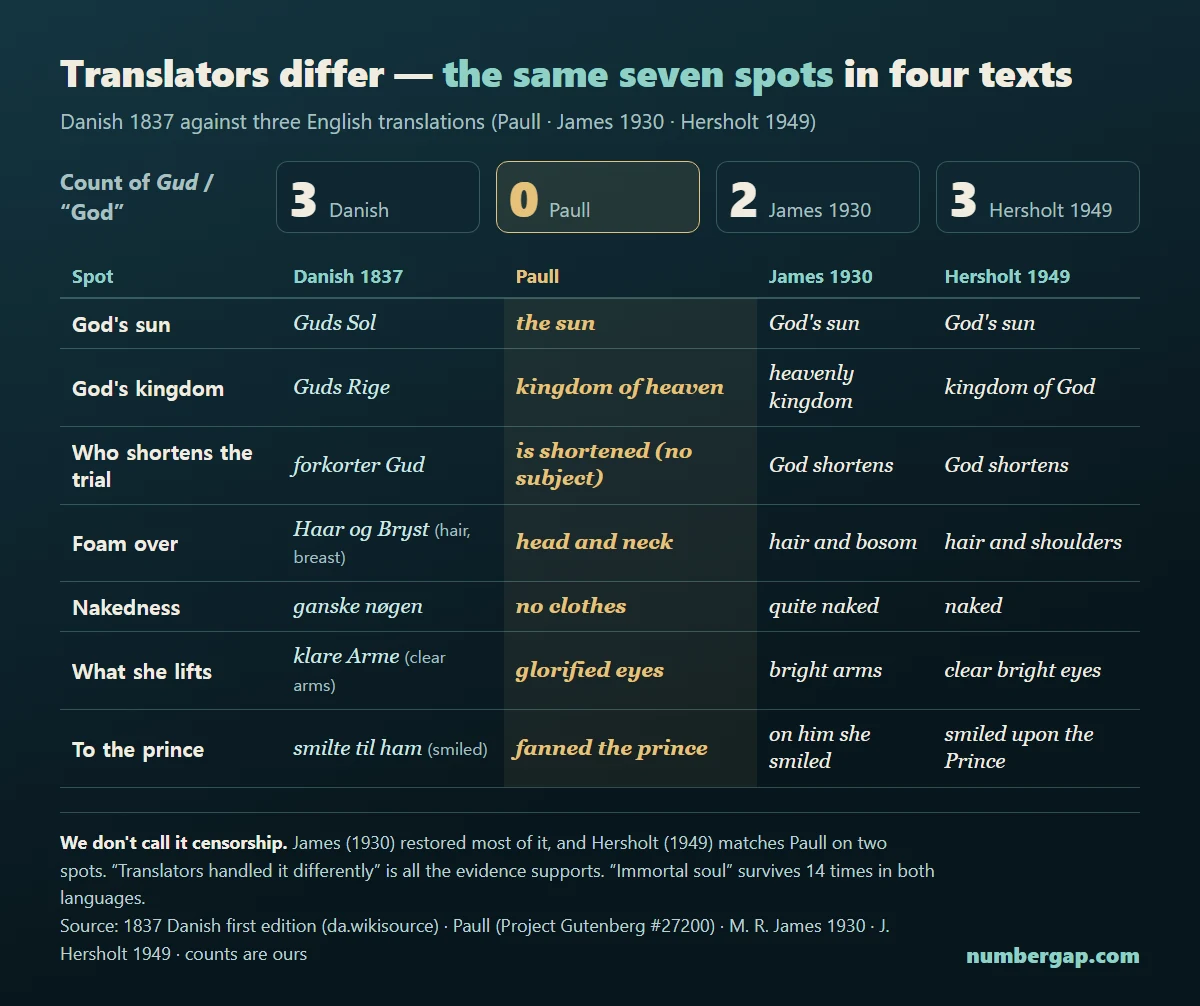
By count: Gud appears three times in the Danish and God zero times in Paull. James has it twice, Hersholt three times. "Immortal soul" survives in both, 14 times each. The soul talk stays. Only God's name goes.
One translation holds a cluster of them. "Breast" becomes "neck." "Quite naked" becomes "no clothes." A smile becomes a fan.
Was it Victorian censorship?
We don't say so. We could not show it.
James (1930) restored most of it. Hersholt (1949) matches Paull on two spots: "arms" becoming "eyes," and a man's outfit (Mandsdragt) becoming a "page's" suit. "Different translators handled it differently" is what the evidence supports.
Breasts show it clearly. Danish Bryst is used of the mermaid in three places. Only the foam scene changes. The other two read "bosom" or "breast" in all three translations. The translators did not avoid the word. One scene, the one where she covers her bare chest with foam, was edited. [Our reading]
There is scholarship on neighboring cases. Kirsten Malmkjær's "What happened to God and the angels" (Target 15(1), 2003) looks at how H. W. Dulcken's Victorian Andersen translations changed religious material, and Hannah Persson (Palgrave, 2022) argues Mary Howitt, the first English translator, cut what she thought unsuitable for children. We read only the abstracts and can't say whether either discusses this story or Paull. [Scholars: Malmkjær; Persson. Abstracts only]
The princess's eyes also shifted in English. Danish sorteblaae trofaste Øine, "black-blue, faithful eyes," became "laughing blue eyes shone with truth and purity." "Black" disappears, and "faithful" becomes "purity."
How We Checked
Everything here was verified on October 21, 2026.
Danish: da.wikisource, "Den lille Havfrue." We treat it as the first-edition text (April 7, 1837). Two reasons. Words that Erik Dal's critical edition flags as first-edition vocabulary (Geburtsdag, forliebt, baltrede, Reenlighed, Crokodillen, kullende mørkt, givtes) all appear in this text exactly as printed. And the H.C. Andersen Centre's modernized-spelling edition of the 1837 print matched it word for word apart from spelling.
English: Project Gutenberg #27200. The file names no translator. A word-by-word diff against Wikisource's transcription of Paull found only eight differences, all typos or page captions.
How we counted. We collapsed line breaks and ran case-insensitive regex searches, writing the Danish old spellings (aa, Haar, Øine) into the patterns. Length: 9,183 English words, 7,976 Danish. The "29 appearance phrases" come from a hand-built list. A script only checked that each phrase exists in both languages. So the number is our count.
What we could not confirm.
- Whether the text changed in the 1849 and 1862 reprints (a modernized-spelling Danish edition differed from 1837 only in spelling, but we don't know which printing it follows)
- The full text of Malmkjær's and Persson's work (abstracts only)
- A document from the time showing Clements's "always red"
- Why the illustrators chose their colors
FAQ
Q. How does the original Little Mermaid end?
A. The mermaid does not stab the prince. She throws the knife into the sea, then throws herself in. She feels her body dissolving into foam but does not feel death, and rises to the daughters of the air. She is told that three hundred years of good deeds can earn her an immortal soul. The last sentence is spoken by one of the daughters of the air.
Q. Does the Little Mermaid die in the original story?
A. The text says she "did not feel as if she were dying" and describes her gaining a body like the airy beings around her. It does not simply say she dies, and it does not end at the foam.
Q. What hair color does the original Little Mermaid have?
A. None is given, in Danish or English. The text says "long hair" and nothing about color. The only colored heads are the prince's black hair and the grandmother's white hair.
Q. Was the Little Mermaid a redhead in the original story?
A. No. The original names no hair color, and "Ariel" is not in it. The red hair comes from the 1989 Disney animation, where director Ron Clements said she was always meant to be a redhead. Charles Robinson painted a red-haired mermaid in 1899, though, so red is older than the movie.
Q. Why is Ariel a redhead in Disney's film?
A. The director gave no reason, only "always a redhead." The popular explanation, that red set her apart from the blonde mermaid in Splash, comes from articles citing a Disney blog. We could not find the blog post, and we found no record of the filmmakers saying it.
Q. What do the eyes and skin of the original Little Mermaid look like?
A. Her skin is "as clear and delicate as a rose-leaf" and her eyes are "as blue as the deepest sea." Her eyes are called deep blue once more elsewhere. Her mouth is red, and her hands, arms and legs are white.
Q. How many times does the Little Mermaid walk on knives in the original?
A. Four, if you count only the knife similes. Five with the scene of bleeding feet, six with the burning feet. There is no pain written into the scene where her tongue is cut.
Q. Is the original Little Mermaid dark?
A. It is painful, but not simply bleak. The pain is counted out, the ending turns toward hope, and the last sentence is about tears. A Swedish writer told Andersen in 1839 that she would have gone mad over it as a child. Andersen titled the preface to this booklet "To the Older Readers," and a critical edition notes that from 1843 he dropped "told for children" from the titles of his collections.
Q. How old is the Little Mermaid in the original story?
A. Fifteen when she first surfaces. The text gives no age for when she becomes human.
Q. Did Andersen write The Little Mermaid because of Edvard Collin?
A. Some scholars read it as an allegory of Andersen's unrequited love for Edvard Collin. [Scholarly claim] We found no letter in which Andersen says so. The dates also don't fit. Collin married on August 10, 1836, but the story's working titles ("Daughters of the Air," "Daughters of the Sea") appear in letters from February and May that year. "He wrote it because of the wedding" doesn't hold. The H.C. Andersen Centre says there is no evidence Andersen had a physical relationship with a man and describes his youthful feelings for Collin as platonic. That statement doesn't mention The Little Mermaid directly.
Reading the Original Yourself? Check These Three Places
If you pick up a translation, look for three things.
One. Does it give the mermaid a hair color? If so, the translator or adapter added it.
Two. Does the last sentence belong to one of the daughters of the air? If that scene is missing, the edition has trimmed or changed the story.
Three. When she feels tears for the first time, what does she lift: arms or eyes? And does the word "God" appear anywhere?
If you're reading in English, Gutenberg #27200 (Paull) is the easiest to find. Read it next to James or Hersholt, as the table above shows.
Sources
Primary and edition texts
- Den lille Havfrue — Wikisource (Danish) — 1837 first-edition text
- Den lille havfrue — H.C. Andersen Centre modernized edition — CC BY 4.0
- The Little Mermaid, trans. Paull — Wikisource; Project Gutenberg #27200
- The Little Mermaid, trans. Jean Hersholt — H.C. Andersen Centre
- The Little Mermaid, trans. M. R. James — gutenberg.ca
- Erik Dal, ed., H.C. Andersens Eventyr, vols. 6 and 7 (C. A. Reitzel, 1990), Royal Danish Library online edition (links in the text)
Illustrations (marked public domain)
- Wikimedia Commons: Charles Robinson, "The Mermaid" (1899); Edmund Dulac, "The Mermaid - in the sea" (1911); W. Heath Robinson (1913); Anne Anderson, "The Little Mermaid's Sisters"
Filmmaker statements and press
- Sean O'Connell, CinemaBlend, 2019-02-12 / Jake Rossen, Mental Floss, 2019-02-13 / Josh Spiegel, SlashFilm, 2019-06-04 / Lauren Duca, HuffPost, 2014-11-17 / Jim Korkis, MousePlanet, 2021-07-28 / Elaina Patton, NBC News, 2023-05-26 / D23, 2019-07-03 / NBC News, 2019-07-08 / Carolyn Jenkins, Looper, 2023-06-01 / Sejal Kapadia Pocha, Stylist, 2015-12-10 / Bea Caicoya, CBR, March 2020


Comments
Post a Comment