What Does the Phantom of the Opera Look Like Unmasked?
Every scene in The Phantom of the Opera where someone finally sees Erik's bare face, the mask has to come off first. For almost the entire book, it doesn't.
Last updated: 13 September 2026 · Quotations and occurrence counts were checked against the source text on this date.
Gaston Leroux's 1910 novel describes it as "a mask that hid his whole face." Not half of it. The whole thing.
That single detail sits oddly next to the costume most people picture when they hear the title — a design sewn 76 years later, for a Broadway stage, on an actor who still needed one eye and half a mouth free to sing.
We pulled the French novel Leroux actually wrote and the 1911 English translation nearly everyone reads instead. They are not quite the same book. One runs 100,949 words. The other, 85,563 — about 15% shorter, with sentences missing that nobody flagged on the cover.
And buried in all those words, the title character's actual title barely gets said out loud.
Here's what turned up, reading both, start to finish.
⚠️ The plot and character sections below spoil the ending. Skip to the FAQ if you'd rather read the book first.
Who's who — the cast, in one table
| Character | Who they are | Why they matter here |
|---|---|---|
| Erik | The genius architect, composer, and illusionist hiding beneath the Paris Opera — the "Phantom" himself | How the original text describes his face is the spine of this piece |
| Christine Daaé | Young soprano trained in secret by a voice she believes is the "Angel of Music" | The only person shown seeing Erik's bare face — once by force, once by her own choice |
| Vicomte Raoul de Chagny | Christine's childhood friend and love interest, a naval officer | The novel's leading man, repeatedly described as almost girlishly naive |
| The Persian (the daroga) | Once employed Erik at the Persian court; the one person in Paris who knows his past | The underground guide, and the sole listener to Erik's final confession |
| Joseph Buquet | The Opera's chief scene-shifter | Gives the most detailed eyewitness account of Erik's face in the whole book — and is never described himself |
| Carlotta | The Opera's reigning prima donna, Christine's rival | Gets almost no physical description at all |
| Madame Giry | Box-keeper assigned to Box 5, mother of a ballet dancer | Described entirely by her clothes, not her face — the secret go-between linking Erik and management |
The plot in six sentences, ending included
A mysterious "Opera ghost" begins terrorizing the Paris Opera's new managers the moment they take over, demanding that Box 5 be kept empty for him. Rising soprano Christine Daaé has been secretly trained by a voice she believes is an "Angel of Music" — who turns out to be Erik, a genius living underground with a facial deformity present since birth. When Christine impulsively tears off his mask, their relationship collapses and Erik abducts her to his lair beneath the Opera. Her fiancé Raoul and the mysterious Persian go down to rescue her but are trapped in Erik's torture chamber, and Erik threatens to blow up the entire Opera House unless Christine chooses him. She kisses his forehead of her own will; moved, Erik releases Raoul and lets the couple go. In the epilogue, the narrator reports that Erik died alone shortly after, and claims a skeleton later found beneath the Opera was his.
What does Erik's face actually look like in the original novel?
Nobody in the book gets a head-to-toe description of him. What the text gives instead is one dense burst of gossip, early, from a single witness — and then almost nothing more.
That witness is Joseph Buquet, the Opera's chief scene-shifter, and his account is relayed among the ballet girls in Chapter I:
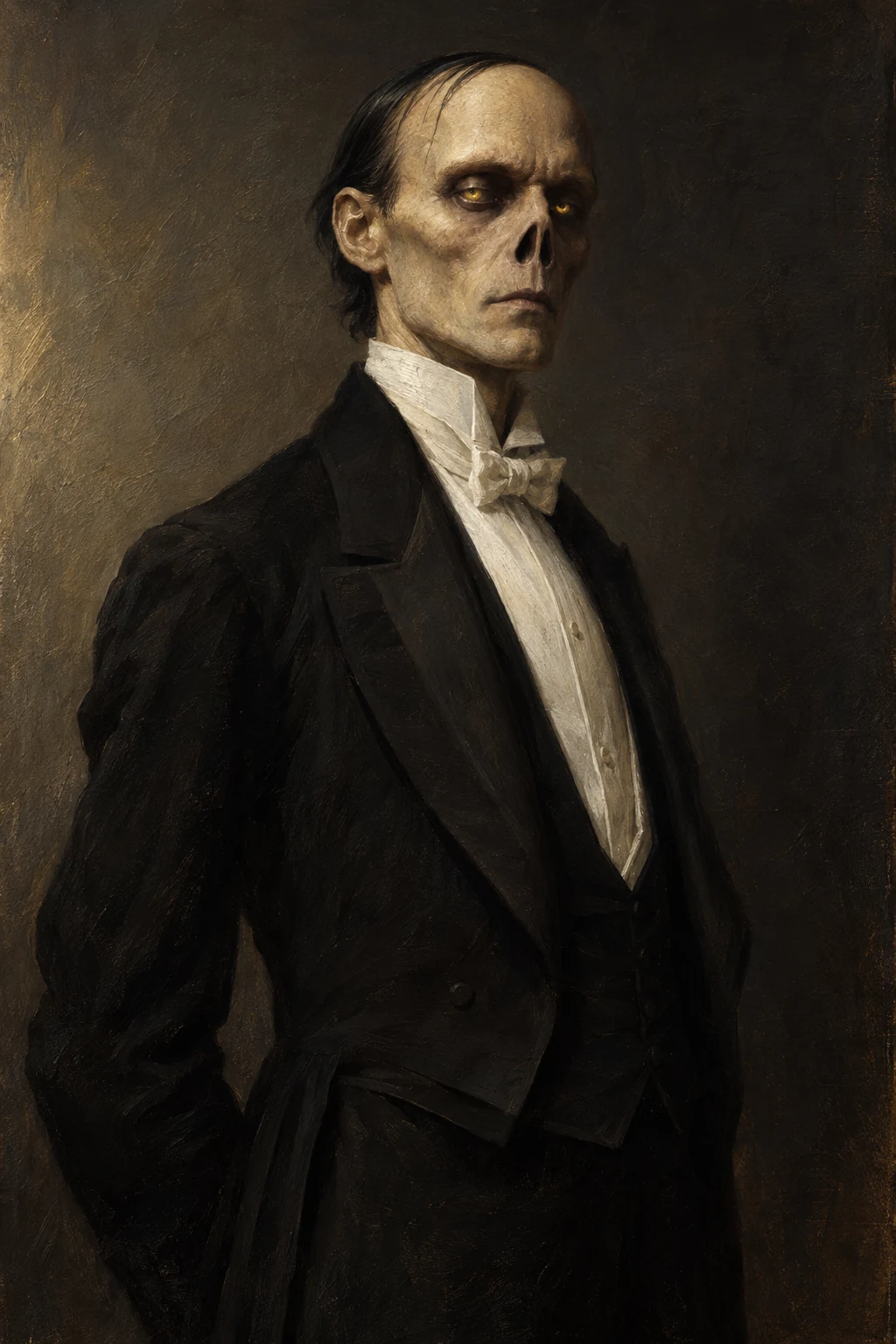
"He is extraordinarily thin and his dress-coat hangs on a skeleton frame. His eyes are so deep that you can hardly see the fixed pupils. You just see two big black holes, as in a dead man's skull. His skin, which is stretched across his bones like a drumhead, is not white, but a nasty yellow. His nose is so little worth talking about that you can't see it side-face; and the absence of that nose is a horrible thing to look at. All the hair he has is three or four long dark locks on his forehead and behind his ears."
Five distinct claims in one paragraph: skeletal build, sunken eye sockets, sallow skin, no nose, and an exact hair count. It is also, word for word, the same testimony in both languages — the French original matches this passage almost line by line, which tells us the translator didn't touch it.
There's an irony sitting right next to that vividness. Buquet, who gives the single most detailed physical description of anyone in the book, is never physically described himself. He turns up dead a few chapters later, found hanging in the third cellar, and the novel spends real pages investigating how he died. It never once says what he looked like. We checked for the same blank spot elsewhere and found it again in the book's own narrator — the unnamed journalist-investigator whose voice carries the whole story in first person, across 26 chapters and an epilogue, without ever once describing his own face, age, or build.
The one line that matters most, though, is this one — Christine's own account of the night she first sees Erik up close:
"...I saw that I was in the hands of a man wrapped in a large cloak and wearing a mask that hid his whole face."
Whole face. Both languages agree on this word for word. And late in the book, when Erik finally lifts the mask himself, by choice, to let Christine see his mouth, the wording confirms that the mouth was covered too:
"Here, I raise my mask a little... Oh, only a little!... You see my lips, such lips as I have? They're not moving!... My mouth is closed."
Search both texts for "half-mask" — English — or "demi-masque" — French — and you get zero hits in either language. The mask that recurs constantly through the book (51 mentions in English, 46 in French) is never once called a half mask. It's a full one, and Erik has to physically lift it to show anyone even a corner of what's underneath.
The book is called "Phantom." The word almost never shows up.
We searched the full body of the 1911 English translation — 85,563 words.
| Word | Occurrences |
|---|---|
phantom |
5 |
ghost (all singular forms, incl. "Opera ghost") |
217 |
Five. Out of 85,563 words, the word that gives this novel its English title appears five times. The other 217 times, the character is simply "the ghost" — almost always "the Opera ghost."
Checking the French original explains why. "Fantôme" — the word "phantom" is supposed to translate — appears 208 times in Leroux's text. The translator, Alexander Teixeira de Mattos, had well over 200 chances to write "phantom" and chose "ghost" almost every single time instead. A fan-scholarship blog that specializes in comparing Phantom translations (fdelopera) flags this exact pattern: Leroux consistently wrote "fantôme," but de Mattos rendered it as "Opera Ghost" through most of the book — landing on an inconsistency with his own title.
One counting rule, so these numbers hold up if you check them yourself: we counted singular forms only. "Ghost" counts; "ghosts" and "ghost's" don't. "Fantôme" counts; "fantômes" doesn't. Case doesn't matter. Include the plurals and possessives and "ghost" climbs to 223, "fantôme" to 216 — the ratio barely moves. We searched the body text only, with Project Gutenberg's header and footer boilerplate stripped from both files first.
And here's the detail that's easy to miss: 217 plus 5 is 222 — which means the shorter English translation actually uses some version of the ghost-word 14 more times than the French original uses "fantôme" (208). Whatever got cut from that missing 15%, it wasn't the ghost.
The name most readers associate with this story is, inside the story itself, almost never the name anyone uses.
What got lost when the book crossed the English Channel
Teixeira de Mattos had less than a year to turn Leroux's serialized French novel into a finished English book for Bobbs-Merrill and Mills & Boon, both racing to publish in 1911. Something had to give. The fdelopera blog, working from a side-by-side comparison of both editions, estimates he cut nearly 100 pages — "sentence by sentence, paragraph by paragraph" — with no note anywhere in the book warning readers it had been abridged.
Two specific losses are checkable line by line.
The first is a joke, and it's a math error that ruins the punchline. In Chapter VII, the Opera's chandelier crashes down for real, killing a woman on the spot, and the novel quotes the next morning's tabloid headline. The French original:
"Deux cent mille kilos sur la tête d'une concierge!" — "Two hundred thousand kilos on the head of a concierge!"
The English translation:
"TWO HUNDRED KILOS ON THE HEAD OF A CONCIERGE"
The word for "thousand" — mille — just isn't there. The French headline was a wildly exaggerated tabloid joke, mocking sensationalist journalism by inflating the number a thousandfold. Strip out "thousand" and the joke becomes a flat, oddly modest, non-funny number — which matters, because the very next line in both languages reads "That was her sole epitaph!" The cruelty of that line only lands if the number above it is absurd.
The second loss is a pun that didn't survive the crossing at all. When Buquet describes running into the ghost face to face, the French original adds a small aside: you couldn't really call it meeting him "nez à nez" — nose to nose — because the phantom didn't have one. That sentence, built entirely on Erik's missing nose, does not exist anywhere in the English translation. It's simply gone.
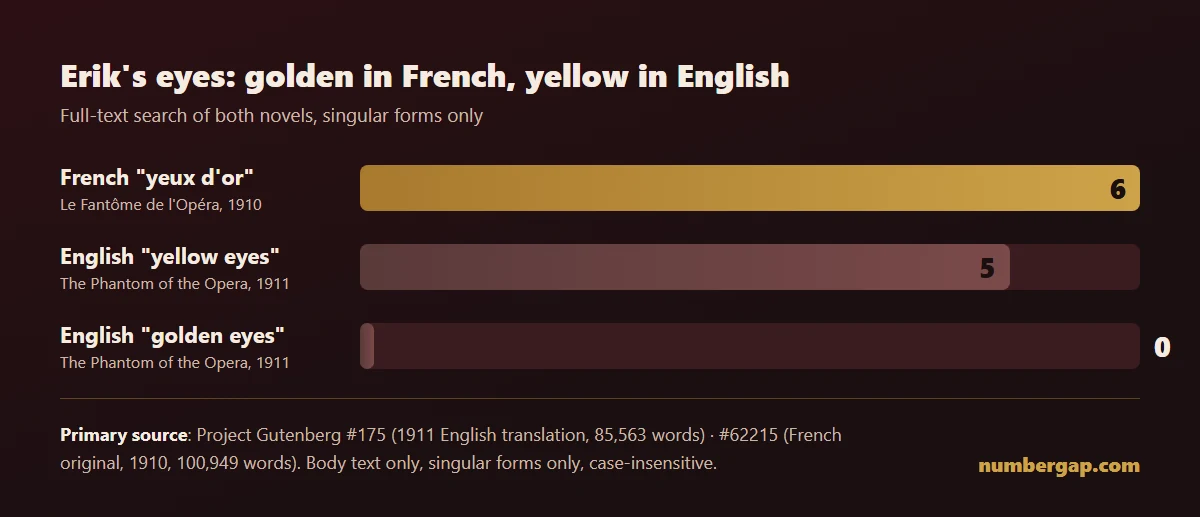
There's a third, quieter loss, and it's a color. Throughout the French text, Erik's eyes are consistently "yeux d'or" — golden eyes, glowing "like beacons" in the dark, six separate times. The English translation renders this as "yellow eyes," five times, and "golden eyes" not once. Golden and yellow aren't the same color emotionally — one gleams, precious and strange; the other reads as sickly, or animal. A translator working fast, cutting nearly 100 pages on a deadline, changed a color and nobody flagged it for over a century.
Is the underground lake under the Paris Opera real?
Yes and no, and the "no" is the more interesting half.
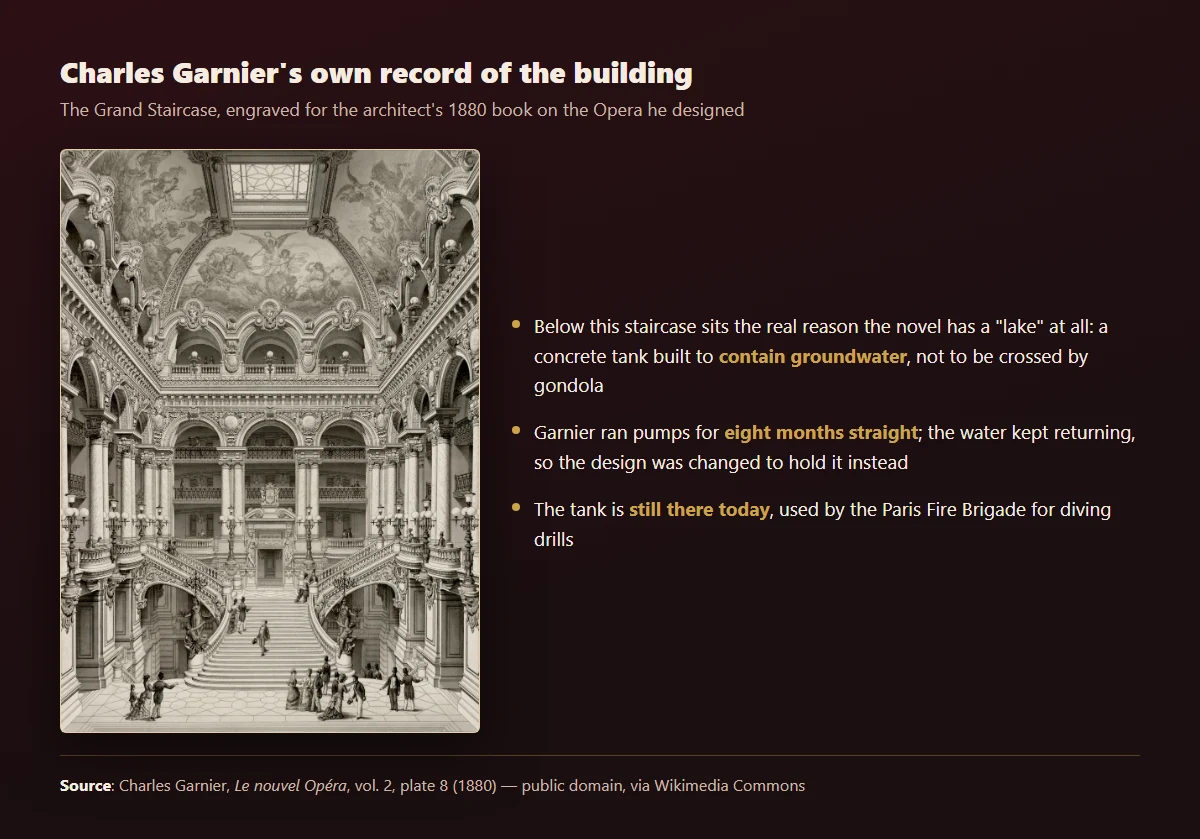
There genuinely is a body of water beneath the Palais Garnier — a purpose-built concrete tank, roughly 50 by 25 meters, built during construction in 1861–1875 to contain groundwater that architect Charles Garnier couldn't pump away. He tried running pumps continuously for eight months; the water kept coming back, so the design was changed to hold it instead. The tank is still there. The Paris Fire Brigade still uses it today for confined-water diving drills.
What isn't real is the gondola gliding through candlelit caverns. Search the novel for "gondola" and you get zero hits, in either language — the text only ever calls it "a boat." Leroux, staying in character as his own narrator, even attaches a footnote claiming he personally lobbied a real government minister to have the water drained:
"I am convinced that it would be easy to reach it by draining the lake, as I have repeatedly requested the Ministry of Fine Arts to do. I was speaking about it to M. Dujardin-Beaumetz, the under-secretary for fine arts, only forty-eight hours before the publication of this book."
That footnote is the whole book's trick in miniature: a made-up story wearing the voice of investigative journalism, right down to naming a real official.
Did they really find the Phantom's skeleton in 1907?
The novel's epilogue has its narrator claim that Erik's actual skeleton was later found beneath the Opera. We went looking for what that might be based on.
Something real did happen underground at the Palais Garnier in 1907. On Christmas Eve that year, a time capsule of phonograph records — sources differ on whether it was 24 or 25 — was genuinely sealed in the building's foundations, part of a project to preserve recorded sound for future generations. It was rediscovered in 1989 and opened in 2008.
We checked for any report of human remains turning up during that excavation.
There isn't one.
A 2014 piece specifically fact-checking this legend (messynessychic.com) found no evidence any skeleton was ever recovered with the capsule. The same article relays a separate claim from literary scholar Isabelle Casta — that Leroux, while researching at the Opera around 1908, picked up a rumor about a real Garnier architect, "named Eric," who supposedly asked to live beneath the building and was never seen again. We tried to trace that rumor to a contemporary newspaper or to Leroux's own notes. We couldn't find one. It stays a secondhand academic claim, not a documented fact — and this piece isn't going to treat it as more than that.
We went looking for a skeleton and found phonograph records instead.
Why does the Phantom's mask only cover half his face?
Now the "why." Leroux's mask covers everything. The 1986 musical's mask covers half. That gap didn't happen by accident — it happened because two people, seventy-six years apart from the book, each had a problem the novel never had to solve.
The first problem belonged to director Harold Prince. A stage actor has to sing, react, and be read from the back row, live, every single night — and a mask over the whole face kills all of that. Prince wrote about the decision himself, in his 2017 memoir Sense of Occasion:
"a mask which bisected his face from forehead to chin, because it would free half of his face to express everything he was feeling."
He layered a second idea on top of the practical one: a face split down the middle, he reasoned, could stand for the divide inside Erik himself — "the light and the dark, the good and the bad."
The second problem belonged to designer Maria Björnson: if the whole face can't be covered, what actually covers the half that is? Björnson gave two explanations for where the shape came from, and they aren't contradictory — they likely reinforced each other. First, her own memory of a costume ball. Her assistant, Jonathan Allen, reminded her of a half mask she'd once worn to a fancy-dress party hosted by Sarah Brightman and Andrew Lloyd Webber — a mask that, in her own words, "enabled the actor to have a facial contact with his audience." Second, research into a very different source: soldiers from the First World War who'd had parts of their faces rebuilt and fitted with painted glass eyes to blend back into their own features, so that half a rebuilt face could still read as a living person's face, not a monster's.
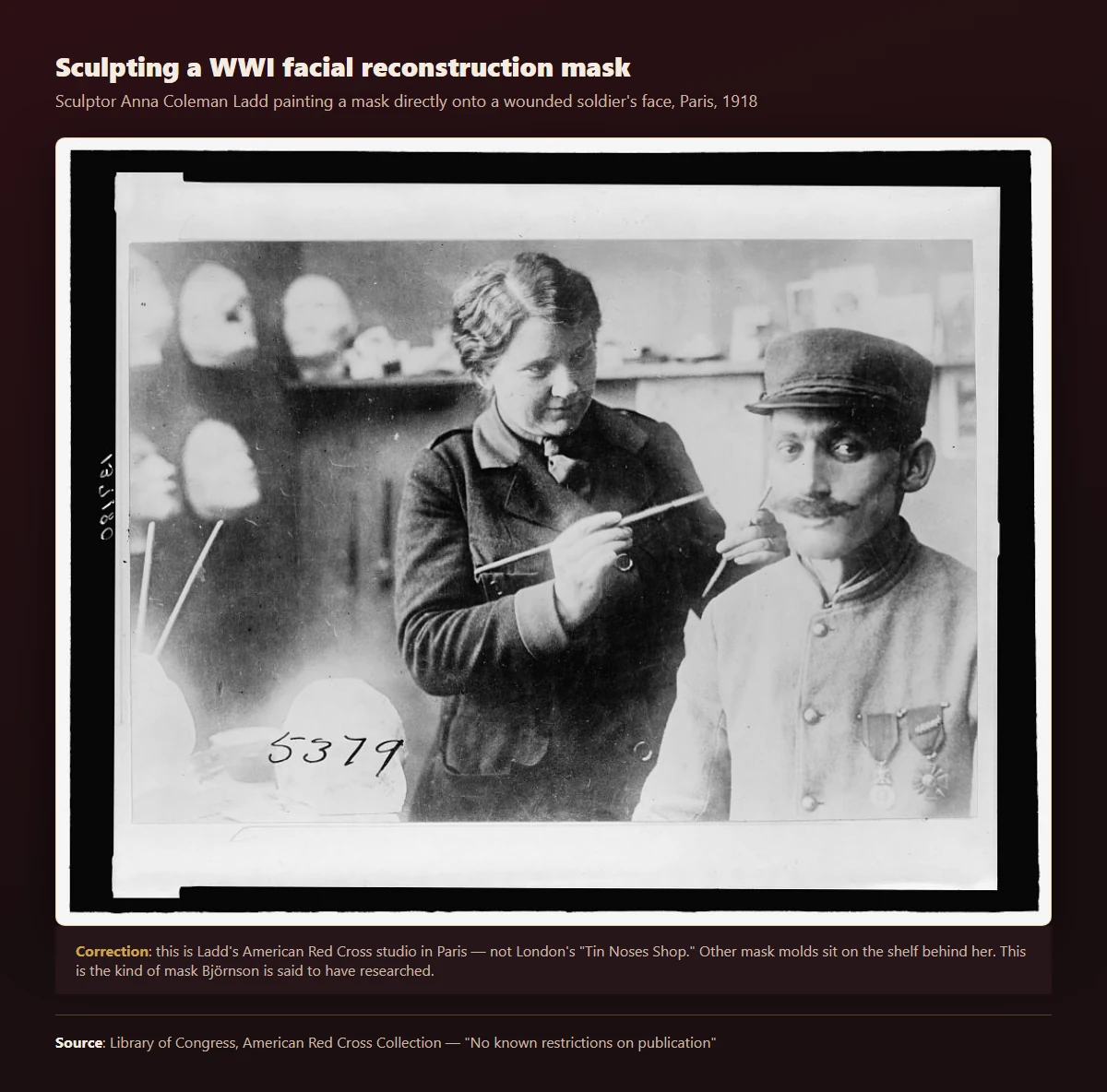
That second idea — a mask modeled, in part, on how the world tried to make wounded men look human again — is where the shape on stage came from.
That's the throughline of this piece in one costume: the novel gave Erik a fully hidden face because nobody in the story could bear to look at it. The stage gave him a half-hidden face because the actor playing him had to be seen.
The mismatch between the mask and the logo is a fossil of exactly this transition. The promotional logo — full face, both eyes visible, no eyebrows — was designed and distributed by the London ad agency Dewynters before the half-mask design was locked in for the stage. Once the production settled on the half mask, nobody went back and updated the logo. Thirty-nine years later, they still don't match.
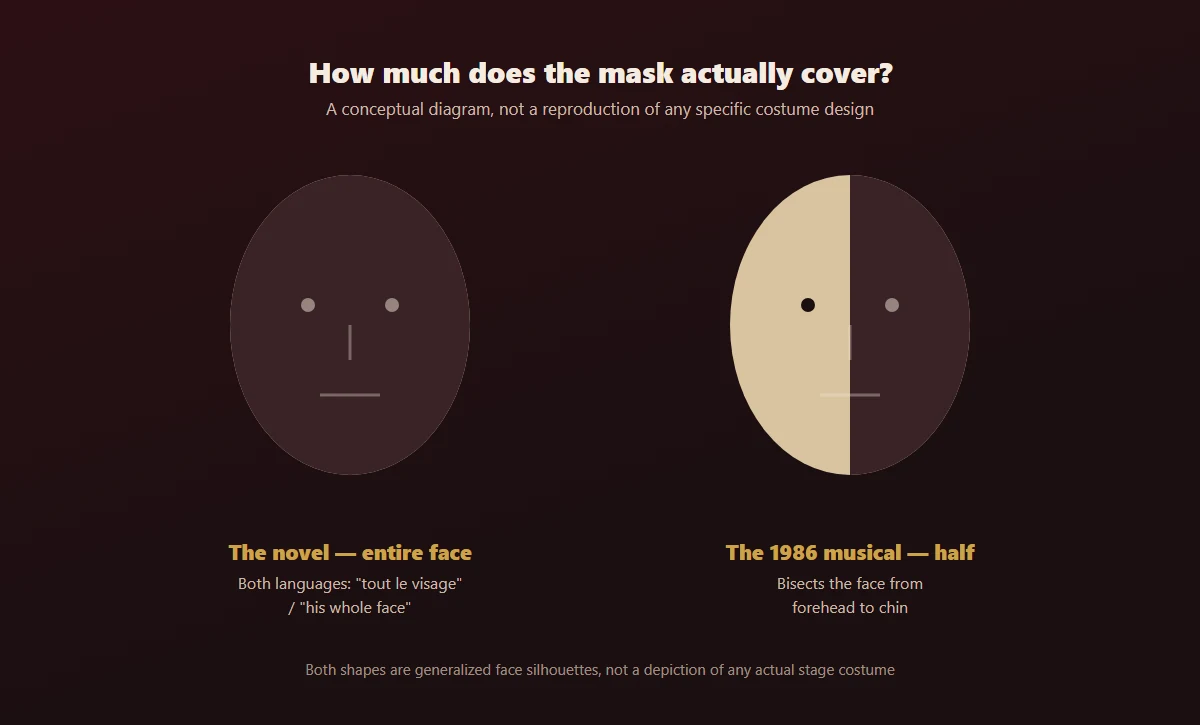
The face under the mask wasn't the novel's face either
Even what's hidden underneath the half mask isn't a straight translation of "death's head." That part of the design belongs to a different person entirely: prosthetics artist Christopher Tucker, who built the makeup Michael Crawford wore under it. Tucker explained his own starting point plainly, in an interview later quoted by Playbill:
"Yes I designed it right at the outset for Michael Crawford… Because I'd done the Elephant Man, they were thinking in terms of something fairly distorted or human, something like maybe an injury or so."
The Elephant Man, not Leroux's "dead man's skull." The face under the world's most famous Phantom mask was built by looking at a different film about a different disfigured man, not by illustrating Buquet's paragraph from Chapter I. The original 1986 makeup took up to three hours to apply; by the time Ramin Karimloo played the role for the 25th-anniversary production in 2011, that was down to a little over an hour.
Erik's face, in other words, got translated twice before it ever reached a modern audience — once by Teixeira de Mattos in 1911, and once more by a design team in 1986 who weren't working from the book at all.
Which screen Phantom actually matches the book?
Credit where it's due, because one of them really does.
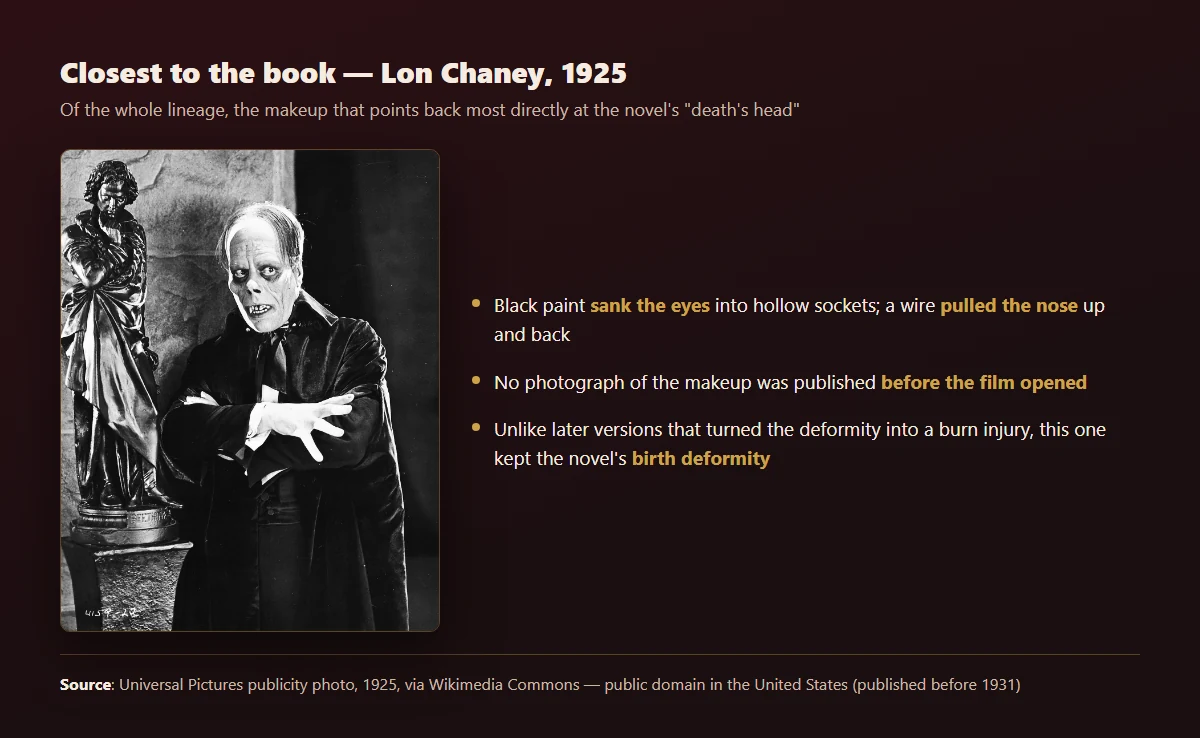
Lon Chaney's 1925 silent film is the version film historians most consistently point to as faithful to the novel's actual premise — a facial deformity Erik was born with, not something inflicted on him later. Chaney did his own makeup, alone, in secret: cotton and collodion built up raised cheekbones, a wire pulled the tip of his nose upward and back, black paint sank his eyes into hollow sockets, and a set of jagged false teeth finished it. No photograph of him in character was published before the film opened — Universal wanted the unmasking to land as a genuine surprise, and by most accounts, it did. Reports from the 1925 release describe audience members fainting at the reveal, and theaters were reportedly advised to stock smelling salts. We looked hard at that claim and couldn't fully untangle it: the same coverage recommending smelling salts reads suspiciously like opening-week studio promotion, and contemporary critics were actually cold on the film — Variety called it "a revolting sort of tale," and the New York Times called it "mechanical." Whatever the real mix of genuine shock and marketing copy was, we can't separate it with what's publicly documented.
Claude Rains's 1943 version, by contrast, moved deliberately in the opposite direction — and for two separate reasons at once. Rains himself didn't want the harsher, scarred-flesh design makeup artist Jack Pierce had originally built, and negotiated down to a simple half mask. Separately, the studio had its own reason to soften things. Lead actress Susanna Foster recalled it years later:
"We had been in the war for just over a year and they were worried about boys coming back with terrible injuries on their faces. So they decided not to make a fantastically horrible make-up."
That's worth sitting with for a second, because it's the mirror image of what Björnson did forty-three years later. In 1986, wartime facial-injury masks became a design inspiration. In 1943, the same subject — men with wartime facial injuries — was the reason a studio chose to tone a design down. Same source material, opposite instinct, four decades apart. That connection is our reading of the two facts, not something either production said outright — but the two facts themselves are both independently documented.
Joel Schumacher's 2004 film landed somewhere in between: a "birthmark"-style disfigurement covering roughly half of Gerard Butler's face, aiming — according to critics who covered the production — for something that reads as a real medical condition rather than a monster mask.
Of the whole lineage, Chaney's 1925 makeup is the one that actually points back at Buquet's paragraph. Everything after it moved further away, for a different practical reason at each step.
The mask outlived the show
Whatever else happened to Erik's face across a century of adaptations, the half mask itself became something the book's Erik never could have been: a product.
The mask Michael Crawford wore on the West End became a Broadway prop too, replicated for 35 years by milliner Rodney Gordon, who told NY1 in 2023 that the eyebrow shape alone "changed five times" under designer input, and that every actor got at least two masks — one as backup. Meanwhile "The Phantom of the Opera" and a mask design are both on record with the U.S. trademark office, filed by Cameron Mackintosh's Really Useful Group — one registration from 1998 explicitly lists mask replicas among the protected merchandise. A 1986 design decision, made to solve a stage-lighting problem, ended up defining a whole line of gift-shop products.
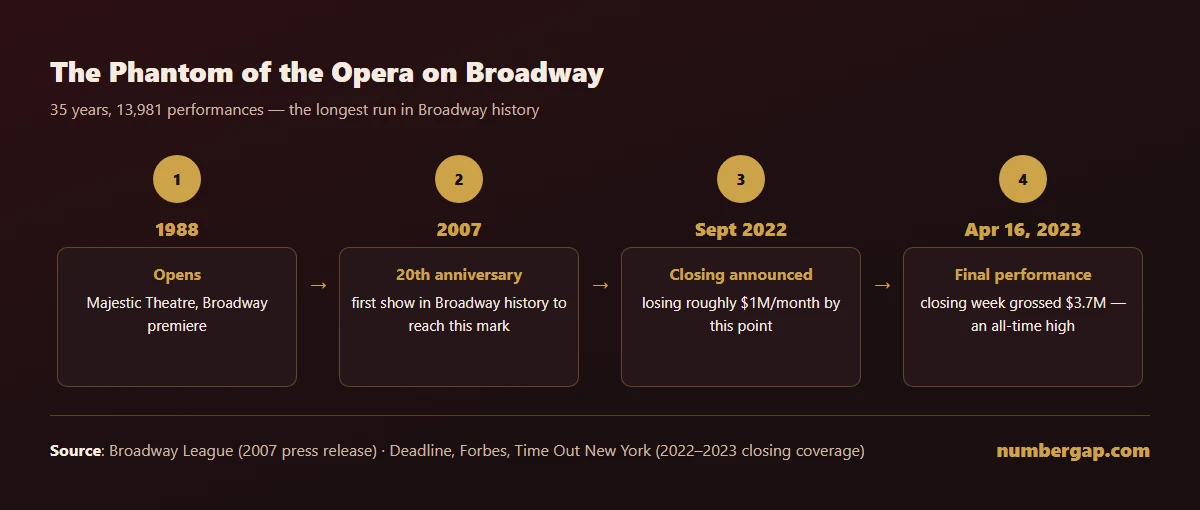
That run lasted longer than almost anything else in Broadway history: 35 years, 13,981 performances, the longest of any show the street has ever staged. It closed on April 16, 2023, at the Majestic Theatre — and the reasons given afterward split into two, not one. Publicly, producers pointed to slow post-pandemic tourist recovery. Internally, the numbers told a cost story: by the time the closing was announced in September 2022, the show was losing roughly $1 million a month, on a ticket price — around $83 average — that had stayed comparatively cheap for a large-scale production for over three decades. Economics writers reached for a term for this: Baumol's cost disease, the idea that live, labor-intensive performance can't get cheaper to produce the way manufactured goods do, while wages keep rising with the rest of the economy regardless. Both explanations — tourism and structural cost — are on the record; neither cancels the other out.
Fittingly, once the closing was announced, demand spiked. The show's Thanksgiving week gross hit an all-time high of $2.2 million, and its very last week brought in $3.7 million — the mask, it turned out, still sold tickets right up to the moment the lights came down for good.
What this piece could not verify
- Whether Leroux actually heard a real rumor about an Opera architect named "Eric" in 1908. This traces back to a single literary scholar's claim, relayed secondhand in a 2014 pop-history article. No contemporary newspaper or Leroux's own notes have surfaced to confirm it.
- Whether the reported fainting at the 1925 Chaney premiere reflects genuine audience shock or Universal's own opening-week publicity. Both threads exist in the same period coverage, and we could not separate them.
- The precise mechanical method behind Chaney's nose effect. A wire-and-tension theory, argued by biographer Michael F. Blake, is the most-cited explanation — but we could not trace it back to a primary account from the production itself.
- Whether the 1986 half mask's design came from Maria Björnson's costume-ball memory, WWI facial-reconstruction research, or Venetian carnival tradition. All three explanations circulate; they aren't mutually exclusive, and no single interview resolves which one came first.
- What the earliest versions of the half mask looked like. Accounts circulate that the 1985–86 workshop mask covered both eyes and was cut back after Michael Crawford had trouble seeing under stage lights, and that a painted glass eye was swapped for an ordinary contact lens. We could trace both only to secondhand summaries with no primary interview behind them, so we left them out of the account above.
- The exact date the original 1986 West End production recouped its investment. We found the 1988 Broadway production's $8 million capitalization, but not a confirmed recoupment date for either production.
Frequently asked questions
Q. What does the Phantom of the Opera actually look like in the original book?
A. The clearest description comes from Joseph Buquet in Chapter I: a skeletal build, sunken black eye sockets, sallow yellow skin stretched tight, no visible nose, and three or four long dark hair strands. No single passage gives a complete, head-to-toe picture — this is the fullest account any character gives.
Q. Does the book ever describe what's under Erik's mask directly?
A. Not in full. Erik lifts his own mask once, near the end, to show Christine his lips, confirming his mouth was covered too. The most detailed account of the whole face still comes from Buquet's secondhand description in Chapter I, not from a direct on-page reveal.
Q. Is "Phantom" actually the word used in the novel?
A. Almost never. The 1911 English translation uses "phantom" 5 times in 85,563 words, versus "ghost" 217 times. The French original's "fantôme" appears 208 times — the translator had hundreds of chances to write "phantom" and picked "ghost" almost every time instead.
Q. Why does the Phantom's mask in the musical only cover half his face?
A. Two practical problems, not one. Director Harold Prince needed half of the actor's face free to express emotion live, every night. Designer Maria Björnson then had to decide what covered the other half, and drew on her own half-mask costume-ball memory alongside research into WWI facial-reconstruction masks.
Q. Was the Paris Opera chandelier accident in the book based on something real?
A. Yes. On May 20, 1896, a counterweight — not the full chandelier — broke loose and killed a concierge, Madame Chomette, during a performance at the Palais Garnier. Leroux fictionalized the scene, including quoting an exaggerated tabloid headline that the English translation accidentally shrank by a factor of 1,000 in translation.
Q. Is there really a lake under the Paris Opera House?
A. There's a real underground water tank, about 50 by 25 meters, built in the 1860s–70s to manage groundwater on the site. It's still used today by the Paris Fire Brigade for diving drills. The novel's boat is real too — the word "gondola" never actually appears in the text.
Q. Did they find the Phantom's skeleton in 1907?
A. No. A real time capsule of phonograph records was sealed under the Opera on Christmas Eve 1907 and rediscovered decades later, but no evidence of human remains has ever surfaced connected to it. The "skeleton" is the novel's own fictional epilogue, not a documented historical find.
Q. Was Lon Chaney's 1925 makeup accurate to the novel's description?
A. It's the adaptation film historians point to most consistently as faithful to the book's premise — a lifelong facial deformity, not an injury. Later versions, including the 1943 and 2004 films, moved toward acid burns or birthmark-style disfigurements instead.
Q. How long did The Phantom of the Opera run on Broadway, and why did it close?
A. It ran 35 years and 13,981 performances at the Majestic Theatre, the longest run in Broadway history, closing April 16, 2023. The producers cited slow post-pandemic tourism; internal figures also show the production losing roughly $1 million a month by the time closing was announced.
Q. Is the original Phantom of the Opera novel in the public domain?
A. Yes. Gaston Leroux died in 1927, and both the 1910 French original and the 1911 English translation are in the public domain. Both are freely available through Project Gutenberg.
Read the paragraph the translator cut
The 1911 translation everyone reads is missing roughly 15% of what Leroux actually wrote — including a pun, a joke that got flattened into a wrong number, and a color that quietly changed. The full French text and the English translation are both free at Project Gutenberg. If you've only ever read the English version, the sentence about "nez à nez" is worth going and finding for yourself. It isn't there.
Sources
Primary texts
- Le Fantôme de l'Opéra (French original, 1910) — Project Gutenberg #62215
- The Phantom of the Opera (1911 English translation) — Project Gutenberg #175
Translation and text history
- It sounds like you've got the abridged 1911... — fdelopera, translation-comparison blog
The 1896 accident and the underground lake
- Guichet du Savoir — Opéra Garnier question — Lyon municipal library reference service
- The Phantom of the Opera: How much truth lies behind the famous legend — Sortiraparis
- Articles in Le Figaro about the counterweight accident — fan archive of period press coverage
The 1907 time capsule
- Unmasking the Parisian Phantom of the Opera — messynessychic.com, 2014
The half mask, the makeup, and the logo
- Behind the Mask: The Evolution of the Phantom's Makeup — Andrew Lloyd Webber Musicals official site
- The story behind the Phantom's mask — NY1, 2023
- Christopher Tucker, The Phantom of the Opera Prosthetics Designer, Passes Away at 76 — Playbill
The films
- How Lon Chaney's Makeup Transformed Hollywood Horror — HISTORY.com
- Phantom of the Opera (Universal 1943) — Classic Monsters
- The Phantom of the Opera (2004) — Box Office and Financial Information — The Numbers
Broadway run and closing
- THE PHANTOM OF THE OPERA TO BECOME THE FIRST SHOW IN BROADWAY HISTORY TO CELEBRATE 20 YEARS — Broadway League, 2007
- What Phantom of the Opera Cost — Econlife, 2023
- phantom of the opera is closing on broadway — Time Out New York, 2022
- 'The Phantom Of The Opera' Goes Out On High Note With $3.7M Weekly Gross — Deadline, 2023
- 'Phantom Of The Opera' Closed On Broadway As Longest-Running Musical — Forbes, 2023
Trademarks
- THE PHANTOM OF THE OPERA Trademark — Trademarkia
This piece covers the novel and its major stage and screen adaptations for historical and critical purposes. It is not affiliated with, and does not reproduce, any copyrighted costume, mask, or makeup design still under protection.


Comments
Post a Comment