How Much Does Unemployment Pay? Your State Decides Most of It
Losing a job is hard enough without also trying to figure out what your state actually owes you.
Last updated: 4 September 2026 · Figures and rules in this post are current as of this date.
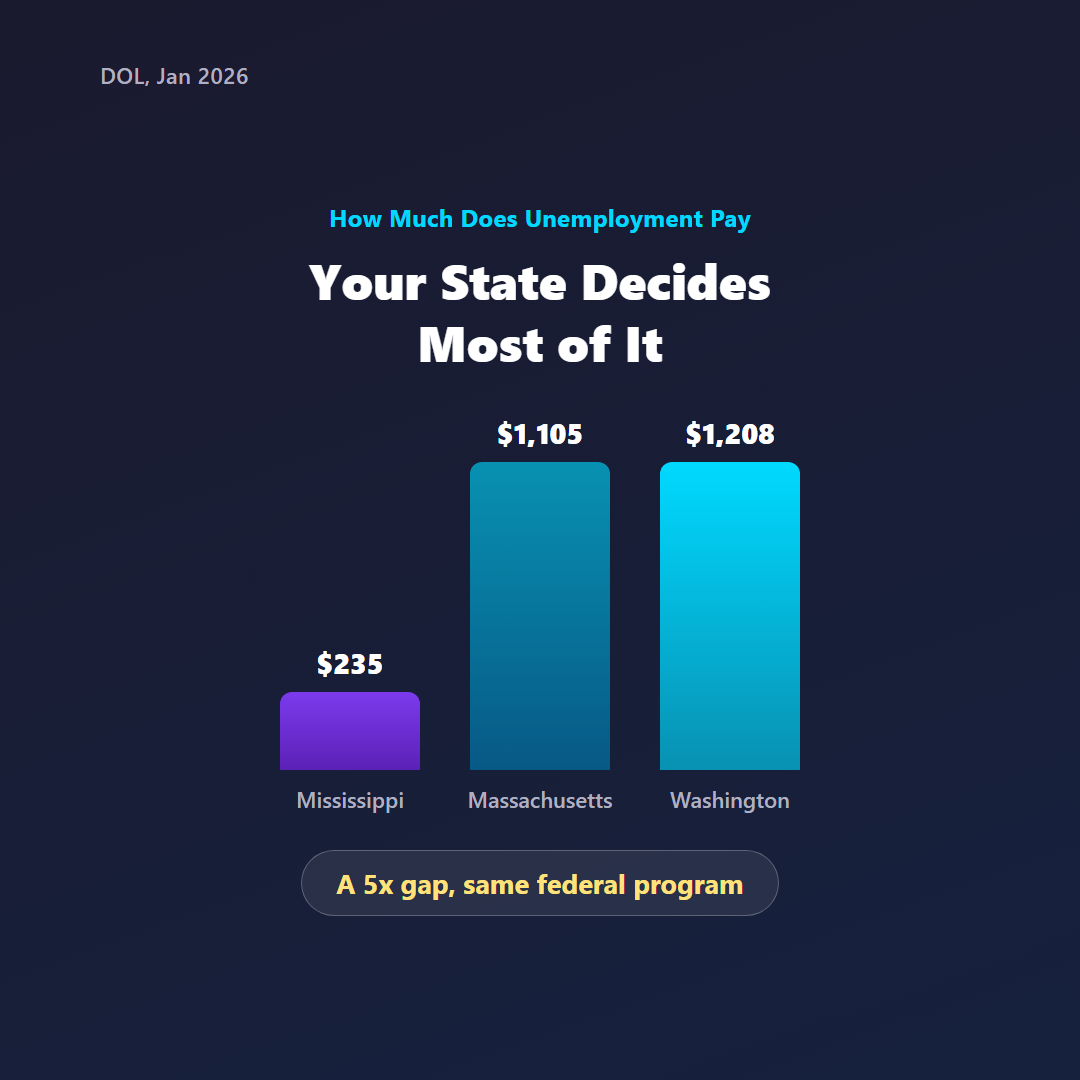
The honest answer is: it depends entirely on which state you're in. In 2026, the maximum weekly unemployment benefit ranges from $235 in Mississippi to $1,208 in Washington - more than a 5x gap, for the exact same federal program.
Last updated: September 3, 2026 · Figures in this article are current as of this date.
That gap isn't a typo or an outdated number floating around online. It's built into how the U.S. runs unemployment insurance. Here's what the U.S. Department of Labor's own comparison table says, state by state.
How Much Does Unemployment Pay in 2026?
There's no single national unemployment payment. Each state runs its own program under a shared federal framework, and each sets its own weekly maximum.
The best single source for comparing states is the U.S. Department of Labor's own publication, "Significant Provisions of State Unemployment Insurance Laws," effective January 2026.
Source: U.S. Department of Labor, Employment and Training Administration, "Significant Provisions of State UI Laws," effective January 2026
https://oui.doleta.gov/unemploy/content/sigpros/2020-2029/January2026.pdf
Reading that table directly for three states with very different formulas:
| State | Minimum weekly benefit | Maximum weekly benefit | Weeks payable |
|---|---|---|---|
| Mississippi | $30 | $235 | 8–24 |
| Massachusetts | $60 | $1,105 | 10–30 |
| Washington | $366 | $1,152 (as of Jan 2026; see below) | 12–26 |
Those numbers alone tell you two things worth remembering before you plug your own wage into a calculator: the ceiling varies enormously by state, and so does how long you can collect. We'll come back to both.
Why Is Mississippi's Unemployment Only $235 a Week?
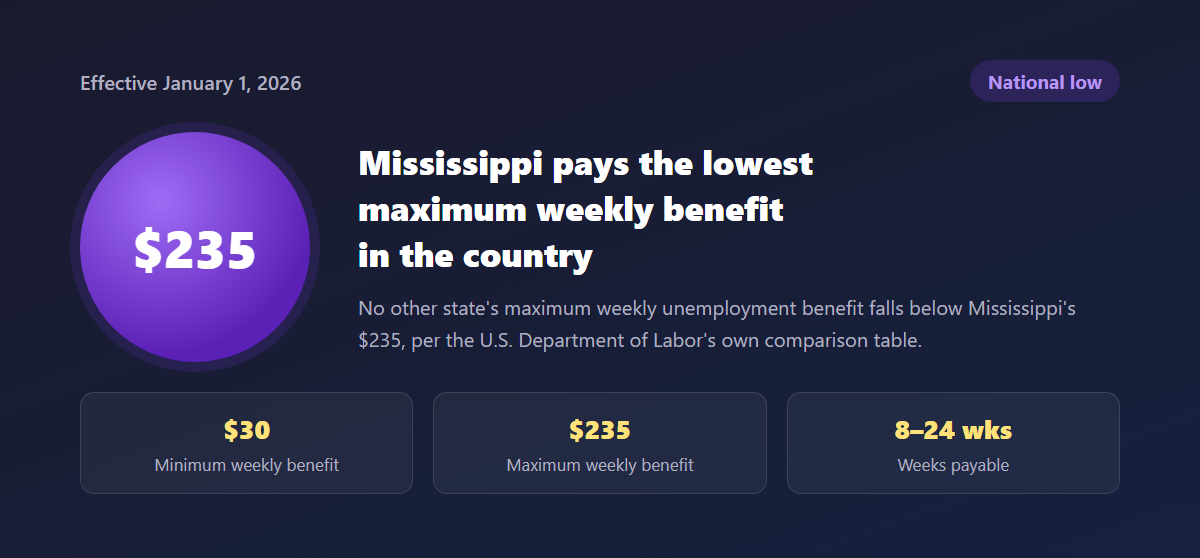
Mississippi has the lowest maximum weekly unemployment benefit in the country, at $235, effective January 1, 2026. Its minimum is $30.
Source: U.S. DOL, "Significant Provisions of State UI Laws," January 2026 edition (Mississippi row); independently confirmed by aggregator sites remotelaws.com and savingtoinvest.com, both citing the same DOL report
Mississippi's Department of Employment Security publishes its own "Weekly Benefits Chart" with the exact wage-to-benefit computation, though this research could not pull the specific dollar breakdown directly from that chart. The $235 figure is corroborated by the federal DOL table itself, so it can be treated as reliable even without that state-level breakdown.
This isn't a glitch or an outlier — it's simply where Mississippi's benefit formula lands. Since each state sets its own wage-replacement formula and its own ceiling, a state with a lower average wage base and a more conservative formula produces a lower cap, full stop.
Why Is Washington So High - and Is It $1,152 or $1,208?
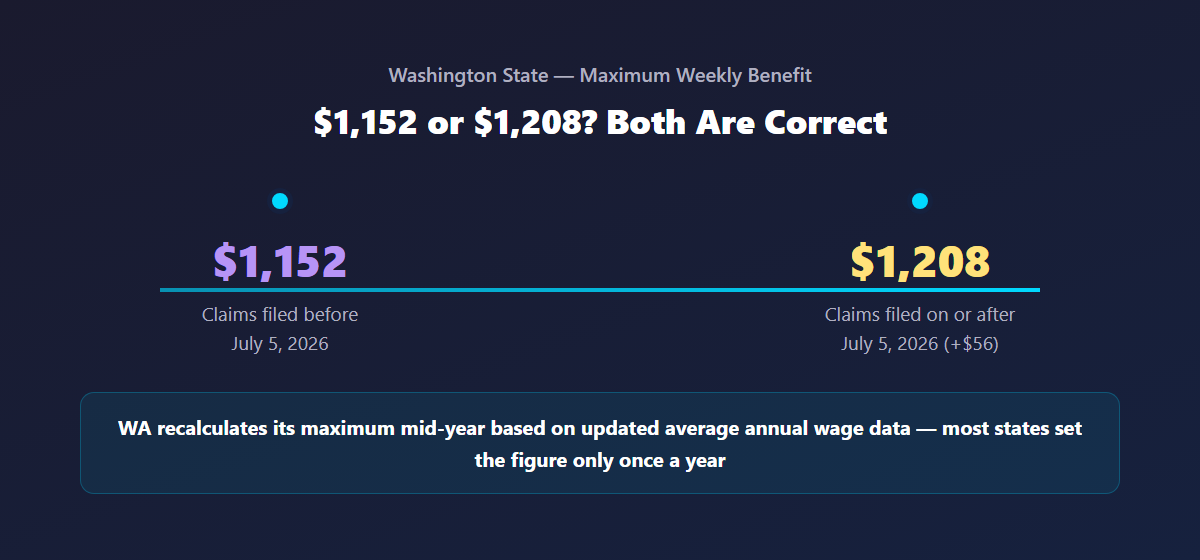
Washington has the highest maximum weekly unemployment benefit in the country. But depending on when you look it up, you'll see two different numbers — and both are correct.
For claims filed before July 5, 2026, the maximum was $1,152. That's the figure in the DOL's January 2026 table above.
For new claims filed on or after July 5, 2026, Washington's Employment Security Department (ESD) raised the maximum to $1,208 — a $56 increase tied to new average annual wage estimates ($99,810, up 4.9% year over year). The formula is the greater of $496 or 63% of the average weekly wage.
Source: Washington State Employment Security Department, official press release, "New average annual wage estimates adjust unemployment insurance and paid leave benefits," 2026
https://esd.wa.gov/about-us/news-release/2026/new-average-annual-wage-estimates-adjust-unemployment-insurance-and-paid-leave-benefits
Why do both numbers circulate at once? Washington is unusual — it recalculates its maximum mid-year based on updated wage data, instead of setting the figure once a year like most states do. The increase only applies to claims opened on or after the new effective date. Content published before July 5, 2026 correctly says $1,152; content published after correctly says $1,208.
A third number, roughly $1,015, also turns up in some secondary aggregator content. We could not trace it to either the DOL table or a WA ESD source. Treat it as unverified until a primary source confirms it.
If you're filing a claim in Washington, the number that matters is whichever one applies to your filing date — not whichever one shows up first in a search.
Massachusetts Pays More If You Have Kids - But Is There a Cap?
Massachusetts calculates weekly benefits as roughly 50% of your average weekly wage, plus a flat $25-per-week allowance for each dependent child (under 18, or older if a full-time student or disabled).
Source: Mass Legal Services, "Are Claimants Entitled to Additional Benefits for Their Children?"
https://www.masslegalservices.org/content/47-are-claimants-entitled-additional-benefits-their-children
Here's where sources genuinely disagree. The DOL's own January 2026 table explicitly says "no cap on DA" (dependency allowance) for Massachusetts. Mass Legal Services confirms this, noting that as of December 7, 2022, the cap on total dependency allowance was removed entirely. But at least one 2026 aggregator/calculator site still describes the allowance as "capped at 50% of the individual's weekly benefit amount."
Since a federal primary source and a specialized legal-aid nonprofit both independently say there's no cap — and both explain exactly when that changed — this article treats "no cap" as the current, reliable answer. The "50% cap" claim likely reflects outdated, pre-2022 information that one or more calculator sites never updated.
Massachusetts' base maximum (before any dependency allowance) is $1,105, effective October 5, 2025.
Most People Never Get the Maximum - What's the Average?
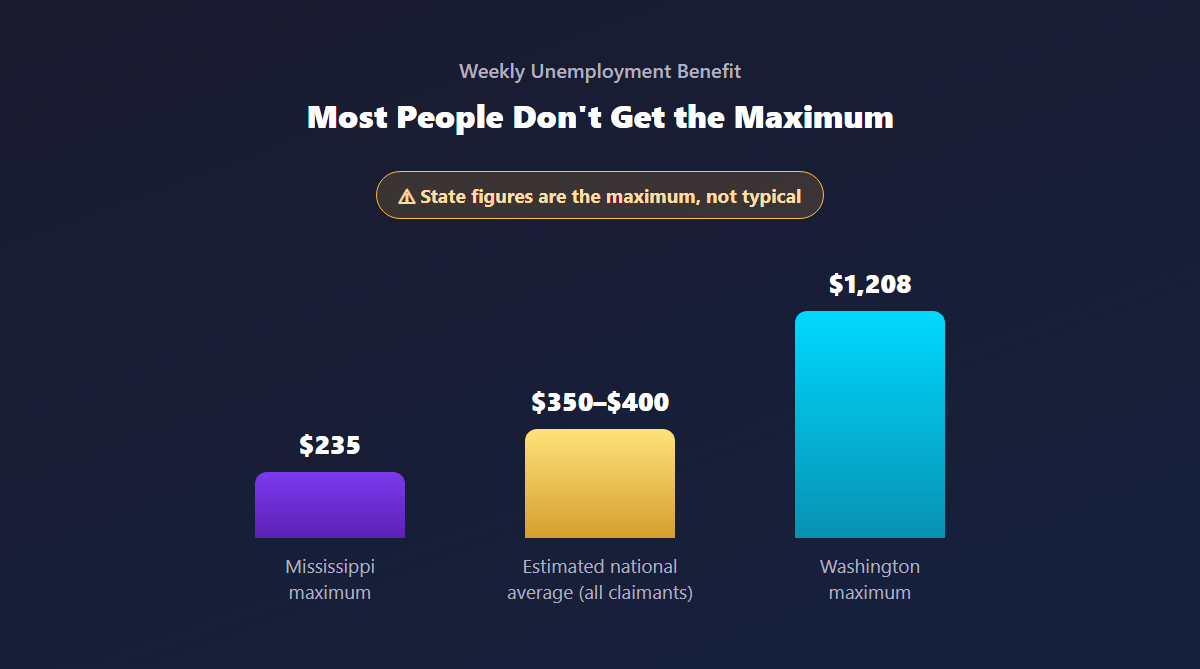
Comparing only the state maximums is misleading, because most people don't qualify for one. The maximum is reserved for claimants whose prior wages were high enough to hit the formula's ceiling.
Several 2026 aggregator sources put the national average weekly unemployment payment at roughly $350–$400 — but this should be read as an estimate compiled from secondary tracking sites, not an official DOL headline statistic with an explicit 2026 date attached to it.
To put that in context: a worker earning around $600/week in wages typically receives roughly $240–$300/week in benefits, depending on the state's formula. A worker earning around $1,000/week might receive roughly $400–$500/week — both well under the state maximums discussed above, because most people's formula percentage (usually 50–60% of wages) simply doesn't reach the ceiling unless their prior wages were unusually high.
A Federal Reserve Bank of Minneapolis analysis, published January 7, 2025, adds useful structural context here: the national average recipiency rate — the share of unemployed workers who actually receive any benefit at all — was about 29%, ranging from 55% in Minnesota down to 10% in Kentucky. The national average replacement rate (share of prior wages replaced by the weekly benefit) was about 43%.
Source: Federal Reserve Bank of Minneapolis, "How unemployment insurance access and benefits vary by state," published 2025-01-07
https://www.minneapolisfed.org/article/2025/how-unemployment-insurance-access-and-benefits-vary-by-state
That figure predates the 2026 dollar amounts above and is included only as background on how unevenly the safety net actually reaches people — not as a 2026 number itself.
How Many Weeks Can You Actually Collect Unemployment?
The weekly amount is only half the picture. How long you can collect it varies by state too — and that's the number most comparisons leave out.
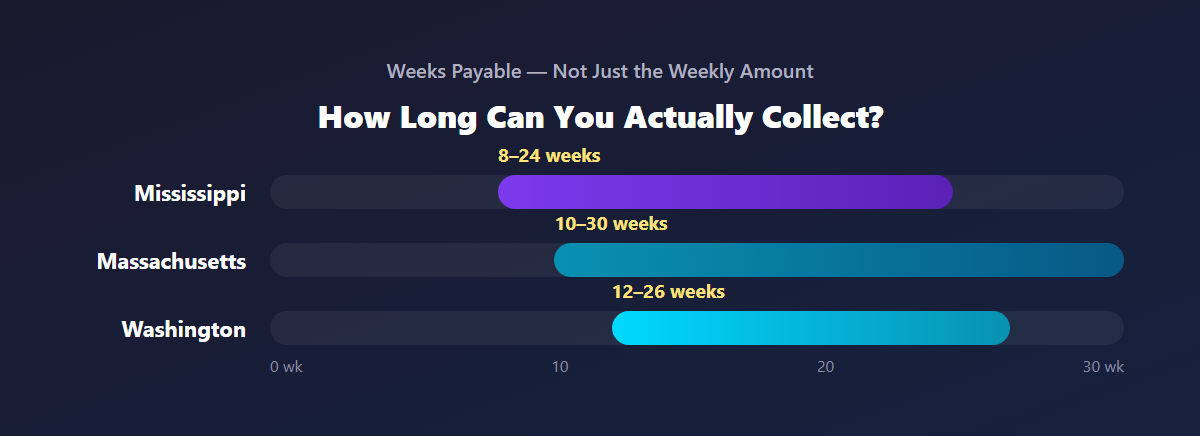
Per the DOL's January 2026 table: Mississippi pays out for 8–24 weeks, Massachusetts for 10–30 weeks, and Washington for 12–26 weeks. Most states cap regular benefits at up to 26 weeks, but that's not universal — Florida and North Carolina run among the shortest, around 12 weeks in many circumstances.
Some states (Alabama, Arizona, Florida, Georgia, North Carolina, Tennessee) tie the maximum number of weeks to the state's current unemployment rate: when the labor market weakens, claimants can draw benefits longer; when it strengthens, the maximum number of weeks shrinks.
This is why the real state-to-state comparison isn't the weekly maximum alone — it's maximum weekly benefit × number of weeks payable. A state with a lower weekly cap but a longer duration limit can, in some cases, pay out a total that isn't far behind a state with a higher weekly cap but a shorter one.
Unemployment insurance in the U.S. is a joint federal-state program: federal law sets broad guidelines and funding, but each of the 50 states (plus DC, Puerto Rico, and the Virgin Islands) independently sets its own eligibility rules, wage requirements, benefit formulas, weekly maximums, and duration limits.
Source: U.S. DOL/ETA, "State Unemployment Insurance Benefits" fact sheet
https://oui.doleta.gov/unemploy/uifactsheet.asp
That's 53 separate programs running under one federal name — which is the real reason the number you get has almost nothing to do with the number your friend in another state gets, even if you both lost similar jobs at similar pay.
How to Find Your Own State's Numbers
Every figure in this article came from the DOL's own January 2026 comparison table or from a state agency's own published numbers - not from a generic online calculator.
If you want your own state's exact minimum, maximum, and benefit-week range, the DOL's "Significant Provisions of State Unemployment Insurance Laws" table linked above covers all 50 states in one document. From there, your state's unemployment office (not a third-party estimator) has the final say on what you'll actually be approved for.
If you're reading this alongside our earlier piece on what actually gets deducted from a paycheck, this is the other half of that story: related article: How Much Does an Employee Really Cost Its Employer? — what comes out of your paycheck while you're working, and what comes back if you lose the job.
Frequently Asked Questions
Q. How much unemployment will I get?
A. It depends entirely on your state and your prior wages. In 2026, weekly maximums range from $235 (Mississippi) to $1,208 (Washington), and most claimants receive well under their state's maximum — the national average is estimated at roughly $350–$400 a week.
Q. What state pays the highest unemployment benefits?
A. Washington, with a maximum of $1,208 a week for claims filed on or after July 5, 2026 (it was $1,152 before that date, per the DOL's January 2026 table).
Q. What state pays the lowest unemployment benefits?
A. Mississippi, with a maximum of $235 a week as of January 2026, according to the U.S. Department of Labor's own comparison table.
Q. How many weeks can you collect unemployment?
A. It varies by state, typically 8 to 30 weeks. Mississippi's range is 8–24 weeks, Massachusetts's is 10–30 weeks, and Washington's is 12–26 weeks. Some states tie the maximum number of weeks to the current unemployment rate.
Q. Does unemployment pay more if you have kids?
A. In some states, yes. Massachusetts adds $25 a week per dependent child with no cap on the total, according to the DOL and Mass Legal Services. Most states don't offer a dependency allowance at all — check your own state's rules.
Q. Is unemployment based on your last paycheck or average wages?
A. Most states, including Massachusetts, calculate it from your average weekly wage over a set base period, not your final paycheck alone. The exact formula and time period used varies by state.
This article summarizes public unemployment insurance figures and program rules as published by the U.S. Department of Labor and individual state agencies. For your specific claim, confirm the exact numbers with your state's unemployment office.


Comments
Post a Comment