How Much Does an Employee Really Cost? It's Not Your Salary
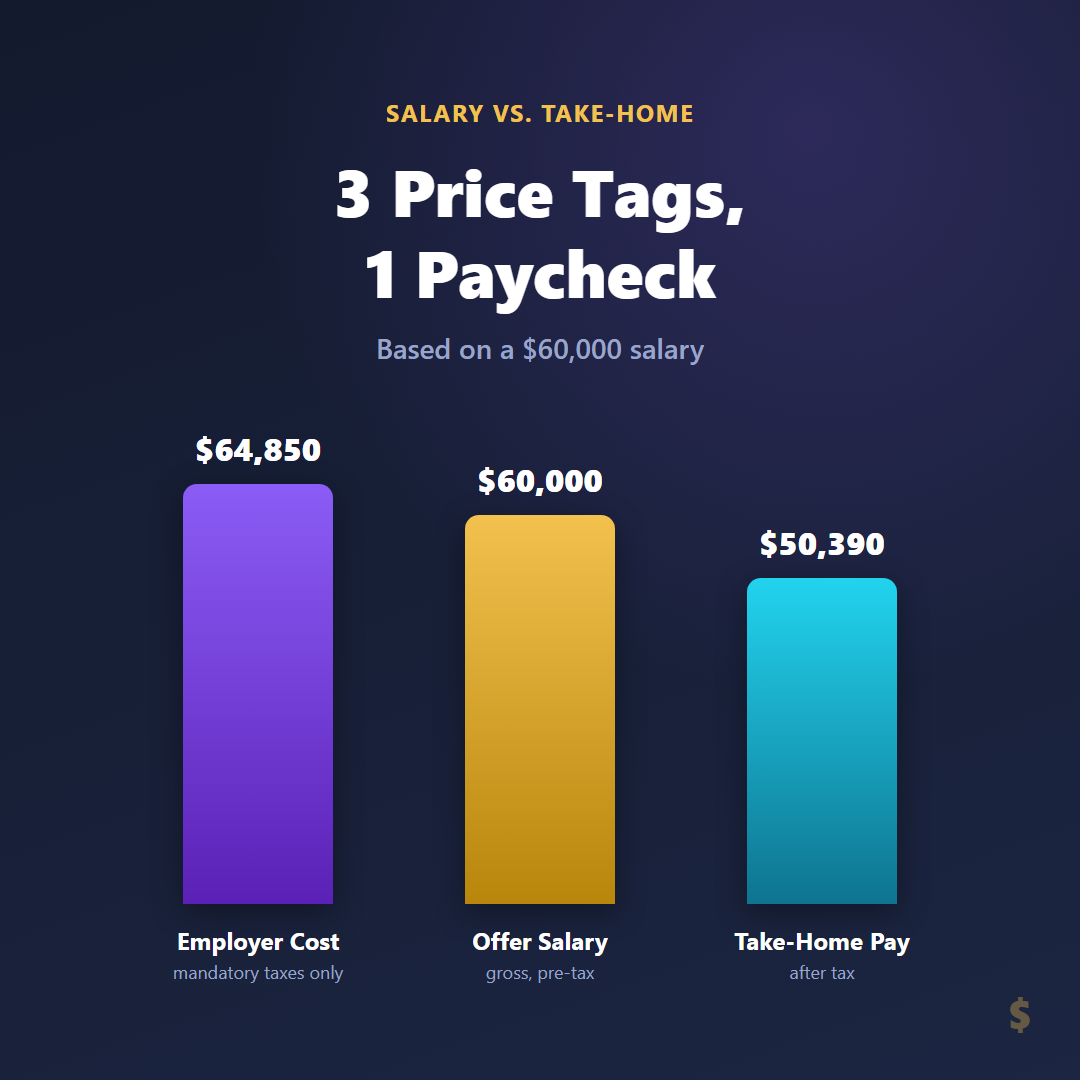
Your paycheck has
three different price tags.
What your employer spends,
what your offer letter says,
and what lands in your bank account.
Last updated: 4 September 2026 · Figures and rules in this post are current as of this date.
Search "how much does an employee really cost" and you'll get dozens of HR and payroll blog posts, all repeating the same line: an employee costs 1.25 to 1.4 times their salary. None of them tell you where that number came from. None of them show it next to what actually leaves your own paycheck.
Last updated: September 2, 2026 — figures in this article are current as of this date.
This article puts three numbers side by side for one worker: what the employer actually spends, what the offer letter says, and what hits the bank account — and traces the most-repeated cost figure back to its original source.
If you've read our earlier piece on what percentile your salary falls into, that article was built entirely on pre-tax salary numbers. This one is about everything that happens before and after that number.
Why Are There Three Different Numbers for the Same Paycheck?
The short answer: your employer, your offer letter, and your bank account are each measuring something different.
- Total cost of employment — base salary plus the employer's share of mandatory payroll taxes (Social Security, Medicare, unemployment taxes) plus any benefits the employer funds.
- Offer/contract salary — the number quoted in a job posting or offer letter, before any deductions.
- Take-home pay (net pay) — what actually lands in your bank account after income tax withholding and your share of FICA taxes.
Employee-facing tools (Indeed, ADP, Paychex, OnPay, Gusto) explain gross pay versus net pay, but stop there. Employer-facing calculators explain the "fully loaded" cost, but rarely connect it back to what a real worker sees on a pay stub. That gap is part of why nearly 4 in 10 U.S. workers say they aren't fully confident their paychecks are calculated correctly, and 42% say the taxes and deductions on it are confusing to read.
Source: SCORE, "How to Explain Paycheck Withholdings, Deductions & Contributions to Your Employees," 2026; APS Payroll, "Gross Pay vs Net Pay," 2026
Does an Employee Really Cost 1.4 Times Their Salary?
Sometimes, yes — but only if "cost" includes voluntary benefits like health insurance, not just mandatory taxes. The two get conflated constantly.
The 1.25x–1.4x figure isn't a government statistic. It traces back to a specific person: Joseph G. Hadzima Jr., a senior lecturer at the MIT Sloan School of Management, who published it as a rule-of-thumb formula for entrepreneurs estimating hiring costs, as part of MIT's "Nuts and Bolts of New Ventures" series.
Source: MIT Sloan faculty directory, Joseph G. Hadzima; cited by Connecteam, "How to Calculate the Real Cost of an Employee," 2026
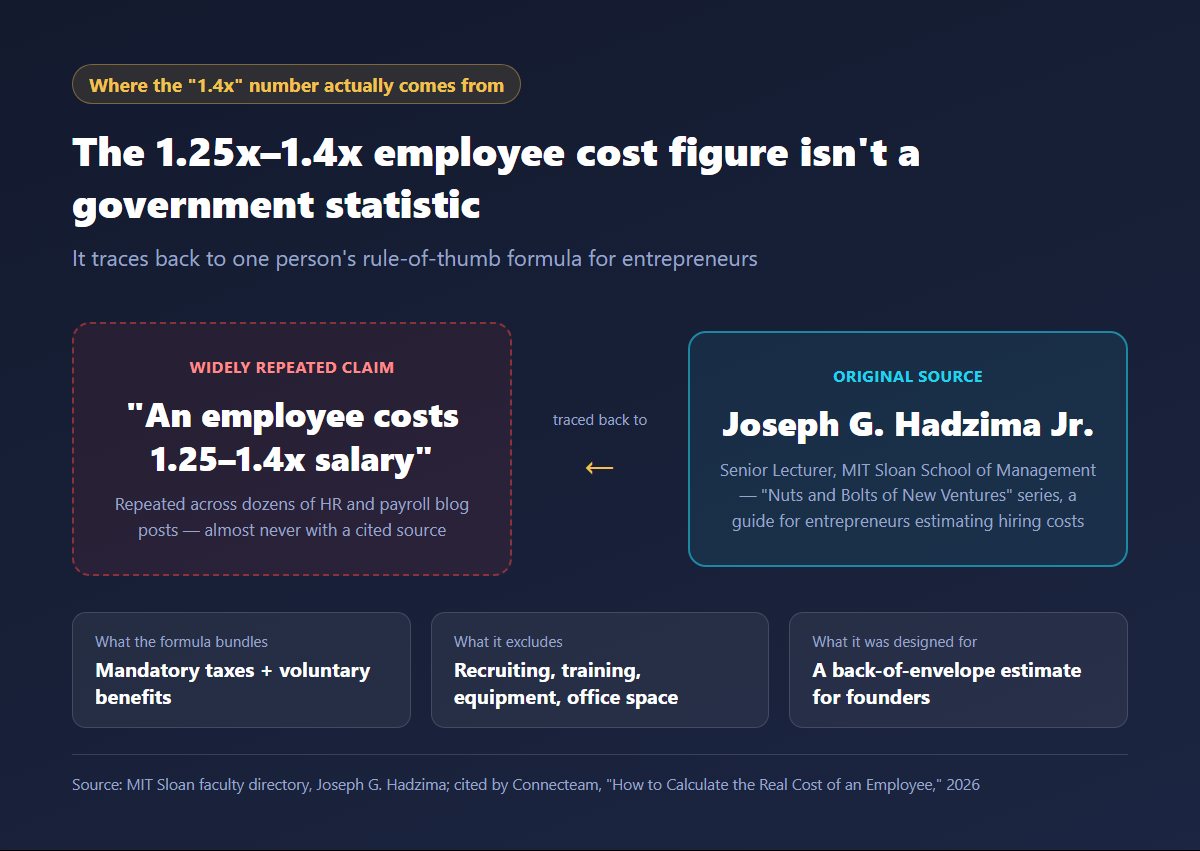
Hadzima's formula bundles mandatory payroll taxes AND discretionary benefits (health insurance, retirement contributions) into a single multiplier, and it explicitly excludes recruiting, training, equipment, and office space. It was never meant to be a measured national average — it's a back-of-envelope estimate for founders.
Cross-checked against the government's own numbers, this isn't far off. The Bureau of Labor Statistics' quarterly Employer Costs for Employee Compensation (ECEC) survey — a direct measurement, not an estimate — found that for private industry workers, total compensation cost averaged $46.60 per hour, made up of wages and salaries at $32.60 (69.9%) and benefits at $14.01 (30.1%). That works out to roughly a 1.43x total-compensation-to-wage ratio, which lines up with the upper end of Hadzima's range.
Source: U.S. Bureau of Labor Statistics, ECEC news release USDL-26-0827, released June 12, 2026, reference period March 2026
But that BLS ratio includes all benefits — health insurance, retirement, paid leave — not just mandatory taxes. So it shouldn't be called a "tax-only" number either. The two figures answer different questions, and mixing them up is the single most common error in this topic.
For context, government workers run even higher: state and local government employers spent $66.41 per hour in total compensation, with benefits making up 38.5% of that — a notably higher share than private employers.
Source: BLS ECEC, March 2026 reference period
How Much Do Mandatory Payroll Taxes Really Add on Top of Salary?
If you strip out voluntary benefits and look only at taxes an employer is legally required to pay, the added cost is roughly 7% to 10% of salary — not 25% to 40%.
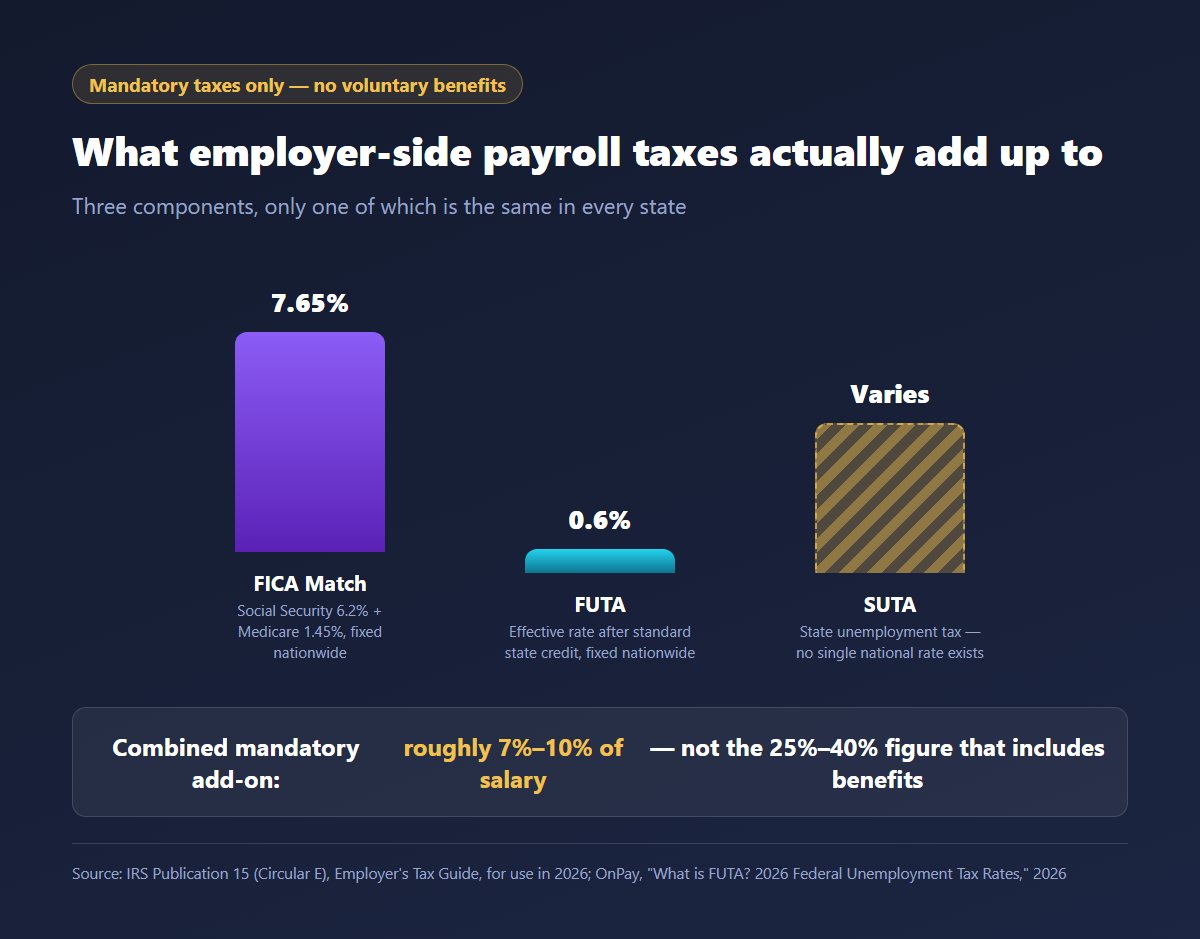
FICA (Social Security + Medicare), employer's matching share:
- Social Security: 6.2%, up to the annual wage base
- Medicare: 1.45%, with no wage cap
- Combined employer match: 7.65% of wages up to the Social Security cap (1.45% continues uncapped above it)
Source: IRS Publication 15 (Circular E), Employer's Tax Guide, for use in 2026
FUTA (Federal Unemployment Tax), employer-only:
- Statutory rate: 6.0% on the first $7,000 of each employee's annual wages
- Most employers get a credit of up to 5.4% for paying state unemployment tax on time, bringing the effective net rate to 0.6% — about $42 per employee per year
- Employers in states with unpaid federal unemployment loan balances lose part of that credit (California and the U.S. Virgin Islands both faced reductions for 2025)
Source: OnPay, "What is FUTA? 2026 Federal Unemployment Tax Rates," 2026
SUTA (State Unemployment Tax), employer-only, and this is where it gets messy — covered in its own section below, because no single number can represent it.
Why Doesn't a Single "Average Employer Tax Rate" Exist?
Because state unemployment tax (SUTA) varies more than any other payroll cost, and no government agency publishes one blended national rate.
New-employer SUTA rates range from 0.35% in South Carolina to 6.09% in North Dakota in some classifications. Rates for employers with a claims history swing even wider — from 0% in ten states (including Iowa, Missouri, New York, and Wisconsin, for employers with the best claims record) up to 12.65% in Massachusetts for employers with the worst record.
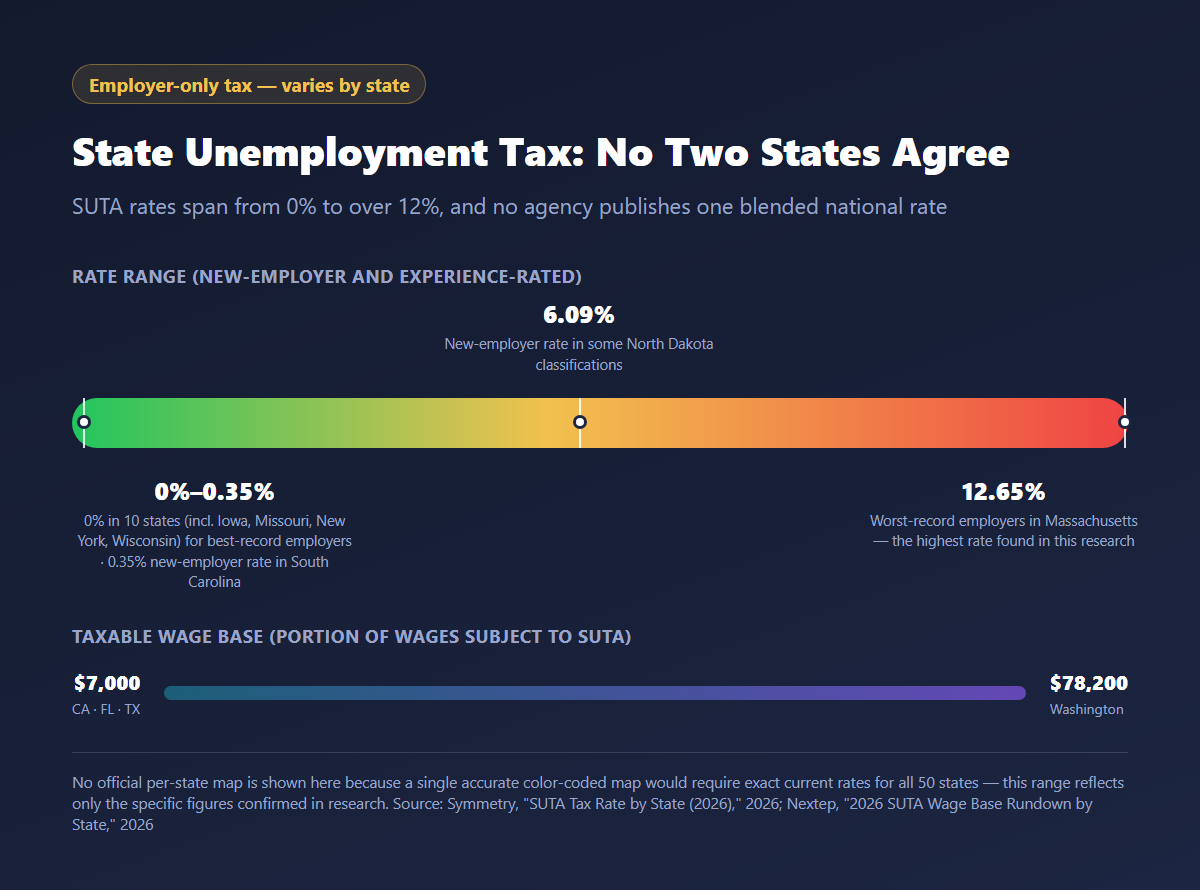
The taxable wage base — the portion of each employee's wages actually subject to SUTA — ranges from $7,000 (California, Florida, Texas) to $78,200 (Washington). That's an 11x spread on its own, before the rate itself is even applied.
Source: Symmetry, "SUTA Tax Rate by State (2026)," 2026; Nextep, "2026 SUTA Wage Base Rundown by State," 2026
Any single percentage used to describe "the employer payroll tax rate" — including the 7%–10% range in this article — is an illustrative estimate built from FICA and FUTA math plus a mid-range SUTA assumption. It is not an official published average, because one doesn't exist.
Is There a Cap on Social Security Tax?
Yes. For 2026, Social Security tax applies only to the first $184,500 of a worker's wages — up from $176,100 in 2025. Above that, the 6.2% Social Security tax stops; only the uncapped 1.45% Medicare tax continues to apply.
Source: Thomson Reuters Tax, "SSA Announces Social Security Taxable Wage Base for 2026," 2026; Paycor, "Social Security Taxable Wage Base & Limits [2026]," 2026
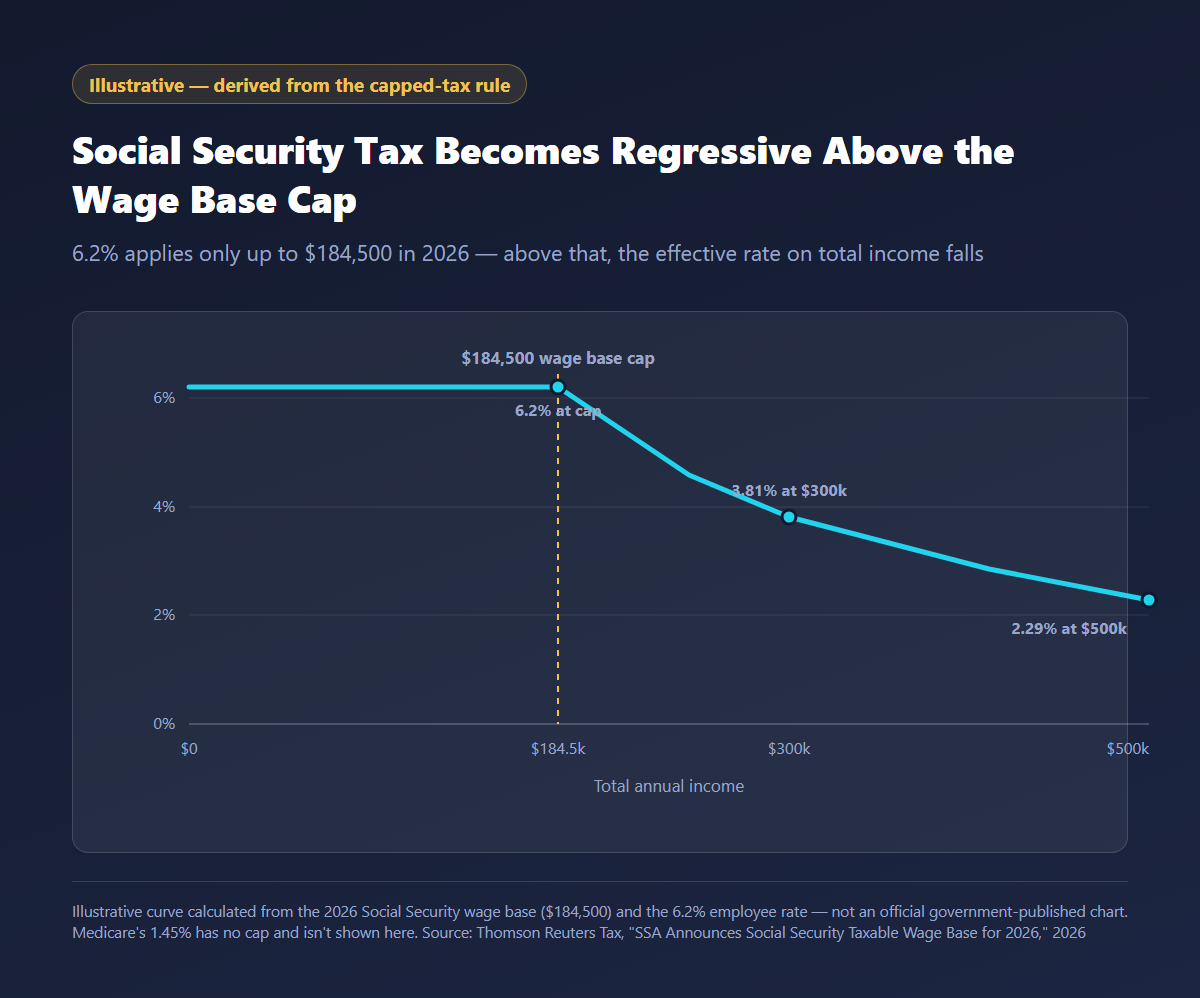
That cap creates the same pattern researchers found on the Korean side of this comparison for the National Pension System: a worker earning well above $184,500 pays 6.2% only on the first $184,500 of income, so their Social Security tax as a share of total income actually falls as income climbs past the cap. Both the employee and employer max out at $11,439 in Social Security tax at this cap. Medicare has no cap, so it doesn't share this effect.
Worked Example: What Does a $60,000 Salary Really Cost?
Here's one worker, followed through all three numbers — with every assumption stated up front: single filer, no dependents, standard deduction, and a state with no income tax (like Texas or Florida), so the numbers isolate the federal-only effect. Actual take-home pay will be lower in most other states.
① Offer/contract salary: $60,000
③ Take-home pay:
- Taxable income after the 2026 standard deduction ($16,100): $60,000 − $16,100 = $43,900
- Federal income tax: 10% on the first $12,400, 12% on the rest up to $43,900 → ≈ $5,020
- Employee FICA (6.2% + 1.45%): $4,590
- Take-home pay: $60,000 − $9,610 ≈ $50,390 (about 84% of salary)
This excludes state/local income tax (which doesn't exist in Texas or Florida but would reduce this further almost everywhere else) and excludes pre-tax deductions like 401(k) or health premiums that most real paychecks also include.
Source: Tax Foundation, "2026 Tax Brackets and Federal Income Tax Rates," 2026
① Employer's cost — mandatory taxes only, no voluntary benefits:
- Employer FICA match: $4,590
- FUTA (effective): $42
- SUTA (illustrative mid-range estimate): roughly $200–$300
- Mandatory-tax-only cost: about $64,850 — roughly 8% above the $60,000 salary
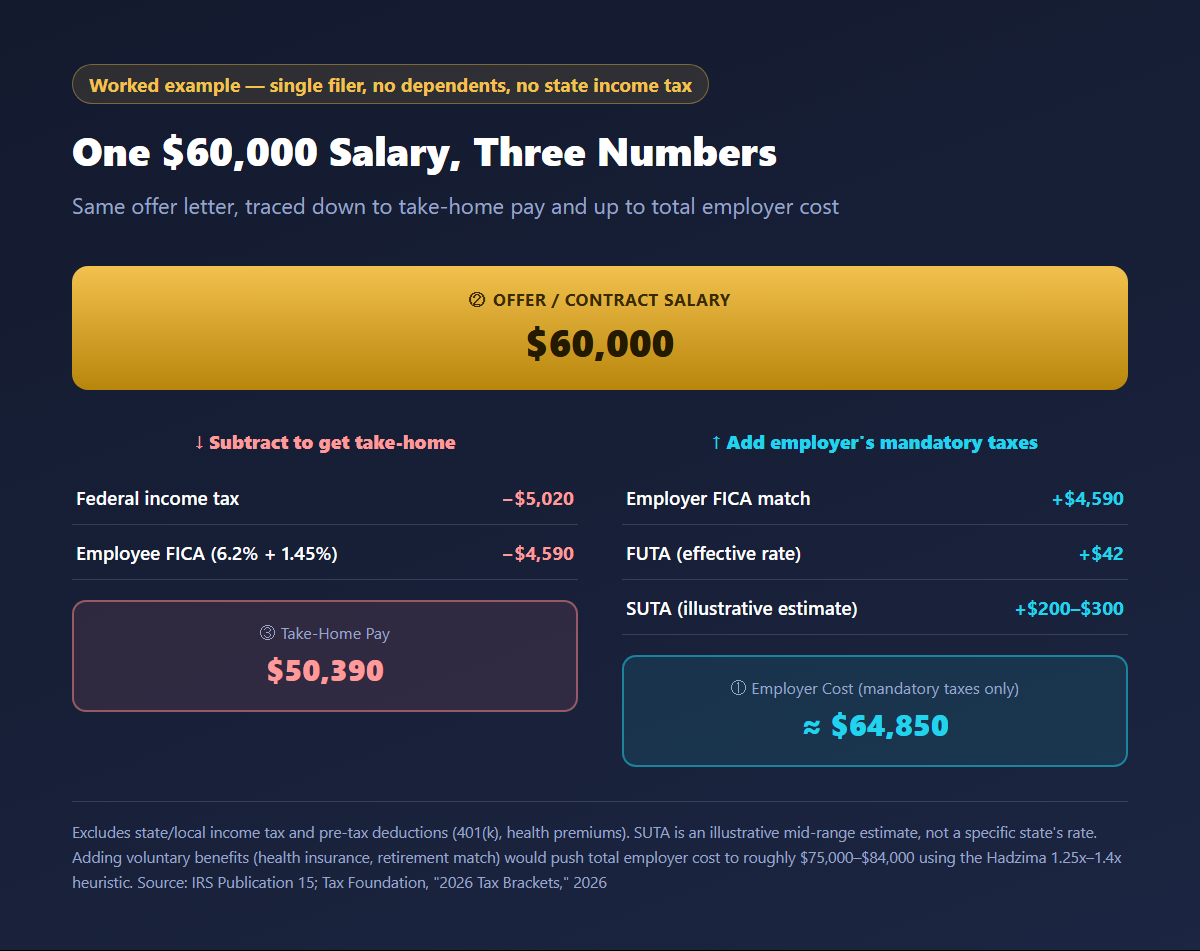
If voluntary benefits are added — health insurance, retirement match, paid leave — using the Hadzima 1.25x–1.4x heuristic, total employer cost for the same $60,000 salary jumps to roughly $75,000 to $84,000. That's a very different number from the $64,850 tax-only figure above, and the two should never be quoted interchangeably.
Frequently Asked Questions
Q. How much does an employee really cost a company beyond their salary?
A. It depends entirely on what you're counting. Mandatory payroll taxes alone add roughly 7%–10% on top of salary. Add employer-funded benefits like health insurance and retirement contributions, and the widely cited range becomes 1.25x to 1.4x total salary — a formula that originated with MIT Sloan lecturer Joseph Hadzima, not a government agency.
Q. What is the difference between gross pay and net pay?
A. Gross pay is the salary before any deductions — the number in your offer letter. Net pay (take-home pay) is what's left after federal and state income tax withholding and your share of FICA taxes are subtracted.
Q. Does my employer pay taxes on my salary too?
A. Yes. Your employer matches your FICA contribution (6.2% Social Security + 1.45% Medicare) and separately pays federal and state unemployment taxes (FUTA and SUTA) — none of which come out of your paycheck.
Q. Is there a cap on Social Security tax?
A. Yes. In 2026, Social Security tax applies only to the first $184,500 of wages. Earnings above that aren't taxed for Social Security, though the 1.45% Medicare tax continues with no cap.
Q. Why do larger companies quote salary differently than small businesses?
A. This research didn't find a documented reason tied to company size specifically. What's well documented is that "cost to company" (the employer's total spend) and take-home pay are frequently confused in salary negotiations, especially when a worker is used to seeing one figure and moves to a role that quotes the other.
Three Things to Check on Your Own Pay Stub
Two things from this article are worth checking directly on your own paycheck.
First, if you're near or above the $184,500 Social Security wage base, check whether your Social Security withholding actually stops once you cross it — it should. Second, if a recruiter or offer letter cites a "1.4x cost" figure to justify a lower salary offer, ask whether that number includes benefits or is tax-only. Those are two different conversations.
This article summarizes public data and program rules current as of the date above. For decisions about your own paycheck or hiring costs, consult a licensed accountant, tax professional, or your HR department.
If this was useful, we'll see you in the next one.
Sources
- U.S. Bureau of Labor Statistics, "Employer Costs for Employee Compensation Summary," news release USDL-26-0827, reference period March 2026
- IRS, Publication 15 (Circular E), Employer's Tax Guide, for use in 2026
- Thomson Reuters Tax, "SSA Announces Social Security Taxable Wage Base for 2026," 2026
- Tax Foundation, "2026 Tax Brackets and Federal Income Tax Rates," 2026
- OnPay, "What is FUTA? 2026 Federal Unemployment Tax Rates," 2026
- Symmetry, "SUTA Tax Rate by State (2026): Wage Bases, Employer Rates & Compliance Guide," 2026
- Nextep, "2026 SUTA Wage Base Rundown by State," 2026
- MIT Sloan School of Management, faculty directory — Joseph G. Hadzima Jr., original source of the 1.25x–1.4x employee cost framework
- Connecteam, "How to Calculate the Real Cost of an Employee," 2026


Comments
Post a Comment