What Does Frankenstein's Monster Look Like in the Book?
Frankenstein is not the monster's name.
It's the last name of the man who built him.
Last updated: 1 September 2026 · Quotations and occurrence counts were checked against the source text on this date.
And when you search Mary Shelley's novel from the first word to the last, almost nothing you picture is in there. No green skin. No neck bolts. No stitches. No flat head.
This piece is a count, not an opinion. I ran a full-text search of the public-domain novel and checked every hit by hand, then built one portrait per character — drawing exactly what the text describes, and leaving blank whatever the text never says.
Counts here were verified on August 31, 2026, against Project Gutenberg's 1831 edition (#42324) and 1818 edition (#41445), counted separately. I say which edition every number comes from.
⚠️ The plot section below spoils the ending. Skip to the next heading if you plan to read the novel first.
First, who's who — the cast in one table
Six names will carry you through the rest of this piece. That's all you need.
| Name | Who they are | Why they matter here |
|---|---|---|
| Victor Frankenstein | Eldest son of a Geneva family; a student at Ingolstadt | The man who builds the creature. "Frankenstein" is his name |
| The creature (unnamed) | What Victor builds. About eight feet tall | The character the text describes most — and never names |
| Elizabeth Lavenza | Victor's fiancée | Shelley changed her hair and eye color between editions |
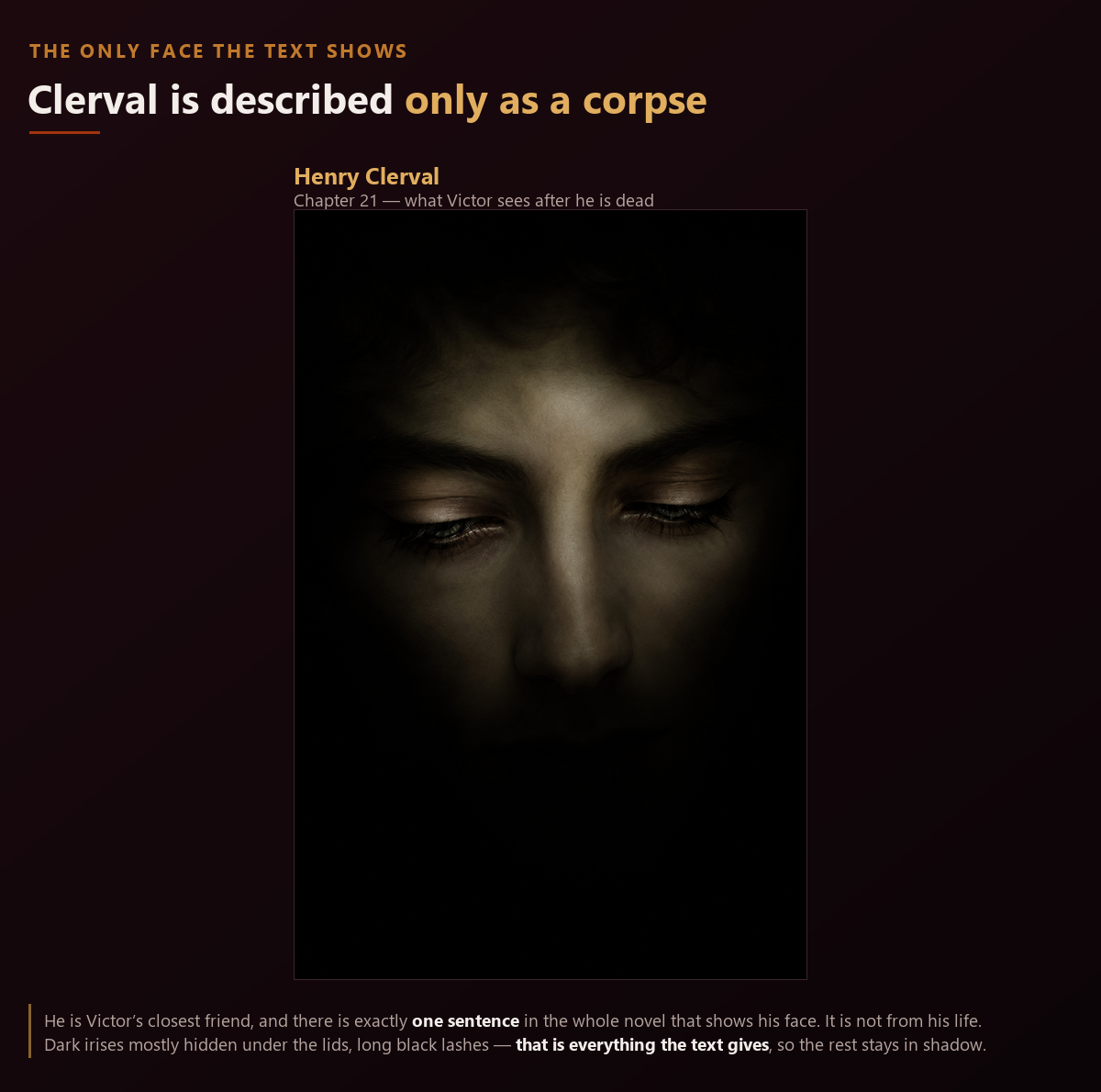
| Henry Clerval | Victor's boyhood friend | The text shows his face exactly once, and he's dead in it |
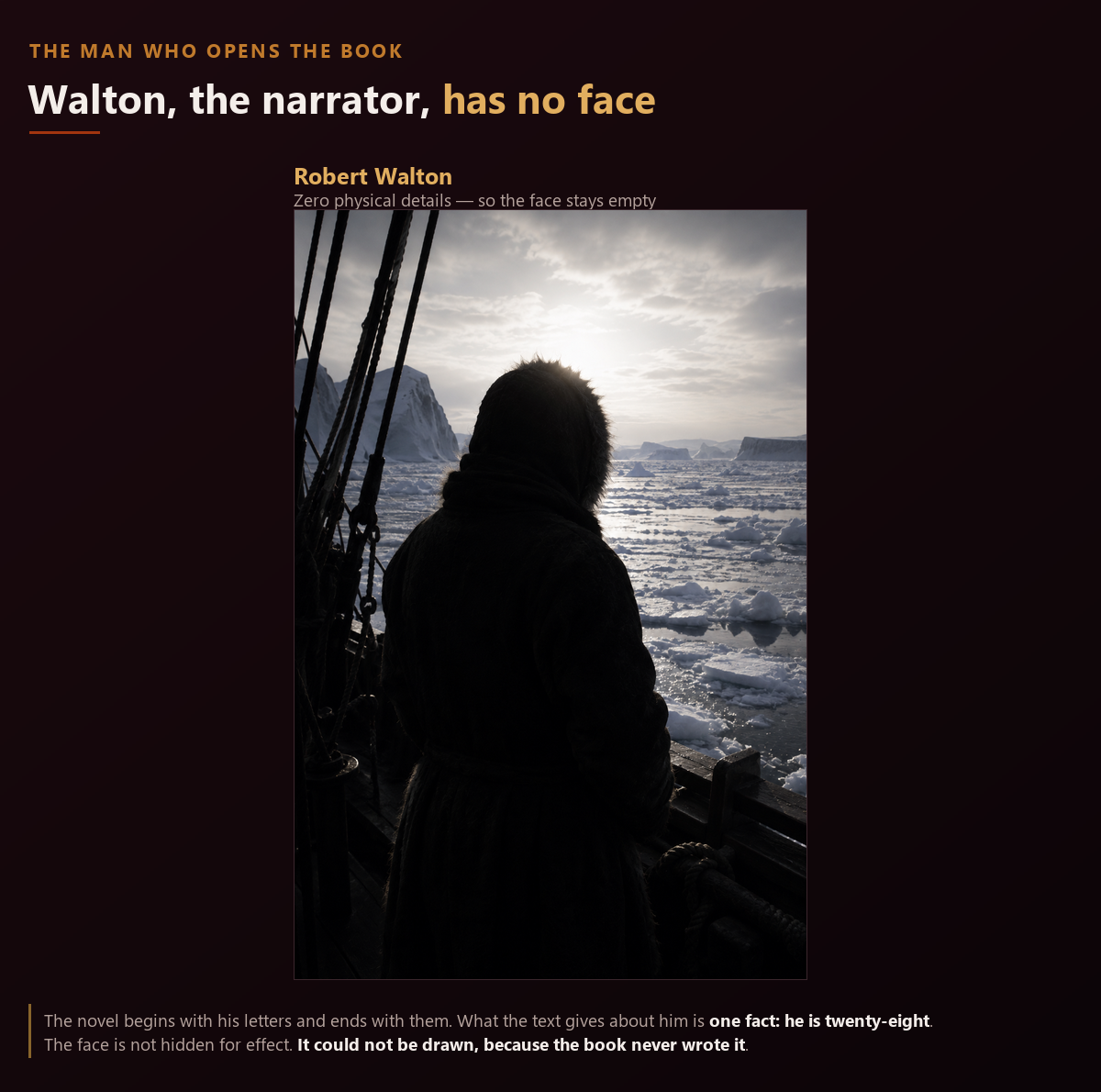
| Robert Walton | 28-year-old English Arctic captain | He narrates the novel and has zero physical description |
| Justine Moritz | The Frankensteins' servant | Executed for a murder she didn't commit. No color words at all |
The plot in six lines (ending included)
Robert Walton, an English captain hunting a northern passage, pulls a dying man off the Arctic ice. The man is Victor Frankenstein, and the whole novel is the story he tells Walton.
Victor goes to the university of Ingolstadt at seventeen, becomes obsessed with the principle of life, and spends roughly two years assembling a being about eight feet tall from charnel-houses, the dissecting room, and the slaughterhouse.
On a rainy November night at one in the morning, it opens its eyes — and Victor runs. The abandoned creature teaches himself language by watching a family through a gap in a wall, and is driven off by every human who sees him.
He starts taking revenge. He strangles Victor's youngest brother William and plants the evidence on the servant Justine Moritz, who is convicted and executed while innocent.
On a glacier, the creature demands a female companion. Victor agrees, then destroys the half-finished body. The creature promises, "I will be with you on your wedding-night," and kills Henry Clerval, then Victor's bride Elizabeth.
Victor's father dies of grief. Victor chases the creature to the Arctic and dies aboard Walton's ship. The creature is found weeping over the coffin and leaps onto an ice raft.
One thing worth getting right, because adaptations almost always change it. The creature does not die on the page. He says he'll burn himself on a funeral pyre. We never see it. The novel's final sentence is:
"He sprang from the cabin-window as he said this, upon the ice raft which lay close to the vessel. He was soon borne away by the waves, and lost in darkness and distance."
— 1831 edition, ch. 24, the last line of the book
Seven portraits: what the text gave, and where it left the page blank
I made one portrait per character under a single rule. Draw only what Shelley wrote. Where she wrote nothing, leave it empty.
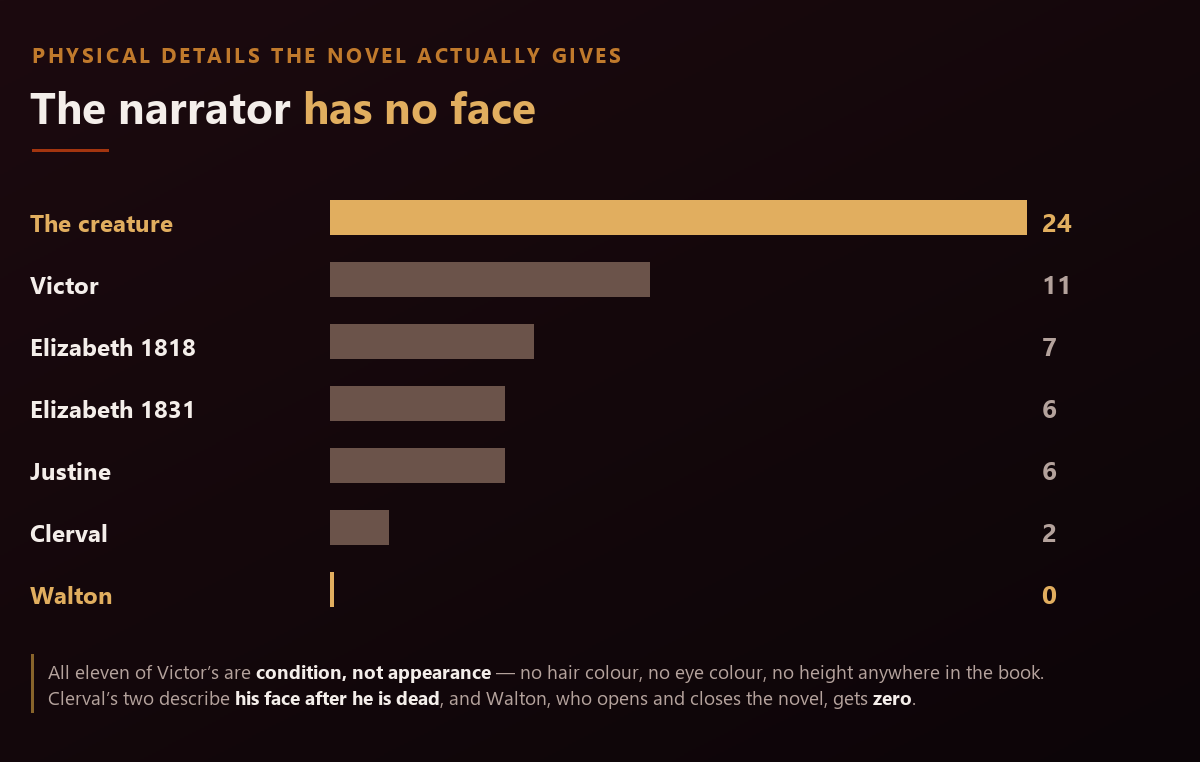
Here's how unevenly the text distributes faces.
| Character | Description items in the text | Hair | Eyes | Height |
|---|---|---|---|---|
| The creature | ~24 | Lustrous black, flowing | Dull yellow, watery | About 8 feet |
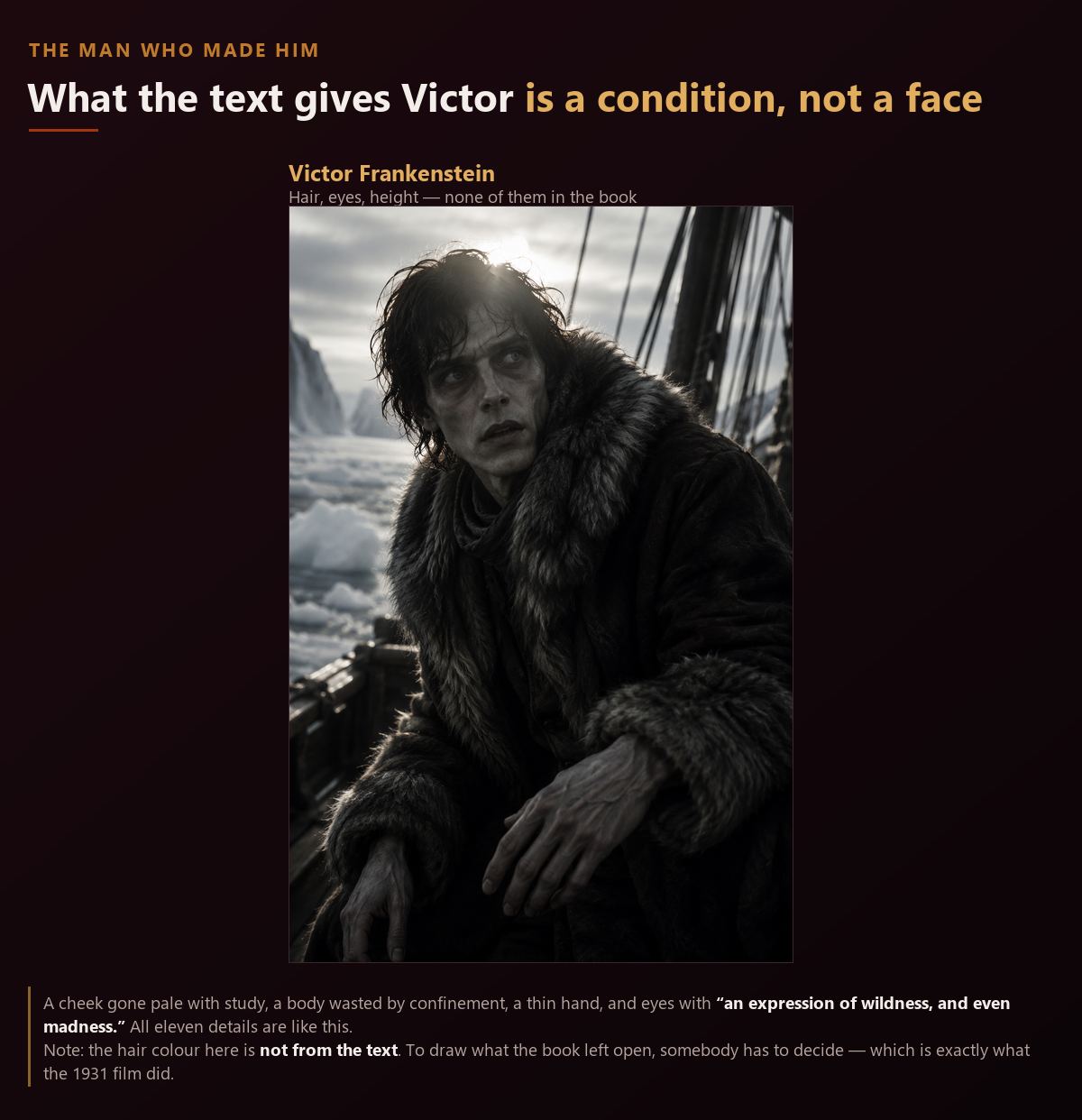
| Victor | 11 (all condition, no features) | None | None | None |
| Elizabeth (1818) | 7 | Rich dark auburn | Hazel | None |
| Elizabeth (1831) | 6 | The brightest living gold | Blue | None |
| Justine | 6 (impression and dress only) | None | None | None |
| Henry Clerval | 2 | None | Dark orbs | None |
| Robert Walton | 0 | None | None | None |
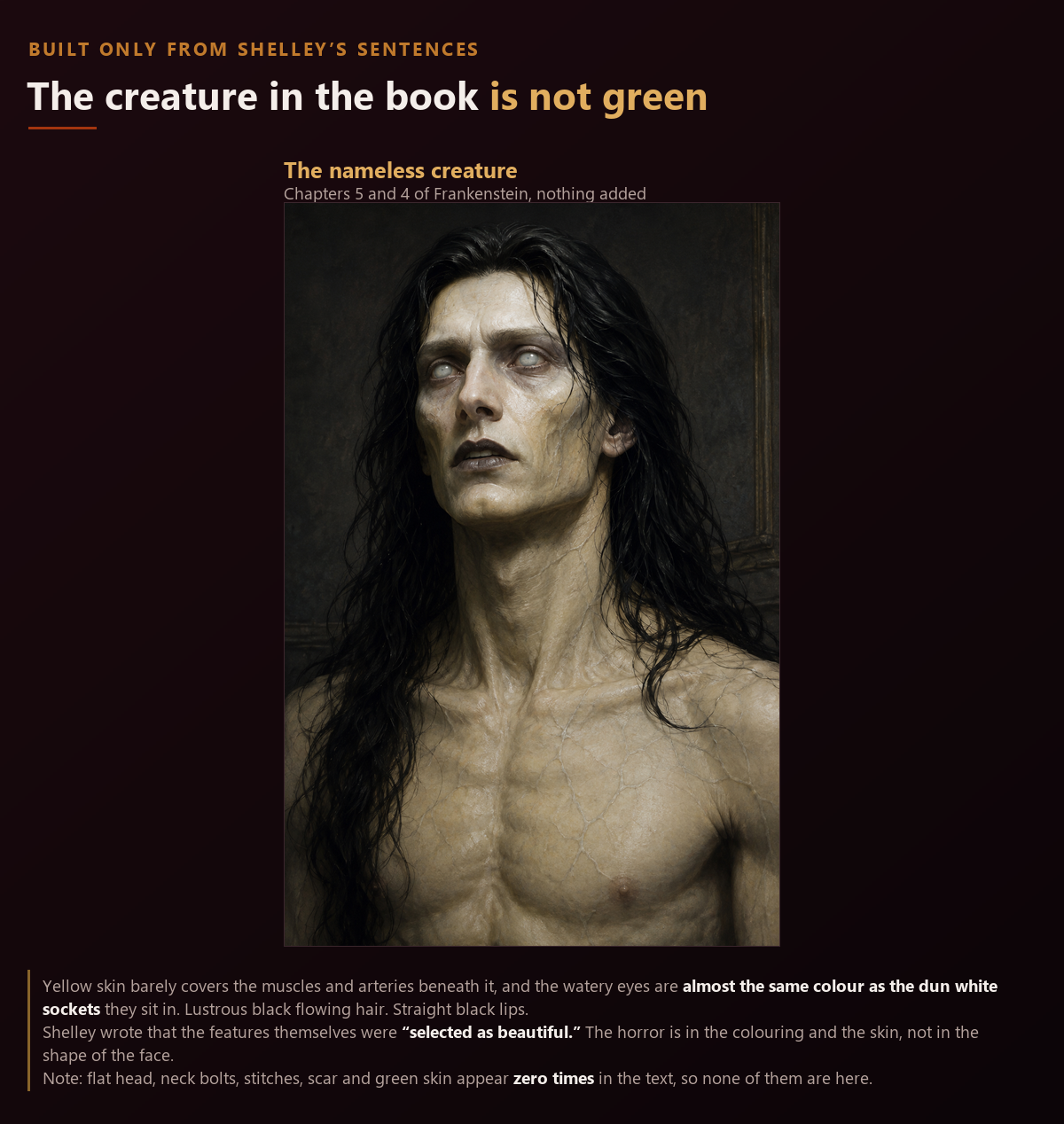
1. The creature
2. Victor Frankenstein
3 & 4. Elizabeth Lavenza — the same woman, two faces
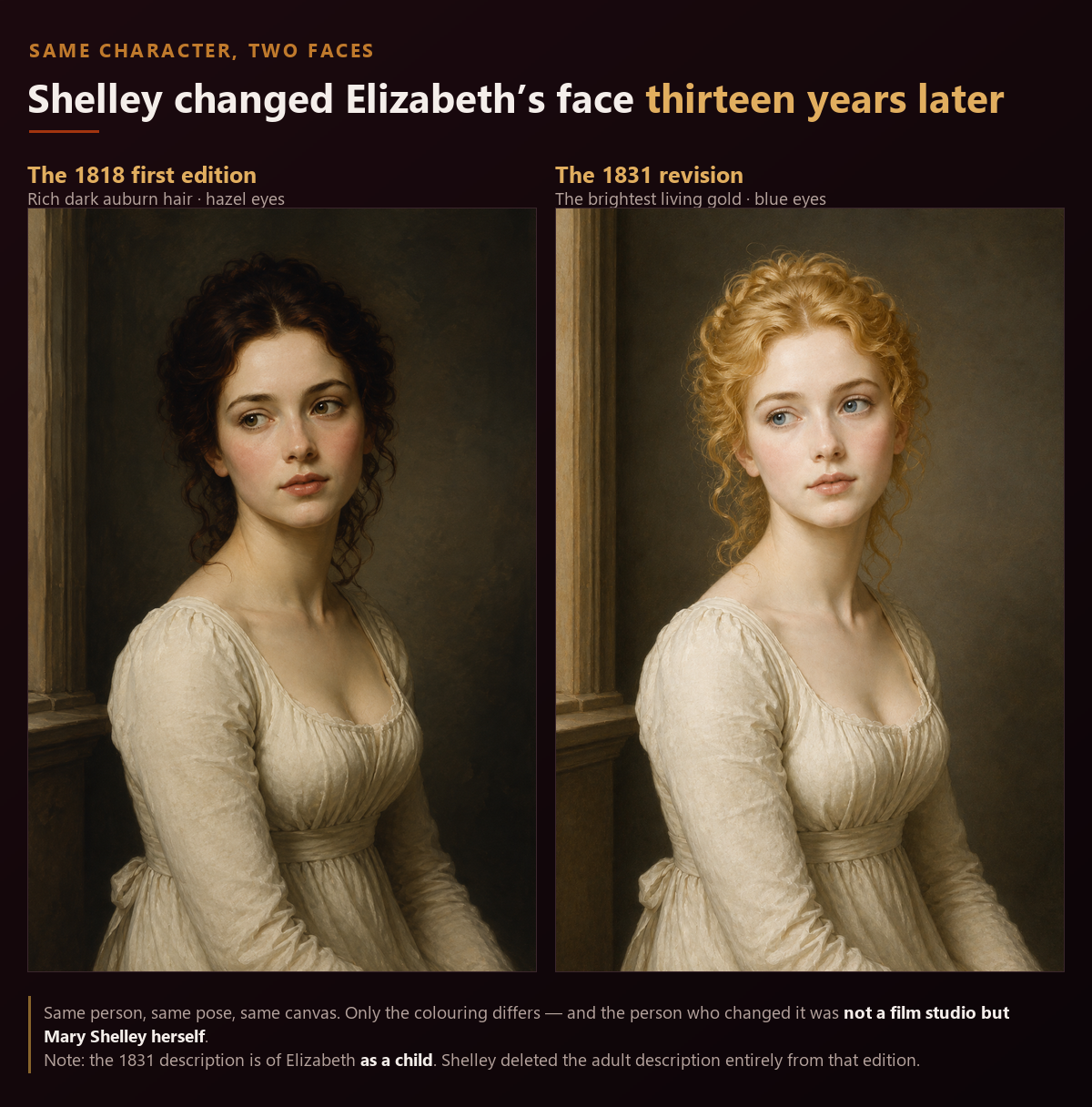
Same character. Different face. And it wasn't Hollywood that changed it — Mary Shelley did, thirteen years later. More on that below.
5. Henry Clerval
6. Robert Walton
7. Justine Moritz
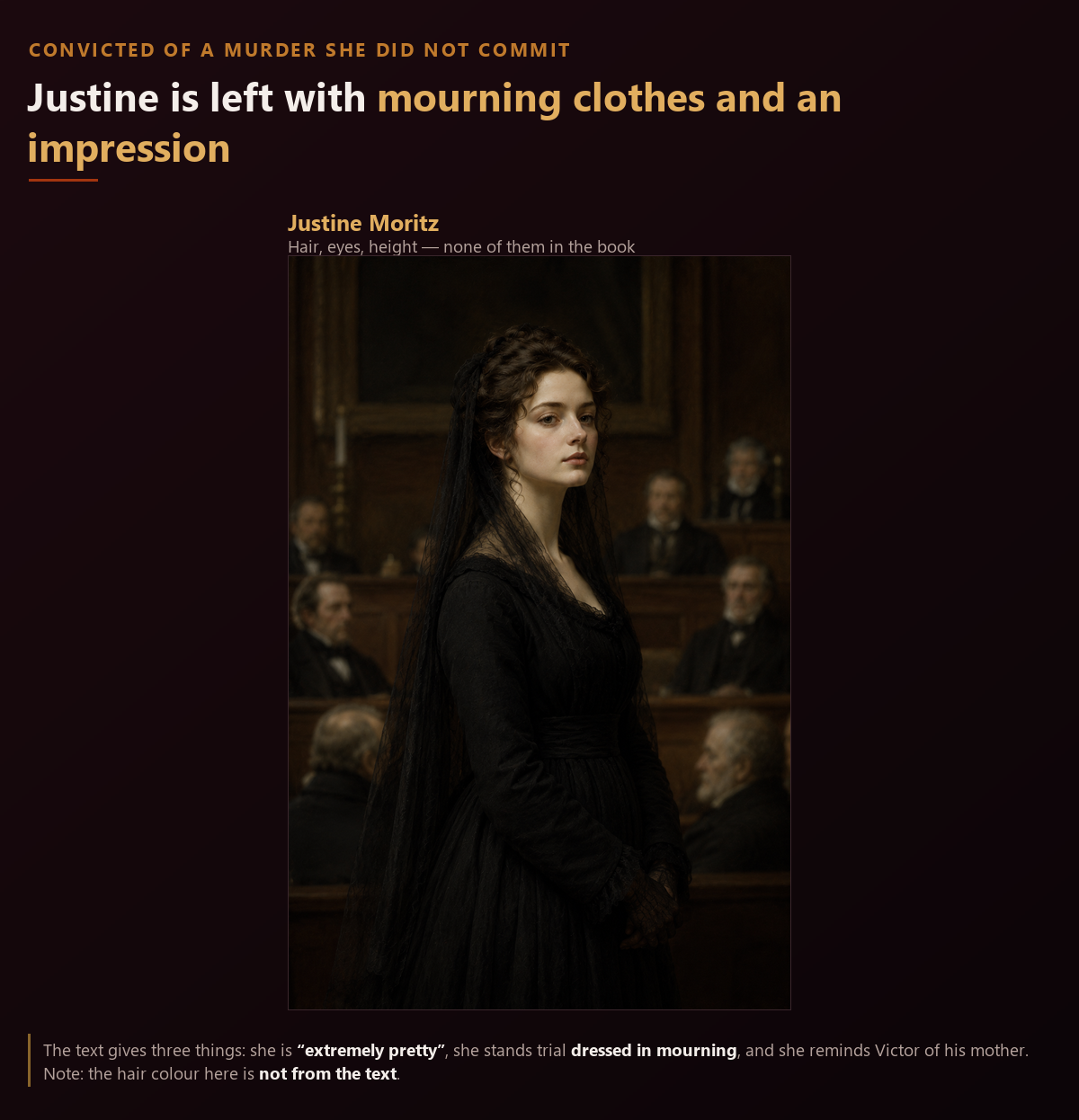 me of my dear aunt" — Victor's mother Caroline (ch. 6). A young woman in black mourning dress standing in a courtroom. Keep coloring neutral and unspecified]
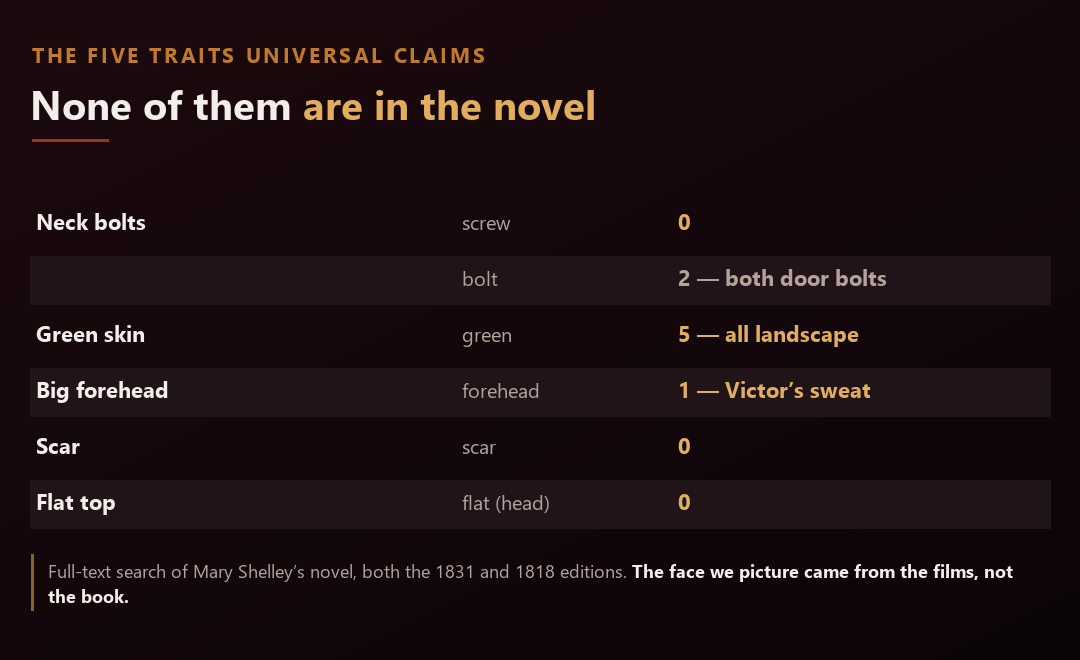
How many times do bolts, green skin, and stitches appear in the novel?
Zero, zero, and zero. All five of the traits Universal treats as its own return nothing.
That framing isn't mine. Universal Pictures has for decades asserted rights in a specific combination of five visual elements of its Monster. A copyright write-up by the law firm Foley Hoag describes a 2010 cease-and-desist letter sent to the author of a poster book, warning him off "the combination of five visual elements that make up the Universal character's appearance: bolts, green skin, big forehead, scar, and flat-top."
Source: Foley Hoag LLP, "Frankenstein and Copyright: 5 Things You Should Know," October 23, 2018 — a law-firm commentary quoting the 2010 letter.
https://foleyhoag.com/news-and-insights/blogs/making-your-mark-blog/2018/october/frankenstein-and-copyright-5-things-you-should-know/
So I searched the novel for all five.
| Universal's protected element | Search term | 1831 | 1818 | What the hits actually are |
|---|---|---|---|---|
| Neck bolts | screw |
0 | 0 | — |
| " | bolt |
2 | 2 | Both are door bolts |
| Green skin | green |
5 | 5 | All five describe landscape — green banks, green herbage, vine slopes, green hills |
| Big forehead | forehead |
1 | 1 | It's Victor's, covered in cold sweat. skull = 0 |
| Scar | scar |
0 | 0 | — |
| Flat-top head | flat |
1 | 1 | The plains of England |
Five for five. Zero for zero.
For completeness: neck appears nine times in both editions — strangulations and a necklace. No hardware anywhere on it.
So what does the creature actually look like on the page?
Yellow skin and long, glossy black hair. And here's the part almost every adaptation drops: his features were chosen to be beautiful.
The single full description in the novel is Victor watching him wake. It is word-for-word identical in both editions.
"His limbs were in proportion, and I had selected his features as beautiful. Beautiful!—Great God! His yellow skin scarcely covered the work of muscles and arteries beneath; his hair was of a lustrous black, and flowing; his teeth of a pearly whiteness; but these luxuriances only formed a more horrid contrast with his watery eyes, that seemed almost of the same colour as the dun white sockets in which they were set, his shrivelled complexion, and straight black lips."
— 1831 ch. 5 / 1818 Vol. I ch. IV
Read that again and notice what horrifies Victor. Not ugliness. He picked beautiful parts. The horror arrives when the beautiful parts start moving.
The height gets exactly one line in the whole book:
"I resolved… to make the being of a gigantic stature; that is to say, about eight feet in height, and proportionably large."
— 1831 ch. 4 / 1818 Vol. I ch. III
eight feet returns exactly one hit per edition. That sentence is the only body measurement in the novel.
And the comparison Shelley reaches for is not a green corpse. It's a mummy.
"A mummy again endued with animation could not be so hideous as that wretch." — 1831 ch. 5
Walton, the one outside witness, says the same thing independently at the end: "gigantic in stature, yet uncouth and distorted in its proportions," his face "concealed by long locks of ragged hair," one vast hand "in colour and apparent texture like that of a mummy" (ch. 24).
Can Frankenstein's monster talk? He narrates 20.1% of the novel
He's the most articulate character in the book — and he does not stop talking for six chapters.
The creature's inset narrative (1831, chs. 11–16) runs 15,068 words, which is 20.1% of the novel's 75,081-word text. In the 1818 edition it's 14,936 words, or 20.7%. I counted these directly.
His first words aren't a groan:
"I expected this reception," said the dæmon. "All men hate the wretched; how then must I be hated, who am miserable beyond all living things!" — 1831 ch. 10
He describes his own voice, too: "My voice, although harsh, had nothing terrible in it" (ch. 15). "My organs were indeed harsh, but supple" (ch. 12).
His reading list is spelled out. He finds a portmanteau in the woods with three books in it — Milton's Paradise Lost, Plutarch's Lives, and Goethe's The Sorrows of Werter (ch. 15). He picks up history and politics by eavesdropping on lessons from Volney's Ruins of Empires (ch. 13). He also reads Victor's own laboratory journal, which was in the pocket of the clothes he grabbed when he fled (ch. 15).
He's a vegetarian: "I do not destroy the lamb and the kid to glut my appetite; acorns and berries afford me sufficient nourishment" (ch. 17).
And he never gets a name
The novel calls him a lot of things. None of them is a name.
| Term | 1831 | 1818 | Note |
|---|---|---|---|
creature |
42 | 44 | Only 18 refer to him; most refer to humans |
fiend |
34 | 33 | Mostly him |
monster |
31 | 30 | One is Justine describing herself |
wretch |
25 | 27 | 17 refer to him |
dæmon |
18 | 20 | Shelley spells it with the ligature. Modern demon = 0 |
| A proper name | 0 | 0 | Never |
The closest he comes to naming himself is theological:
"Remember, that I am thy creature; I ought to be thy Adam; but I am rather the fallen angel, whom thou drivest from joy for no misdeed." — 1831 ch. 10
Is Victor Frankenstein a doctor?
No. Dr. and doctor each return zero hits in the novel text, in both editions.
What the text actually says about his standing:
"When I had attained the age of seventeen my parents resolved that I should become a student at the university of Ingolstadt." — 1831 ch. 3
People address him as "M. Frankenstein" (ch. 6). The family member with a public title is his father, Alphonse — when little William is cornered, he shouts that his papa is "a syndic — he is M. Frankenstein" (ch. 16).
He never finishes. After the creation he collapses with nervous fever and develops "a violent antipathy even to the name of natural philosophy" (ch. 6).
Here's the twist for American readers: the 1931 film doesn't make him a doctor either. What it does is rename him. The scientist becomes Henry Frankenstein, and the name Victor is handed to his friend, Victor Moritz — a splice of the novel's Victor and Justine Moritz.
Why Elizabeth's hair color depends on which copy you own
Because there are two novels, not one. Shelley published in 1818 and revised heavily for 1831, and Elizabeth's face is one of the things she changed.
| 1818 text | 1831 text | |
|---|---|---|
| Hair | "rich, dark auburn" | "the brightest living gold" |
| Eyes | "hazel, and expressive of mildness" | "her blue eyes cloudless" |
| Relation to Victor | His first cousin — his aunt's daughter | An adopted foundling, no blood tie |
| Adult description | Present, and detailed | Deleted entirely |
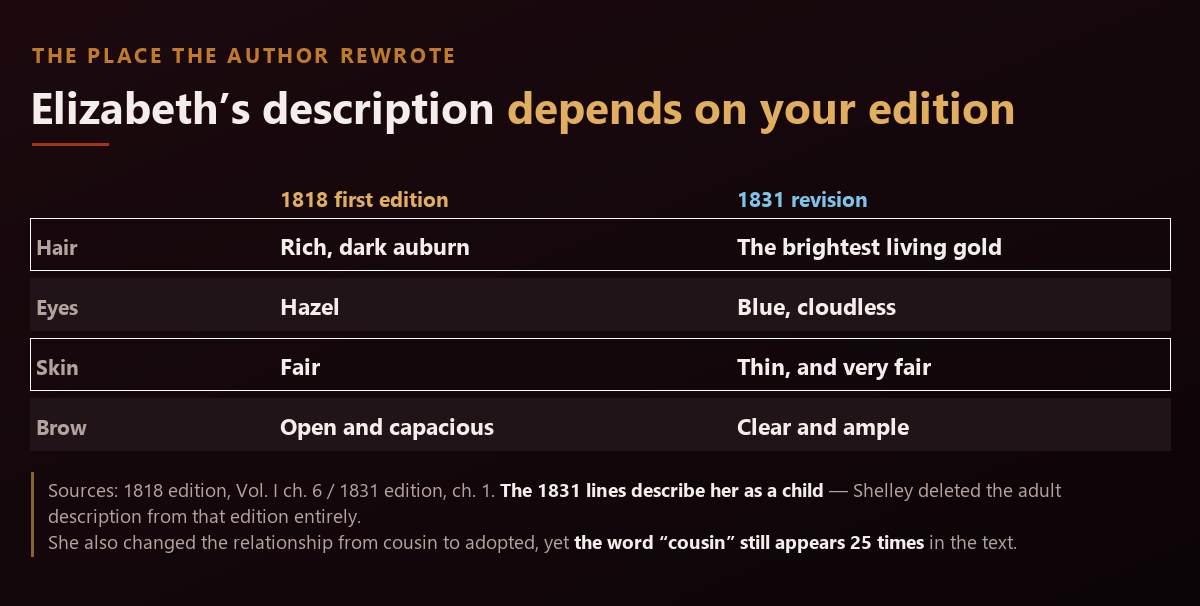
Put the same moment from both editions next to each other — Victor returning home before Justine's trial — and you can watch the deletion happen.
1818: "She was now a woman in stature… An open and capacious forehead… Her eyes were hazel… Her hair was of a rich, dark auburn, her complexion fair, and her figure slight and graceful."
1831: "Time had altered her since I last beheld her; it had endowed her with loveliness surpassing the beauty of her childish years. There was the same candour, the same vivacity, but it was allied to an expression more full of sensibility and intellect."
— 1818 Vol. I ch. VI / 1831 ch. 6. The 1831 version contains no physical detail at all.
The revision leaks
Shelley cut the blood relationship, but she didn't catch every word.
In the 1831 novel, cousin still appears 25 times, and Elizabeth still calls Victor's father "my uncle" six times in her letters. (The 1818 counts are 33 and 8.)
You can see the edit half-finished, in print, in the edition most twentieth-century readers grew up on.
Which text is the "real" one? I'm not going to rule on that. The 1818 text is what Shelley first published and is widely taught today; the 1831 text was the standard reading edition for most of the last century and is what many mass-market reprints still use. Both claims hold up. The point is that two different books share one title.
The face changed five times — 1818 to 1931
The face in your head wasn't invented once. It was built up in at least five layers, and only the first one is Shelley's.
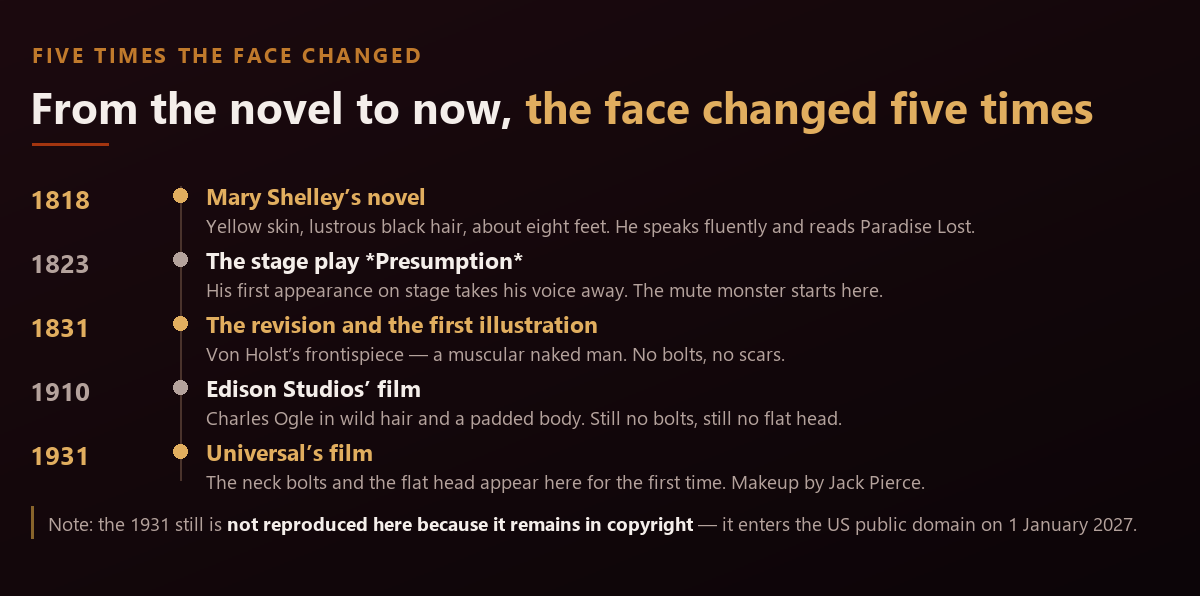
| When | Added | Lost |
|---|---|---|
| 1818 — first edition | (Original) Yellow skin, long black hair, white teeth, watery eyes, black lips, eight feet. Speaks brilliantly. Vegetarian | — |
| July 1823 — Presumption; or, The Fate of Frankenstein, London | ① The creature is made mute — T.P. Cooke plays him without a line ② A servant character, "Fritz", the ancestor of every later lab assistant | His language. All ~15,000 words of his self-defense |
| Nov 1831 — revised edition + first illustration | ① Elizabeth's golden hair and blue eyes ② The word galvanism ③ Shelley's Author's Introduction ④ The first published image of the creature, by Theodor von Holst | ① Elizabeth's blood relation to Victor ② Her adult description, deleted |
| March 1910 — Edison Studios (creature: Charles Ogle) | An explosion of hair, a padded misshapen body, clawed hands — a design matching neither the novel nor the stage | Nearly all of the plot (a ~12-minute short) |
| Nov 1931 — Universal (dir. James Whale; makeup Jack Pierce; creature: Boris Karloff) | ① Flat-topped skull ② Neck electrodes ③ Grey-green skin ④ A mute, grunting monster ⑤ The criminal brain ⑥ The burning windmill ⑦ The assistant Fritz ⑧ "It's alive!" | Almost all of the novel — including the hero's name |
1823: the year he lost his voice
The first stage adaptation gave the creature nothing to say. Not one line. The 20% of the novel he narrates in his own defense vanished in that production and has mostly never come back.
The playbill listed his part as "———". Mary Shelley went to see it on August 29, 1823 with her father William Godwin, and wrote to Leigh Hunt approvingly of "this nameless mode of naming the un[n]ameable." In the same letter: "I found myself famous!"
Source: Princeton University, "Frankenstein 200" exhibit; The Frankenstein Meme database entry on Presumption — secondary and fan-maintained sources. The reported costume color ("light blue or French gray") comes from the same tier of sourcing, so I've left it out of the body text.
https://frankenstein200.princeton.edu/3-t-p-cooke-as-creature-for-1823play
1831: the first published picture of the creature, in Shelley's own book
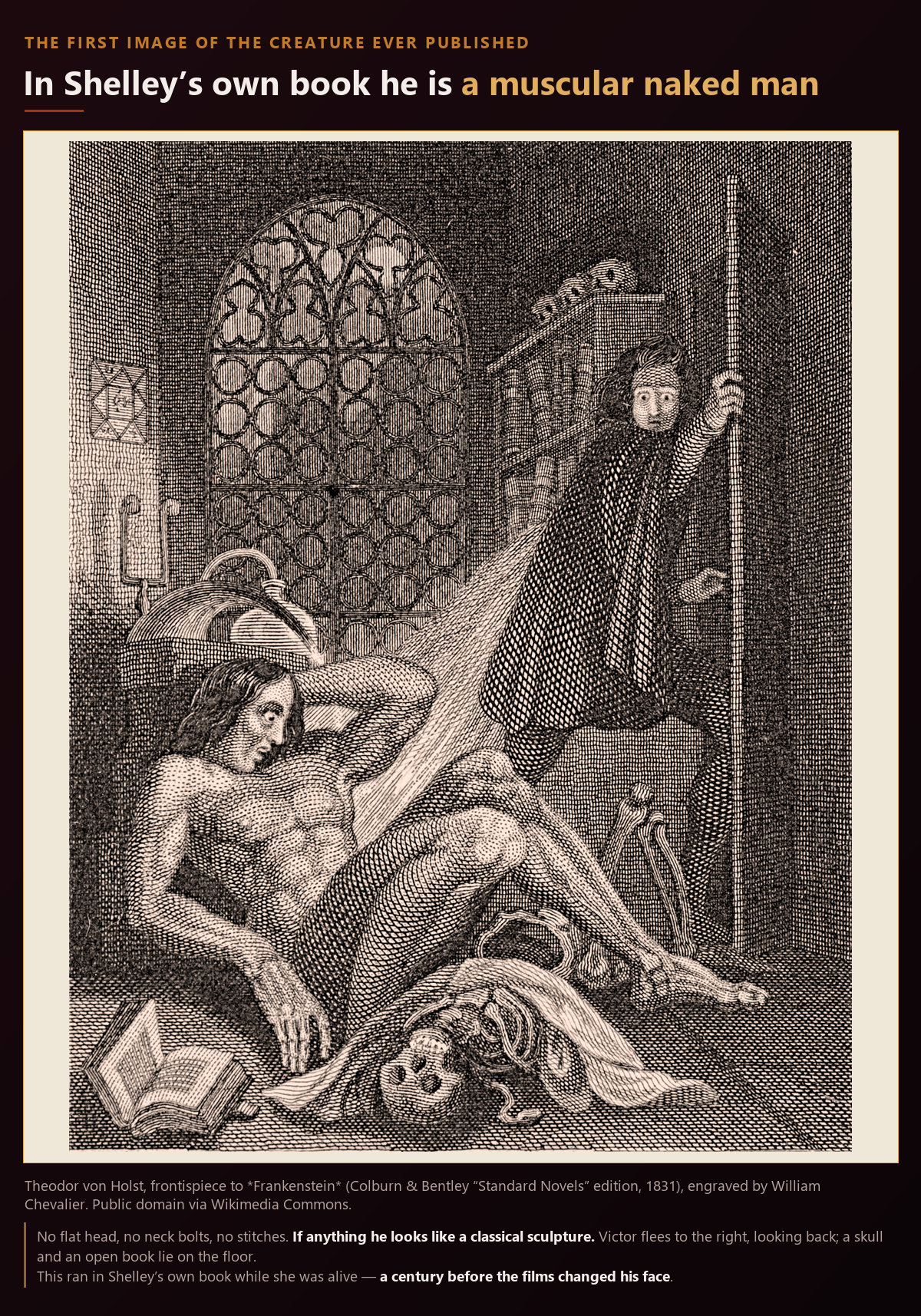
I opened this file and checked it myself rather than relying on a description.
The creature is in the foreground, nude, with long glossy dark hair and a classical, sculpted torso. His face is handsome, not hideous — the expression is closer to bewilderment than menace. His left arm is bent up over his head as he pushes himself upright. Only the hands and feet are rendered as gaunt and anatomical. Victor flees at the right rear, gripping a doorframe and looking back. Behind them: a large Gothic tracery window, a bookcase, glass vessels joined by a tube, a candle sconce, a skull on the floor and an open book.
No green. No bolts. No flat skull. No stitches. The first picture ever published of the creature, in Shelley's lifetime and in her own book, is closer to her text than anything that came after it.
Image: Theodor von Holst, frontispiece to Frankenstein (Colburn & Bentley 'Standard Novels' edition, 1831), engraved by William Chevalier. Public domain via Wikimedia Commons.
1910: Edison gets there first
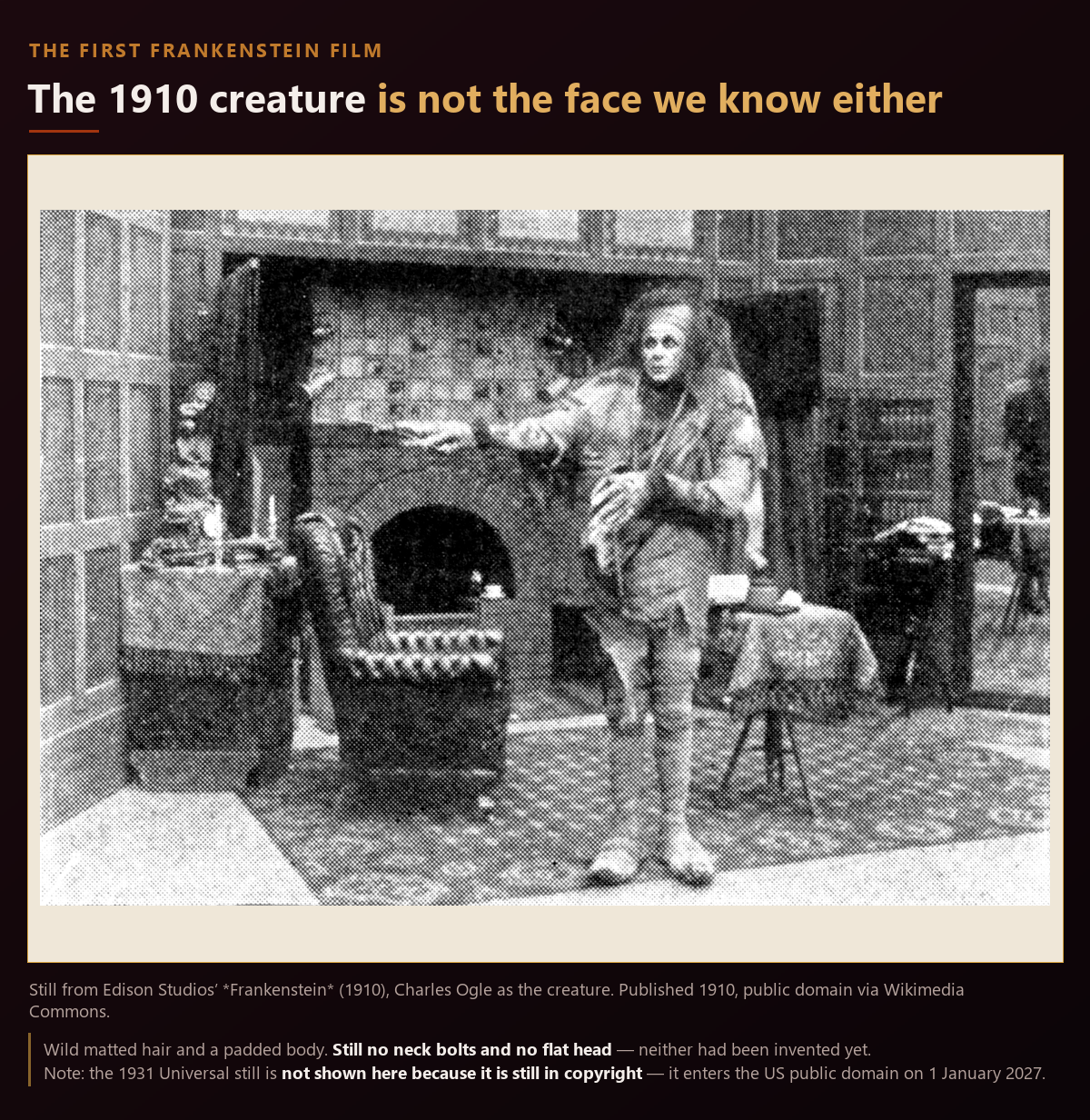
Edison's twelve-minute short gave Charles Ogle a wild explosion of hair and a bulked, misshapen frame. It looks like neither the novel nor the stage tradition. And notably — still no flat head, still no bolts.
Image: Charles Ogle as the creature in Edison Studios' Frankenstein (1910), the first screen adaptation. Public domain via Wikimedia Commons. The complete film is viewable at The Public Domain Review.
https://publicdomainreview.org/collection/frankenstein-1910
1931: why there is no picture of that face in this article
The face you actually pictured when you clicked this headline is Jack Pierce's makeup on Boris Karloff, from Universal's 1931 Frankenstein. It is one of the most recognizable faces in American cinema. The Library of Congress added the film to the National Film Registry in 1991, and the American Film Institute ranked "It's alive! It's alive!" the 49th greatest movie quote in American film.
And there is not one frame of it in this article. There can't be.
Frankenstein (1931) is a 1931 published work. Under the U.S. 95-year term it enters the American public domain on January 1, 2027. As of August 31, 2026, it is still under copyright. And copyright expiry won't settle it either — Universal has separately asserted trademark rights in the Monster's look, which is exactly what that 2010 cease-and-desist was about.
Source: Duke University School of Law, Center for the Study of the Public Domain, "Public Domain Day 2026" — the 95-year rule explained.
https://web.law.duke.edu/cspd/publicdomainday/2026/
So here's where the whole piece lands. The face you picture is still under copyright, and it isn't in the book.
How the monster turned green
Pierce painted Karloff a greyish-green, in part because the film stock of the era rendered certain greens as a ghostly white on screen. Which means that in the black-and-white film, you never actually see green.
The green reached you through color posters and promotional art, and it stuck.
Source: Mental Floss, April Snellings, "Why Is Frankenstein's Monster Green?" — general-interest reporting.
https://www.mentalfloss.com/article/651163/why-frankenstein-monster-green
Igor isn't in the novel — and he isn't in the 1931 film either
Igor, Ygor, Fritz, assistant and hunchback all return zero in both editions. Victor works alone.
The 1931 assistant is Fritz, played by Dwight Frye. Ygor debuts eight years later in Son of Frankenstein (1939), played by Bela Lugosi — and he is neither a hunchback nor a lab assistant. He's a blacksmith who survived his own hanging with a broken neck.
The hunchbacked assistant named Igor appears in none of them: not the novel, not 1931, not 1939.
No lab, no lightning, no "It's alive!"
The workshop in the novel is not an underground laboratory. It's an attic in a boarding house.
"In a solitary chamber, or rather cell, at the top of the house, and separated from all the other apartments by a gallery and staircase, I kept my workshop of filthy creation… The dissecting room and the slaughter-house furnished many of my materials." — 1831 ch. 4
The weather isn't a thunderstorm either. It's rain, at one in the morning, by a candle that has nearly burned out.
"It was already one in the morning; the rain pattered dismally against the panes, and my candle was nearly burnt out, when, by the glimmer of the half-extinguished light, I saw the dull yellow eye of the creature open." — 1831 ch. 5
lightning appears three times in the 1831 novel and none of them is the creation scene. machine = 0. engine = 0 in the novel text.
Victor says nothing at all during the animation. There is no dialogue in the scene. it's alive and it is alive both return zero in both editions.
One caveat worth flagging, because it trips up a lot of otherwise careful writing: the famous passage about galvanism and "some powerful engine" comes from Shelley's 1831 Author's Introduction, where she recounts her waking dream. It is not in the novel. The National Library of Medicine's Frankenstein exhibition quotes the same passage and correctly attributes it to the dream, not the story.
Frequently asked questions
Q. Is Frankenstein the monster or the scientist?
A. The scientist. Frankenstein is the surname of the man who builds the creature, and the creature is never given a name in the novel.
Q. Does Frankenstein's monster have a name?
A. No. The text calls him creature, monster, fiend, wretch and dæmon, but a proper name returns zero hits in both editions. The nearest thing to self-naming is his line about being "the fallen angel" rather than "thy Adam."
Q. Why is Frankenstein's monster green?
A. Because Jack Pierce's 1931 makeup was greyish-green and that color spread through color posters and promotional art. In the black-and-white film itself you never see green. In the novel, green appears five times and all five describe scenery.
Q. Can Frankenstein's monster talk in the book?
A. Yes — extensively. He narrates chapters 11 through 16 himself, 15,068 words, about 20.1% of the 1831 text. He also reads Paradise Lost, Plutarch's Lives and The Sorrows of Werter.
Q. Is Victor Frankenstein a doctor?
A. Not in the novel. Dr. and doctor return zero hits in the text. He's a university student who never finishes, and he's addressed as "M. Frankenstein."
Q. Is Igor in the Frankenstein book?
A. No. There is no assistant of any kind — Victor works alone. The 1931 film's assistant is Fritz, and Ygor (1939) is a blacksmith, not a hunchbacked helper.
Q. Should I read the 1818 or the 1831 Frankenstein?
A. Either, but know what changes. In 1818 Elizabeth has dark auburn hair, hazel eyes, and is Victor's first cousin. In 1831 she has golden hair, blue eyes, and no blood relation — and her adult description is gone.
Q. When does the 1931 Frankenstein enter the public domain?
A. January 1, 2027, under the U.S. 95-year term. Universal's separate trademark claims on the Monster's appearance are a different question and don't expire on that date.
Q. How tall is Frankenstein's monster?
A. About eight feet. That phrase appears exactly once per edition and is the only body measurement anywhere in the novel.
What I could not verify
Counting is easy to check. These are the things I couldn't nail down, listed so you can weigh them yourself.
1. No usable image of the 1823 stage production. A T.P. Cooke print is known to exist, but I couldn't secure a high-resolution file with documented licensing. That's why there's no 1823 image above.
2. The 1823 costume color is secondary-source only. The reported direction to paint face, hands, arms and legs the same "light blue or French gray" as the body suit comes from fan-maintained databases, not a primary costume document. I left it out of the body.
3. No high-resolution file of the 1831 title-page vignette. The Standard Novels edition carried a vignette in addition to the frontispiece; I could confirm it exists but not obtain it.
4. The creature's exact first spoken line in Bride of Frankenstein (1935). Secondary sources report that Karloff objected strongly to the Monster speaking, and that the production limited him to roughly 44 simple words. I could not confirm either against a primary source.
5. The frontispiece apparatus. I opened the original file and confirmed the figures, the Gothic window, the bookcase, the skull, the open book and the glass vessels joined by a tube. A scholarly description also identifies a bell jar and horn-shaped galvanic electrodes. I couldn't resolve those from the image alone, so I only described what I could see.
One thing to check before you argue about this at a party
Pull your copy of Frankenstein off the shelf and find Elizabeth's first appearance in chapter 1.
If her hair is "the brightest living gold," you're holding the 1831 text. If there's no hair color there at all — and "rich, dark auburn" turns up much later, when she's grown — you're holding the 1818 text.
Most editions state the copy text in the front matter or the editor's introduction. It takes about five seconds to find.
If you and a friend remember different faces from the same novel, neither of you misremembered. You read different books.
Sources
Primary text
- Project Gutenberg eBook #42324 — Frankenstein; Or, The Modern Prometheus, 1831 edition (H. Colburn & R. Bentley) · https://www.gutenberg.org/ebooks/42324
- Project Gutenberg eBook #41445 — 1818 edition · https://www.gutenberg.org/ebooks/41445
- Counts were run with Python regex over the body text with Gutenberg headers and footers stripped (75,081 words for 1831; 72,038 for 1818), printing a chapter label with every hit so each referent could be checked individually.
Public-domain images
- Theodor von Holst, frontispiece to Frankenstein, 1831 · https://commons.wikimedia.org/wiki/File:Frontispiece_to_Frankenstein_1831.jpg
- Charles Ogle in Edison Studios' Frankenstein, 1910 · https://commons.wikimedia.org/wiki/File:Frankenstein1910.jpg
Institutional and legal
- Foley Hoag LLP, "Frankenstein and Copyright: 5 Things You Should Know," 2018-10-23
- Duke University School of Law, Center for the Study of the Public Domain, "Public Domain Day 2026"
- U.S. National Library of Medicine, Frankenstein: Penetrating the Secrets of Nature
- Princeton University, "Frankenstein 200"
Reference and reporting
- Wikipedia: Frankenstein (1931 film), Frankenstein (1910 film), Son of Frankenstein, Igor (character), Jack Pierce (make-up artist)
- Mental Floss, April Snellings, "Why Is Frankenstein's Monster Green?"
- Screen Rant, "How Censorship Created Frankenstein's Most Iconic Line"
- Ian Haywood (University of Roehampton), "Image of the Month: Theodore von Holst, 'Frankenstein' (1831)," Romantic Illustration Network, 2016-11-26
- The Public Domain Review, Frankenstein (1910)


Comments
Post a Comment