Original Snow White Story: No Kiss, and Mom Was the Villain
We went looking for the kiss.
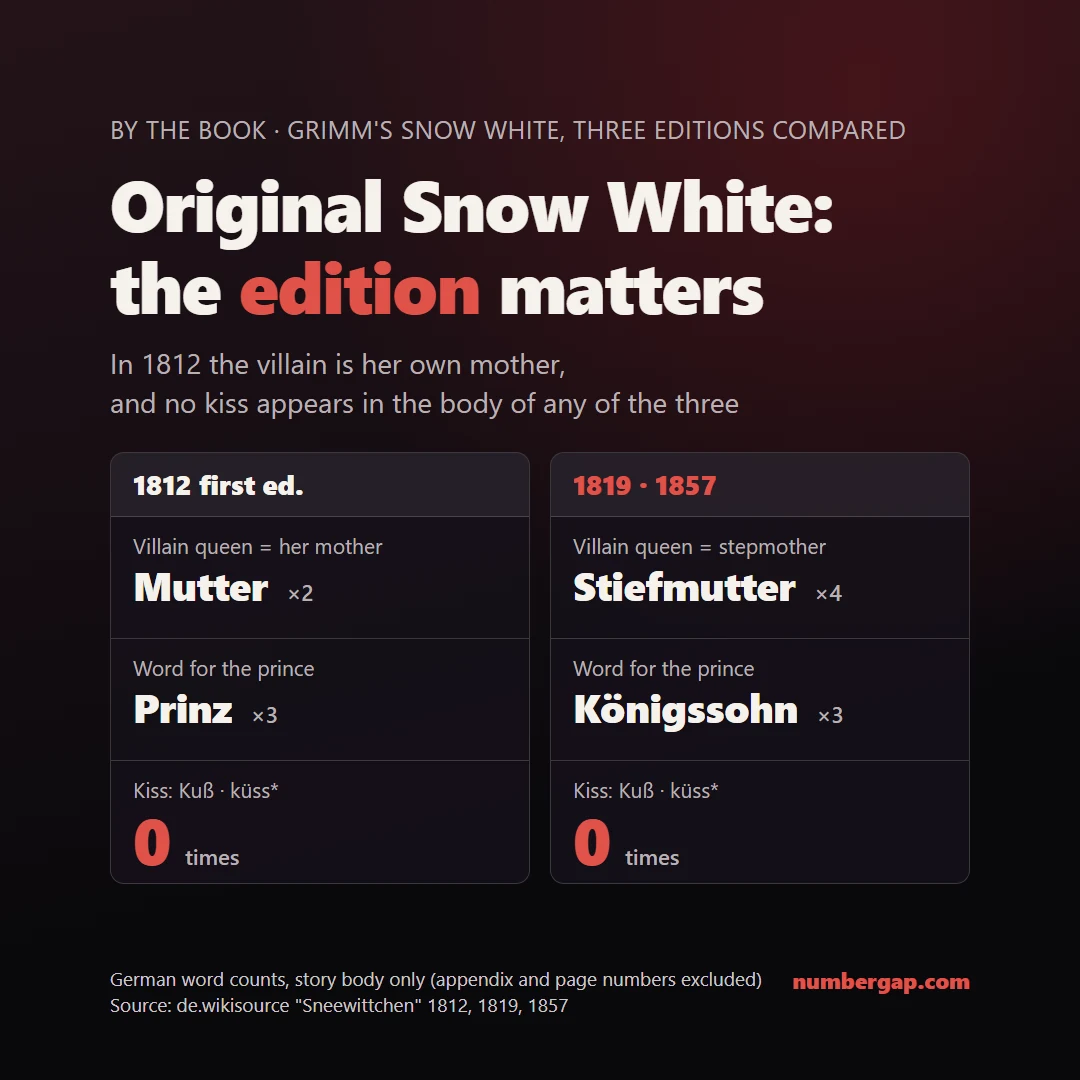
Not Disney's. The one in the original Snow White story, the one the Brothers Grimm wrote down. We searched the German text of three editions: the 1812 first edition, the 1819 second edition and the 1857 seventh edition. We searched every one for words starting with Kuß and küss.
Last updated: 24 October 2026 · Quotations and occurrence counts were checked against the source text on this date.
Zero hits.
All three editions.
So we searched for the stepmother. Stiefmutter appears four times in the 1857 text. Four times in 1819. In the 1812 story body, zero.
In the first edition, the woman who wants Snow White dead is her Mutter. Her mother.
| German word | Meaning | 1812 first edition | 1819 second | 1857 seventh |
|---|---|---|---|---|
Mutter |
mother (alone) | 2 | 0 | 0 |
Stiefmutter |
stepmother | 0 | 4 | 4 |
Prinz |
prince | 3 | 0 | 0 |
Königssohn |
king's son | 0 | 3 | 3 |
Kuß / küss* |
kiss | 0 | 0 | 0 |
Source: de.wikisource transcriptions of "Sneewittchen" (1812, 1819, 1857). Counts cover the story body only; the appendix attached to the end of the 1812 file is excluded.
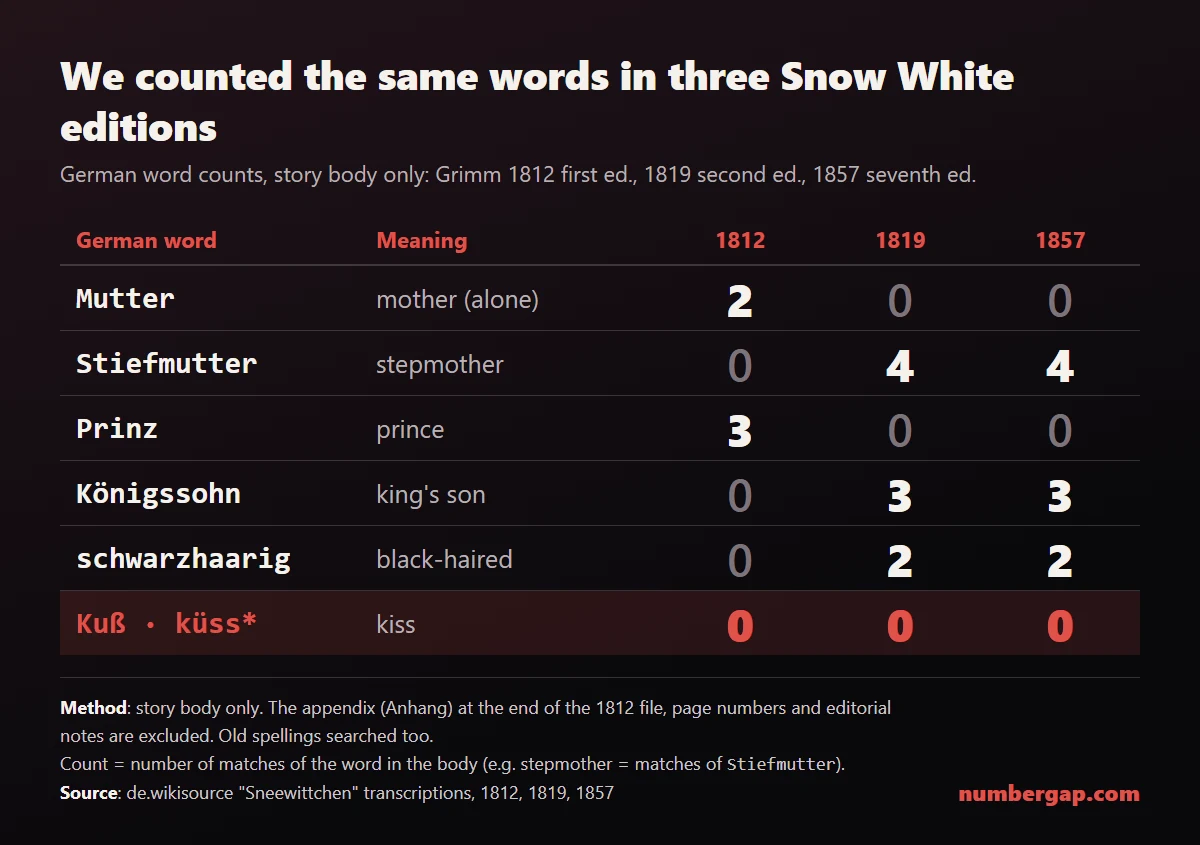
One of those zeroes started out as a one. We'll show you where that one came from, and why we took it back, further down.
We kept counting, scene by scene. The story most of us think we know changes from edition to edition.
What Happens in the Original Snow White? A Plot Summary
The summary below includes the ending. If you already know the story, skim the table and move on.
It follows the 1857 seventh edition, the last one published in the Grimms' lifetimes. The 1812 differences come later, one at a time. One thing is missing from the original entirely: names for the seven dwarfs. The labels in the table below are ours.
| Character | Who | Why it matters here |
|---|---|---|
Snow White (Sneewittchen) |
Daughter of a king and his first queen. The mirror names her for the first time when she is seven | Her looks are given as three colors |
| The queen | The king's second wife from 1819 on. In the 1812 first edition, her own mother | The spine of this post. Her identity changes by edition |
| The mirror | What the queen questions every morning | Never calls Snow White "the fairest" |
| The huntsman | Sent to kill Snow White in the forest | What does he bring back as proof? |
| The seven dwarfs | Miners in a small house in the woods | No names, no beards in the German |
The prince (Königssohn) |
Falls for Snow White in her glass coffin | Does he wake her? |
| The cook | Appears only in 1857, in the editions we compared | Boils what the huntsman brings |
The story in eight lines
- In winter, a queen wishes for a child white as snow, red as blood and black as ebony. A daughter is born and the queen dies. A year later the king marries again.
- The new queen is beautiful and proud of it. Every day she asks her mirror who is the fairest in the land.
- When Snow White is seven, the mirror names her for the first time. The queen orders a huntsman to kill her in the forest and bring back her lungs and liver as proof. He can't do it and kills a young boar instead. The queen eats what he brings.
- Snow White runs through the forest to the house of seven dwarfs. She can stay if she keeps house. They warn her: let no one in.
- The queen learns from the mirror that Snow White is alive. In disguise she comes three times: a lace, a poisoned comb, a poisoned apple. The dwarfs revive Snow White after the first two. Nobody can undo the apple.
- The dwarfs can't bury her, so they lay her in a glass coffin. A prince takes the coffin. The men carrying it stumble over a shrub, the apple piece falls out of her throat, and she wakes. He proposes.
- The queen is invited to the wedding. The mirror says: the young queen is a thousand times fairer than you.
- At the wedding, iron shoes sit on a coal fire. The queen puts them on and dances until she falls dead.
Source: de.wikisource transcription of "Sneewittchen" (1857), summarized. The remarriage exists only in 1819 and 1857.
What Does Snow White Look Like in the Original Story?
Three colors. White, red, black. The text never says where on her body any of them sits.
It starts in 1812, in the first scene. A queen sits sewing at a window with an ebony frame in the middle of winter. She pricks her finger, and three drops of blood fall in the snow. The red looks so beautiful against the white that she thinks:
hätt ich doch ein Kind so weiß wie Schnee, so roth wie Blut und so schwarz wie dieser Rahmen.
If only I had a child as white as snow, as red as blood and as black as this frame. [our translation]
Soon after, a daughter is born.
Und bald darauf bekam sie ein Töchterlein, so weiß wie der Schnee, so roth wie das Blut, und so schwarz wie Ebenholz, und darum ward es das Sneewittchen genannt.
Soon after she had a little daughter, as white as snow, as red as blood and as black as ebony, and for that reason she was called Sneewittchen. [our translation]
Source: "Sneewittchen" (1812), de.wikisource transcription.
All three colors come from objects: snow, blood, an ebony window frame. No sentence says which part of the child is white, red or black.
So we searched for body words. Skin, Haut. Lips, Lippen. Zero hits in all three editions.
When does Snow White get black hair?
In 1819.
The 1812 sentence ends at "black as ebony." It does not say what is black. In 1819 and 1857 the same sentence reads:
Bald darauf bekam sie ein Töchterlein, das war so weiß wie Schnee, so roth wie Blut, und so schwarzhaarig wie Ebenholz, und ward darum das Sneewittchen (Schneeweißchen) genannt.
Soon after she had a little daughter who was as white as snow, as red as blood and as black-haired as ebony, and was therefore named Sneewittchen (Schneeweißchen). [our translation]
Source: "Sneewittchen" (1857), de.wikisource transcription. The 1819 text also uses
schwarzhaarig(black-haired).
schwarzhaarig appears zero times in 1812, twice in 1819, twice in 1857.
The first edition does have one sentence about her eyes. It sits in the glass-coffin passage.
und wenns die Aeuglein hätte können aufthun, wären sie so schwarz gewesen wie Ebenholz
and if she could have opened her little eyes, they would have been as black as ebony [our translation]
Source: "Sneewittchen" (1812), de.wikisource transcription.
It's a hypothetical. Across all three editions it is the only sentence that gives an eye color, and 1819 deleted it. The black moved into the hair. [Our interpretation. It's what we read in the sentence-by-sentence comparison. We found no place where the Grimms say why.]
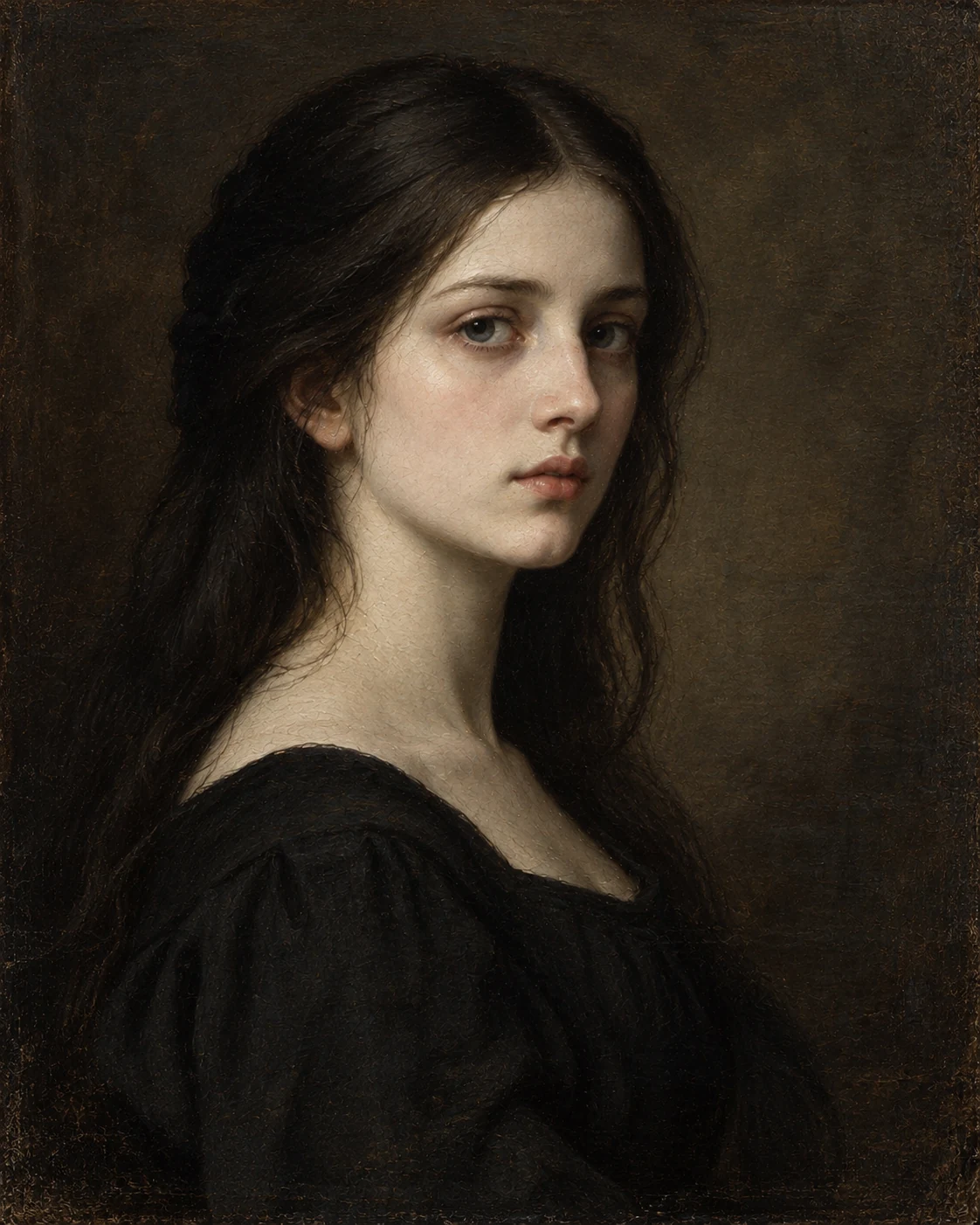
The text gives three colors and nothing else. White as snow, red as blood, black as ebony. To paint her, though, you have to decide where those colors go. “Black-haired” (schwarzhaarig) first appears in the 1819 second edition; the 1812 first edition never says what is black. This painting follows the later editions. Read only the first one, and you could have painted her differently. (AI-generated image)
Where are Snow White's red cheeks?
The red of the wish turns up on her face in exactly one place.
The dwarfs have wept for three days and are about to bury her.
dann wollten sie es begraben, da sahen sie aber daß es noch frisch und gar nicht wie ein Todter aussah, und daß es auch seine schönen rothen Backen noch hatte.
Then they wanted to bury her, but they saw that she was still fresh and did not look at all like a dead person, and that she still had her lovely red cheeks. [our translation]
Source: "Sneewittchen" (1812), de.wikisource transcription. The 1819 and 1857 texts use
rothen Backenin the same scene.
So instead of burying her, the dwarfs have a glass coffin made.
No edition says the living girl's cheeks or lips are red. The body with red cheeks is a dead one. The only other red cheeks belong to the poisoned apple.
Where does "skin as white as snow" come from?
Folklorist Maria Tatar has a short answer. In a Harvard Gazette interview she says the Grimm description is "white as snow, red as blood, and black as the wood on this window frame," and that the phrase "skin white as snow" came from Disney, which rewrote the description. [Scholarly claim — Maria Tatar, Harvard Gazette, 2020-07-16] Our zero count for skin fits that.
Source: Harvard Gazette, "The tale of Snow White and what the various versions mean to us," 2020-07-16. An interview with Tatar.
What does the text say about the 2025 casting debate?
When Rachel Zegler, a Latina actor, was cast as Snow White in Disney's 2025 live-action film, some critics pointed to the Grimm description of skin as white as snow, according to English Wikipedia's summary. [English Wikipedia, "Snow White (2025 film)" — secondary summary]
This post does not rule on that debate. We will only report what the text says. "White as snow" is a simile applied to the child in the wish and the birth sentence, and the text never says which part of her. No word for skin appears in any of the three editions.
How Old Is Snow White in the Original Story?
Seven. The text gives her age exactly once.
Sneewittchen aber wuchs heran, und wurde immer schöner, und als es sieben Jahr alt war, war es so schön, wie der klare Tag, und schöner als die Königin selbst. Als diese einmal ihren Spiegel fragte »Spieglein, Spieglein an der Wand, wer ist die schönste im ganzen Land?« so antwortete er »Frau Königin, ihr seid die schönste hier, aber Sneewittchen ist tausendmal schöner als ihr.«
Snow White grew up and became more and more beautiful, and when she was seven years old she was as beautiful as the clear day, and more beautiful than the queen herself. Once, when the queen asked her mirror, "Mirror, mirror on the wall, who is the fairest in the land?", it answered, "My lady queen, you are the fairest here, but Snow White is a thousand times more beautiful than you." [our translation]
Source: "Sneewittchen" (1857), de.wikisource transcription.
sieben Jahr alt appears once in each edition. That moment isn't a birthday. It is the first time the mirror mentions her.
The next scene is the huntsman. No time-lapse phrase sits between "seven" and the summons. So "she was seven when she was sent into the forest" is a reasonable reading from the order of events. The text doesn't state that age for the forest. [Our interpretation]
How much time passes after she turns seven?
We collected every time expression after the age. There aren't many. She runs "the whole day." The seventh dwarf sleeps an hour beside each companion through the night. The dwarfs mourn "three days."
Then the glass coffin.
lange, lange Zeit
a long, long time [our translation]
No months, no years. All three editions say the same.
No edition gives Snow White's age at the wedding. None gives the prince's age.
So "a seven-year-old got married" is not what the text says. Neither is "she was eighteen." What we can say is this: her age is stated once, no edition states it again, and the coffin interval is "lange, lange Zeit." [Confirmed — comparison of all three editions]
Who gets the number wrong?
We checked how English-language sources handle it.
English Wikipedia's plot summary, based on the 1857 text, says: "When Snow White is seven years old, her fairness surpasses that of her stepmother." NPR, in a 2014 interview about the first-edition translation, said that in the first edition Snow White is seven and her biological mother wants to murder her for her beauty. [Wikipedia, "Snow White"; NPR/WUNC, 2014-11-16]
Then Slashfilm (2025-08-11). It quotes a translation labeled as the 1812 tale: "When she was seven years old she was as beautiful as the light of day." It concludes this is the only age the story gives. That conclusion is right.
The label is another matter. Our 1812 German reads "so schön, daß es selbst die Königin an Schönheit übertraf," which means "so beautiful that she surpassed even the queen in beauty." The phrase "as the clear day" (wie der klare Tag) first appears in 1819. The quoted line matches the 1819/1857 wording. We could not open the page Slashfilm cites, so we cannot say which edition that translation follows. [Our interpretation; the cited page is unverified]
The Disney film's Snow White is 14, according to a 1934 studio outline quoted by Mouse Planet. [Mouse Planet's quotation of a Disney studio outline dated 1934-10-22 — secondary] We did not see that document ourselves.
Was the Evil Queen Snow White's Mother in the Original?
In the 1812 first edition, yes. The stepmother arrives in 1819. The 1812 story body has no stepmother and no king.
Go back to the first scene. A queen pricks her finger at a window, makes a wish and gets a daughter. She does not die. The next lines read:
Die Königin war die schönste im ganzen Land, und gar stolz auf ihre Schönheit.
The queen was the most beautiful in the whole land, and very proud of her beauty. [our translation]
Source: "Sneewittchen" (1812), de.wikisource transcription.
The woman who made the wish and the woman who wants the child dead are the same person.
In the 1812 body, the text calls her "mother" in just two places. One is Snow White telling the dwarfs her story: wie seine Mutter es habe wollen umbringen, how her mother wanted to kill her. The other is the wedding invitation.
Auf den andern Tag ward die Hochzeit bestellt, und Sneewittchens gottlose Mutter, auch eingeladen.
The next day the wedding was arranged, and Snow White's godless mother was invited too. [our translation]
Source: "Sneewittchen" (1812), de.wikisource transcription.
What happens to that "godless mother" at the wedding comes later.
What changed in 1819?
Two sentences arrive at the start of the story.
Und wie das Kind geboren war, starb die Königin. Ueber ein Jahr nahm sich der König eine andere Gemahlin, sie war eine schöne Frau, aber stolz auf ihre Schönheit
And when the child was born, the queen died. After a year the king took another wife; she was a beautiful woman, but proud of her beauty [our translation]
Source: "Sneewittchen" (1819), de.wikisource transcription. The same sentences are in 1857. They are not in the 1812 body.
The 1812 body never mentions a king. Not once. The word König on its own appears zero times. The queen who survived childbirth in 1812 dies in 1819, a king appears, and a second wife with him.
That second wife is the Stiefmutter. Here are the four places the word shows up, next to 1812:
| Scene | 1812 first edition | 1819 and 1857 |
|---|---|---|
| Snow White tells the dwarfs her story | seine Mutter (her mother) |
seine Stiefmutter (her stepmother) |
| The dwarfs' first warning | hüt dich nur vor der Königin (beware of the queen) |
hüt dich vor deiner Stiefmutter (beware of your stepmother) |
| The dwarfs guess after the comb | just "the queen" | 1819 die böse Stiefmutter (the wicked stepmother); 1857 hatten sie gleich die Stiefmutter in Verdacht (they suspected the stepmother at once) |
| The wedding invitation | gottlose Mutter |
gottlose Stiefmutter |
Source: comparison of the 1812, 1819 and 1857 de.wikisource transcriptions. English renderings are ours. Two of the four are swaps of
Mutter; the other two sit where 1812 saidKöniginor just "the queen."
English-language sources line up with this. English Wikipedia's article on the Evil Queen says that in the 1812 first edition the queen is Snow White's biological mother and that the 1819 text was changed so her mother died and the king remarried. Reports on Jack Zipes's translation of the first edition, in the Christian Science Monitor and on NPR, say the same about the 1812 villain. [Wikipedia, "Evil Queen"; CSMonitor, 2014-11-13; NPR/WUNC, 2014-11-16]
Where did our first "one" come from?
Now the promised story.
We searched the 1812 file for Stiefmutter and got one hit. A one. We nearly wrote, "even the first edition had a stepmother."
We opened the line it came from. It wasn't the story.
The Wikisource transcription of 1812 has the Grimms' own notes stuck on after the end of the story. They call it the Anhang, the appendix. The hit was inside it, in a passage describing a variant of the tale. We cut the file down to the story body and counted again. Zero.
A second number fell into the same trap. Counting whole files, 1812 has 3,380 words and 1819 has 2,861. It looks like the story got shorter. Strip the appendix and the page numbers, and the story body runs about 2,450 words in 1812, about 2,800 in 1819 and about 2,840 in 1857. It didn't shrink. It grew. The “about” is doing real work: depending on whether you also strip the heading line and the editors' notes, the totals move by a dozen words or so. The direction holds; the last digit doesn't.
We almost wrote "the story shrank." That sentence was wrong.
But fixing the mistake led us somewhere better. That appendix.
Did the Grimms already know the stepmother version?
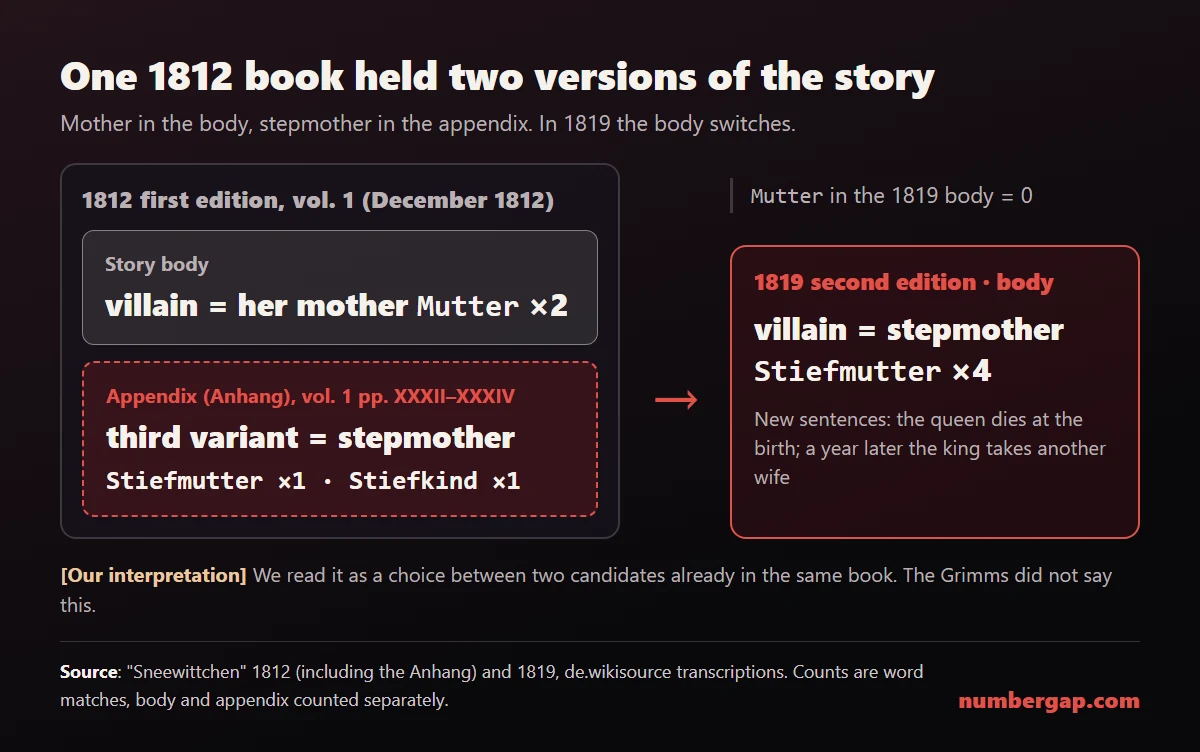
Yes. The appendix lists three variants the Grimms themselves wrote down.
In the first, a count and countess driving past snow, blood and ravens make a wish. In the second, a queen takes the girl into the forest to pick roses and leaves her there. Then the third.
Endlich kennen wir noch eine dritte Recension: Ein König verliert seine Gemahlin, mit der er eine einzige Tochter Sneewittchen hat und nimmt eine andere, mit der er drei Töchter bekommt. Diese haßt das Stiefkind, auch wegen seiner wunderbaren Schönheit
Finally we know a third version: A king loses his wife, with whom he has a single daughter, Sneewittchen, and takes another, with whom he has three daughters. She hates the stepchild, partly because of her wonderful beauty [our translation]
Source: "Sneewittchen" (1812), appendix (
Anhang, vol. 1, pp. XXXII–XXXIV), de.wikisource transcription.
A stepmother version. It gets stranger. In this variant the dwarfs kill every girl who comes near them. The mirror's role is played by Snow White's dog, named Spiegel, "mirror." The coffin is silver, set in a tree.
The same stepmother story shows up in a 1913 scholarly edition of the Grimms' notes. The editors, Bolte and Polívka, record it as told by "Marie in the Wild household in Kassel" on October 13, 1812. [Bolte and Polívka, 1913] The first edition came out in December 1812. That's two months earlier.
So here is where we stand. One book, published December 1812. In the body, a mother. In the appendix, a stepmother.
The Grimms didn't skip the stepmother because they'd never heard of her. They knew her. They put the other woman in the body.
In 1819 they reversed that. We don't read it as "the Grimms invented the stepmother." We read it as a choice between two candidates that were already in the same book. [Our interpretation. It sets two confirmed facts side by side; the Grimms did not say this.]
Did the Grimms say why they changed it?
They didn't. We looked for the sentence.
There's a preface to the second edition, written in Kassel on July 3, 1819. We searched its full text for Mutter and Stiefmutter. Neither appears. Snow White isn't named either.
The preface says two things. The book is meant to work as a "Erziehungsbuch," a book for educating children, and so "every expression unsuited to childhood" was carefully deleted from this edition. And when variants conflict, the Grimms put "the best" in the text and kept the others for the notes.
Dabei haben wir jeden für das Kindesalter nicht passenden Ausdruck in dieser neuen Auflage sorgfältig gelöscht.
In doing so we have carefully deleted from this new edition every expression not suited to childhood. [our translation]
Source: Brothers Grimm, preface to the second edition of the Children's and Household Tales, Kassel, 1819-07-03 (German History Documents, GHDI).
From the preface alone we can't tell which of those two sentences the stepmother is a result of. The same preface says "we have added nothing of our own" and that the first volume was "almost entirely reworked." Whether the Grimms thought a plot change like this was a matter of "expression and presentation" is not something the preface lets us read.
Who made the change is also less clear than it sounds. German Wikipedia says that from the second edition on Wilhelm mainly took over the collecting and rewriting. The folklorist Heinz Rölleke says it is in practice impossible to separate Jacob's revisions from Wilhelm's. [Scholarly claim — Rölleke, via German Wikipedia] "Wilhelm changed it all himself" would be wrong.
Who said the Grimms "held motherhood sacred"?
You've probably seen the explanation. The Grimms held motherhood sacred, so they turned mothers into stepmothers.
We went looking for where that was printed.
The earliest we found is Alison Flood's article in The Guardian on November 12, 2014, about the first full English translation of the 1812 edition:
the stepmothers of Snow White and Hansel and Gretel were, originally, their mothers, Zipes believing that the Grimms made the change in later editions because they "held motherhood sacred".
Source: Alison Flood, The Guardian, 2014-11-12 — a news report.
Only three words sit inside the quotation marks: "held motherhood sacred." It's a partial quote inside the reporter's sentence. It is not Jack Zipes's own statement in full.
In the same article, Zipes offers another explanation. In the Grimms' day many women died in childbirth and widowers often remarried young women, so the change may reflect a real condition: "jealousy between a young stepmother and stepdaughter." The article says Zipes "speculates." [Scholarly claim — Jack Zipes, The Guardian, 2014]
Maria Tatar says the Grimms published the version with a stepmother rival "in part because they did not want to violate the sanctity of motherhood." [Scholarly claim — Maria Tatar, Harvard Gazette, 2020-07-16] German Wikipedia adds a hedged guess: "probably" to protect a Biedermeier ideal of family harmony.
The three explanations overlap and differ. What they share: none of them points to a sentence the Grimms wrote.
In the sources we could reach, there is no first-hand statement from the Grimms that says "mothers are sacred, so we're changing her to a stepmother." That doesn't mean none exists. We did not search their full letters or the preface to the small edition. "We didn't find it" is the extent of what's confirmed.
One more check on dates. The year 1819 for the switch isn't in anything the Grimms wrote, either. It appears in a 1913 note by the editors Bolte and Polívka: "1819 stylistically improved, also the persecutor of Snow White is here her stepmother, not her real mother." If you write "the Grimms noted," you'll be wrong. That note comes from editors a century later.
You'll also see "1857" given as the year of the stepmother. That likely traces to German Wikipedia describing the story as it stands in the final edition. [Our interpretation] By our comparison the change is 1819.
Who gets the date wrong?
One US review does. Lucy Lethbridge in the Literary Review (May 2020) calls "the 1812 Grimm version" one with a stepmother. Elsewhere in the same piece she says that "in an earlier edition" the biological mother orders the killing and eats the entrails with joy. She doesn't say which edition. Our text puts the mother in 1812 and the stepmother from 1819. [Literary Review, May 2020; our interpretation of the labeling]
How many times did the story change?
The Grimms' large-format collection came out in seven editions. The 1812 and 1815 volumes are the two halves of one first edition, so there were six revisions, not seven. The seven editions are 1812, 1819, 1837, 1840, 1843, 1850 and 1857. [English Wikipedia, "Grimms' Fairy Tales"; The Guardian, 2014-11-12]
Does the Prince Kiss Snow White in the Original?
No. In none of the three editions does the prince's hand or mouth wake her.
In the first edition, the person who wakes Snow White is a servant. Angry. With a blow to the back.
What happens in the 1812 first edition?
The 1812 prince is a traveler. He comes to the dwarfs' house to spend the night and finds a girl in a glass coffin.
konnt er sich nicht satt an seiner Schönheit sehen, und las die goldene Inschrift und sah, daß es eine Königstochter war.
he could not get enough of looking at her beauty, and he read the golden inscription and saw that she was a king's daughter. [our translation]
Source: "Sneewittchen" (1812), de.wikisource transcription.
He asks to buy the coffin. The dwarfs refuse "for all the gold in the world." So he asks them to give it to him. He says he can't live without seeing her, and he will honor her like the dearest thing he has. The dwarfs pity him and hand it over.
The prince has the coffin carried to his castle and set in his room.
er selber saß den ganzen Tag dabei, und konnte die Augen nicht abwenden; und wenn er aus mußte gehen und konnte Sneewittchen nicht sehen, ward er traurig, und er konnte auch keinen Bissen essen, wenn der Sarg nicht neben ihm stand.
he himself sat beside it all day and could not turn his eyes away; and when he had to go out and could not see Snow White, he grew sad, and he could not eat a bite unless the coffin stood next to him. [our translation]
Source: "Sneewittchen" (1812), de.wikisource transcription.
A prince who can't eat a bite unless the coffin is beside him. This scene disappears completely in 1819.
And there's someone else with a problem here. The servants who have to keep carrying that coffin around.
Die Diener aber, die beständig den Sarg herumtragen mußten, waren bös darüber, und einer machte einmal den Sarg auf, hob Sneewittchen in die Höh und sagte: »um so eines todten Mädchens willen, werden wir den ganzen Tag geplagt,« und gab ihm mit der Hand einen Stumpf in den Rücken. Da fuhr ihm der garstige Apfelgrütz, den es abgebissen hatte, aus dem Hals, und da war Sneewittchen wieder lebendig.
The servants, who had to keep carrying the coffin about, were angry about it, and one of them opened the coffin one day, lifted Snow White up and said, "We're plagued all day long for the sake of a dead girl like this," and gave her a blow on the back with his hand. Then the nasty piece of apple she had bitten off shot out of her throat, and Snow White was alive again. [our translation]
Source: "Sneewittchen" (1812), de.wikisource transcription. We could not check the exact sense of
Stumpfin a dictionary; we followed English Wikipedia's summary of this scene ("strikes her on the back") and the context.
Irritation woke her.
The prince wasn't there. The next sentence has her go to him. He doesn't know what to do for joy, and the two sit down together at the table and eat happily. The wedding is arranged for the next day.
The prince who couldn't eat a bite without the coffin now sits at a table with the woman who was in it, eating. Put those two sentences next to each other and that's how they read. The text doesn't comment on the contrast.
What changed in 1819 and 1857?
From 1819 the prince's role changes. His title goes from Prinz to Königssohn, king's son. The coffin stands on a mountain, not inside the dwarfs' house. There is still a request for the coffin, but the sitting beside it and the not eating are gone, and so is the servant's irritation.
Here is the waking in 1857.
Der Königssohn ließ ihn nun von seinen Dienern auf den Schultern forttragen. Da geschah es, daß sie über einen Strauch stolperten, und von dem Schüttern fuhr der giftige Apfelgrütz, den Sneewittchen abgebissen hatte, aus dem Hals. Und nicht lange so öffnete es die Augen, hob den Deckel vom Sarg in die Höhe, und richtete sich auf, und war wieder lebendig.
The king's son now had his servants carry it away on their shoulders. It happened that they stumbled over a shrub, and from the jolt the poisoned piece of apple that Snow White had bitten off shot out of her throat. And soon she opened her eyes, lifted the lid of the coffin, sat up, and was alive again. [our translation]
Source: "Sneewittchen" (1857), de.wikisource transcription.
Deckel(lid) is new in 1857.
The proposal comes after she wakes.
ich habe dich lieber als alles auf der Welt; komm mit mir in meines Vaters Schloß, du sollst meine Gemahlin werden.
I love you more than anything in the world; come with me to my father's castle, you shall be my wife. [our translation]
Source: "Sneewittchen" (1857), de.wikisource transcription. The 1819 text has the same proposal, and Snow White goes with him.
| What woke her | The prince at that moment | Proposal | |
|---|---|---|---|
| 1812 | A servant, angry, hits her on the back | Not there | No speech. They sit down to eat; wedding next day |
| 1819 | The men carrying the coffin stumble over a shrub | Had only ordered the carrying | After she wakes |
| 1857 | Same shrub; she lifts the lid | Had only ordered his servants to carry it on their shoulders | After she wakes |
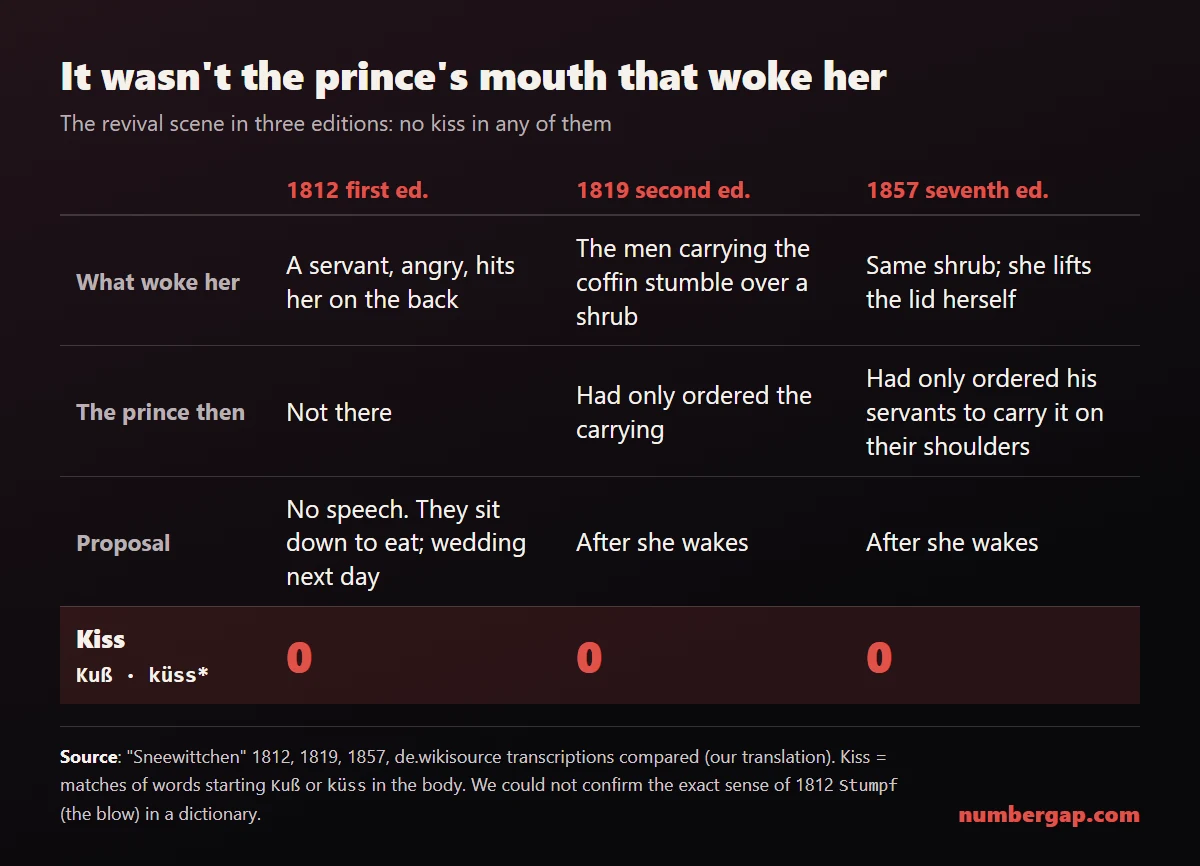
D. L. Ashliman's translation notes at the University of Pittsburgh say the same about the change: from the 1819 edition on, the apple is dislodged when a servant accidentally stumbles. [D. L. Ashliman, "Little Snow-White," University of Pittsburgh]
The Christian Science Monitor also noted back in 2012 that in some versions "it's not that kiss from the prince that awakens Snow White." [Molly Driscoll, CSMonitor, 2012-12-20] Our count is stronger than "some versions." The kiss is absent from all three.
Why did only the prince scene shrink?
We cut the story into eight blocks and counted the words in each. From 1812 to 1819 the story body grew by 14 percent. Seven blocks got longer.
One block shrank. The one where the prince appears and Snow White wakes: from 281 words to 227.
The story was swelling, and the prince's scene was the one thing trimmed. What got trimmed matches what we just read. The prince at the coffin who can't eat. The meal right after she wakes.
We found no place where the Grimms say why. [Not confirmed — editorial intent] What we know is what got shorter.
So where does Disney's kiss come from?
Disney's 1937 film has one. The queen herself says the poisoned apple can only be broken by "love's first kiss," and the prince's kiss wakes Snow White. [English Wikipedia, "Snow White and the Seven Dwarfs (1937 film)," plot summary — secondary]
English Wikipedia's "Snow White" article says the kiss "appears in the Disney film, which … borrowed it from Grimm's 'Little Briar Rose'." We did not trace that sentence's footnote. A similar claim on a Disney fan wiki isn't a source we trust, so we left it out.
So we don't say "Disney invented the kiss." What is confirmed is narrower: it isn't in the body of any of the three Grimm editions.
Did the Huntsman Bring Back a Heart in the Original?
No. What the huntsman brings is lungs (Lunge) and liver (Leber), the same in all three editions.
And the queen eats it.
What does the 1812 queen say?
In the first edition the queen calls the huntsman and gives this order:
führ das Sneewittchen hinaus in den Wald an einen weiten abgelegenen Ort, da stichs todt, und zum Wahrzeichen bring mir seine Lunge und seine Leber mit, die will ich mit Salz kochen und essen.
Take Snow White out into the forest to a far, remote place, stab her dead, and as a token bring me her lungs and her liver; I will boil them with salt and eat them. [our translation]
Source: "Sneewittchen" (1812), de.wikisource transcription.
She doesn't stop at asking for proof. She says she will eat it.
That line leaves the order in 1819. It's in the first edition only.
The huntsman's problem is written out in the text. He has drawn his knife. Snow White begins to cry and begs for her life; she says she will never come back out of the forest.
Den Jäger erbarmte es, weil es so schön war und gedachte: die wilden Thiere werden es doch bald gefressen haben, ich bin froh, daß ich es nicht zu tödten brauche
The huntsman took pity, because she was so beautiful, and thought: the wild animals will surely have eaten her soon, I am glad I don't have to kill her [our translation]
Source: "Sneewittchen" (1812), de.wikisource transcription.
Just then a young boar (Frischling) comes running. The huntsman stabs it, takes out lungs and liver and brings them to the queen.
die kochte sie mit Salz und aß sie auf, und meinte sie hätte Sneewittchens Lunge und Leber gegessen.
she boiled them with salt and ate them up, and believed she had eaten Snow White's lungs and liver. [our translation]
Source: "Sneewittchen" (1812), de.wikisource transcription. The 1819 and 1857 texts each have
aß sie auf(ate them up) once.
What she ate came from a boar. She believed it was her daughter's. The German is meinte, "believed."
That belief calms her for a while. The first edition says: Die Königin aber glaubte, sie sey wieder die allerschönste im Land, the queen believed she was again the fairest in the land.
Why does she eat it?
The text doesn't say. No sentence in any of the three editions says she ate it to gain beauty or youth.
"She eats it to gain Snow White's beauty" is a later gloss, not the German. [Our interpretation] In 1812 she says only that she will eat it, never why.
How does the eating scene change?
The queen eats in all three editions. The telling changes.
| The order | The eating sentence | |
|---|---|---|
| 1812 | She says herself: "I will boil them with salt and eat them" | die kochte sie mit Salz und aß sie auf |
| 1819 | Proof only | Die ließ sie in ihrer Gier gleich in Salz kochen, aß sie auf (in her greed she had them boiled in salt at once and ate them) |
| 1857 | Proof only | Der Koch mußte sie in Salz kochen, und das boshafte Weib aß sie auf (the cook had to boil them in salt, and the wicked woman ate them up) |
Source: comparison of the 1812, 1819 and 1857 de.wikisource transcriptions. English renderings are ours.
In the first edition she says she'll eat. By 1857 a cook boils it and she is "the wicked woman." The same event, but the voice moves from the queen to the narrator. [Our interpretation]
The cook (Koch) shows up only in 1857 among the editions we compared. English Wikipedia's Evil Queen article is consistent with that: the queen prepares and eats the organs, "or in some retellings a cook." [English Wikipedia, "Evil Queen"]
Where does the heart come from?
The word "heart" turns up once in the German, in 1857: Sneewittchens unschuldiges Herz durchbohren wollte, wanted to pierce Snow White's innocent heart. It's the place he was about to stab. Not the proof he carries home.
If you picture a heart in a box, that's the 1937 film. By English Wikipedia's plot summary, the film's proof is a heart in a jeweled box. The structure of "bring me proof" stays; the contents change; and that plot summary has no scene of eating. [English Wikipedia, "Snow White and the Seven Dwarfs (1937 film)" — secondary]
What did the 1852 illustrator draw?
Let's open a picture. Its file name on Wikimedia Commons is Snow White Heart.
It's page 8 of an 1852 Icelandic picture book, Mjallhvít. The scan is from the National Library of Iceland, and the illustrator is unknown. The file description suggests Theodor Hosemann may have drawn it, though the upload comment says "artist unknown." It is in the public domain.
From the file name we expected a huntsman holding a heart.
We opened it. It wasn't a huntsman.
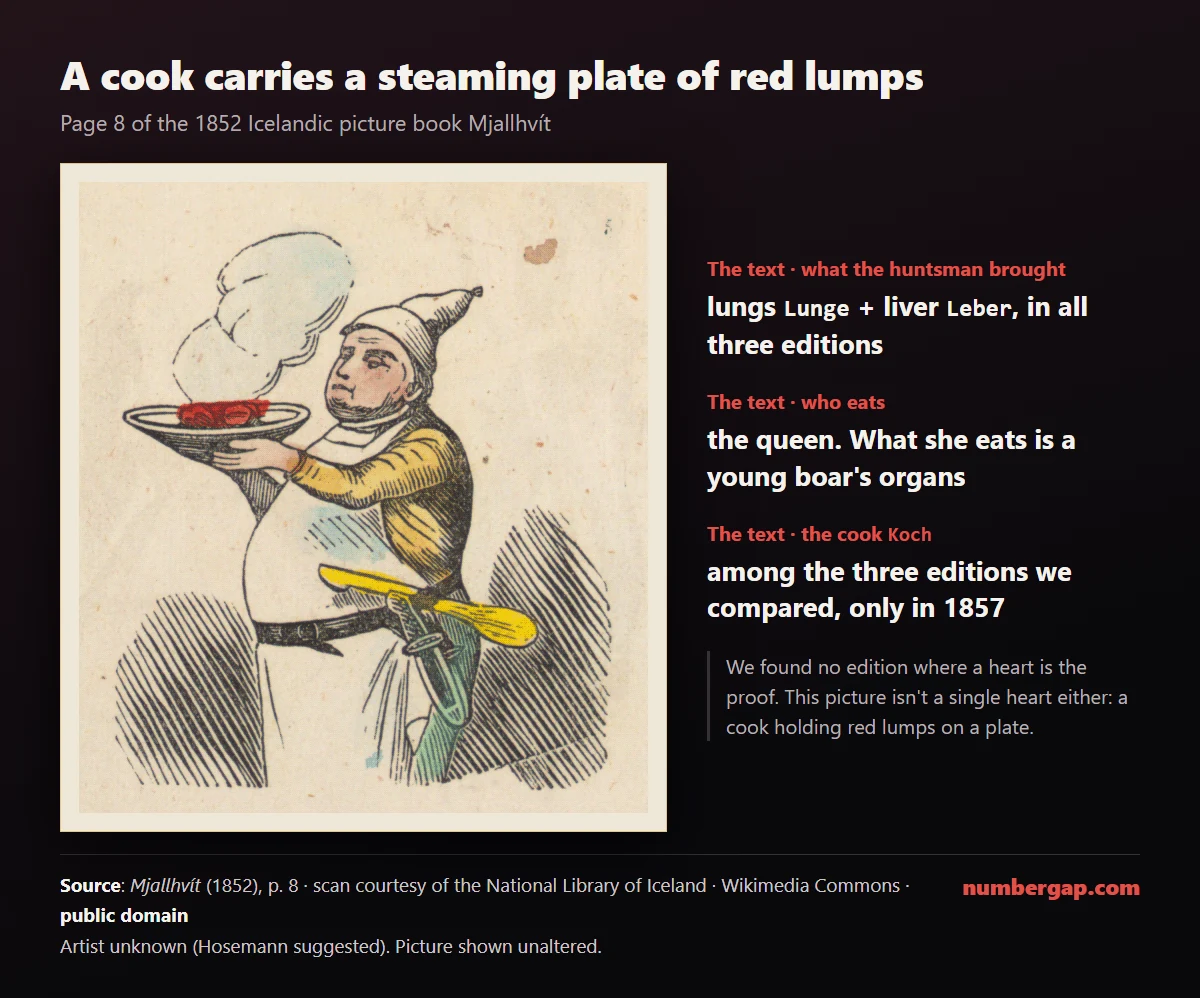
It's a cook. A man in a tall cap and apron, a knife at his belt, holds a steaming plate in both hands. On the plate sit red lumps. To our eyes it isn't one heart-shaped thing. It looks like two lumps. [Our reading]
Set it next to the text. What the huntsman brought was lungs and liver, two organs. A cook cooks them (in the 1857 text), and the queen eats them.
The picture read the text exactly. This isn't "the original was gruesome and the picture cleaned it up." An early illustrator put the organs on a plate and handed it to a cook.
One caution. In the three editions we compared, the cook appears only in 1857. This book is from 1852. We don't know which edition it followed. A cook in a picture leaves open that he was in the text before 1857. We haven't compared the editions in between (1837, 1840, 1843, 1850).
How Does the Original Snow White End?
The queen goes to the wedding, puts on red-hot iron shoes and dances until she falls dead. The sentence that says so has no grammatical subject.
Why does the queen go to the wedding?
She is terrified, and she goes anyway. Here is the last mirror scene in the first edition.
Frau Königin, Ihr seyd die schönste hier, aber die junge Königin ist tausendmal schöner als Ihr! Als sie das hörte, erschrack sie, und es war ihr so Angst, so Angst, daß sie es nicht sagen konnte. Doch trieb sie der Neid, daß sie auf der Hochzeit die junge Königin sehen wollte
My lady queen, you are the fairest here, but the young queen is a thousand times more beautiful than you! When she heard that, she was startled, and she was so afraid, so afraid, that she could not say it. Yet envy drove her to want to see the young queen at the wedding [our translation]
Source: "Sneewittchen" (1812), de.wikisource transcription. 1819 is nearly the same. In 1857 she "uttered a curse" (
Fluch) and the reason she goes becomesdoch ließ es ihr keine Ruhe(yet it would not leave her in peace).
She can't stay away. And when she arrives:
wie sie ankam, sah sie, daß es Sneewittchen war
when she arrived, she saw that it was Snow White [our translation]
In the first edition, the mother who tried to have her daughter killed recognizes her daughter at the daughter's wedding.
Who put the iron shoes there?
Here is the first edition's sentence.
da waren eiserne Pantoffeln im Feuer glühend gemacht, die mußte sie anziehen und darin tanzen, und ihre Füße wurden jämmerlich verbrannt, und sie durfte nicht aufhören bis sie sich zu todt getanzt hatte.
there were iron slippers made glowing in the fire, which she had to put on and dance in, and her feet were miserably burned, and she was not allowed to stop until she had danced herself to death. [our translation]
Source: "Sneewittchen" (1812), de.wikisource transcription.
And in 1857:
Aber es waren schon eiserne Pantoffeln über Kohlenfeuer gestellt und wurden mit Zangen herein getragen und vor sie hingestellt. Da mußte sie in die rothglühenden Schuhe treten und so lange tanzen, bis sie todt zur Erde fiel.
But iron slippers had already been set over a coal fire and were carried in with tongs and placed before her. She had to step into the red-glowing shoes and dance until she fell dead to the ground. [our translation]
Source: "Sneewittchen" (1857), de.wikisource transcription.
"Made glowing." "Had been set." "Were carried in." All passive. The text doesn't say who heated them or who carried them.
So there is no sentence in which Snow White or the prince gives the order. There is none in which they stand and watch. The German words for watching (zusehen, zuschauen) appear zero times, and so does Gäste, guests. In this scene neither Snow White nor the prince does anything.
The German word is Pantoffeln, slippers or mules. "Iron shoes" is a translator's choice, and English sources differ: Wikipedia says "red-hot iron slippers," the Literary Review says "red-hot iron shoes." English Wikipedia also notes that the 1810 manuscript doesn't say the shoes were iron. [English Wikipedia, "Snow White"; Literary Review, May 2020]
Did 1857 get more brutal or less?
Lay the editions side by side and something odd turns up.
In 1812 and 1819, the queen's feet are jämmerlich verbrannt, miserably burned. In 1857 that clause is gone, and "danced herself to death" becomes "fell dead to the ground." What 1857 adds is tongs (mit Zangen). No sentence says her feet burn. The shoes are glowing, and she falls.
Researchers do say punishment of villains grew more violent in later editions. [English Wikipedia, "Grimms' Fairy Tales," citing Tatar's introduction] In this one scene it runs the other way. That's one scene, not a verdict on the trend.
| Scene | 1812 | 1819 | 1857 |
|---|---|---|---|
| The queen eats the lungs and liver | Announces she will eat them, then does | Eats them | A cook boils them; she eats |
| The prince can't eat without the coffin beside him | Yes | No | No |
| A servant hits Snow White on the back | Yes | No (stumble over a shrub) | No (stumble over a shrub) |
| Dancing in glowing shoes | Yes (feet miserably burned) | Yes (feet miserably burned) | Yes (the burning clause cut; tongs added) |
How did the 1852 illustrator draw the last scene?
We opened the final picture from the same 1852 book. Page 31. The iron shoes.
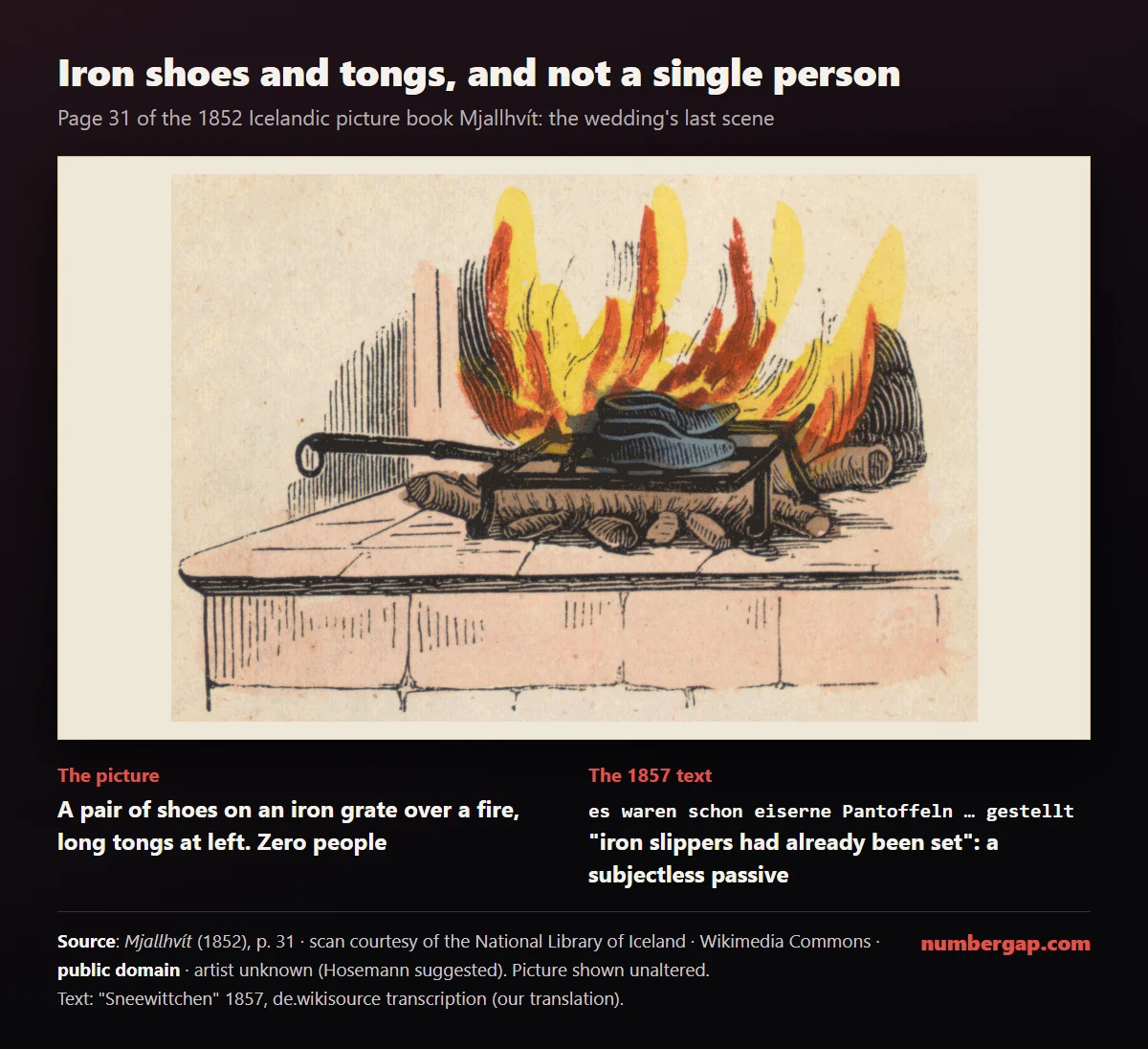
There's nobody in it.
Flames, a pair of iron shoes, a pair of long tongs. That's all. No queen, no Snow White, no prince, no bystanders.
The subjectless sentence became a picture with no subject. This is the same point as the cook: the picture isn't evidence of softening. The illustrator read the text as written.
One more thing. The tongs in the picture match a word that, among the three editions we compared, appears only in 1857 (Zangen). First the cook, now the tongs. The 1852 pictures contain elements we first see in text in 1857. That's a clue, not a conclusion. The illustrator may have added them, or the edition this book followed may already have had the words. [Our interpretation]
Do the Seven Dwarfs Have Names in the Original?
No. Forms of Zwerg appear 19, 22 and 22 times across the three editions. Personal names for them appear zero times in all three.
So how do you tell seven apart without names? By their things. When they come home in the evening, they speak in turn:
Der erste sprach: „wer hat auf meinem Stühlchen gesessen?“ Der zweite: „wer hat von meinem Tellerchen gegessen?“ Der dritte: „wer hat von meinem Brödchen genommen?“
The first said: "Who has been sitting on my little chair?" The second: "Who has been eating from my little plate?" The third: "Who has taken from my little bread?" [our translation]
Source: "Sneewittchen" (1812), de.wikisource transcription.
The fourth asks about his vegetables, the fifth his fork, the sixth his knife, the seventh his cup. Where names would go, there are ordinals and tiny tableware.
Beards, caps, height: zero in all three editions. "Small" reaches us through the house and its objects, not through anyone's body. "Everything was small" in the house, and diminutive words for plate, spoon and bed. The dwarfs' bodies are never described. [Our interpretation]
The Literary Review calls the dwarfs "immaculately tidy." In the German it is the house that is "so zierlich und reinlich, daß es nicht zu sagen ist," so dainty and clean it can't be told. [Literary Review, May 2020; our comparison with the German]
They are miners. In 1812 they dig gold by day, and from 1819 on, ore (Erz) comes first.
Who gave them names first?
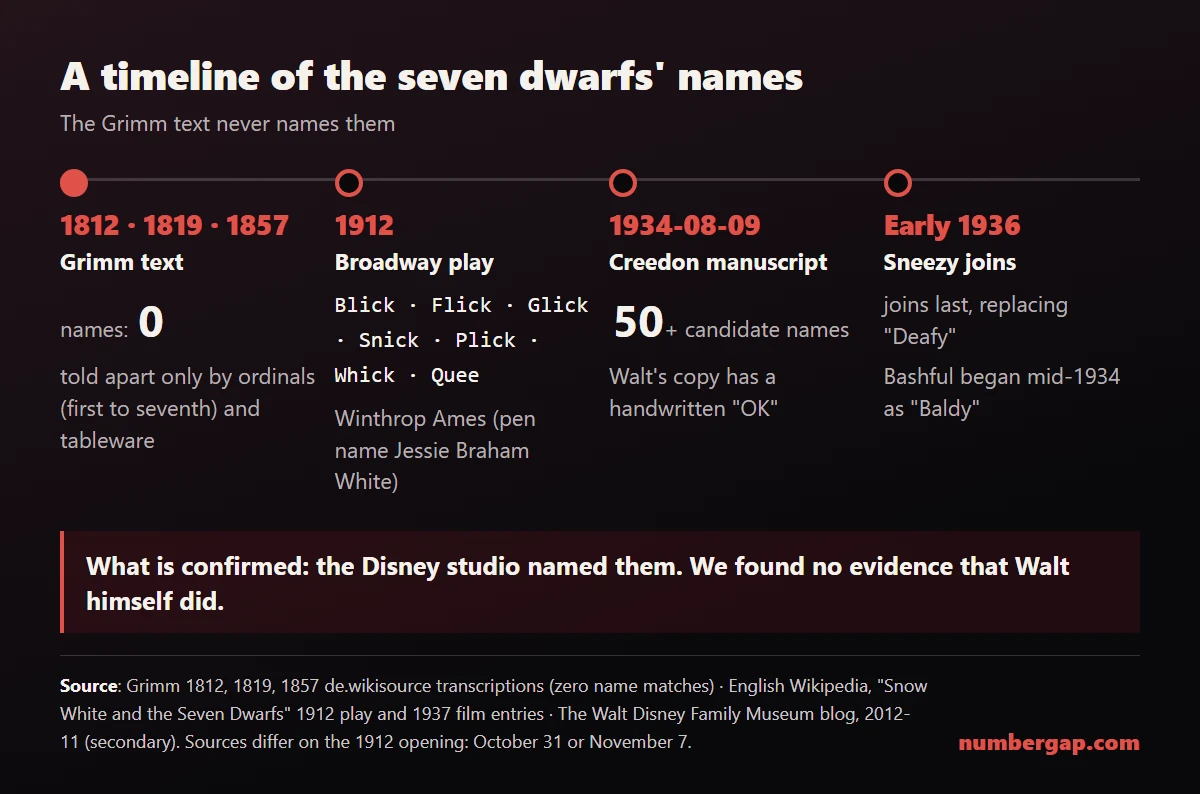
English Wikipedia says the dwarfs "were first given individual names in the 1912 Broadway play": Blick, Flick, Glick, Snick, Plick, Whick and Quee, in a play written by Winthrop Ames under the pen name Jessie Braham White. The Disney film then used different names. Korean Wikipedia credits the 1937 film as first. We could not settle that conflict beyond the English Wikipedia entry on the play, and sources disagree on the play's opening date (October 31 or November 7). [English Wikipedia, "Snow White and the Seven Dwarfs (1912 play)" — secondary]
Disney's names left some paper behind.
The earliest plot document is a manuscript by writer Richard Creedon dated August 9, 1934, with more than 50 candidate names for the dwarfs. Beside one of them, "Sneezy-Wheezy or Gaspy," Walt's copy has a handwritten "OK." That idea sat unused for over a year, then in early 1936 Sneezy joined as the last dwarf, replacing "Deafy." Bashful started in mid-1934 as "Baldy." [English Wikipedia, "Snow White and the Seven Dwarfs (1937 film)"; The Walt Disney Family Museum blog, 2012-11 — secondary]
We found no evidence that Walt himself coined the names. The Creedon document, Walt's "OK" and the writers' meetings are what's confirmed. So we say "the Disney studio named them," not "Walt named them."
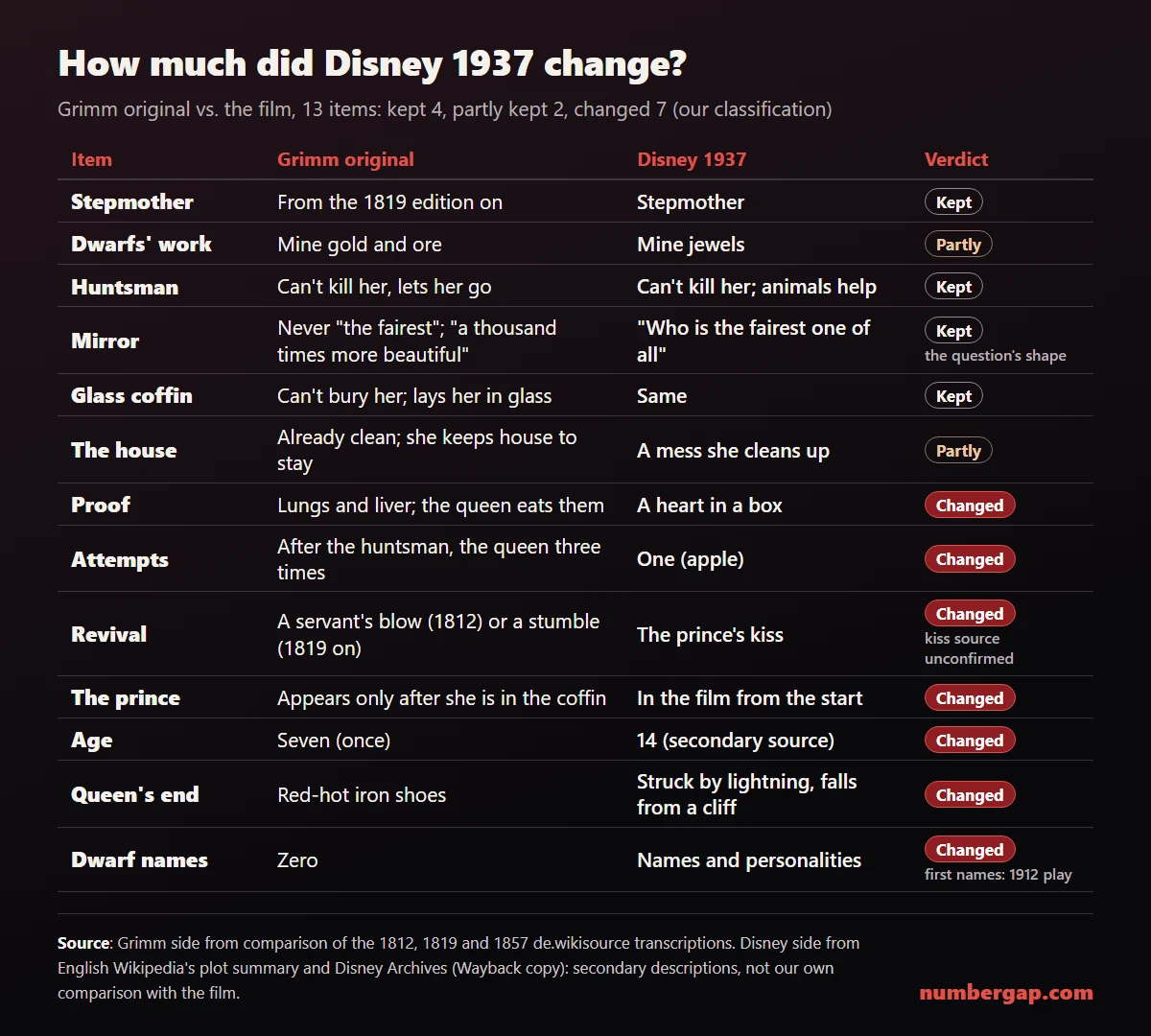
How Much Did Disney Change? Give Credit Where It's Due
A good deal of what Disney did, it took straight from the Grimms. The stepmother is the big example.
You'll hear "Disney turned the mother into a stepmother." That's backwards. The Grimms had already made the change in 1819, and Disney followed that edition. Disney Archives' page on the villain describes Snow White in the film as the queen's "stepdaughter." [Disney Archives, Evil Queen page (Wayback copy, 2010-04-01)]
| Item | Grimm original | Disney 1937 | Verdict |
|---|---|---|---|
| Stepmother | From the 1819 edition on | Stepmother | Follows the original (1819 on) |
| Dwarfs' work | Mine gold and ore | Mine jewels | Keeps the mine; changes what's dug |
| Huntsman | Can't kill her; forest animals leave her unharmed | Can't kill her; forest animals help | Follows and expands |
| Mirror | "Magic" zero times; never calls her "the fairest," only "a thousand times more beautiful than you" (5 times) | "Who is the fairest one of all" | Keeps the question's shape |
| Glass coffin | Can't bury her, lays her in glass; dwarfs and animals keep watch | Same | Follows |
| The house | Already clean (zierlich und reinlich); she keeps house to stay |
A mess she cleans up | Keeps the housekeeping deal; reverses the setup |
| Proof | Lungs and liver; the queen eats them | A heart in a box | Changes |
| Attempts | The huntsman, then the queen three times (lace, comb, apple) | One (apple) | Cuts |
| Revival | A servant's blow (1812) or a stumble (1819 on) | The prince's kiss | Changes; the kiss's source is unconfirmed |
| The prince | Appears only after she is in the coffin | In the film from the start | Changes |
| Age | Seven (once) | 14 (secondary source) | Changes |
| The queen's end | Red-hot iron shoes | A cliff fall in a storm | Changes |
| Dwarf names | Zero | Names and personalities | Changes; first names were the 1912 play |
Source: Grimm side from comparison of the 1812, 1819 and 1857 de.wikisource transcriptions. Disney side from English Wikipedia's plot summary and Disney Archives (Wayback copy); these are secondary descriptions, not our own comparison with the film.
Disney didn't build everything from scratch, either. Walt Disney saw the 1916 silent film Snow White in Kansas City at fifteen, and the National Film Preservation Foundation says that memory inspired the 1937 feature. That 1916 film already had a stepmother, a magic mirror, a poisoned comb and seven dwarfs, plus a Cinderella thread: a kitchen-working Snow White dancing with a prince. We found no sentence saying the 1937 film took these directly from it. [National Film Preservation Foundation, "Snow White (1916)"]
Frequently Asked Questions
Q. How does the original Snow White end?
A. The queen is invited to the wedding, steps into iron shoes heated over coals and dances until she falls dead. The text doesn't say who heated them; the sentence has no subject. The cliff fall of the Disney film isn't in the original.
Q. Was the Evil Queen Snow White's mother or stepmother in the original?
A. It depends on the edition. In the 1812 first edition story body she is Snow White's own mother. The stepmother begins with the 1819 second edition. The 1812 appendix already contained a stepmother variant.
Q. Is there a kiss in the original Snow White?
A. No. The words for kiss (Kuß, küss*) appear zero times in the 1812, 1819 and 1857 story bodies. Snow White wakes when an angry servant hits her on the back (1812) or when the men carrying her coffin stumble over a shrub (1819 on).
Q. How does the prince wake Snow White in the original?
A. He doesn't. In 1812 the text has her go to him after she wakes. In 1819 and 1857 he has ordered the coffin carried, and a stumble shakes the apple out of her throat.
Q. Did the huntsman bring back a heart in the original Snow White?
A. No. He brings lungs and liver, the same in all three editions, from a young boar, not a deer. We found no edition where a heart is the proof.
Q. Does the queen eat Snow White's liver in the original?
A. She eats a boar's lungs and liver, believing they are Snow White's. No sentence says why. In 1812 she announces she will boil them in salt and eat them.
Q. How old is Snow White in the original story?
A. Seven, stated once, when the mirror first names her. Her age at the wedding is not given in any of the three editions.
Q. Do the seven dwarfs have names in the original Snow White?
A. No. Zero names in all three editions; they are told apart by ordinals (first to seventh). English Wikipedia says the first names came from a 1912 Broadway play.
Q. What does Snow White look like in the original?
A. White as snow, red as blood and black as ebony. No word for skin or lips appears in the three editions, and "black-haired" (schwarzhaarig) starts in 1819.
Q. Who heated the iron shoes in Snow White?
A. The text doesn't say. "Had been set over a coal fire" and "were carried in" are passives with no agent. No sentence has Snow White or the prince order it or watch it.
Q. Why did the Grimms change the mother into a stepmother?
A. We didn't find a sentence in which they say. "Held motherhood sacred" is Jack Zipes's reported view and Maria Tatar says something similar; Zipes also offered a second explanation about young stepmothers and stepdaughters.
Q. How many times did the Grimms revise Snow White?
A. The large editions came out in seven versions, so six revisions. The 1812 and 1815 volumes are two halves of the first edition.
Q. Did Disney change the mother into a stepmother?
A. No. The Grimms made that change in 1819, and Disney followed that edition.
How We Checked: Which Editions, and How We Counted
The check date is October 24, 2026.
Editions. German transcriptions on de.wikisource of the 1812 first edition, the 1819 second edition and the 1857 seventh edition. For 1812 and 1857 the saved pages are titled "Sneewittchen (1812)" and "Sneewittchen (1857)." The 1819 transcription came to us as a file, and the file does not record its original URL.
How we counted. Story body only. We stripped page numbers, title blocks, Wikisource editorial notes and the appendix attached to the end of the 1812 file. A word is a whitespace-separated token. We did not normalize old spellings (roth/rot, seyd/seid, th); both forms went into each pattern. Matching is case-sensitive except for names. Every count can be rerun from scripts.
The illustrations. We downloaded the two public-domain pages from the 1852 picture book on Wikimedia Commons and looked at them ourselves. We did not write from file names or descriptions.
What we got wrong and fixed. Two things. The first Stiefmutter count of one in the 1812 file was the appendix, not the story. And the drop from 3,380 to 2,861 words was an illusion from the appendix being in the file; counting only the body, the story grew.
What we could not check.
- The Princeton University Press translation of the 1812 first edition by Jack Zipes (we only read press coverage of it)
- The body text of the 1837, 1840, 1843 and 1850 editions, and which edition the 1852 picture book followed
- The exact sense of
Stumpf - The Grimms' full letters and the preface to the small edition, to see whether they say why they changed the mother
- The Slashfilm-cited translation page, which would not open
- Where the Disney film's kiss came from, and the film's dialogue and scenes themselves (we relied on Wikipedia's plot summary and Disney Archives)
Reading the Original Yourself: Three Things to Look For
If you want to read the original, check three spots in the translation you pick.
One. Which edition it follows. If it follows the 1812 first edition, the queen should be Snow White's mother. A translation that follows 1819 or later will have a stepmother. Jack Zipes's 2014 Princeton University Press translation of the complete first edition is the one to look for; we haven't read it ourselves, only the coverage of it.
Two. What the huntsman brings back. Lungs and liver, or a heart?
Three. How she wakes. A kiss, or a jolt of the coffin?
If this was useful, we'll see you in the next post.
Sources
Primary texts: Sneewittchen (1812), de.wikisource (story body and appendix, vol. 1 pp. XXXII–XXXIV) · Sneewittchen (1819), de.wikisource transcription · Sneewittchen (1857), de.wikisource · Bolte and Polívka, Anmerkungen zu den Kinder- und Hausmärchen der Brüder Grimm I, 53 Sneewittchen (1913), de.wikisource · Brothers Grimm, preface to the second edition (1819-07-03), German History Documents
Illustrations (public domain per Wikimedia Commons): Mjallhvít (1852, courtesy of the National Library of Iceland), pages 8 and 31
Scholarship and press: Alison Flood, The Guardian, 2014-11-12 · Molly Driscoll, Christian Science Monitor, 2014-11-13 and 2012-12-20 · NPR/WUNC, interview by Rachel Martin, 2014-11-16 · Harvard Gazette, interview with Maria Tatar, 2020-07-16 · Lucy Lethbridge, Literary Review, May 2020 · Caroline Madden, Slashfilm, 2025-08-11 · D. L. Ashliman, "Little Snow-White," University of Pittsburgh · English Wikipedia: "Snow White," "Evil Queen," "Grimms' Fairy Tales," "Snow White (2025 film)," "Snow White and the Seven Dwarfs (1912 play)," "Snow White and the Seven Dwarfs (1937 film)" · German Wikipedia: "Grimms Märchen," "Schneewittchen" · Disney Archives, Evil Queen page (Wayback copy, 2010-04-01) · The Walt Disney Family Museum blog, "Seven Dwarf Days," 2012-11 · National Film Preservation Foundation, "Snow White (1916)" · Mouse Planet, "The Little Princess: Snow White"


Comments
Post a Comment