Noisy Upstairs Neighbor: Who Fixes It? (NYC 311 Data)
Picture it. It is 11 p.m., and the floor above you sounds like someone is dragging furniture across it.
Last updated: 26 October 2026 · Figures and rules in this post are current as of this date.
In New York, you call 311. The city's own data names one agency as responding to these complaints: the NYPD.
So we pulled the 311 file and read how the police closed each complaint.
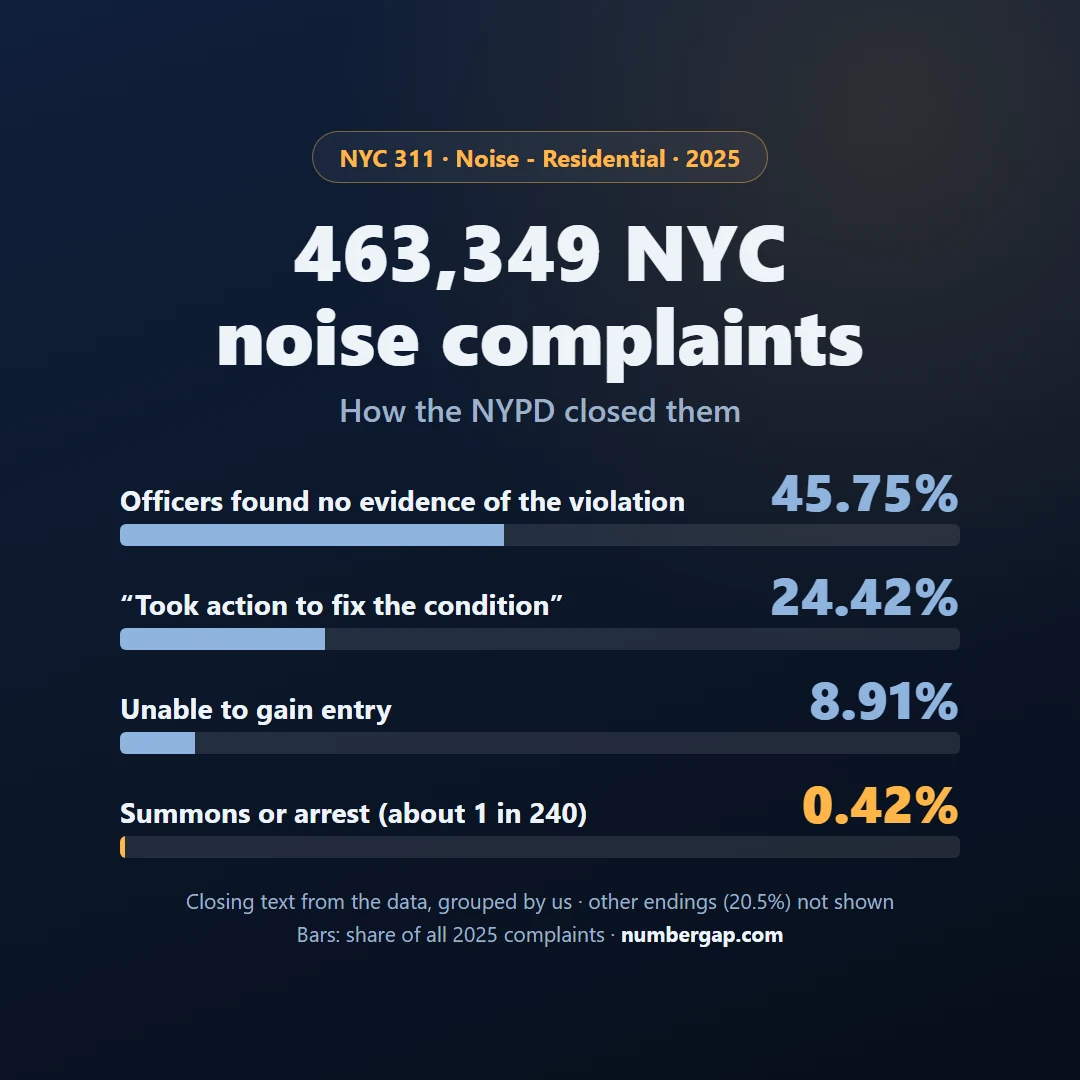
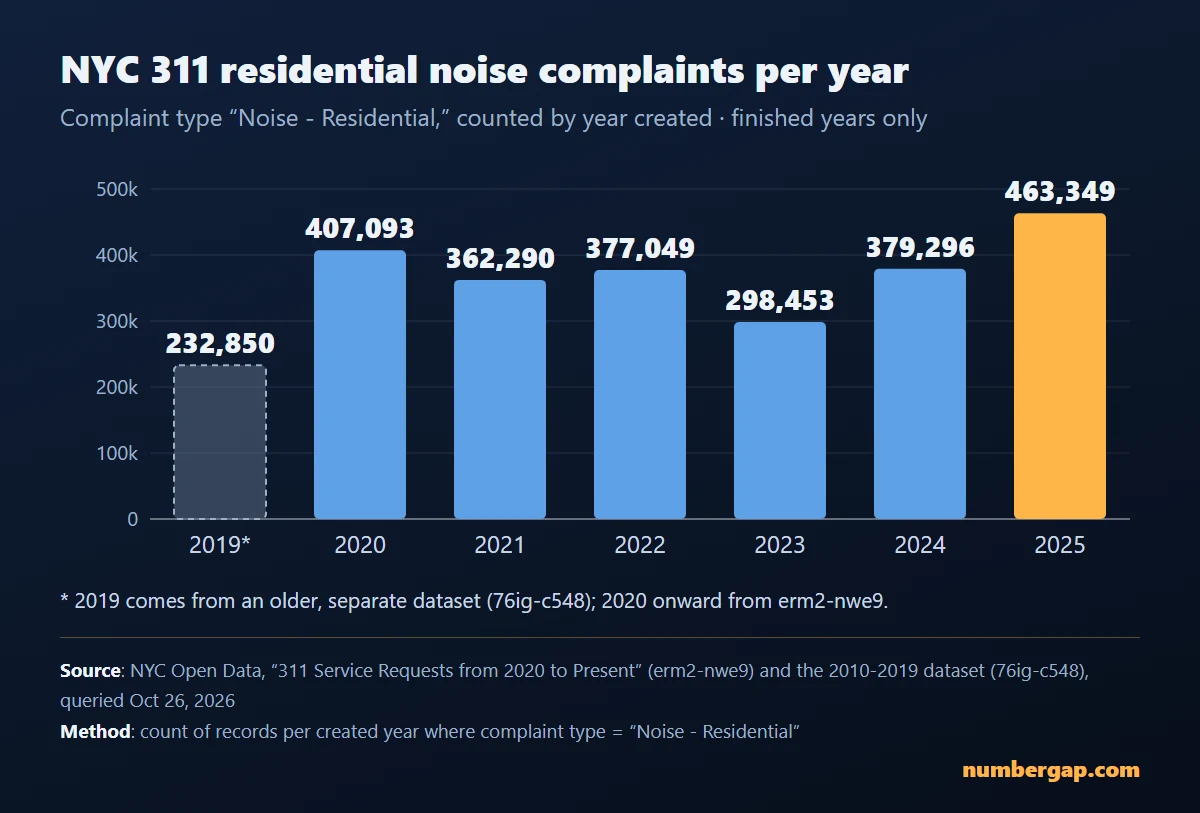
In 2025, New Yorkers filed 463,349 residential noise complaints, more than in any other year we found. The police wrote a summons or made an arrest on about 1 in 240 of them.
The most common ending was something else. Officers showed up and found no evidence of the violation. That happened 45.75% of the time.
This post reflects the sources we checked on October 26, 2026. The NYC figures cover the finished year 2025. We looked at New York in depth and at four other cities more briefly. Nothing below says "in the country." It says "in the places we checked."
This is information, not legal advice. We can tell you what a code, a case, or a dataset says. We cannot tell you what it means for your lease, your landlord, or your neighbor. For your own situation, contact a local tenant organization, a legal aid office, or a licensed attorney in your state.
What Happens When You Call 311 About a Noisy Upstairs Neighbor in NYC?
Most calls end without a ticket. In 2025, the NYPD closed 45.75% of residential noise complaints saying officers found no evidence of the violation, and 0.42% with a summons or an arrest.
| How the NYPD closed the complaint (our grouping) | Share of 2025 complaints |
|---|---|
| Officers found no evidence of the violation | 45.75% (211,985) |
| "Responded and took action to fix the condition" | 24.42% (113,128) |
| Police action "not necessary" | 12.29% (56,979) |
| Officers "unable to gain entry into the premises" | 8.91% (41,298) |
| Condition corrected on scene, "without the need to issue a summons or effect an arrest" | 5.30% (24,578) |
| Those responsible were gone on arrival | 1.21% (5,626) |
| Not NYPD jurisdiction, insufficient contact information, report prepared, other | about 1.7% |
| Summons issued | 0.37% (1,722) |
| Arrest made | 0.05% (205) |
Source: NYC Open Data, "311 Service Requests from 2020 to Present" (dataset erm2-nwe9), complaint type "Noise - Residential," complaints created in 2025, queried October 26, 2026 — agency data. The grouping of closing messages is ours.
https://data.cityofnewyork.us/resource/erm2-nwe9.json
Two cautions before you read anything into that table.
First, "took action to fix the condition" is the NYPD's closing wording. The dataset does not say what the action was. It could be a knock on the door. We do not read it as a fine or a lasting fix.
Second, these are complaints, not households. Repeat callers inflate the count.
One more number. Callers choose a descriptor when they file, and the one closest to upstairs stomping is "Banging/Pounding." It drew 126,388 complaints in 2025. Of those, police issued 259 summonses and made 54 arrests. About 1 in 400.
Source: same dataset, Banging/Pounding descriptor, 2025 — agency data. The descriptor is chosen by the caller and is not a measured impact noise.
The volume has a history too. 2025 was the highest year in the file, close to double 2019's 232,850 (an older, separate dataset). The jump to 407,093 in 2020 coincides with the pandemic. We found no source that explains the full increase, so we will not.
Did NYC Police Really Issue Summonses on Only 0.4% of Noise Complaints?
By our count, yes. But we got it wrong the first time.
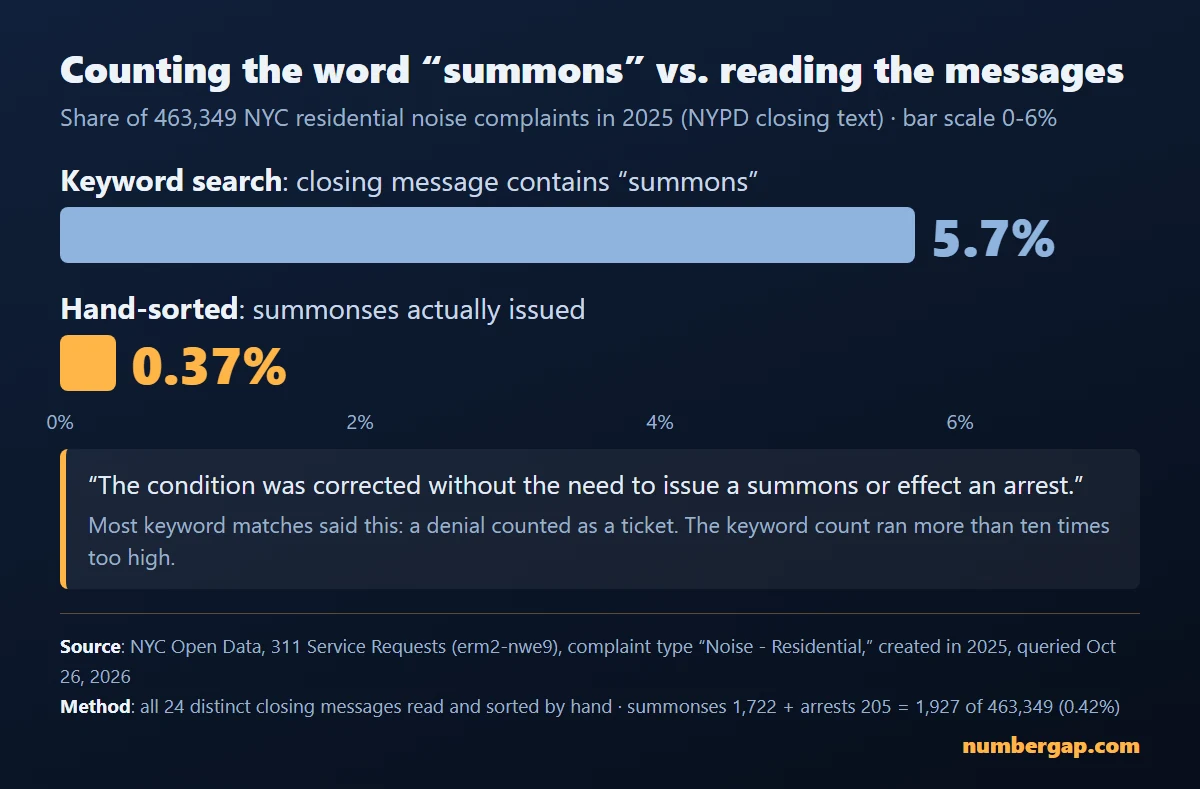
Our first pass searched the closing messages for the word "summons." The result: 5.7% of complaints. We nearly wrote it down.
Then we read the sentences. Most of the matches said this: "The condition was corrected without the need to issue a summons or effect an arrest."
The police were saying they had not issued one. We had counted the denial as a ticket.
So we stopped searching for words and read all 24 distinct closing messages, one at a time, and sorted them by hand. The real figures: 0.37% summonses and 0.05% arrests. The keyword count had been more than ten times too high.
A note on grouping, because the same messages can be sorted more than one way. An earlier pass by our researcher folded the "corrected without a summons" messages into "took action" and got 29.7% instead of our 24.4%. Add the 1.2% "gone on arrival" to "no evidence" and you get 47.0% instead of 45.75%. Neither grouping is wrong. The summons-and-arrest share, about 0.4%, comes out the same either way.
Is There a Federal Noise Limit for Apartments and Neighbors?
No. We found no federal statute or regulation that sets an indoor decibel limit for noise between neighbors.
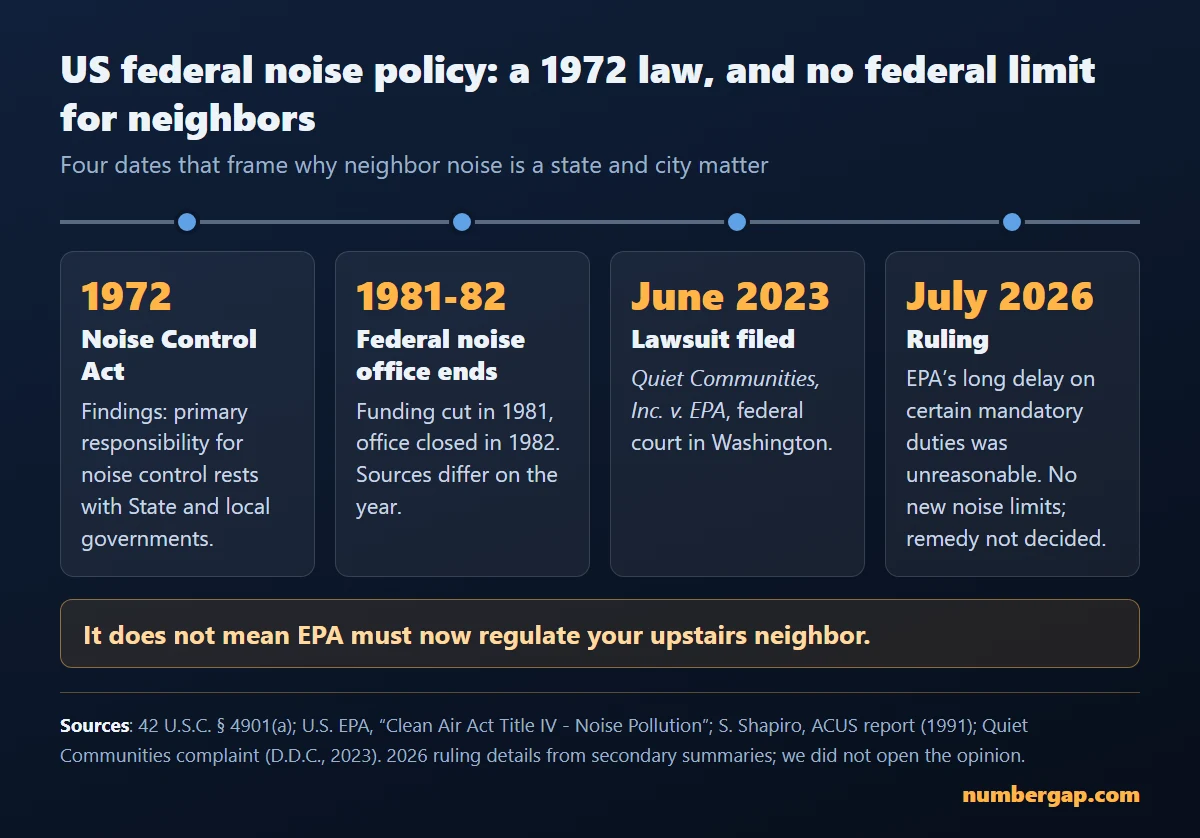
That is not because Congress never tried. The Noise Control Act of 1972 is still on the books (42 U.S.C. §§ 4901-4918). Its own findings hand the job down: "primary responsibility for control of noise rests with State and local governments," while "Federal action is essential to deal with major noise sources in commerce."
Source: 42 U.S.C. § 4901(a), Cornell Legal Information Institute — federal statute text.
https://www.law.cornell.edu/uscode/text/42/4901
The federal office built to carry the Act, the Office of Noise Abatement and Control, did not last. EPA's own page says it coordinated federal noise control "until 1981, when the administration concluded that 'noise issues were best handled at the State and local level.'" The office was closed and primary responsibility shifted to state and local governments.
Source: U.S. EPA, "Clean Air Act Title IV - Noise Pollution," fetched October 26, 2026 — agency page.
https://www.epa.gov/clean-air-act-overview/clean-air-act-title-iv-noise-pollution
Sources disagree on the year, 1981 or 1982. Our reading is that 1981 was the funding decision and 1982 was the shutdown, so we say 1981-82.
Sidney Shapiro, writing a report for the Administrative Conference of the United States in 1991, put the damage in numbers. Local noise programs fell, he wrote, "from 300 to 400 in 1981 to 50 to 75." And the Act itself was never repealed. It "stands alone in being stripped of budgetary support."
Source: Sidney A. Shapiro, report for the Administrative Conference of the United States, November 1991, hosted at nonoise.org — a secondary source we did not check against the original.
https://nonoise.org/library/shapiro/shapiro.htm
The story has a recent chapter. In Quiet Communities, Inc. v. EPA, a federal judge in Washington, Jia M. Cobb, ruled in July 2026 that EPA's long delay in performing certain mandatory duties under the Act was unreasonable.
Summaries of the ruling differ in how broadly they describe it. One consultancy says it sets no new noise limits and that the remedy has not been decided. A law-firm summary reads it more broadly. We use the narrower description, and we did not open the opinion itself, so treat the details as secondary.
It does not mean EPA must now regulate your upstairs neighbor.
How Loud Does an Upstairs Neighbor Have to Be to Break the Law?
It depends on the city, and there is no common number. Some cities compare the noise with what was already in the room. Some pick a fixed figure. Some name no figure at all.
| City | How the code defines too loud | Who enforces |
|---|---|---|
| New York | Sound from a "device" above ambient by 7 dB(A) from 10 p.m. to 7 a.m. (10 dB(A) from 7 a.m. to 10 p.m.), measurable inside a neighboring dwelling unit. A separate ban covers "unreasonable noise." | Civil penalty; first violation $350 to $1,000. 311 complaints go to the NYPD. |
| Los Angeles | Noise that exceeds ambient "within any adjoining unit" of an apartment house by more than 5 dB | Police Department |
| Seattle | 45 dBA at night, measured at the receiving property's property line | Seattle Police for loud-stereo cases |
| Boston | Per a City Council order restating the code: 50 dBA from 11 p.m. to 7 a.m., 70 dBA other hours | Police; reports through 311 and 911 |
| Chicago | No decibel figure. The test is "average conversational level" at a distance | Police and city hearings; $300 first offense |
Sources: NYC Administrative Code §§ 24-203, 24-218, 24-257 (read through the nycadmincode.readthedocs.io mirror, not the official publisher). Los Angeles Municipal Code § 112.01(c) as reproduced in a City Planning EIR reference file, undated, with amendments through 1998 — verify against the current code before quoting. Seattle SDCI "Noise Abatement Program FAQ." Boston City Council hearing order, filed July 22, 2026 (it restates the code; we did not open the code itself). Chicago from legalclarity.org, a secondary source, because the municipal code site blocked our automated access.
https://seattle.gov/documents/Departments/SDCI/About/NoiseFAQ.pdf
Two readings of that table are our interpretation, not a legal conclusion.
Seattle's figure is measured at a property line. For an apartment building that is probably the lot line, not your neighbor's wall.
And New York's +7 dB rule applies to a "device," which the code defines as "any mechanism which is intended to or which actually produces sound when operated or handled." Is a footstep a device? We found no New York case or guidance saying whether stomping falls under the +7 dB rule or the general "unreasonable noise" ban. We will not guess which applies.
Boston's City Council described its own residents' experience this way: calls to law enforcement and other city resources "frequently result in little or no apparent enforcement, resolution, communication, or follow-up." That is a council statement of complaints, not an audit.
Is the Landlord Responsible for a Noisy Upstairs Neighbor?
Sometimes. In the cases we read, courts tie a landlord's duty to two things: the landlord knew about the noise, and the landlord had the power to stop it.
Start with a tenant in Maryland. In April 1984, the tenant began complaining about the neighbors upstairs. As the court later described the allegations: clomping on an uncarpeted floor, a 5 a.m. alarm, a loud stereo. The landlord wrote two letters. Nothing changed. On August 8, 1985, the tenant moved out.
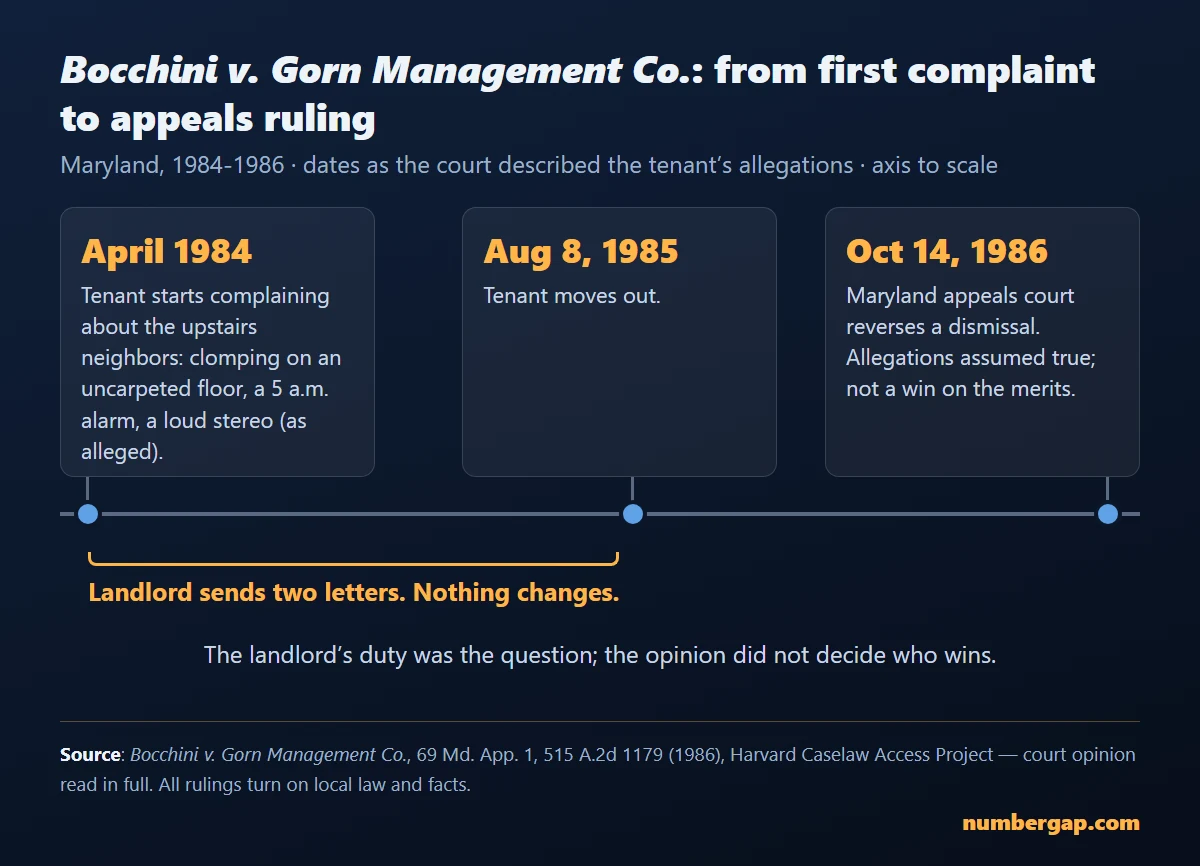
In Bocchini v. Gorn Management Co. (Md. Court of Special Appeals, 1986), the court reversed a dismissal. It adopted the Restatement view that a landlord who can "correct or terminate" another tenant's conduct "through lease provisions or otherwise" cannot escape by "steadfastly refusing to exercise his authority."
That was a ruling on a motion to dismiss. The court assumed the tenant's allegations were true. The tenant did not win on the merits in that opinion.
Source: Bocchini v. Gorn Management Co., 69 Md. App. 1, 515 A.2d 1179 (1986), Harvard Caselaw Access Project — court opinion, read in full.
https://static.case.law/md-app/69/cases/0001-01.json
Other courts went the other way, or somewhere in between.
| Case | What the court said |
|---|---|
| Gottdiener v. Mailhot, N.J. App. Div. (1981) | A tenant must show the noise made the home "substantially unsuitable for ordinary residential living" and that abating it was "within the landlord's power." The test is objective. |
| Blackett v. Olanoff, Mass. (1977) | The landlord answered for a nightly amplified-music lounge it leased next to the apartments. The court said this "is different from the usual annoyance of one residential tenant by another, where traditionally the landlord has not been chargeable." |
| Washington Realty Co. v. Rowe, D.C. Rental Housing Commission (1986) | "A covenant of quiet enjoyment is not a promise by a landlord to protect or insulate a tenant from noise." (An agency decision, not a court.) |
| Nostrand Gardens Co-Op v. Howard, N.Y. App. Div. (1995) | Affirmed a 50% rent abatement for late-night neighbor noise the landlord failed to stop "despite having ample notice." |
| Armstrong v. Archives L.L.C., N.Y. App. Div. (2007) | Reversed a tenant's partial summary judgment. A showing that many complaints were made was not enough on its own, and the landlord's evidence of steps taken created a factual dispute. |
| Brown v. Blennerhasset Corp., N.Y. App. Div. (2014) | Dismissed the claim against the upstairs neighbors: "heavy footsteps, snoring, and using a dishwasher" are "incidental to normal occupancy." But it let a claim against the landlord proceed. |
Sources: opinions read in full through the Harvard Caselaw Access Project (static.case.law), except Washington Realty, read from the D.C. Office of the Tenant Advocate. All rulings turn on local law and facts.
https://static.case.law/ad3d/113/cases/0454-01.json
The Brown case is worth a second look. The tenant's own expert testified that the upstairs neighbors' walking "is not going to be stopped by a simple carpet or pad" and was "attributable to the structure of the building itself." Ordinary footsteps were not a legal wrong. But a noise that comes from the building, not the person, shifts the question toward the landlord.
California shows how the answer can differ. Its list of conditions that make a rental "untenantable" (Civil Code § 1941.1) covers things like plumbing, heating, and weatherproofing. Noise is not on the list. We found no California authority letting a tenant repair-and-deduct for a neighbor's noise. "Not found" is not the same as "prohibited," so we say only that we found none.
Then there is the risk. In Gottdiener and Blackett, tenants moved out and prevailed only after the landlord sued them for the remaining rent. In Armstrong, a tenant who said she had "rightfully terminated her lease" lost her summary judgment. Leaving a lease over neighbor noise can be a gamble that gets decided afterward.
How Does Korea Handle the Same Problem?
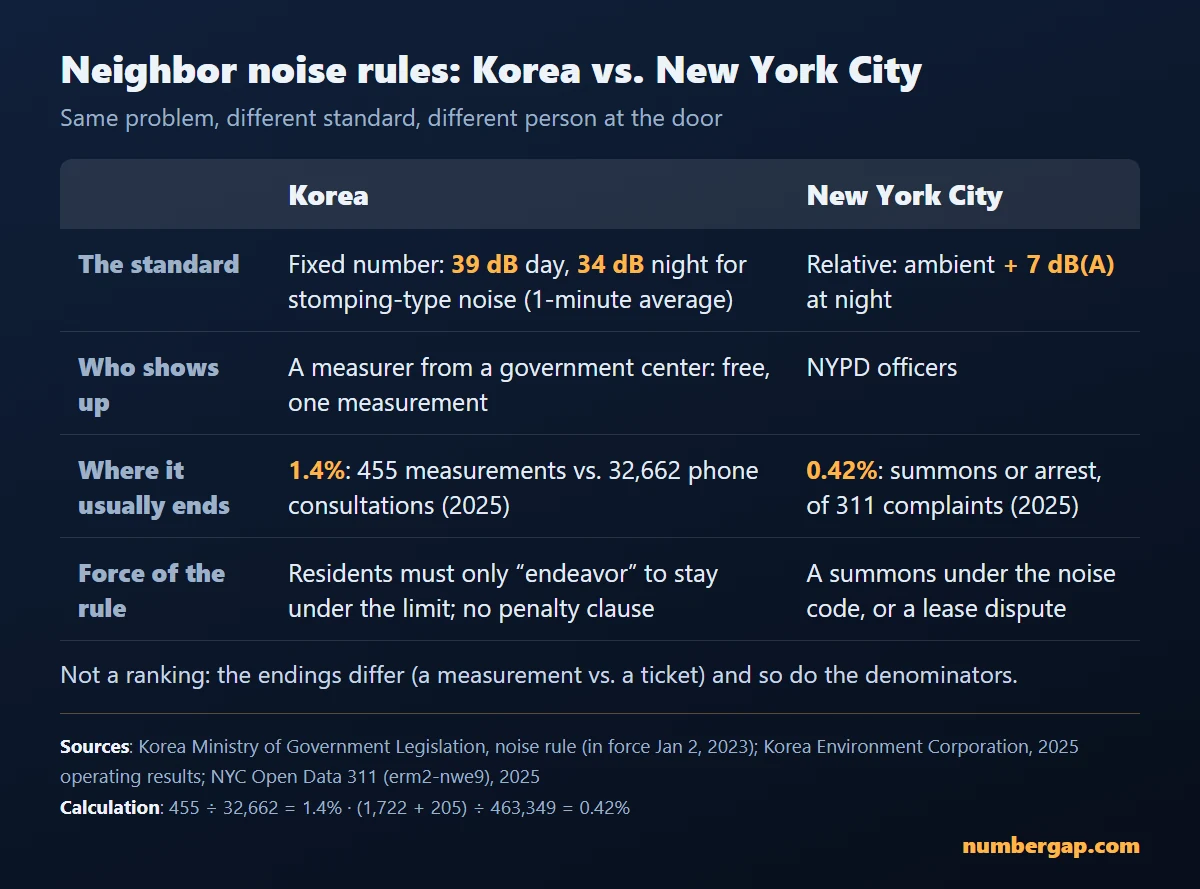
Korea made two choices that New York did not: a fixed number, and a person with a meter. Even so, only a small share of cases reaches the end of the line.
| Korea | New York City | |
|---|---|---|
| The standard | Fixed number: 39 dB by day, 34 dB at night for stomping-type noise, averaged over one minute | Relative: ambient + 7 dB(A) at night |
| Who shows up | A measurer from a government center: free, one measurement, requested by the household hearing the noise | NYPD officers |
| Where it usually ends | 455 measurements against 32,662 phone consultations in 2025 (1.4%) | Summons or arrest on 0.42% of 311 complaints |
| Force of the rule | Residents are required only to "endeavor" to stay under the limit (the rule's wording, our translation); the rule contains no penalty clause | A summons under the noise code, or a lease dispute |
Sources: Korean rule text from the Korea Ministry of Government Legislation (law.go.kr), in force since January 2, 2023. Counts from the Korea Environment Corporation's published 2025 operating results for its floor-noise center — agency data. NYC from the dataset above.
https://keco.or.kr/web/lay1/bbs/S1T230C1378/F/261/list.do?cat=65228&sajun_board_seq=252
Do not read that table as a ranking. The endings differ (a measurement versus a ticket) and so do the denominators (phone consultations versus 311 complaints).
Even inside Korea, the door you come through matters. In 2025, residents who applied to the center directly reached a measurement in 1.9% of the cases processed. Residents who went through their building management reached one 20.7% of the time.
The center's procedure sends managed complexes through a mediation step by building management first. It has not said that explains the gap, and neither can we.
Of the 455 measurements Korea's center logged in 2025, 76 (16.7%) were recorded as over the limit. Measurement is rare. Among the measurements, about one in six was over.
Frequently Asked Questions
Q. Who do I call about a noisy upstairs neighbor?
A. In New York City, the city's environmental agency says to call 311, and the 311 data show the NYPD as the responding agency. Other cities differ. Seattle's building department says loud-stereo cases are enforced by the Seattle Police Department. Chicago sources we found say 911 for in-progress problems and 311 for recurring ones, but that comes from a secondary source. If anyone is in danger, call 911.
Q. Is there a legal decibel limit for noise from an upstairs neighbor?
A. There is no federal limit. City codes set the numbers, and they differ: New York uses ambient plus 7 dB(A) at night, Los Angeles ambient plus 5 dB inside an adjoining unit, Seattle 45 dBA at night at the property line. Chicago names no number.
Q. Does calling 311 about a noisy neighbor do anything?
A. The data cannot answer that. They show only the police's closing text. In 2025, 24.42% of complaints were closed as "took action to fix the condition," 45.75% as no evidence found, and 0.42% ended in a summons or arrest. In a New York case, a tenant's many complaints alone were not enough to win.
Q. Is walking noise from the upstairs neighbor illegal?
A. In the New York case we read, no. A court called "heavy footsteps, snoring, and using a dishwasher" noises "incidental to normal occupancy" (Brown v. Blennerhasset, 2014). That was one ruling. It does not say every stomping complaint fails.
Q. Does my landlord have to stop a noisy neighbor?
A. It depends on the state and the facts. Cases in New Jersey, Maryland, and New York tie a landlord's duty to notice plus the power to stop the noise, often through a lease clause or the right to evict. A D.C. agency decision said the covenant of quiet enjoyment is not a promise to insulate a tenant from noise. Anyone with a live dispute should ask a tenant lawyer.
Q. Can I break my lease because of a noisy upstairs neighbor?
A. We cannot tell you that. In the cases we read, tenants who moved out in New Jersey and Massachusetts won only after the landlord sued for the remaining rent, and a New York tenant who said she had rightfully ended her lease lost her summary judgment. Talk to a local tenant attorney or legal aid office before acting.
What Can You Do Tonight About a Noisy Upstairs Neighbor?
Three small things, none of them legal advice.
- Read your lease for a noise or quiet-hours clause. In the cases we read, a landlord's duty often hinges on whether the landlord had the power to act, and a lease clause is where that power usually lives.
- Find out which city department your 311 or noise line routes to. In New York it is the NYPD. Elsewhere it may not be.
- If you are weighing rent withholding or leaving the lease, talk to a tenant lawyer or legal aid office first. The cases above show that outcome depends on the state and the facts.
How we counted. We queried the NYC 311 file through the city's open-data API, one year at a time, and read every distinct closing message for complaint type "Noise - Residential." Records from 2010 to 2019 sit in a separate dataset (76ig-c548) from 2020 onward (erm2-nwe9). When we first looked, 2019 appeared to have zero complaints. That was the boundary between the two datasets, not a quiet year. The real figure is 232,850. We quote finished years only, because the current year's count moved between two runs on the same day. For the case law, we read opinions in full where we could and say so where we did not.
What we did not find. A 50-state table of which states allow rent withholding for noise. Current fine amounts in several cities. A federal rule on indoor neighbor noise. Any source that says what the NYPD's "took action" actually meant. The numbers on Korea come from the center's published tables and the rule text. We have not researched Korean law beyond that.
This post is information, not legal advice.
If this was useful, we will see you in the next one.


Comments
Post a Comment